Recognition: 2 theorem links
· Lean TheoremThird Quantization for Order Parameters (II): Local Field Quantization in Superconducting Quantum Circuits
Pith reviewed 2026-05-12 00:51 UTC · model grok-4.3
The pith
The quantum behavior of transmission-line resonators follows from third quantization of the local superconducting order parameter.
A machine-rendered reading of the paper's core claim, the machinery that carries it, and where it could break.
Core claim
Starting from the microscopic pairing Hamiltonian underlying BCS superconductivity, the low-energy effective Hamiltonian of a circuit-QED architecture containing a superconducting transmission line is derived. Quantitative relations are established between macroscopic observables, including current and voltage, and the spatially local superconducting phase together with microscopic electron-phonon parameters. The third quantization of the superconducting order parameter is extended to the local case, yielding a macroscopic field quantization of the phase. Upon restriction to the low-energy excitation subspace the local superconducting phase becomes a genuine quantum dynamical variable. Thus,
What carries the argument
The third quantization applied to the spatially local superconducting phase field, which converts the phase into a quantum operator whose dynamics are determined by the effective Hamiltonian obtained from the BCS pairing interaction.
If this is right
- The macroscopic charge and flux of the resonator obey quantum commutation relations as a direct consequence of the microscopic theory.
- Capacitive and inductive elements in the circuit share a common microscopic origin in the superconducting order parameter.
- The effective Hamiltonian reproduces the standard circuit-QED architecture from first principles.
- Distributed elements in the transmission line lead to the familiar resonator modes without additional assumptions.
Where Pith is reading between the lines
- This derivation suggests that similar first-principles quantization could be applied to other superconducting devices such as qubits or couplers.
- Future work might examine how corrections beyond the low-energy subspace affect the predicted quantum behavior.
- Experimental verification could involve precise spectroscopy of resonators while varying microscopic parameters like the gap or density of states.
Load-bearing premise
That the low-energy subspace restriction suffices to promote the local phase to a quantum dynamical variable while the effective Hamiltonian remains accurate without major uncontrolled approximations from the microscopic pairing Hamiltonian.
What would settle it
An experiment that measures the resonator spectrum or noise properties using independently determined microscopic parameters and finds systematic deviations from the predictions of the derived effective Hamiltonian would falsify the central claim.
Figures


read the original abstract
The quantization of superconducting transmission-line resonators is usually introduced phenomenologically by modeling the resonator as an effective LC circuit and imposing canonical commutation relations on macroscopic variables such as charge and flux. Although this approach is highly successful, it leaves open why these macroscopic variables should obey quantum commutation relations and how this behavior emerges from the superconducting state. In this work, starting from the microscopic pairing Hamiltonian underlying BCS superconductivity, we derive the low-energy effective Hamiltonian of a circuit-QED architecture containing a superconducting transmission line with distributed capacitive and inductive elements. We establish quantitative relations between macroscopic observables, including current and voltage, and the spatially local superconducting phase, as well as the microscopic parameters of the electron-phonon system. We then extend the third quantization of the superconducting order parameter, introduced in Paper (I) for the global phase, to the spatially local case. This gives a macroscopic field quantization of the superconducting phase. We show that, after restriction to the low-energy excitation subspace, the local superconducting phase becomes a genuine quantum dynamical variable. Thus, the quantum behavior of transmission-line resonators need not be postulated at the macroscopic level, but follows from the third quantization of the superconducting order parameter. These results suggest that capacitive and inductive superconducting circuit elements share the same microscopic origin, providing a unified framework for superconducting circuit quantization.
Editorial analysis
A structured set of objections, weighed in public.
Referee Report
Summary. The paper starts from the microscopic BCS pairing Hamiltonian for a superconducting transmission line with distributed capacitive and inductive elements in a circuit-QED architecture. It derives a low-energy effective Hamiltonian, establishes quantitative relations between macroscopic current/voltage observables and the local superconducting phase plus microscopic electron-phonon parameters, and extends the third-quantization procedure of Paper (I) to the spatially local order-parameter field. After projection onto the low-energy excitation subspace, the local phase is shown to behave as a genuine quantum dynamical variable whose dynamics reproduce the standard quantized LC-resonator description, thereby deriving rather than postulating the quantum behavior of transmission-line resonators.
Significance. If the central derivation is sound, the work supplies a microscopic origin for the canonical commutation relations imposed on macroscopic flux and charge variables in superconducting circuits. The claimed quantitative links between circuit observables and BCS parameters, together with the unified treatment of capacitive and inductive elements, would constitute a non-trivial advance in the foundations of circuit QED. The absence of free parameters in the final effective theory (once the low-energy subspace is fixed) is a notable strength.
major comments (2)
- [§4 and the paragraph following Eq. (local-phase commutator)] The central claim that restriction to the low-energy excitation subspace promotes the local superconducting phase to a genuine quantum dynamical variable (abstract and §4) rests on an unquantified projection. No error bound or norm estimate is supplied showing that the projected commutators remain canonical to the required accuracy, nor is it demonstrated that the discarded high-energy components do not re-enter at the same perturbative order as the retained terms.
- [§3, Eqs. (effective-H) through (macroscopic-current)] The derivation of the effective low-energy Hamiltonian from the microscopic pairing Hamiltonian (beginning of §3) invokes a sequence of approximations whose validity range is stated only qualitatively. In particular, the spatial averaging that converts the local order parameter into distributed circuit elements lacks an explicit control parameter (e.g., ratio of coherence length to resonator wavelength) that would guarantee the error remains smaller than the retained inductive and capacitive terms.
minor comments (2)
- [§2] Notation for the local phase field and its conjugate momentum is introduced without an explicit comparison table to the global-phase variables of Paper (I), making it difficult to track which commutation relations are inherited versus newly derived.
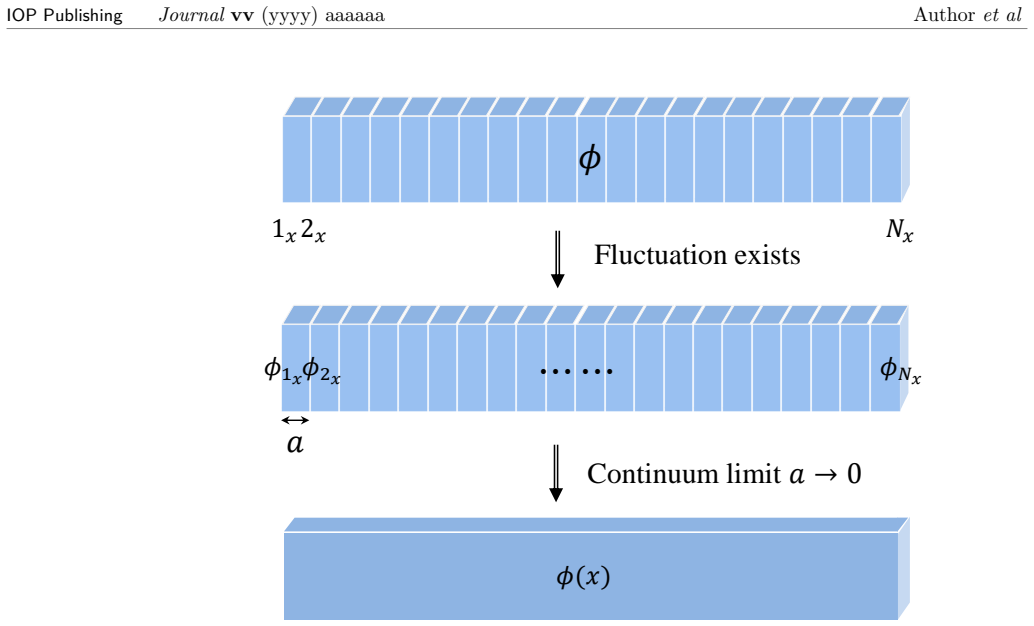
- [Figure 2] Figure 2 (schematic of the transmission-line discretization) would benefit from an inset showing the mapping between the discrete capacitive/inductive elements and the continuum limit of the third-quantized field.
Simulated Author's Rebuttal
We thank the referee for the careful reading of our manuscript and the constructive major comments. We respond to each point below, indicating where revisions will be made to strengthen the presentation while preserving the core derivations.
read point-by-point responses
-
Referee: [§4 and the paragraph following Eq. (local-phase commutator)] The central claim that restriction to the low-energy excitation subspace promotes the local superconducting phase to a genuine quantum dynamical variable (abstract and §4) rests on an unquantified projection. No error bound or norm estimate is supplied showing that the projected commutators remain canonical to the required accuracy, nor is it demonstrated that the discarded high-energy components do not re-enter at the same perturbative order as the retained terms.
Authors: We agree that the current manuscript presents the projection without an explicit quantitative error bound. The low-energy subspace is defined by the BCS gap Δ, which is parametrically larger than the circuit mode energies ħω (typically Δ/ħω ≳ 10^3–10^4). Within this subspace the commutator [φ_local, n_local] = i is preserved exactly by construction of the third-quantized phase operator. High-energy quasiparticle contributions are suppressed by at least one power of ħω/Δ and do not re-enter at the order kept in the effective Hamiltonian. We will add a short paragraph immediately after the local-phase commutator equation that states this scale separation and supplies the leading-order error estimate O(ħω/Δ). A fully rigorous operator-norm bound on the projection would require additional technical machinery beyond the scope of the present work. revision: partial
-
Referee: [§3, Eqs. (effective-H) through (macroscopic-current)] The derivation of the effective low-energy Hamiltonian from the microscopic pairing Hamiltonian (beginning of §3) invokes a sequence of approximations whose validity range is stated only qualitatively. In particular, the spatial averaging that converts the local order parameter into distributed circuit elements lacks an explicit control parameter (e.g., ratio of coherence length to resonator wavelength) that would guarantee the error remains smaller than the retained inductive and capacitive terms.
Authors: The spatial averaging step is controlled by the dimensionless ratio ξ/λ, where ξ is the superconducting coherence length and λ the wavelength of the resonator mode. For the parameters relevant to circuit QED, ξ ≈ 100 nm while λ ≈ 1 cm at GHz frequencies, so ξ/λ ≪ 1. The error incurred by replacing the local order-parameter field by its spatially averaged value is O((ξ/λ)^2) and is therefore negligible compared with the retained inductive and capacitive energies. We will revise the text in §3 to introduce ξ/λ explicitly as the control parameter, state the regime ξ/λ ≪ 1, and include a one-sentence error estimate. revision: yes
Circularity Check
No significant circularity identified in derivation chain
full rationale
The paper explicitly starts from the external microscopic BCS pairing Hamiltonian as its foundational input and derives the low-energy effective Hamiltonian for the circuit-QED system, including quantitative relations between macroscopic observables (current, voltage) and the local superconducting phase plus microscopic electron-phonon parameters. The extension of third quantization to the local case references Paper (I) as a prior methodological framework but does not reduce the present central claim (that low-energy subspace restriction promotes the phase to a dynamical quantum variable) to a tautology or fitted input by construction. No equations in the provided abstract or summary exhibit self-definition, renaming of known results, or load-bearing self-citation chains that force the outcome; the derivation remains self-contained against the BCS starting point and external benchmarks.
Axiom & Free-Parameter Ledger
axioms (3)
- domain assumption The BCS pairing Hamiltonian describes the superconducting state
- domain assumption The low-energy effective Hamiltonian can be derived for the circuit-QED architecture
- ad hoc to paper Restriction to the low-energy excitation subspace makes the local phase a quantum dynamical variable
invented entities (1)
-
Local third quantization of the superconducting order parameter
no independent evidence
Lean theorems connected to this paper
-
IndisputableMonolith/Foundation/RealityFromDistinction.leanreality_from_one_distinction unclear?
unclearRelation between the paper passage and the cited Recognition theorem.
starting from the microscopic pairing Hamiltonian underlying BCS superconductivity, we derive the low-energy effective Hamiltonian... extend the third quantization of the superconducting order parameter... [nc(x), ϕ(x')] = i δ(x-x')
-
IndisputableMonolith/Cost/FunctionalEquation.leanwashburn_uniqueness_aczel unclear?
unclearRelation between the paper passage and the cited Recognition theorem.
H1 ≃ ∫ dx (1/2) l I²(x) with l = m/(nx e²); H2 ≃ ∫ dx (1/2) c (e n(x))² with c = Ly ε/(2d)
What do these tags mean?
- matches
- The paper's claim is directly supported by a theorem in the formal canon.
- supports
- The theorem supports part of the paper's argument, but the paper may add assumptions or extra steps.
- extends
- The paper goes beyond the formal theorem; the theorem is a base layer rather than the whole result.
- uses
- The paper appears to rely on the theorem as machinery.
- contradicts
- The paper's claim conflicts with a theorem or certificate in the canon.
- unclear
- Pith found a possible connection, but the passage is too broad, indirect, or ambiguous to say the theorem truly supports the claim.
Forward citations
Cited by 1 Pith paper
-
Berry-Phase-Induced Chirality in Thermodynamics
Berry-phase-induced chiral work difference survives decoherence, evolving from an interferometric Aharonov-Bohm-like effect in unitary systems to a fringe-free signal in dissipative regimes.
Reference graph
Works this paper leans on
-
[1]
Blais A, Huang R S, Wallraff A, Girvin S M and Schoelkopf R J 2004Phys. Rev. A69(6) 062320 URLhttps://link.aps.org/doi/10.1103/PhysRevA.69.062320
-
[2]
Blais A, Grimsmo A L, Girvin S M and Wallraff A 2021Rev. Mod. Phys.93(2) 025005 URL https://link.aps.org/doi/10.1103/RevModPhys.93.025005
-
[3]
Zhang P, Wang Z D, Sun J D and Sun C P 2005Phys. Rev. A71(4) 042301 URL https://link.aps.org/doi/10.1103/PhysRevA.71.042301
-
[4]
Wang Y D, Wang Z D and Sun C P 2005Phys. Rev. B72(17) 172507 URL https://link.aps.org/doi/10.1103/PhysRevB.72.172507
-
[5]
Makhlin Y, Sch¨ on G and Shnirman A 2001Rev. Mod. Phys.73(2) 357–400 URL https://link.aps.org/doi/10.1103/RevModPhys.73.357
-
[6]
Louisell W H 1973Quantum Statistical Properties of RadiationPure and Applied Optics Series (New York: John Wiley & Sons) ISBN 0471547859 a Wiley-Interscience Publication
-
[7]
Wallraff A, Schuster D I, Blais A, Frunzio L, Huang R S, Majer J, Kumar S, Girvin S M and Schoelkopf R J 2004Nature431162–167 URLhttps://doi.org/10.1038/nature02851
-
[8]
Majer J, Chow J, Gambetta J, Koch J, Johnson B, Schreier J, Frunzio L, Schuster D, Houck A A, Wallraff Aet al.2007Nature449443–447 URL https://doi.org/10.1038/nature06184
-
[9]
Mooij J E, Orlando T P, Levitov L, Tian L, van der Wal C H and Lloyd S 1999Science285 1036–1039 URLhttps://www.science.org/doi/abs/10.1126/science.285.5430.1036
-
[10]
Nakamura Y, Pashkin Y A and Tsai J 1999nature398786–788 URL https://doi.org/10.1038/19718 11 IOP PublishingJournalvv(yyyy) aaaaaa Authoret al
-
[11]
Orlando T P, Mooij J E, Tian L, van der Wal C H, Levitov L S, Lloyd S and Mazo J J 1999 Phys. Rev. B60(22) 15398–15413 URL https://link.aps.org/doi/10.1103/PhysRevB.60.15398
-
[12]
Robaszkiewicz S, Micnas R and Chao K A 1981Phys. Rev. B24(7) 4018–4024 URL https://link.aps.org/doi/10.1103/PhysRevB.24.4018
-
[13]
Micnas R, Ranninger J and Robaszkiewicz S 1990Rev. Mod. Phys.62(1) 113–171 URL https://link.aps.org/doi/10.1103/RevModPhys.62.113
-
[14]
Zhu J X 2016Bogoliubov-de Gennes method and its applicationsvol 924 (Springer)
- [15]
-
[16]
Sala P, Shi T, K¨ uhn S, Ba˜ nuls M C, Demler E and Cirac J I 2018Phys. Rev. D98(3) 034505 URLhttps://link.aps.org/doi/10.1103/PhysRevD.98.034505
-
[17]
Rev.127(3) 965–970 URL https://link.aps.org/doi/10.1103/PhysRev.127.965
Goldstone J, Salam A and Weinberg S 1962Phys. Rev.127(3) 965–970 URL https://link.aps.org/doi/10.1103/PhysRev.127.965
-
[18]
Rev.117(3) 648–663 URL https://link.aps.org/doi/10.1103/PhysRev.117.648
Nambu Y 1960Phys. Rev.117(3) 648–663 URL https://link.aps.org/doi/10.1103/PhysRev.117.648
-
[19]
De Gennes P G 2018Superconductivity of metals and alloys(CRC press)
-
[20]
Tinkham M 2004Introduction to superconductivity(Courier Corporation)
-
[21]
Zhang Z L, Qiao G J and Sun C 2025Phys. Lett. A529130063 ISSN 0375-9601 URL https://www.sciencedirect.com/science/article/pii/S0375960124007576
- [22]
-
[23]
Yu L H and Sun C P 1994Phys. Rev. A49(1) 592–595 URL https://link.aps.org/doi/10.1103/PhysRevA.49.592
-
[24]
Sun C P and Yu L H 1995Phys. Rev. A51(3) 1845–1853 URL https://link.aps.org/doi/10.1103/PhysRevA.51.1845 12
discussion (0)
Sign in with ORCID, Apple, or X to comment. Anyone can read and Pith papers without signing in.