Recognition: unknown
Quantum algorithm for solving high-dimensional linear stochastic differential equations via amplitude encoding of the noise term
Pith reviewed 2026-05-08 04:12 UTC · model grok-4.3
The pith
Quantum algorithms prepare amplitude-encoded states for solutions to high-dimensional linear SDEs using polylog queries via PRNG noise encoding.
A machine-rendered reading of the paper's core claim, the machinery that carries it, and where it could break.
Core claim
Both the Dyson-series and Euler-Maruyama methods generate the amplitude-encoding state of X_t while making only polylog(N) queries to the PRNG circuit and the block-encodings of A and B, and they extend to estimating expectations of functions of X_t.
What carries the argument
Amplitude encoding of the noise term via a quantum PRNG circuit, combined with quantum linear systems solvers applied to either Dyson-series or Euler-Maruyama approximations of the SDE.
Load-bearing premise
An efficient quantum circuit for a pseudorandom number generator exists whose output can be amplitude-encoded into the noise term without destroying the overall polylog(N) scaling, and the resulting linear systems remain well-conditioned enough for the quantum linear systems solver to succeed.
What would settle it
Run the quantum linear systems solver on the approximated system for increasing N and measure whether the number of queries to the PRNG circuit or block-encodings exceeds polylog(N) or the solver fails due to ill-conditioning.
Figures


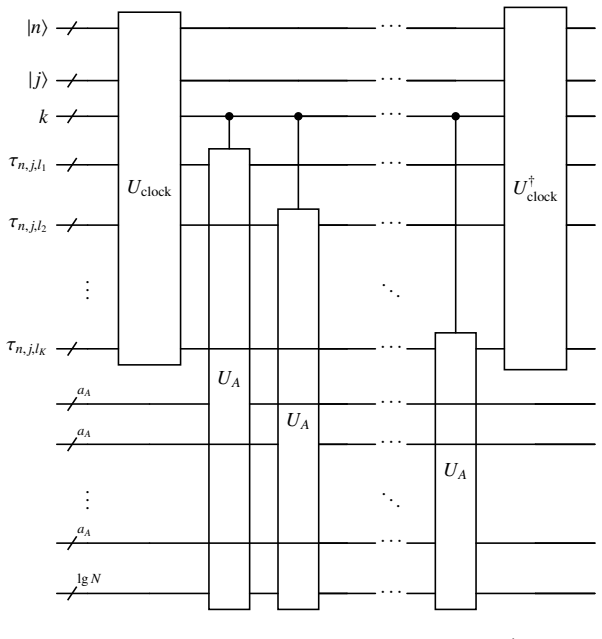

read the original abstract
This work studies quantum algorithms to solve high-dimensional stochastic differential equations (SDEs) $\mathrm{d} \mathbf{X}_t = A(t) \mathbf{X}_t \mathrm{d} t + B(t) \mathrm{d} \mathbf{W}_t$. Aiming for a speed-up in the dimension $N$ of $\mathbf{X}_t$, we generate quantum states that encode $\mathbf{X}_t$ in the amplitudes, while most of the existing quantum methods for SDEs employ binary encoding. A key challenge is the amplitude encoding of the noise term, and we address this by utilizing the quantum circuit implementation of a pseudorandom number generator (PRNG). We propose two methods: the Dyson series-based method and the Euler-Maruyama (EM)-based method. In the former, we express the noise term via the Dyson series approximation of the time evolution operator, while in the latter, it is approximated using the EM time discretization. Both methods use the quantum linear systems solver to generate the amplitude-encoding state of $\mathbf{X}_t$, making only ${\rm polylog}(N)$ queries to the PRNG circuit and the block-encodings of $A$ and $B$. Additionally, going beyond state preparation, we present methods to estimate expectations of functions of $\mathbf{X}_t$ using the state.
Editorial analysis
A structured set of objections, weighed in public.
Referee Report
Summary. The manuscript proposes two quantum algorithms for high-dimensional linear SDEs dX_t = A(t)X_t dt + B(t)dW_t that prepare an amplitude-encoded state for the solution X_t. One approach uses a Dyson-series approximation of the time-evolution operator to incorporate the noise; the other uses an Euler-Maruyama time discretization. Both reduce the problem to a quantum linear system solved via QLSS, with the noise term handled by amplitude encoding from a PRNG circuit. The claimed complexity is polylog(N) queries to the PRNG and to the block-encodings of A and B; the work also gives procedures to estimate expectations of functions of X_t.
Significance. If the polylog(N) scaling, error bounds, and conditioning can be established, the result would constitute a dimension-independent quantum method for preparing states that encode solutions to linear SDEs, offering potential exponential improvement over classical sampling methods whose cost grows with N. The use of a PRNG circuit to realize amplitude encoding of the stochastic increment is a technically interesting device that sidesteps direct preparation of high-dimensional Gaussian states. The extension from state preparation to expectation estimation further increases the practical relevance.
major comments (2)
- [§4 and §5] §4 (Dyson-series construction) and §5 (Euler-Maruyama construction): the central polylog(N) query claim is stated without an explicit bound on the condition number of the effective linear-system matrix that embeds the PRNG-encoded noise term. Because QLSS runtime scales with the condition number, absence of a polylog(N) upper bound on this quantity renders the complexity statement unsupported.
- [§3.2] §3.2 (PRNG amplitude encoding): no gate-complexity or query analysis is supplied for the circuit that amplitude-encodes the PRNG output into the noise vector (or its action inside the Dyson/EM operator). If this subroutine incurs even a linear-in-N or linear-in-d_W overhead, the overall polylog(N) scaling collapses; the manuscript must exhibit the circuit depth or block-encoding cost explicitly.
minor comments (2)
- [Theorem 1 and Theorem 2] The dependence of the polylog(N) bound on the time horizon T, the Lipschitz constants of A and B, and the dimension d_W of the Wiener process should be stated explicitly in the complexity theorem.
- [§2] Notation for the block-encoding of the time-dependent operators A(t) and B(t) is introduced only after the main algorithms; moving the definition to §2 would improve readability.
Simulated Author's Rebuttal
We thank the referee for the positive evaluation of the significance of our results and for the constructive comments on the complexity analysis. We address each major point below and have revised the manuscript to strengthen the supporting arguments.
read point-by-point responses
-
Referee: [§4 and §5] §4 (Dyson-series construction) and §5 (Euler-Maruyama construction): the central polylog(N) query claim is stated without an explicit bound on the condition number of the effective linear-system matrix that embeds the PRNG-encoded noise term. Because QLSS runtime scales with the condition number, absence of a polylog(N) upper bound on this quantity renders the complexity statement unsupported.
Authors: We agree that an explicit bound on the condition number is required to rigorously support the claimed complexity. In the revised manuscript we have added a new lemma (Lemma 4.3 in §4 and the analogous statement in §5) that bounds the condition number of the effective linear-system matrix. Under the standard assumptions that the coefficients A(t) and B(t) are Lipschitz continuous with constant L and that the time horizon T is fixed, the condition number satisfies κ = O(T L / ε), where ε is the truncation or discretization error. This bound is independent of the dimension N because the Dyson-series truncation and Euler-Maruyama discretization preserve the well-posedness of the original SDE, and the amplitude-encoded noise term is incorporated via a unitary block-encoding whose norm is controlled by the same Lipschitz constants. Consequently the QLSS contributes only an additional polylog(N) factor once ε is chosen to be polylogarithmic in the target accuracy, restoring the overall polylog(N) query complexity. The revised theorems now state the dependence on κ explicitly. revision: yes
-
Referee: [§3.2] §3.2 (PRNG amplitude encoding): no gate-complexity or query analysis is supplied for the circuit that amplitude-encodes the PRNG output into the noise vector (or its action inside the Dyson/EM operator). If this subroutine incurs even a linear-in-N or linear-in-d_W overhead, the overall polylog(N) scaling collapses; the manuscript must exhibit the circuit depth or block-encoding cost explicitly.
Authors: The referee is correct that the original submission omitted a detailed gate-complexity analysis of the PRNG subroutine. In the revised §3.2 we have inserted a complete analysis. The amplitude encoding of the PRNG output is realized by a coherent quantum circuit implementing a quantum linear-congruential generator (or equivalent pseudorandom construction) whose state-preparation cost is O(log N + log(1/δ)) gates per block-encoding query, where δ is the precision. Because the PRNG circuit is used inside the block-encoding of the composite Dyson or Euler-Maruyama operator, it is invoked only polylog(N) times by the QLSS; no classical extraction of individual samples is required. The resulting block-encoding norm and query complexity remain O(polylog(N)) and introduce no linear factors in N or in the Wiener-process dimension d_W. The revised text now contains the explicit gate count and the proof that the overall query complexity to the PRNG oracle stays polylogarithmic. revision: yes
Circularity Check
No significant circularity; derivation relies on external quantum subroutines (QLSS, block-encodings) and stated assumptions about PRNG efficiency rather than self-referential reductions.
full rationale
The paper's central construction uses the quantum linear systems solver on Dyson-series or Euler-Maruyama discretizations to prepare an amplitude-encoded state of X_t, with query complexity expressed in terms of polylog(N) accesses to an assumed-efficient PRNG circuit and block-encodings of A and B. No equation or claim reduces a derived quantity to a fitted parameter by construction, nor does any load-bearing step rest on a self-citation whose content is itself unverified within the paper. The polylog scaling is presented as following from the number of terms in the series/discretization and the properties of the external solvers; these are external benchmarks, not internal redefinitions. The reader's assessment of score 2.0 is consistent with minor reliance on prior literature that does not collapse the derivation.
Axiom & Free-Parameter Ledger
axioms (3)
- domain assumption Efficient block-encodings of A(t) and B(t) exist and can be queried in polylog(N) time.
- domain assumption A quantum circuit for a pseudorandom number generator can be implemented such that its output amplitudes can be used directly in the noise term without destroying the overall complexity.
- domain assumption The quantum linear systems solver (QLSS) can be applied to the resulting system with polylog(N) queries.
Reference graph
Works this paper leans on
-
[1]
Harrow, Avinatan Hassidim, and Seth Lloyd
Aram W. Harrow, Avinatan Hassidim, and Seth Lloyd. Quantum algorithm for linear systems of equations.Phys. Rev. Lett., 103:150502, Oct 2009. URL:https://link.aps.org/doi/10.1103/PhysRevLett.103.150502, doi:10.1103/PhysRevLett.103.150502
-
[2]
Childs, Robin Kothari, and Rolando D
Andrew M. Childs, Robin Kothari, and Rolando D. Somma. Quantum algorithm for systems of linear equations with exponentially improved dependence on precision.SIAM Journal on Computing, 46(6):1920–1950, 2017.doi: 10.1137/16M1087072
-
[3]
Quantum algorithms for systems of linear equations inspired by adiabatic quantum computing,
Yi ˘git Subas ¸ı, Rolando D. Somma, and Davide Orsucci. Quantum algorithms for systems of linear equations inspired by adiabatic quantum computing.Phys. Rev. Lett., 122:060504, Feb 2019. URL:https://link.aps.org/doi/ 10.1103/PhysRevLett.122.060504,doi:10.1103/PhysRevLett.122.060504
-
[4]
Lin Lin and Yu Tong. Optimal polynomial based quantum eigenstate filtering with application to solving quantum linear systems.Quantum, 4:361, November 2020.doi:10.22331/q-2020-11-11-361
-
[5]
Grand unification of quantum algorithms,
John M. Martyn, Zane M. Rossi, Andrew K. Tan, and Isaac L. Chuang. Grand unification of quantum algorithms. PRX Quantum, 2:040203, Dec 2021. URL:https://link.aps.org/doi/10.1103/PRXQuantum.2.040203, doi:10.1103/PRXQuantum.2.040203
-
[6]
Dong An and Lin Lin. Quantum linear system solver based on time-optimal adiabatic quantum computing and quantum approximate optimization algorithm.ACM Transactions on Quantum Computing, 3(2), March 2022.doi: 10.1145/3498331. 5Ref. [40] considers a nonlinear differential equation with its inhomogeneous term being a random process, but its SDE is linear. 56
-
[7]
Optimal scaling quantum linear-systems solver via discrete adiabatic theorem.PRX quantum, 3(4):040303, 2022.doi:10.1103/ PRXQuantum.3.040303
Pedro CS Costa, Dong An, Yuval R Sanders, Yuan Su, Ryan Babbush, and Dominic W Berry. Optimal scaling quantum linear-systems solver via discrete adiabatic theorem.PRX quantum, 3(4):040303, 2022.doi:10.1103/ PRXQuantum.3.040303
2022
-
[8]
Quantum linear system solvers: A survey of algorithms and applications
Mauro ES Morales, Lirand ¨e Pira, Philipp Schleich, Kelvin Koor, Pedro Costa, Dong An, Al ´an Aspuru-Guzik, Lin Lin, Patrick Rebentrost, and Dominic W Berry. Quantum linear system solvers: A survey of algorithms and appli- cations.arXiv preprint arXiv:2411.02522, 2024
-
[9]
Dominic W Berry. High-order quantum algorithm for solving linear differential equations.Journal of Physics A: Mathematical and Theoretical, 47(10):105301, feb 2014.doi:10.1088/1751-8113/47/10/105301
-
[10]
Dominic W Berry, Andrew M Childs, Aaron Ostrander, and Guoming Wang. Quantum algorithm for linear differ- ential equations with exponentially improved dependence on precision.Communications in Mathematical Physics, 356(3):1057–1081, 2017.doi:10.1007/s00220-017-3002-y
-
[11]
Andrew M Childs and Jin-Peng Liu. Quantum spectral methods for differential equations.Communications in Mathematical Physics, 375(2):1427–1457, 2020.doi:10.1007/s00220-020-03699-z
-
[12]
Jin-Peng Liu, Herman Øie Kolden, Hari K. Krovi, Nuno F. Loureiro, Konstantina Trivisa, and Andrew M. Childs. Efficient quantum algorithm for dissipative nonlinear differential equations.Proceedings of the National Academy of Sciences, 118(35):e2026805118, 2021.doi:10.1073/pnas.2026805118
-
[13]
Di Fang, Lin Lin, and Yu Tong. Time-marching based quantum solvers for time-dependent linear differential equa- tions.Quantum, 7:955, March 2023.doi:10.22331/q-2023-03-20-955
-
[14]
Hari Krovi. Improved quantum algorithms for linear and nonlinear differential equations.Quantum, 7:913, February 2023.doi:10.22331/q-2023-02-02-913
-
[15]
Dong An, Jin-Peng Liu, and Lin Lin. Linear Combination of Hamiltonian Simulation for Nonunitary Dynamics with Optimal State Preparation Cost.Phys. Rev. Lett., 131:150603, Oct 2023. URL:https://link.aps.org/ doi/10.1103/PhysRevLett.131.150603,doi:10.1103/PhysRevLett.131.150603
-
[16]
Dominic W. Berry and Pedro C. S. Costa. Quantum algorithm for time-dependent differential equations using Dyson series.Quantum, 8:1369, June 2024.doi:10.22331/q-2024-06-13-1369
-
[17]
David Jennings, Matteo Lostaglio, Robert B. Lowrie, Sam Pallister, and Andrew T. Sornborger. The cost of solving linear differential equations on a quantum computer: fast-forwarding to explicit resource counts.Quantum, 8:1553, December 2024.doi:10.22331/q-2024-12-10-1553
-
[18]
Optimal quantum simulation of linear non-unitary dynamics.arXiv preprint arXiv:2508.19238, 2025
Guang Hao Low and Rolando D Somma. Optimal quantum simulation of linear non-unitary dynamics.arXiv preprint arXiv:2508.19238, 2025
-
[19]
Dong An, Jin-Peng Liu, Daochen Wang, and Qi Zhao. Quantum differential equation solvers: Limitations and fast- forwarding.Communications in Mathematical Physics, 406(8):189, 2025.doi:10.1007/s00220-025-05358-7
-
[20]
Dong An, Akwum Onwunta, and Gengzhi Yang. Fast-forwarding quantum algorithms for linear dissipative differ- ential equations.Quantum, 10:1986, January 2026.doi:10.22331/q-2026-01-27-1986
-
[21]
Dong An, Andrew M Childs, and Lin Lin. Quantum algorithm for linear non-unitary dynamics with near- optimal dependence on all parameters.Communications in Mathematical Physics, 407(1):19, 2026.doi: 10.1007/s00220-025-05509-w
-
[22]
Kloeden and Eckhard Platen.Numerical Solution of Stochastic Differential Equations
Peter E. Kloeden and Eckhard Platen.Numerical Solution of Stochastic Differential Equations. Springer, 1992
1992
-
[23]
Daniel T. Gillespie. Stochastic simulation of chemical kinetics.Annual Review of Physical Chemistry, 58(V olume 58, 2007):35–55, 2007.doi:10.1146/annurev.physchem.58.032806.104637
work page doi:10.1146/annurev.physchem.58.032806.104637 2007
-
[24]
Desmond J. Higham. Modeling and simulating chemical reactions.SIAM Review, 50(2):347–368, 2008.doi: 10.1137/060666457. 57
-
[25]
Yurino Mizuguchi, Tomoaki Murata, and Yuichiro Tada. STOLAS: STOchastic LAttice Simulation of cosmic infla- tion.Journal of Cosmology and Astroparticle Physics, 2024(12):050, dec 2024.doi:10.1088/1475-7516/2024/ 12/050
-
[26]
Tomoaki Murata and Yuichiro Tada. STOchastic LAttice Simulation of hybrid inflation.arXiv preprint arXiv:2603.04850, 2026
-
[27]
Patrick Rebentrost, Brajesh Gupt, and Thomas R. Bromley. Quantum computational finance: Monte Carlo pricing of financial derivatives.Phys. Rev. A, 98:022321, Aug 2018.doi:10.1103/PhysRevA.98.022321
-
[28]
Egger, Yue Sun, Christa Zoufal, Raban Iten, Ning Shen, and Stefan Woerner
Nikitas Stamatopoulos, Daniel J. Egger, Yue Sun, Christa Zoufal, Raban Iten, Ning Shen, and Stefan Woerner. Option Pricing using Quantum Computers.Quantum, 4:291, 2020.doi:10.22331/q-2020-07-06-291
-
[29]
Shouvanik Chakrabarti, Rajiv Krishnakumar, Guglielmo Mazzola, Nikitas Stamatopoulos, Stefan Woerner, and William J. Zeng. A Threshold for Quantum Advantage in Derivative Pricing.Quantum, 5:463, June 2021. doi:10.22331/q-2021-06-01-463
-
[30]
Kazuya Kaneko, Koichi Miyamoto, Naoyuki Takeda, and Kazuyoshi Yoshino. Quantum pricing with a smile: implementation of local volatility model on quantum computer.EPJ Quantum Technology, 9(1):1–32, 2022.doi: 10.1140/epjqt/s40507-022-00125-2
-
[31]
Creating superpositions that correspond to efficiently integrable probability distributions
Lov Grover and Terry Rudolph. Creating superpositions that correspond to efficiently integrable probability distri- butions.arXiv preprint quant-ph/0208112, 2002
work page Pith review arXiv 2002
-
[32]
Black-box quantum state preparation without arithmetic,
Yuval R. Sanders, Guang Hao Low, Artur Scherer, and Dominic W. Berry. Black-Box Quantum State Preparation without Arithmetic.Phys. Rev. Lett., 122:020502, Jan 2019.doi:10.1103/PhysRevLett.122.020502
-
[33]
Christa Zoufal, Aur ´elien Lucchi, and Stefan Woerner. Quantum generative adversarial networks for learning and loading random distributions.npj Quantum Information, 5(1):103, 2019.doi:10.48550/arXiv.2205.00519
-
[34]
Mudassir Moosa, Thomas W Watts, Yiyou Chen, Abhijat Sarma, and Peter L McMahon. Linear-depth quantum circuits for loading Fourier approximations of arbitrary functions.Quantum Science and Technology, 9(1):015002, oct 2023. URL:https://dx.doi.org/10.1088/2058-9565/acfc62,doi:10.1088/2058-9565/acfc62
-
[35]
Koichi Miyamoto and Kenji Shiohara. Reduction of qubits in a quantum algorithm for Monte Carlo simulation by a pseudo-random-number generator.Phys. Rev. A, 102:022424, Aug 2020. URL:https://link.aps.org/doi/ 10.1103/PhysRevA.102.022424,doi:10.1103/PhysRevA.102.022424
-
[36]
Kazuya Kaneko, Koichi Miyamoto, Naoyuki Takeda, and Kazuyoshi Yoshino. Quantum speedup of Monte Carlo integration with respect to the number of dimensions and its application to finance.Quantum Information Processing, 20(5):185, 2021.doi:10.1007/s11128-021-03127-8
-
[37]
Emanuel Knill, Gerardo Ortiz, and Rolando D. Somma. Optimal quantum measurements of expectation values of observables.Phys. Rev. A, 75:012328, Jan 2007. URL:https://link.aps.org/doi/10.1103/PhysRevA.75. 012328,doi:10.1103/PhysRevA.75.012328
-
[38]
Quantum simulation of a noisy classical nonlinear dynamics.arXiv preprint arXiv:2507.06198,
Sergey Bravyi, Robert Manson-Sawko, Mykhaylo Zayats, and Sergiy Zhuk. Quantum simulation of a noisy classical nonlinear dynamics.arXiv preprint arXiv:2507.06198, 2025
-
[39]
Hsuan-Cheng Wu and Xiantao Li. Universal Dilation of Linear It\ˆ o SDEs: Quantum Trajectories and Lindblad Simulation of Second Moments.arXiv preprint arXiv:2601.05928, 2026
-
[40]
Xiangyu Li, Ahmet Burak Catli, Ho Kiat Lim, Matthew Pocrnic, Dong An, Jin-Peng Liu, and Nathan Wiebe. Efficient quantum simulation for nonlinear stochastic differential equations.arXiv preprint arXiv:2603.12398, 2026
-
[41]
Adam Bouland, Aditi Dandapani, and Anupam Prakash. A quantum spectral method for simulating stochastic processes, with applications to Monte Carlo.arXiv preprint arXiv:2303.06719, 2023
-
[42]
Tassa Thaksakronwong and Koichi Miyamoto. Quantum analog-encoding for correlated gaussian vectors and their exponentiation with application to rough volatility.arXiv preprint arXiv:2604.22463, 2026. 58
work page internal anchor Pith review Pith/arXiv arXiv 2026
-
[43]
SIAM, 2015
Roger W Brockett.Finite dimensional linear systems. SIAM, 2015
2015
-
[44]
Springer Science & Business Media, 2012
Amnon Pazy.Semigroups of linear operators and applications to partial differential equations, volume 44. Springer Science & Business Media, 2012
2012
-
[45]
SIAM, 2009
Charles A Desoer and Mathukumalli Vidyasagar.Feedback systems: input-output properties. SIAM, 2009
2009
-
[46]
Gisiro Maruyama. Continuous Markov processes and stochastic equations.Rend. Circ. Mat. Palermo, 4:48–90, 1955.doi:10.1007/BF02846028
-
[47]
G. N. Mil’shtejn. Approximate integration of stochastic differential equations.Theory of Probability&Its Applica- tions, 19(3):557–562, 1975.doi:10.1137/1119062
-
[48]
Siyi Wang, Xiufan Li, Wei Jie Bryan Lee, Suman Deb, Eugene Lim, and Anupam Chattopadhyay. A comprehensive study of quantum arithmetic circuits.Philosophical Transactions A, 383(2288):20230392, 2025.doi:10.1098/ rsta.2023.0392
-
[49]
Optimizing quantum circuits for arithmetic,
Thomas H ¨aner, Martin Roetteler, and Krysta M Svore. Optimizing quantum circuits for arithmetic.arXiv preprint arXiv:1805.12445, 2018
-
[50]
Yewei Yuan, Chao Wang, Bei Wang, Zhao-Yun Chen, Meng-Han Dou, Yu-Chun Wu, and Guo-Ping Guo. An improved QFT-based quantum comparator and extended modular arithmetic using one ancilla qubit.New Journal of Physics, 25(10):103011, oct 2023.doi:10.1088/1367-2630/acfd52
-
[51]
Quantum risk analysis.npj Quantum Information, 5(1):15, 2019.doi: 10.1038/s41534-019-0130-6
Stefan Woerner and Daniel J Egger. Quantum risk analysis.npj Quantum Information, 5(1):15, 2019.doi: 10.1038/s41534-019-0130-6
-
[52]
Andr ´as Gily´en, Yuan Su, Guang Hao Low, and Nathan Wiebe. Quantum singular value transformation and beyond: exponential improvements for quantum matrix arithmetics. InProceedings of the 51st Annual ACM SIGACT Sympo- sium on Theory of Computing, STOC 2019, page 193–204, New York, NY , USA, 2019. Association for Computing Machinery. [Full version] arXiv:1...
-
[53]
Andrew M Childs and Nathan Wiebe. Hamiltonian simulation using linear combinations of unitary operations. Quant. Inf. Comput., 12:901–924, 2012.doi:10.26421/QIC12.11-12
-
[54]
Shantanav Chakraborty, Andr ´as Gily´en, and Stacey Jeffery. The Power of Block-Encoded Matrix Powers: Improved Regression Techniques via Faster Hamiltonian Simulation. In46th International Colloquium on Automata, Lan- guages, and Programming (ICALP 2019), pages 33–1. Schloss Dagstuhl–Leibniz-Zentrum f ¨ur Informatik, 2019. [Full version] arXiv:1804.01973...
-
[55]
Scott Aaronson. Read the fine print.Nature Physics, 11(4):291–293, 2015.doi:10.1038/nphys3272
-
[56]
Melissa E. O’Neill. PCG: A Family of Simple Fast Space-Efficient Statistically Good Algorithms for Random Number Generation. Technical Report HMC-CS-2014-0905, Harvey Mudd College, Claremont, CA, September 2014
2014
-
[57]
Continuous random variate generation by fast numerical inversion.ACM Trans
Wolfgang H ¨ormann and Josef Leydold. Continuous random variate generation by fast numerical inversion.ACM Trans. Model. Comput. Simul., 13(4):347–362, October 2003.doi:10.1145/945511.945517
-
[58]
A remark on Stirling’s formula.The American mathematical monthly, 62(1):26–29, 1955
Herbert Robbins. A remark on Stirling’s formula.The American mathematical monthly, 62(1):26–29, 1955
1955
-
[59]
M ´aria Kieferov´a, Artur Scherer, and Dominic W. Berry. Simulating the dynamics of time-dependent Hamiltonians with a truncated Dyson series.Phys. Rev. A, 99:042314, Apr 2019. URL:https://link.aps.org/doi/10. 1103/PhysRevA.99.042314,doi:10.1103/PhysRevA.99.042314
-
[60]
SIAM, 2022
Lloyd N Trefethen and David Bau.Numerical linear algebra. SIAM, 2022
2022
-
[61]
F. L. Bauer and C. T. Fike. Norms and exclusion theorems.Numerische Mathematik, 2:137, 1960.doi:10.1007/ BF01386217
1960
-
[62]
Springer, 2002
Marvin K Simon.Probability distributions involving Gaussian random variables: A handbook for engineers and scientists. Springer, 2002
2002
-
[63]
The best constants in the Khintchine inequality.Studia Mathematica, 70(3):231–283, 1981
Uffe Haagerup. The best constants in the Khintchine inequality.Studia Mathematica, 70(3):231–283, 1981. 59 A Bound onN 0,l−1 2k Lemma 18.For k,l∈N, N 0,l−1 2k ≤(2k−1)!!l k (401) holds. Proof.We note N 0,l 2k = kX s=0 2k 2s ! N 0,l−1 2(k−s) .(402) By using induction with respect tolalong with N 0,0 2k =1, we see N 0,l−1 2k = 1 2l lX s=0 l s ! (2s−l) 2k.(40...
1981
discussion (0)
Sign in with ORCID, Apple, or X to comment. Anyone can read and Pith papers without signing in.