Recognition: unknown
Survival of Pairing Correlations and Shell Effects at Scission in Finite-Temperature Nuclear Fission: Implications for Odd-Even Staggering
Pith reviewed 2026-05-07 17:52 UTC · model grok-4.3
The pith
Pairing correlations persist near scission in hot fission and explain odd-even staggering in charge yields, while shell corrections are suppressed with rising temperature.
A machine-rendered reading of the paper's core claim, the machinery that carries it, and where it could break.
Core claim
These results support the interpretation of odd-even staggering in fragment charge yields as a manifestation of pairing correlations surviving into the strongly deformed pre-scission configuration.
Load-bearing premise
The finite-temperature BCS treatment combined with the Strutinsky method, together with the chosen constant versus surface-dependent pairing-strength prescriptions, faithfully represents the microscopic free-energy corrections near scission.
Figures


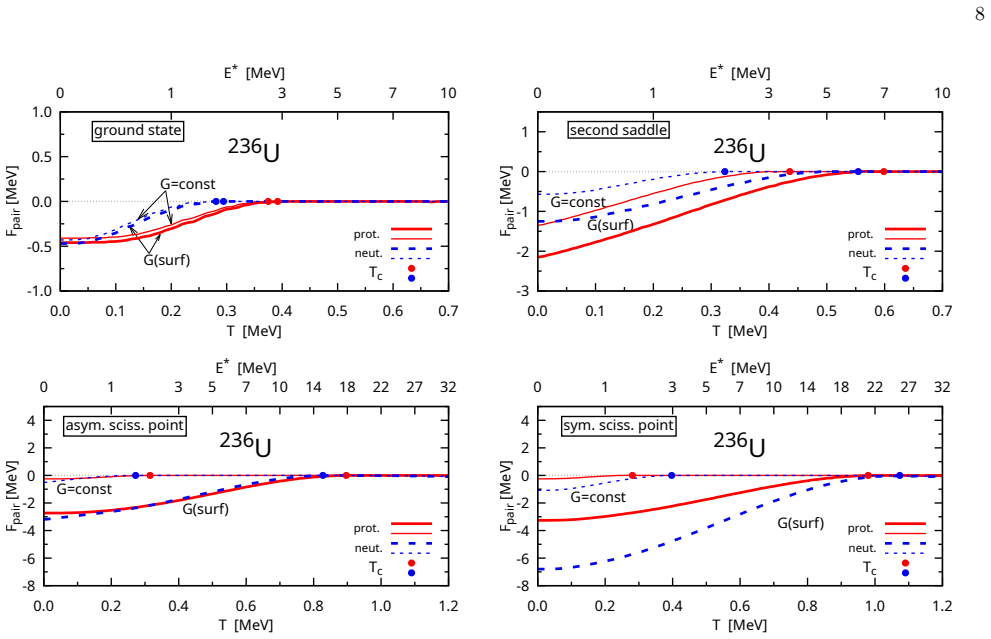


read the original abstract
We investigate the finite-temperature evolution of microscopic free-energy corrections in nuclear fission, focusing on pairing and shell effects near scission. The analysis is based on a finite-temperature BCS treatment combined with the Strutinsky method and is performed for representative deformation points along the fission path. Both pairing and shell contributions exhibit regular thermal attenuation, but their deformation dependencies differ substantially. In particular, pairing remains strongly deformation-dependent in the scission region, and its free-energy contribution differs markedly between the constant and surface-dependent pairing-strength prescriptions. The shell correction near scission is also significant at low temperature and is progressively suppressed with increasing excitation energy. These results support the interpretation of odd-even staggering in fragment charge yields as a manifestation of pairing correlations surviving into the strongly deformed pre-scission configuration. They also show that pairing and shell effects should be treated separately in finite-temperature dynamical calculations, with distinct deformation- and temperature-dependent attenuation laws.
Editorial analysis
A structured set of objections, weighed in public.
Referee Report
Summary. The manuscript examines the finite-temperature evolution of microscopic free-energy corrections due to pairing and shell effects near scission in nuclear fission. Using a finite-temperature BCS treatment combined with the Strutinsky method applied to representative deformation points along the fission path, it finds that both contributions exhibit regular thermal attenuation, but pairing remains strongly deformation-dependent at scission with marked differences between constant and surface-dependent pairing-strength prescriptions. The shell correction is significant at low temperature and suppressed with increasing excitation energy. These results are interpreted as supporting the view that odd-even staggering in fragment charge yields manifests pairing correlations surviving into the strongly deformed pre-scission configuration, and they advocate treating pairing and shell effects separately in dynamical calculations with distinct deformation- and temperature-dependent attenuation laws.
Significance. If the results hold under a designated pairing prescription, the work provides a useful microscopic basis for understanding the persistence of odd-even effects in fission yields by demonstrating survival of pairing correlations at large deformations. The application of standard finite-temperature BCS plus Strutinsky methods to fission is a strength, yielding concrete insights into differing deformation dependencies that can inform future dynamical models. The emphasis on separate attenuation laws for pairing and shell effects is a constructive contribution, though the conditional character of the central interpretation limits broader immediate impact.
major comments (3)
- [Results and discussion of pairing prescriptions] The calculations show that the pairing free-energy correction near scission differs markedly between the constant and surface-dependent pairing-strength prescriptions, yet the manuscript does not designate a preferred prescription for the scission region. This renders the support for the odd-even staggering interpretation conditional on an unresolved model choice (see abstract and results on deformation dependence).
- [Implications for odd-even staggering] The paper infers implications for odd-even staggering in fragment charge yields from the surviving pairing free-energy corrections but does not quantify how the free-energy differences between prescriptions would propagate into the charge-yield distribution. Without this step, the link between the computed corrections and observed yields remains qualitative.
- [Method and deformation-point selection] The analysis is based on static sampling of representative deformation points. It remains open whether the free-energy landscape evaluated at these discrete points controls the final fragment yields, since dynamical evolution during the descent to scission is not modeled.
minor comments (2)
- [Abstract] The abstract could usefully specify the nuclei or fission systems studied to allow immediate assessment of applicability.
- [Figures] Figures displaying free-energy corrections versus deformation should explicitly mark the scission region and distinguish the two pairing prescriptions in legends and captions for clarity.
Simulated Author's Rebuttal
We appreciate the referee's positive evaluation of our work and the insightful comments provided. Below we respond to each major comment in detail, outlining the revisions we intend to implement in the manuscript.
read point-by-point responses
-
Referee: [Results and discussion of pairing prescriptions] The calculations show that the pairing free-energy correction near scission differs markedly between the constant and surface-dependent pairing-strength prescriptions, yet the manuscript does not designate a preferred prescription for the scission region. This renders the support for the odd-even staggering interpretation conditional on an unresolved model choice (see abstract and results on deformation dependence).
Authors: We thank the referee for highlighting this aspect. The manuscript presents both prescriptions to demonstrate that the survival of pairing correlations at scission is a robust feature, independent of the specific pairing strength prescription. The quantitative differences are discussed to inform model choices in future work. To address the concern, we will revise the abstract and the relevant sections to explicitly state that the interpretation of odd-even staggering holds qualitatively for both prescriptions, while noting the differences in magnitude. revision: partial
-
Referee: [Implications for odd-even staggering] The paper infers implications for odd-even staggering in fragment charge yields from the surviving pairing free-energy corrections but does not quantify how the free-energy differences between prescriptions would propagate into the charge-yield distribution. Without this step, the link between the computed corrections and observed yields remains qualitative.
Authors: We agree that our inference remains qualitative. Performing a quantitative mapping to charge yields would require a complete dynamical fission calculation incorporating these free energies, which is not within the scope of this study. Our focus is on providing the microscopic temperature and deformation dependence of the corrections. We will update the discussion to more clearly indicate the qualitative character of the link and to suggest how these results can be used in dynamical models. revision: yes
-
Referee: [Method and deformation-point selection] The analysis is based on static sampling of representative deformation points. It remains open whether the free-energy landscape evaluated at these discrete points controls the final fragment yields, since dynamical evolution during the descent to scission is not modeled.
Authors: This comment correctly identifies a limitation of our static approach. The representative points are chosen to evaluate the corrections specifically in the scission region, providing essential information on how pairing and shell effects attenuate with temperature and deformation. We do not model the full dynamical path, as our goal is to supply these corrections for use in dynamical simulations. We will add text in the conclusions to clarify this scope and the intended application of our findings. revision: yes
Axiom & Free-Parameter Ledger
free parameters (1)
- pairing-strength prescription
axioms (2)
- domain assumption Finite-temperature BCS treatment remains valid for strongly deformed nuclei near scission.
- domain assumption Strutinsky shell corrections can be evaluated at finite temperature without additional temperature-dependent renormalization.
Reference graph
Works this paper leans on
-
[1]
Brack, J
M. Brack, J. Damgaard, A. S. Jensen, H. C. Pauli, V. M. Strutinsky, and C. Y. Wong, Reviews of Modern Physics 44, 320 (1972)
1972
-
[2]
Ledergerber and H.-C
T. Ledergerber and H.-C. Pauli, Nuclear Physics A207, 1 (1973)
1973
-
[3]
Moretto and R
L. Moretto and R. Babinet, Physics Letters B49, 147 (1974)
1974
-
[4]
Staszczak, A
A. Staszczak, A. Baran, K. Pomorski, and K. Böning, Physics Letters B161, 227 (1985)
1985
-
[5]
Łojewski and K
Z. Łojewski and K. Pomorski, Nuclear Physics A345, 134 (1980)
1980
-
[6]
Staszczak, S
A. Staszczak, S. Piłat, and K. Pomorski, Nuclear Physics A 504, 589 (1989)
1989
-
[7]
Łojewski and A
Z. Łojewski and A. Staszczak, Nuclear Physics A657, 134 (1999)
1999
-
[8]
S. A. Giuliani, L. M. Robledo, and R. Rodríguez- Guzmán, Physical Review C90, 054311 (2014)
2014
-
[9]
Sadhukhan, J
J. Sadhukhan, J. Dobaczewski, W. Nazarewicz, J. A. Sheikh, and A. Baran, Physical Review C 90, 061304 (2014)
2014
-
[10]
Zhao, B.-N
J. Zhao, B.-N. Lu, T. Nikšić, D. Vretenar, and S.-G. Zhou, Physical Review C93, 044315 (2016)
2016
-
[11]
Rodríguez-Guzmán, L
R. Rodríguez-Guzmán, L. M. Robledo, C. A. Jiménez- Hoyos, and N. C. Hernández, Physical Review C107, 044307 (2023)
2023
-
[12]
Landau, Physikalische Zeitschrift der Sowjetunion1, 88 (1932)
L. Landau, Physikalische Zeitschrift der Sowjetunion1, 88 (1932)
1932
-
[13]
Zener, Proceedings of the Royal Society of London
C. Zener, Proceedings of the Royal Society of London. Series A137, 696 (1932)
1932
-
[14]
E. C. G. Stückelberg, Helvetica Physica Acta 5, 369 (1932)
1932
-
[15]
D. L. Hill and J. A. Wheeler, Physical Review89, 1102 (1953)
1953
-
[16]
Schütte and L
G. Schütte and L. Wilets, Zeitschrift für Physik A286, 313 (1978)
1978
-
[17]
Nazarewicz, Nuclear Physics A557 (1993)
W. Nazarewicz, Nuclear Physics A557 (1993)
1993
-
[18]
Kowal and J
M. Kowal and J. Skalski, inHandbook of Nuclear Physics, edited by I. Tanihata, H. Toki, and T. Kajino (Springer, Singapore, 2022)
2022
-
[19]
A. Zdeb, M. Warda, L. M. Robledo, and S. A. Giuliani, Physical Review C111, 044607 (2025)
2025
-
[20]
Pomorski, B
K. Pomorski, B. Nerlo-Pomorska, J. Bartel, C. Schmitt, Z. G. Xiao, Y. J. Chen, and L. L. Liu, Phys. Rev. C110, 034607 (2024)
2024
-
[21]
Pomorski, A
K. Pomorski, A. Augustyn, T. Cap, Y. J. Chen, M. Kowal, B. Nerlo-Pomorska, M. Warda, and Z. G. Xiao, Phys. Rev. C (2025), accepted for publication
2025
-
[22]
J. N. Wilson and et al., Nature590, 566 (2021)
2021
-
[23]
Pomorski and Z
K. Pomorski and Z. G. Xiao, Chin. Phys. C49, 064109 (2025)
2025
-
[24]
Pomorski, B
K. Pomorski, B. Nerlo-Pomorska, J. Bartel, and C. Schmitt, Phys. Rev. C107, 054616 (2023)
2023
-
[25]
Pomorski and B
K. Pomorski and B. Nerlo-Pomorska, Acta Phys. Pol. B Proc. Suppl.16, 4 (2023)
2023
-
[26]
Pomorski and J
K. Pomorski and J. Dudek, Phys. Rev. C 67, 044316 (2003)
2003
-
[27]
Dobrowolski, K
A. Dobrowolski, K. Pomorski, and J. Bartel, Comput. Phys. Commun.199, 118 (2016)
2016
-
[28]
F. A. Ivanyuk, C. Ishizuka, M. D. Usang, and S. Chiba, Physical Review C97, 054331 (2018)
2018
-
[29]
Bardeen, L
J. Bardeen, L. N. Cooper, and J. R. Schrieffer, Physical Review 108, 1175 (1957)
1957
-
[30]
F. A. Ivanyuk and H. Hofmann, Nuclear Physics A657, 19 (1999)
1999
-
[31]
Decowski, W
P. Decowski, W. Grochulski, A. Marcinkowski, K. Siwek, and Z. Wilhelmi, Nuclear Physics A110, 129 (1968)
1968
-
[32]
G. D. Adeev and P. A. Cherdantsev, Yadernaya Fizika 21, 491 (1975)
1975
-
[33]
Rahmatinejad, T
A. Rahmatinejad, T. M. Shneidman, G. G. Adamian, N. V. Antonenko, P. Jachimowicz, and M. Kowal, Euro- pean Physical Journal A60, 214 (2024)
2024
-
[34]
Rahmatinejad, A
A. Rahmatinejad, A. N. Bezbakh, T. M. Shneidman, G. Adamian, N. V. Antonenko, P. Jachimowicz, and M. Kowal, Physical Review C103, 034309 (2021)
2021
-
[35]
R. C. Kennedy, L. Willets, and E. M. Henley, Physical Review Letters12, 36 (1964)
1964
-
[36]
S. G. Nilsson, A. Sobiczewski, Z. Szymański, S. Wyczech, C. Gustavson, C. F. Tsang, I. L. Möller, and P. Nilsson, Nuclear Physics A131, 1 (1969)
1969
-
[37]
Stępień and Z
W. Stępień and Z. Szymański, Physics Letters B26, 181 19 (1968)
1968
-
[38]
Böning, A
K. Böning, A. Sobiczewski, and K. Pomorski, Acta Phys- ica Polonica B16, 393 (1985)
1985
-
[39]
J. Zhao, T. Nikšić, D. Vretenar, and S.-G. Zhou, Physical Review C99, 014618 (2019)
2019
-
[40]
Zhao, B.-N
J. Zhao, B.-N. Lu, T. Nikšić, D. Vretenar, and S.-G. Zhou, Physical Review C104, 044612 (2021)
2021
-
[41]
J. J. Li, Y. F. Niu, H. Liang, W. H. Long, T. Nikšić, D. Vretenar, and J. Meng, Physical Review C92, 014302 (2015)
2015
-
[42]
X.B.Wang et al.,PhysicalReviewC 108,034306(2023)
2023
-
[43]
Tinkham, Introduction to Superconductivity, 2nd ed
M. Tinkham, Introduction to Superconductivity, 2nd ed. (Dover Publications, Mineola, New York, 2004)
2004
-
[44]
Bohr and B
A. Bohr and B. R. Mottelson,Nuclear Structure. Volume II: Nuclear Deformations (W. A. Benjamin, Inc., Read- ing, Massachusetts, 1975)
1975
-
[45]
F. A. Ivanyuk, C. Schmitt, C. Ishizuka, and S. Chiba, Phys. Rev. C111, 054620 (2025)
2025
-
[46]
Bartel, B
J. Bartel, B. Nerlo-Pomorska, K. Pomorski, and A. Do- browolski, Comput. Phys. Commun.241, 139 (2019)
2019
-
[47]
Pomorski and H
K. Pomorski and H. Hofmann, J. Phys. (Paris)42, 381 (1981)
1981
-
[48]
Nerlo-Pomorska, K
B. Nerlo-Pomorska, K. Pomorski, and J. Bartel, Phys. Rev. C74, 034327 (2006)
2006
-
[49]
Bartel, K
K.Pomorski, B.Nerlo-Pomorska, A.Surowiec, M.Kowal, J. Bartel, K. Dietrich, J. Richert, C. Schmitt, B. Benoit, E. de Goes Brennand, L. Donadille, and C. Badimon, Nucl. Phys. A679, 25 (2000)
2000
-
[50]
Delagrange et al., Z
H. Delagrange et al., Z. Phys. A323, 437 (1986)
1986
-
[51]
Dostrovsky, Z
I. Dostrovsky, Z. Fraenckel, and G. Friedlander, Phys. Rev. 116, 683 (1959)
1959
-
[52]
Nerlo-Pomorska, K
B. Nerlo-Pomorska, K. Pomorski, J. Bartel, and K. Di- etrich, Phys. Rev. C66, 034327 (2002)
2002
discussion (0)
Sign in with ORCID, Apple, or X to comment. Anyone can read and Pith papers without signing in.