Recognition: unknown
Cone hierarchy and the screening of matter by gravity
Pith reviewed 2026-05-08 02:28 UTC · model grok-4.3
The pith
Gravity screens negative-energy clouds around positive-energy seeds via a causal cone hierarchy
A machine-rendered reading of the paper's core claim, the machinery that carries it, and where it could break.
Core claim
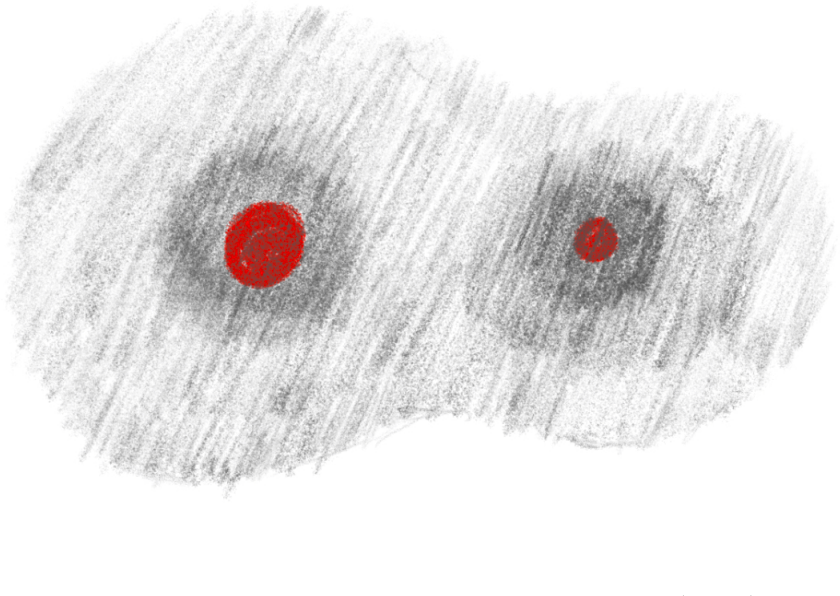
The cone hierarchy of the Harmonic Background Paradigm corresponds to a screening property of gravity: negative-energy gravitational clouds form around positive-energy seeds but remain subordinate to them, providing the mechanism needed to carry the paradigm into the nonlinear regime.
What carries the argument
The causal cone hierarchy, in which a fundamental causal cone always encompasses the effective gravitational causal cone, thereby enabling the screening of negative-energy clouds.
If this is right
- The Harmonic Background Paradigm applies to full nonlinear gravitational dynamics.
- Spherically symmetric matter distributions exhibit the screening property.
- Gravitational phenomena can be described without negative energies overcoming positive sources.
- The framework permits discussion of gravitational physics beyond General Relativity.
Where Pith is reading between the lines
- The screening may constrain nonlinear solutions by keeping negative energies subordinate in strong fields.
- This offers a route to examine gravitational collapse or compact objects without standard singularities.
- Predictions could be compared against observations of strong-field gravity to test the extension.
Load-bearing premise
The Harmonic Background Paradigm, developed only in the linear approximation, extends to nonlinear gravity through the conjectured screening of negative-energy clouds.
What would settle it
An explicit nonlinear calculation for a spherically symmetric positive-energy seed that checks whether the surrounding negative-energy gravitational cloud stays screened and never dominates the source.
Figures



read the original abstract
In a previous paper by some of the authors (Gen. Rel. Grav. 56, 116, 2024), we introduced a novel paradigm with which to understand gravitational phenomena. We called it the Harmonic Background Paradigm (HBP). In this paradigm, gravity amounts to an effective causality deformation with respect to a more fundamental causality, which always encompasses the former through a causal cone hierarchy. In that paper, the fundamental idea was described in detail but fully elaborated only when restricted to the linear gravitational approximation. In this work, we discuss and conjecture how this idea could be extended to the full non-linear regime. We identify a connection between the cone hierarchy and a property of gravity that can be described as a screening mechanism of negative-energy gravitational clouds surrounding (but never overcoming) positive-energy seeds. We illustrate our ideas by applying them to spherically symmetric matter distributions. The paper concludes with a discussion of some key implications and directions for future research, including some remarks beyond General Relativity.
Editorial analysis
A structured set of objections, weighed in public.
Referee Report
Summary. The paper extends the authors' prior Harmonic Background Paradigm (HBP), previously developed only in the linear gravitational approximation, to the full non-linear regime. It conjectures that a causal cone hierarchy induces a screening mechanism in which negative-energy gravitational clouds surround but never overcome positive-energy matter seeds, and illustrates the idea for spherically symmetric distributions while discussing implications beyond General Relativity.
Significance. If the conjectured screening mechanism can be formalized with explicit non-linear equations and bounds, the work could offer a conceptually new route to understanding gravitational non-linearity and causality deformation. At present the absence of derivations or quantitative checks limits its immediate technical impact, though the link between cone hierarchies and energy screening is an interesting direction for further exploration in modified gravity or effective field theories.
major comments (2)
- [Abstract and §1] Abstract and §1: The screening conjecture—that negative-energy clouds surround but never overcome positive-energy seeds—is stated without deriving the corresponding non-linear field equations, without exhibiting an explicit bound on the negative-energy contribution, and without showing how the cone hierarchy enforces the 'never overcoming' condition in any dynamical regime beyond the linear approximation already treated in the 2024 Gen. Rel. Grav. paper.
- [Spherically symmetric matter distributions] Section on spherically symmetric matter distributions: The illustration for spherical symmetry is presented only conceptually; no explicit metric ansatz, stress-energy components, or integration of the conjectured screening condition is supplied to demonstrate that the hierarchy prevents negative-energy clouds from dominating the positive seeds.
minor comments (1)
- [Introduction] The manuscript should clarify which elements of the non-linear extension are new versus direct consequences of the linear HBP, to reduce dependence on the prior reference.
Simulated Author's Rebuttal
We thank the referee for their careful reading of the manuscript and for identifying the primarily conjectural character of the proposed extension of the Harmonic Background Paradigm. We address each major comment below, clarifying the intended scope of the work while indicating where we will revise the text for greater precision.
read point-by-point responses
-
Referee: [Abstract and §1] Abstract and §1: The screening conjecture—that negative-energy clouds surround but never overcome positive-energy seeds—is stated without deriving the corresponding non-linear field equations, without exhibiting an explicit bound on the negative-energy contribution, and without showing how the cone hierarchy enforces the 'never overcoming' condition in any dynamical regime beyond the linear approximation already treated in the 2024 Gen. Rel. Grav. paper.
Authors: We agree that the screening conjecture is advanced without explicit non-linear field equations, quantitative bounds on the negative-energy contribution, or a dynamical demonstration of the 'never overcoming' condition beyond the linear regime treated previously. The present manuscript is framed as a conjecture that links the causal cone hierarchy to a screening property of gravity; its purpose is to identify this connection and to outline its possible implications rather than to supply the full nonlinear formalism. We will revise the abstract and Section 1 to state more explicitly that the screening mechanism remains conjectural at this stage and that the derivation of the corresponding equations and bounds lies outside the scope of the current work. revision: partial
-
Referee: [Spherically symmetric matter distributions] Section on spherically symmetric matter distributions: The illustration for spherical symmetry is presented only conceptually; no explicit metric ansatz, stress-energy components, or integration of the conjectured screening condition is supplied to demonstrate that the hierarchy prevents negative-energy clouds from dominating the positive seeds.
Authors: The discussion of spherically symmetric distributions is offered as a qualitative illustration of how the cone hierarchy might enforce screening, rather than as a quantitative solution. Because the nonlinear field equations have not been derived, we do not supply an explicit metric ansatz, stress-energy components, or perform integrations. We will insert a clarifying paragraph in the relevant section noting that the example is conceptual and that concrete calculations await the development of the full nonlinear framework. revision: partial
- Derivation of the non-linear field equations that realize the screening conjecture
- Explicit bounds on negative-energy contributions and dynamical verification that the cone hierarchy prevents domination
- Explicit metric ansatz, stress-energy components, and integration for the spherically symmetric case
Circularity Check
Minor self-citation to prior linear HBP work; extension presented as open conjecture without any reduction to self-defined inputs
full rationale
The manuscript explicitly references the authors' 2024 Gen. Rel. Grav. paper for the linear Harmonic Background Paradigm and states that the present work 'discuss[es] and conjecture[s]' the non-linear extension via a screening mechanism. No equations, fitted parameters, or derivations are supplied that reduce any claimed prediction or screening bound to quantities defined in the prior work or by construction within this paper. The screening property is illustrated only for spherical symmetry and labeled a conjecture without non-linear field equations or explicit bounds. This constitutes a normal self-citation to foundational prior work rather than a load-bearing circular step; the central claim remains an unproven conjecture rather than a forced result.
Axiom & Free-Parameter Ledger
invented entities (1)
-
negative-energy gravitational clouds
no independent evidence
Reference graph
Works this paper leans on
-
[1]
The actual gravitational field is the tensorh µν but subject to the de Donder Harmonic Condition (dDHC)∇ µ¯hµν = 0
-
[2]
The initial configuration forh µν is such it does not contain incoming waves at past infinity (neither actual physical waves nor gauge waves, as detailed in [3])
-
[3]
de Donder Harmonic Condition
The matter SET satisfies a Background Null Energy Condition (B-NEC), namely that Tµνlµlν ≥0 for any future-pointing null vectorl µ with respect toη, i.e. anyl µ such thatη µνlµlν = 0. Then, one first realizes that the equation of motion of the field is simply 2¯hµν =−16πG T M µν ; or□h µν =−16πG ¯T M µν.(9) Under condition 2. above, one can write the evol...
-
[4]
constrained to satisfy the dDHC
First of all, remember that gravity is encoded in a tensorial objecth .. constrained to satisfy the dDHC
-
[5]
Gravity is initially very weak; among other things this implies that the free matter SET, being itself small, is however much bigger than the gravity and interaction SETs
-
[6]
dies off at spatial infinity so that the effective metricg
The tensorh .. dies off at spatial infinity so that the effective metricg.. is asymptotically flat
-
[7]
There are no gravitational waves incoming from infinity
-
[8]
Finally, we impose that the free matter SET initially satisfies the B-NEC. Therefore, on the one hand, we know by construction thath µν is very small untilt 0. More- over, we have a precise definition of what it means forh .. to be small, namely that theh µν components are much smaller than the correspondingη µν components (recall thath µν is a unique obj...
-
[9]
Theorems on gravitational time delay and related issues
S. Gao and R. M. Wald, Theorems on gravitational time delay and related issues, Class. Quant. Grav.17, 4999 (2000), arXiv:gr-qc/0007021
work page Pith review arXiv 2000
-
[10]
M. Lenzi and C. F. Sopuerta, Master functions and equations for perturbations of vacuum spherically symmetric spacetimes, Phys. Rev. D104, 084053 (2021), arXiv:2108.08668 [gr-qc]
-
[11]
C. Barcel´ o and G. Jannes, The harmonic background paradigm, or why gravity is attractive, Gen. Rel. Grav.56, 116 (2024), arXiv:2307.11472 [gr-qc]
-
[12]
Rosen, General relativity and flat space
N. Rosen, General relativity and flat space. i, Phys. Rev.57, 147 (1940)
1940
-
[13]
Rosen, General relativity and flat space
N. Rosen, General relativity and flat space. ii, Phys. Rev.57, 150 (1940)
1940
-
[14]
A. A. Logunov and M. A. Mestvirishvili, Relativistic Theory of Gravitation, Progress of The- oretical Physics74, 31 (1985)
1985
- [15]
- [16]
- [17]
-
[18]
Rosen, A bi-metric theory of gravitation, Gen
N. Rosen, A bi-metric theory of gravitation, Gen. Rel. Grav.4, 435 (1973)
1973
-
[19]
Rosen, A bi-metric theory of gravitation
N. Rosen, A bi-metric theory of gravitation. ii, General Relativity and Gravitation6, 259 (1975)
1975
-
[20]
Foures-Bruhat, Theoreme d’existence pour certains systemes derivees partielles non lin- eaires, Acta Mat.88, 141 (1952)
Y. Foures-Bruhat, Theoreme d’existence pour certains systemes derivees partielles non lin- eaires, Acta Mat.88, 141 (1952)
1952
-
[21]
Friedrich, On the hyperbolicity of Einstein’s and other gauge field equations, Commun
H. Friedrich, On the hyperbolicity of Einstein’s and other gauge field equations, Commun. Math. Phys.100, 525 (1985)
1985
-
[22]
Friedrich, Hyperbolic reductions for Einstein’s equations, Class
H. Friedrich, Hyperbolic reductions for Einstein’s equations, Class. Quant. Grav.13, 1451 (1996)
1996
-
[23]
Fock, The theory of space, time and gravitation (2nd Revised Edition, Pergamon Press, New York
V. Fock, The theory of space, time and gravitation (2nd Revised Edition, Pergamon Press, New York. Russian original: Moscow (1955), 1964)
1955
-
[24]
Schoen and S.-T
R. Schoen and S.-T. Yau, On the proof of the positive mass conjecture in general relativity, Communications in Mathematical Physics65, 45 (1979). 29
1979
-
[25]
Schoen and S.-T
R. Schoen and S.-T. Yau, Proof of the positive mass theorem. ii, Communications in Mathe- matical Physics79, 231 (1981)
1981
-
[26]
Witten, A new proof of the positive energy theorem, Communications in Mathematical Physics80, 381 (1981)
E. Witten, A new proof of the positive energy theorem, Communications in Mathematical Physics80, 381 (1981)
1981
-
[27]
Parker and C
T. Parker and C. H. Taubes, On witten’s proof of the positive energy theorem, Communica- tions in Mathematical Physics84, 223 (1982)
1982
-
[28]
L. D. Faddeev, The energy problem in einstein’s theory of gravitation (dedicated to the mem- ory of va fock), Soviet Physics Uspekhi25, 130 (1982)
1982
-
[29]
Komar, Positive-Definite Energy Density and Global Consequences for General Relativity, Phys
A. Komar, Positive-Definite Energy Density and Global Consequences for General Relativity, Phys. Rev.129, 1873 (1963)
1963
-
[30]
J. D. Brown and J. W. York, Jr., Quasilocal energy and conserved charges derived from the gravitational action, Phys. Rev. D47, 1407 (1993), arXiv:gr-qc/9209012
work page Pith review arXiv 1993
- [31]
-
[32]
M.-T. Wang and S.-T. Yau, Quasilocal mass in general relativity, Phys. Rev. Lett.102, 021101 (2009), arXiv:0804.1174 [gr-qc]
-
[33]
Bel, Sur les tenseurs de courbure-´ energie et de super-´ energie, Comptes Rendus Hebdo- madaires des S´ eances de l’Acad´ emie des Sciences248, 1297 (1959)
L. Bel, Sur les tenseurs de courbure-´ energie et de super-´ energie, Comptes Rendus Hebdo- madaires des S´ eances de l’Acad´ emie des Sciences248, 1297 (1959)
1959
-
[34]
M. ´A. G. Bonilla and J. Senovilla, M. M., Some Properties of the Bel and Bel-Robinson Tensors, Gen. Rel. Grav.29, 91 (1997)
1997
- [35]
-
[36]
C. Barcel´ o, L. J. Garay, and G. Jannes, Quantum Non-Gravity and Stellar Collapse, Found. Phys.41, 1532 (2011), arXiv:1002.4651 [gr-qc]
-
[37]
C. Barcel´ o, R. Carballo-Rubio, L. J. Garay, and G. Jannes, The lifetime problem of evaporating black holes: mutiny or resignation, Class. Quant. Grav.32, 035012 (2015), arXiv:1409.1501 [gr-qc]
-
[38]
F. J. Belinfante and J. C. Garrison, On the Uniqueness of Fock’s Harmonic Coordinate Systems in the Presence of Static, Spherically Symmetric Sources, Phys. Rev.125, 1124 (1962)
1962
-
[39]
H. A. Buchdahl, General Relativistic Fluid Spheres, Phys. Rev.116, 1027 (1959)
1959
-
[40]
Bondi, Massive spheres in general relativity, Proc
H. Bondi, Massive spheres in general relativity, Proc. Roy. Soc. Lond. A282, 303 (1964). 30
1964
-
[41]
J. Arrechea, C. Barcel´ o, G. Garc´ ıa-Moreno, and J. Polo-G´ omez, Beyond Buchdahl’s limit: Bi- layered stars and thin-shell configurations, Phys. Rev. D111, 124017 (2025), arXiv:2411.14018 [gr-qc]
-
[42]
Arrechea, C
J. Arrechea, C. Barcel´ o, and V. Boyanov, After collapse: On how a physical vacuum can change the black hole paradigm, in New Frontiers in Gravitational Collapse and Spacetime Singularities, edited by D. Malafarina and P. S. Joshi (Springer Nature Singapore, Singapore, 2024) pp. 1–51
2024
-
[43]
Einstein, Einstein to schwarzschild, in The Collected Papers of Albert Einstein
A. Einstein, Einstein to schwarzschild, in The Collected Papers of Albert Einstein. Vol. 8, edited by R. Schulmann, A. J. Kox, M. Janssen, and J. Illy (Princeton University Press, Princeton, 2002) doc. 169, note 5
2002
-
[44]
Stachel, The hole argument and some physical and philosophical implications, Living Re- views in Relativity17, 1 (2014)
J. Stachel, The hole argument and some physical and philosophical implications, Living Re- views in Relativity17, 1 (2014)
2014
-
[45]
Marolf, Emergent Gravity Requires Kinematic Nonlocality, Phys
D. Marolf, Emergent Gravity Requires Kinematic Nonlocality, Phys. Rev. Lett.114, 031104 (2015), arXiv:1409.2509 [hep-th]. 31
discussion (0)
Sign in with ORCID, Apple, or X to comment. Anyone can read and Pith papers without signing in.