Recognition: unknown
Precision extraction of the deuteron electric polarizability via the Baldin sum rule with full low-energy coverage
Pith reviewed 2026-05-07 17:20 UTC · model grok-4.3
The pith
New deuteron photodisintegration data from 2.33 to 19.65 MeV yields electric polarizability of 0.637 fm³ that matches theory.
A machine-rendered reading of the paper's core claim, the machinery that carries it, and where it could break.
Core claim
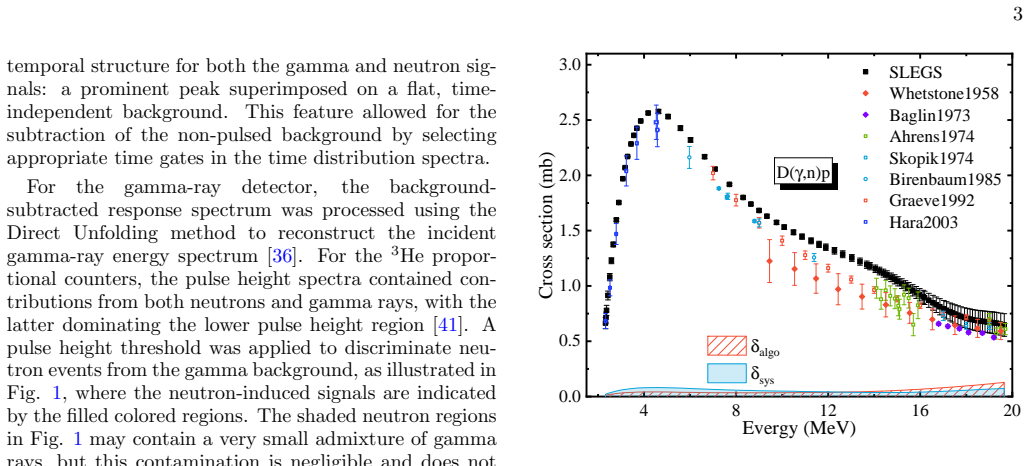
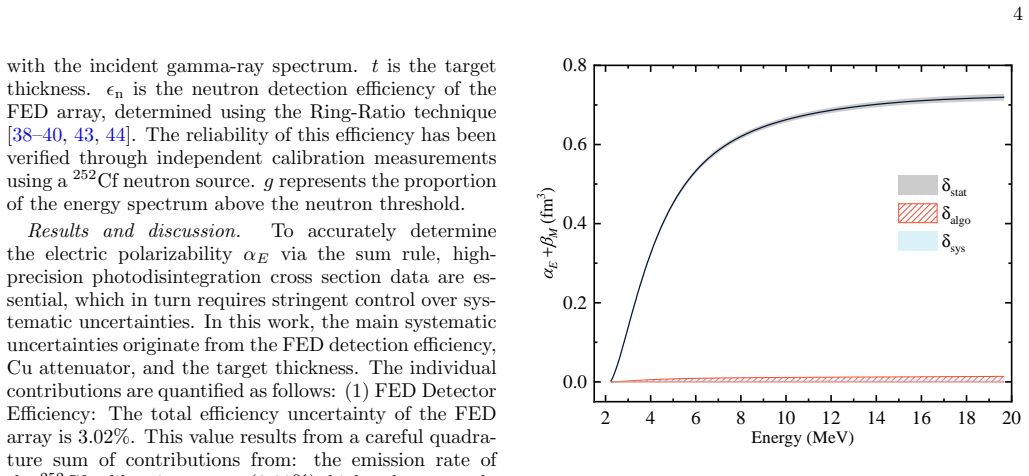
By applying the Baldin sum rule to the newly obtained data, the sum of the electric and magnetic dipole polarizabilities of the deuteron is extracted for the first time based solely on a dense and continuous experimental dataset, yielding α_E + β_M = 0.719±0.009stat±0.014algo±0.023syst fm³. With theoretical values of the magnetic polarizability β_M calculated from the pionless effective field theory, a new value of the electric polarizability is obtained as α_E = 0.637 ± 0.009stat ± 0.014algo ± 0.023syst ± 0.004theo fm³, which is in excellent agreement with current theoretical predictions. This result resolves the previous discrepancy between experimental measurements from elastic scattering
What carries the argument
The Baldin sum rule, which relates the sum of electric and magnetic dipole polarizabilities to an energy-weighted integral of the total photodisintegration cross section.
Load-bearing premise
The pionless effective field theory value for the magnetic polarizability β_M is accurate to the quoted theoretical uncertainty and the unmeasured photon energies outside the covered range contribute negligibly or are modeled correctly in the integral.
What would settle it
A direct experimental measurement of β_M differing from the pionless EFT prediction by more than 0.004 fm³, or new cross-section data that shifts the integrated sum beyond the reported uncertainties, would change the extracted α_E and test the claimed agreement.
Figures


read the original abstract
The photodisintegration cross sections of the deuteron have been systematically measured over the photon energy range of 2.33-19.65 MeV at the Shanghai Laser Electron Gamma Source (SLEGS). By applying the well-established Baldin sum rule to the newly obtained data, the sum of the electric and magnetic dipole polarizabilities of the deuteron is extracted for the first time based solely on a dense and continuous experimental dataset, yielding {\alpha}E +\{beta}M = 0.719\pm0.009stat\pm0.014algo\pm0.023syst fm3 . With theoretical values of the magnetic polarizability \{beta}M calculated from the pionless effective field theory, a new value of the electric polarizability is obtained as {\alpha}E = 0.637 \pm 0.009stat \pm 0.014algo \pm 0.023syst \pm 0.004theo fm3 , which is in excellent agreement with current theoretical predictions. This result resolves the previous discrepancy between experimental measurements from elastic scattering and theory, providing a high-precision benchmark for nuclear interaction models.
Editorial analysis
A structured set of objections, weighed in public.
Referee Report
Summary. The manuscript reports new measurements of deuteron photodisintegration cross sections over 2.33-19.65 MeV at SLEGS. Applying the Baldin sum rule to this dataset, the authors extract α_E + β_M = 0.719 ± 0.009stat ± 0.014algo ± 0.023syst fm³ for the first time from a dense continuous experimental coverage. Subtracting a pionless-EFT value of β_M then yields α_E = 0.637 ± 0.009stat ± 0.014algo ± 0.023syst ± 0.004theo fm³, claimed to agree with theory and resolve prior discrepancies with elastic-scattering results.
Significance. If the modeling of unmeasured regions is shown to be robust, the work supplies a high-precision experimental anchor for deuteron polarizabilities via the Baldin sum rule with improved low-energy data density. The direct extraction of the sum α_E + β_M from measured cross sections is a clear strength, and the subsequent agreement with pionless EFT after subtracting its β_M prediction provides a useful benchmark for nuclear models. The result could tighten constraints on few-body interactions if the tail contributions are quantified.
major comments (2)
- [Abstract] Abstract: the statement that α_E + β_M is extracted 'based solely on a dense and continuous experimental dataset' is undercut by the limited coverage. The Baldin integral runs from threshold (~2.22 MeV) to infinity, yet data exist only for 2.33-19.65 MeV; the threshold interval and high-energy tail (meson-production region) must be modeled, so their contribution is not purely experimental and the quoted stat/algo/syst uncertainties do not capture this model dependence.
- [Extraction and results] The separation step that isolates α_E subtracts an external pionless-EFT β_M whose 0.004 fm³ theoretical uncertainty is added in quadrature. The manuscript should state the numerical value of β_M adopted and show the propagation of its uncertainty (and any variation within the EFT error band) into the final α_E to demonstrate that the claimed resolution of the elastic-scattering discrepancy remains stable.
minor comments (1)
- [Abstract] The abstract contains LaTeX artifacts (e.g., {alpha}E, {beta}M) that should be rendered correctly in the published version.
Simulated Author's Rebuttal
We thank the referee for the careful reading and constructive comments. We address each major point below and have revised the manuscript to improve clarity on the modeling aspects and the β_M subtraction procedure.
read point-by-point responses
-
Referee: [Abstract] Abstract: the statement that α_E + β_M is extracted 'based solely on a dense and continuous experimental dataset' is undercut by the limited coverage. The Baldin integral runs from threshold (~2.22 MeV) to infinity, yet data exist only for 2.33-19.65 MeV; the threshold interval and high-energy tail (meson-production region) must be modeled, so their contribution is not purely experimental and the quoted stat/algo/syst uncertainties do not capture this model dependence.
Authors: We agree that the abstract phrasing risks implying a purely experimental result without qualification. The full manuscript already describes the modeling: the sub-threshold interval (2.22–2.33 MeV) is evaluated via the effective-range expansion anchored to the known deuteron binding energy and low-energy theorems, while the high-energy tail (>19.65 MeV) employs a Regge-inspired parametrization constrained by existing data above the pion threshold. These contributions and their uncertainties are folded into the quoted systematic error. To eliminate ambiguity we will revise the abstract to: “using the new dense experimental dataset in the measured interval together with standard model evaluations of the unmeasured regions.” We will also add an explicit statement that model dependence is included in the systematic uncertainty. revision: yes
-
Referee: [Extraction and results] The separation step that isolates α_E subtracts an external pionless-EFT β_M whose 0.004 fm³ theoretical uncertainty is added in quadrature. The manuscript should state the numerical value of β_M adopted and show the propagation of its uncertainty (and any variation within the EFT error band) into the final α_E to demonstrate that the claimed resolution of the elastic-scattering discrepancy remains stable.
Authors: We accept the suggestion. The pionless-EFT value adopted is β_M = 0.082 ± 0.004 fm³. Subtracting this central value from the measured sum 0.719 fm³ produces the quoted α_E = 0.637 fm³, with the ±0.004 theo uncertainty added in quadrature. We will insert the explicit β_M value in the text and add a short sensitivity paragraph (with a one-line table) showing α_E obtained for β_M varied across its 1σ band (0.078–0.086 fm³). The resulting α_E range remains fully consistent with current theoretical predictions and preserves the resolution of the earlier elastic-scattering discrepancy. revision: yes
Circularity Check
No circularity: experimental integral plus independent EFT subtraction
full rationale
The derivation applies the external Baldin sum rule to measured cross-section data over 2.33-19.65 MeV to obtain α_E + β_M directly from the integral; β_M is then subtracted using a separate pionless-EFT calculation whose value and uncertainty are not derived from the present dataset or equations. No step equates a claimed prediction to a fitted parameter by construction, no self-citation is load-bearing for the central result, and the sum-rule formula itself is cited as well-established rather than redefined. Partial high-energy tail modeling is a completeness issue, not a definitional reduction.
Axiom & Free-Parameter Ledger
axioms (2)
- standard math The Baldin sum rule α_E + β_M = (1/(2π²)) ∫ σ(ω)/ω² dω from threshold to infinity holds for the deuteron.
- domain assumption The pionless effective field theory calculation of β_M is accurate to ±0.004 fm³.
Reference graph
Works this paper leans on
-
[1]
A number of theoretical calculations of the deuteron electric dipole polarizability,α E, have been reported, in- cluding values of 0.63 fm 3 [20], 0.615 fm 3 0.622 fm3 and 0.628 fm3[16], 0.639(6) fm 3 [21], 0.632(3) fm 3 [22], 0.627 fm3 [23], 0.6328(17) fm 3 and 0.6334(14) fm 3 [24], 0.6339 fm3 [12], 0.6378(12) fm 3 [11]. To provide a consolidated theoret...
-
[2]
B. R. Holstein and S. Scherer, in Annual Review of Nuclear and Particle Science, Vol. 64 (2014) pp. 51–81
2014
-
[3]
Lundin et al., Compton Scattering from the Deuteron and Extracted Neutron Polarizabilities, Phys
M. Lundin et al., Compton Scattering from the Deuteron and Extracted Neutron Polarizabilities, Phys. Rev. Lett. 90, 192501 (2003)
2003
-
[4]
Kossert et al., Neutron Polarizabilities Investigated by Quasifree Compton Scattering from the Deuteron, Phys
K. Kossert et al., Neutron Polarizabilities Investigated by Quasifree Compton Scattering from the Deuteron, Phys. Rev. Lett.88, 162301 (2002)
2002
-
[5]
Hornidge et al., Elastic Compton Scattering from the Deuteron and Nucleon Polarizabilities, Phys
D. Hornidge et al., Elastic Compton Scattering from the Deuteron and Nucleon Polarizabilities, Phys. Rev. Lett. 84, 2334 (2000)
2000
-
[6]
Schmiedmayer et al., Measurement of the electric po- larizability of the neutron, Phys
J. Schmiedmayer et al., Measurement of the electric po- larizability of the neutron, Phys. Rev. Lett.66, 1015 (1991)
1991
-
[7]
Levchuk and A
M. Levchuk and A. L’vov, Deuteron Compton scatter- ing below pion photoproduction threshold, Nucl. Phys. A674, 449 (2000)
2000
-
[8]
L. S. Myers et al., Measurement of Compton Scatter- ing from the Deuteron and an Improved Extraction of the Neutron Electromagnetic Polarizabilities, Phys. Rev. Lett.113, 262506 (2014)
2014
-
[9]
H. W. Griesshammer et al., Using Effective Field The- ory to analyse low-energy Compton scattering data from protons and light nuclei, Prog. Part. Nucl. Phys.67, 841 (2012)
2012
-
[10]
Hagelstein et al., Nucleon polarizabilities: From Compton scattering to hydrogen atom, Prog
F. Hagelstein et al., Nucleon polarizabilities: From Compton scattering to hydrogen atom, Prog. Part. Nucl. Phys.88, 29 (2016)
2016
-
[11]
Li et al., Proton Compton Scattering from Linearly Polarized Gamma Rays, Phys
X. Li et al., Proton Compton Scattering from Linearly Polarized Gamma Rays, Phys. Rev. Lett.128, 132502 (2022)
2022
-
[12]
Friar and G
J. Friar and G. Payne, Deuteron dipole polarizabilities and sum rules, Phys. Rev. C72, 014004 (2005)
2005
-
[13]
Ji and Y.-c
X.-d. Ji and Y.-c. Li, Sum rules and spin dependent polar- izabilities of the deuteron in effective field theory, Phys. Lett. B591, 76 (2004)
2004
-
[14]
Liu and R
C. Liu and R. Timmermans, P- and T-odd two-nucleon interaction and the deuteron electric dipole moment, Phys. Rev. C70, 055501 (2004)
2004
-
[15]
Koohrokhi and S
T. Koohrokhi and S. Kartal, A new effective potential for deuteron, Commun. Theor. Phys.74, 075301 (2022)
2022
-
[16]
Arenh¨ ovel and M
H. Arenh¨ ovel and M. Sanzone, Photodisintegration of the deuteron: a review of theory and experiment, (2012)
2012
-
[17]
Arenh¨ ovel and W
H. Arenh¨ ovel and W. Fabian, Photonuclear sum rules and interaction effects in the deuteron, Nucl. Phys. A 292, 429 (1977)
1977
-
[18]
Hughes et al., Photodisintegration of deuterium at 0 ◦ for outgoing protons, Nucl
R. Hughes et al., Photodisintegration of deuterium at 0 ◦ for outgoing protons, Nucl. Phys. A267, 329 (1976)
1976
-
[19]
Wilbois et al., in Mesons and Light Nuclei ’95 (Springer Vienna, Vienna, 1996) pp
T. Wilbois et al., in Mesons and Light Nuclei ’95 (Springer Vienna, Vienna, 1996) pp. 263–266
1996
-
[20]
Rodning et al., Measurement of the Electric Polariz- ability of the Deuteron , Phys
N. Rodning et al., Measurement of the Electric Polariz- ability of the Deuteron , Phys. Rev. Lett.49, 909 (1982)
1982
-
[21]
C. F. Clement, Electric polarizability, Phys. Rev.128, 2724 (1962)
1962
-
[22]
Lopes et al., Electric polarizability of the deuteron and the nucleon-nucleon interaction, Phys
M. Lopes et al., Electric polarizability of the deuteron and the nucleon-nucleon interaction, Phys. Rev. C28, 1779 (1983)
1983
-
[23]
J. L. Friar and S. Fallieros, Deuteron electric polarizabil- ity, Phys. Rev. C29, 232 (1984)
1984
-
[24]
Weyrauch, Deuteron Compton scattering, Phys
M. Weyrauch, Deuteron Compton scattering, Phys. Rev. C41, 880 (1990)
1990
-
[25]
Friar and G
J. Friar and G. Payne, Nuclear polarizabilities and loga- rithmic sum rules, Phys. Rev. C55, 2764 (1997)
1997
-
[26]
J.-W. Chen, H. W. Griesshammer, M. J. Savage, and R. P. Springer, The Polarizability of the deuteron, Nucl. Phys. A644, 221 (1998)
1998
-
[27]
Goeckner et al., Measurement of the electric polariz- ability of 3He, Phys
F. Goeckner et al., Measurement of the electric polariz- ability of 3He, Phys. Rev. C43, 66 (1991)
1991
-
[28]
Stetcu et al., Electric dipole polarizabilities of hydrogen and helium isotopes, Phys
I. Stetcu et al., Electric dipole polarizabilities of hydrogen and helium isotopes, Phys. Rev. C79, 064001 (2009)
2009
-
[29]
Friar et al., Electric polarizability of the deuteron, Phys
J. Friar et al., Electric polarizability of the deuteron, Phys. Rev. C27, 1364 (1983)
1983
-
[30]
E. G. Fuller and H. Gerstenberg, Photonuclear data in- dex 1973–1981, National Bureau of Standards Report No. NBSIR-82-25-43 (1983)
1973
-
[31]
Baglin et al., 2H(γ, p) absolute cross section and an- gular distribution at 17-25 MeV, Nucl
J. Baglin et al., 2H(γ, p) absolute cross section and an- gular distribution at 17-25 MeV, Nucl. Phys. AA201, 593 (1973)
1973
-
[32]
Baldin, Polarizability of nucleons, Nucl
A. Baldin, Polarizability of nucleons, Nucl. Phys.18, 310 (1960)
1960
-
[33]
H. W. Wang et al., Commissioning of laser electron gamma beamline SLEGS at SSRF, Nucl. Sci. Tech.33, 87 (2022)
2022
-
[34]
K. Chen et al., First systematic experimental 2D map- ping of linearly polarizedγ-ray polarimetric distribu- tion in relativistic Compton scattering, Natl. Sci. Rev. 10.1093/nsr/nwag073 (2026)
-
[35]
R. Z. Tai and Z. T. Zhao, Overview of SSRF phase-II beamlines, Nucl. Sci. Tech.35, 137 (2024)
2024
-
[36]
Xu et al., Gamma-ray flux in Gated CW operation of CO 2 laser at SLEGS, Nucl
H. Xu et al., Gamma-ray flux in Gated CW operation of CO 2 laser at SLEGS, Nucl. Instrum. Methods Phys. Res. Sect. A-Accel. Spectrom. Dect. Assoc. Equip.1073, 170249 (2025)
2025
-
[37]
Liu et al., Energy profile of laser Compton slant- scatteringγ-ray beams determined by direct unfolding of total-energy responses of a BGO detector, Nucl
L. Liu et al., Energy profile of laser Compton slant- scatteringγ-ray beams determined by direct unfolding of total-energy responses of a BGO detector, Nucl. Instrum. Methods Phys. Res. Sect. A-Accel. Spectrom. Dect. As- soc. Equip.1063, 169314 (2024)
2024
-
[38]
Hao et al., Photoneutron cross-section data gener- 7 ation and analysis at the shanghai laser electron gamma source, Nucl
Z.-R. Hao et al., Photoneutron cross-section data gener- 7 ation and analysis at the shanghai laser electron gamma source, Nucl. Sci. Tech.36, 183 (2025)
2025
-
[39]
Gheorghe et al., Photoneutron cross-section measure- ments in the 209Bi(γ, xn) reaction with a new method of direct neutron-multiplicity sorting, Phys
I. Gheorghe et al., Photoneutron cross-section measure- ments in the 209Bi(γ, xn) reaction with a new method of direct neutron-multiplicity sorting, Phys. Rev. C96, 044604 (2017)
2017
-
[40]
Utsunomiya et al., Direct neutron-multiplicity sorting with a flat-efficiency detector, Nucl
H. Utsunomiya et al., Direct neutron-multiplicity sorting with a flat-efficiency detector, Nucl. Instrum. Methods Phys. Res. Sect. A-Accel. Spectrom. Dect. Assoc. Equip. 871, 135 (2017)
2017
-
[41]
Kawano et al., IAEA Photonuclear Data Library 2019, Nucl
T. Kawano et al., IAEA Photonuclear Data Library 2019, Nucl. Data Sheets163, 109 (2020)
2019
-
[42]
G. F. Knoll, Radiation Detection and Measurement (John Wiley and Sons, New York, 2000)
2000
-
[43]
Hubbell and S
J. Hubbell and S. Seltzer, X-Ray Mass Attenuation Co- efficients, online (2004)
2004
-
[44]
Itoh et al., Photoneutron Cross Sections for Au Re- visited: Measurements with Laser Compton Scattering γ-Rays and Data Reduction by a Least-Squares Method, J
O. Itoh et al., Photoneutron Cross Sections for Au Re- visited: Measurements with Laser Compton Scattering γ-Rays and Data Reduction by a Least-Squares Method, J. Nucl. Sci. Technol.48, 834 (2011)
2011
-
[45]
Krzysiek et al., Photoneutron Cross-section Measure- ments for 165Ho by the Direct Neutron-Multiplicity Sort- ing at NewSUBARU, Acta Phys
M. Krzysiek et al., Photoneutron Cross-section Measure- ments for 165Ho by the Direct Neutron-Multiplicity Sort- ing at NewSUBARU, Acta Phys. Pol. B50, 487 (2019)
2019
-
[46]
Liu et al., Direct unfolding determination of energy spectra using a LaBr 3 detector for SLEGS, Nucl
L. Liu et al., Direct unfolding determination of energy spectra using a LaBr 3 detector for SLEGS, Nucl. In- strum. Methods Phys. Res. Sect. A-Accel. Spectrom. Dect. Assoc. Equip.1083, 171075 (2026)
2026
-
[47]
Renstrøm et al., Verification of detailed balance for γabsorption and emission in Dy isotopes, Phys
T. Renstrøm et al., Verification of detailed balance for γabsorption and emission in Dy isotopes, Phys. Rev. C 98, 054310 (2018)
2018
-
[48]
Hao et al., The day-one experiment at SLEGS: system- atic measurement of the (γ, 1n) cross sections on 197Au and 159Tb for resolving existing data discrepancies, Sci
Z. Hao et al., The day-one experiment at SLEGS: system- atic measurement of the (γ, 1n) cross sections on 197Au and 159Tb for resolving existing data discrepancies, Sci. Bull.70, 2591 (2025)
2025
-
[49]
Z. C. Li et al., New measurement of63Cu(γ, n)62Cu cross- section using quasi-monoenergeticγ-ray beam, Nucl. Sci. Tech.36, 34 (2025)
2025
-
[50]
Zhou et al., Measurement of 59Co(γ, n) 58Co using a new flat-efficiency neutron detector at the Shanghai Laser Electron Gamma Source, Phys
M.-D. Zhou et al., Measurement of 59Co(γ, n) 58Co using a new flat-efficiency neutron detector at the Shanghai Laser Electron Gamma Source, Phys. Rev. C111, 054612 (2025)
2025
-
[51]
D. M. Skopik et al., Photodisintegration of deuterium de- termined from electrodisintegration process, Phys. Rev. C9, 531 (1974)
1974
-
[52]
Birenbaum et al., Absolute cross section for the pho- todisintegration of deuterium, Phys
Y. Birenbaum et al., Absolute cross section for the pho- todisintegration of deuterium, Phys. Rev. C32, 1825 (1985)
1985
-
[53]
Degraeve et al., Absolute total cross-sections for deuteron photodisintegration between 7 and 19 MeV, Phys
A. Degraeve et al., Absolute total cross-sections for deuteron photodisintegration between 7 and 19 MeV, Phys. Rev. C45, 860 (1992)
1992
-
[54]
D. R. Phillips, G. Rupak, and M. J. Savage, Improving the convergence of N N effective field theory, Phys. Lett. B473, 209 (2000)
2000
-
[55]
J.-W. Chen, G. Rupak, and M. J. Savage, Nucleon- nucleon effective field theory without pions, Nucl. Phys. A653, 386 (1999)
1999
-
[56]
Chen and M
J.-W. Chen and M. J. Savage, n p —>d gamma for big bang nucleosynthesis, Phys. Rev. C60, 065205 (1999)
1999
-
[57]
Rupak, Precision calculation of n p —>d gamma cross-section for big bang nucleosynthesis, Nucl
G. Rupak, Precision calculation of n p —>d gamma cross-section for big bang nucleosynthesis, Nucl. Phys. A 678, 405 (2000)
2000
-
[58]
See Supplemental Material at [url] for calculation of the deuteron magnetic polarizability using pionless effective field theory
discussion (0)
Sign in with ORCID, Apple, or X to comment. Anyone can read and Pith papers without signing in.