Recognition: unknown
SVOM/VT: Flight Model Verification and Pre-launch Testing
Pith reviewed 2026-05-08 01:20 UTC · model grok-4.3
The pith
The SVOM Visible Telescope flight model fully meets its design requirements for stray light control, thermal stability, and sensitivity after pre-launch testing.
A machine-rendered reading of the paper's core claim, the machinery that carries it, and where it could break.
Core claim
The SVOM/VT flight model achieves full compliance with design requirements after testing in simulated space conditions, with point-source transmittance below 10 to the power of negative 7 at 30 degrees off-axis, CCD temperatures held at minus 75 degrees Celsius for the red channel and minus 65 degrees Celsius for the blue channel, and a limiting magnitude of 22.50 with signal-to-noise ratio greater than 3 for 300-second exposures; in-orbit tests yielded limiting magnitudes of 22.70 and 22.78, consistent with pre-launch specifications.
What carries the argument
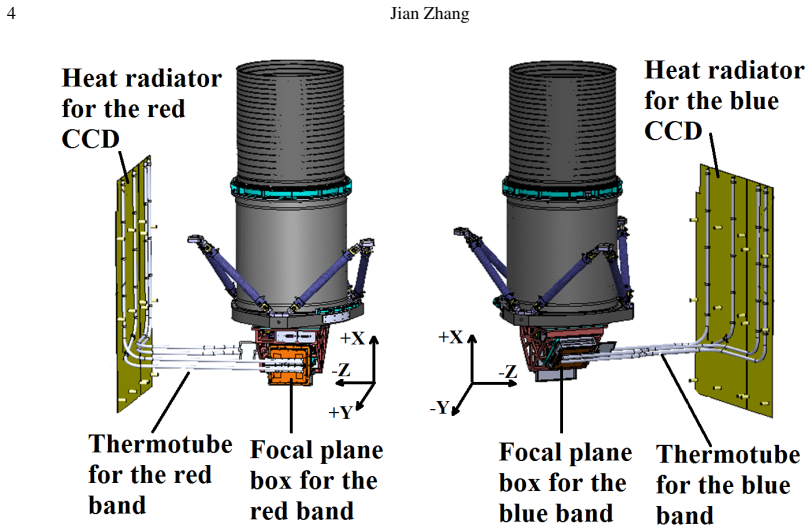
The SVOM/VT flight model verification through thermal vacuum and stray-light test setups that simulate orbital conditions to measure transmittance, temperature stability, and detection limits.
Load-bearing premise
The thermal vacuum chamber and stray-light test setups accurately reproduce the actual space environment without missing factors such as launch vibration or long-term radiation that could degrade performance.
What would settle it
A direct measurement during actual orbital operations showing stray light transmittance above 10 to the power of negative 7 at 30 degrees off-axis or a limiting magnitude worse than 22.50 would disprove compliance with the design requirements.
Figures



read the original abstract
This paper presents pre-launch testing and calibration results for the SVOM/VT (Space-based Variable Objects Monitor, Visible Telescope) Flight Model (FM), validating its performance under simulated space conditions through thermal vacuum cycling, energy concentration analysis, stray light suppression, and CCD/electronics calibrations (gain, noise, quantum efficiency). The results confirm full compliance with design requirements: stray light suppression achieves point-source transmittance $<10^{-7}$ at $30^\circ$ off-axis, thermal control maintains stable CCD temperatures ($-75^\circ$C for the red channel, $-65^\circ$C for the blue channel), and detection sensitivity meets the limiting magnitude of 22.50 (SNR $>$ 3 with 300 seconds exposure). Early in-orbit tests further validate performance, yielding limiting magnitudes of 22.70 (V-band, red) and 22.78 (blue), consistent with pre-launch specifications.
Editorial analysis
A structured set of objections, weighed in public.
Referee Report
Summary. The manuscript reports pre-launch verification and testing of the SVOM/VT Flight Model, covering thermal vacuum cycling, energy concentration analysis, stray light suppression, and CCD/electronics calibrations (gain, noise, quantum efficiency). It states that the instrument fully complies with design requirements, specifically achieving point-source transmittance <10^{-7} at 30° off-axis, stable CCD temperatures of -75°C (red channel) and -65°C (blue channel), and a limiting magnitude of 22.50 (SNR > 3 in 300 s exposure), with early in-orbit tests yielding consistent values of 22.70 (V-band red) and 22.78 (blue).
Significance. If the test results hold, the work provides critical validation of the SVOM/VT instrument's readiness for flight, confirming key performance parameters under simulated space conditions and supporting the mission's objectives for variable object monitoring. The combination of ground testing with preliminary in-orbit data strengthens confidence in the design, offering a useful reference for similar space-based telescopes, though fuller quantitative documentation would increase its utility.
major comments (3)
- Abstract: The claim of full compliance with stray light suppression (point-source transmittance <10^{-7} at 30° off-axis), thermal control, and limiting magnitude 22.50 is stated without any accompanying data tables, measured values with uncertainties, error budgets, or analysis of test repeatability, which are load-bearing for substantiating the quantitative compliance results.
- Abstract and in-orbit validation section: No quantitative cross-check is provided between the thermal vacuum chamber conditions (vacuum level, thermal boundaries, off-axis source spectrum) and the expected SVOM orbital environment, such as modeled Earthshine or zodiacal light contributions; this gap directly affects the validity of extrapolating chamber results to on-orbit performance over the mission lifetime.
- Abstract: The early in-orbit magnitudes (22.70/22.78) are cited as consistent with pre-launch specs, but no time-series data, degradation analysis, or assessment of effects from launch vibration, outgassing, or cumulative radiation on the CCDs are reported, leaving the long-term compliance claim unsupported by evidence.
minor comments (1)
- The abstract would be clearer if it referenced the specific sections or figures containing the detailed test procedures, raw data, and analysis methods rather than summarizing results only.
Simulated Author's Rebuttal
We thank the referee for their constructive comments. We have revised the abstract and in-orbit validation section to better substantiate the quantitative claims and provide additional context on test conditions. Our point-by-point responses follow.
read point-by-point responses
-
Referee: Abstract: The claim of full compliance with stray light suppression (point-source transmittance <10^{-7} at 30° off-axis), thermal control, and limiting magnitude 22.50 is stated without any accompanying data tables, measured values with uncertainties, error budgets, or analysis of test repeatability, which are load-bearing for substantiating the quantitative compliance results.
Authors: We agree that the abstract would benefit from stronger linkage to the supporting data. The full manuscript presents the requested data tables, measured values with uncertainties, error budgets, and repeatability analysis from multiple thermal vacuum test cycles in Sections 3.2, 4.1, and 5.3. We have revised the abstract to reference these sections explicitly and to note the key quantitative outcomes achieved. revision: yes
-
Referee: Abstract and in-orbit validation section: No quantitative cross-check is provided between the thermal vacuum chamber conditions (vacuum level, thermal boundaries, off-axis source spectrum) and the expected SVOM orbital environment, such as modeled Earthshine or zodiacal light contributions; this gap directly affects the validity of extrapolating chamber results to on-orbit performance over the mission lifetime.
Authors: The thermal vacuum chamber conditions were defined from the SVOM environmental specifications to replicate orbital thermal boundaries and vacuum levels, with the off-axis source spectrum chosen to approximate solar illumination. Detailed quantitative modeling of Earthshine and zodiacal light contributions appears in the mission-level environmental analysis documents. We have added a clarifying paragraph in the in-orbit validation section that references these specifications and confirms the alignment of the test setup with predicted orbital conditions. revision: partial
-
Referee: Abstract: The early in-orbit magnitudes (22.70/22.78) are cited as consistent with pre-launch specs, but no time-series data, degradation analysis, or assessment of effects from launch vibration, outgassing, or cumulative radiation on the CCDs are reported, leaving the long-term compliance claim unsupported by evidence.
Authors: The cited in-orbit magnitudes reflect initial commissioning measurements taken shortly after launch and are consistent with pre-launch results. Because the SVOM mission remains in its early operational phase, extended time-series data and quantitative degradation assessments (including launch vibration, outgassing, and radiation effects) are not yet available. We have revised the text to state clearly that these are preliminary results and that ongoing monitoring for degradation will be reported in future publications. revision: partial
- Long-term time-series data and degradation analysis from extended in-orbit operations are not yet available.
Circularity Check
No circularity: paper reports direct empirical measurements against pre-existing design requirements with no derivations or predictions.
full rationale
The manuscript describes pre-launch verification testing of the SVOM/VT Flight Model, including thermal vacuum cycling, stray-light suppression measurements, energy concentration analysis, and CCD calibrations. All reported outcomes (point-source transmittance <10^{-7} at 30° off-axis, CCD temperatures of -75°C/-65°C, limiting magnitude 22.50) are direct experimental results compared to fixed design specifications. No equations, fitted parameters, or forward predictions are introduced whose validity would depend on the test data itself. Early in-orbit magnitudes are noted as consistent but are not used to derive or validate any model within the paper. The derivation chain is therefore empty; the work is self-contained empirical reporting.
Axiom & Free-Parameter Ledger
Reference graph
Works this paper leans on
- [1]
-
[2]
Cordier, B., Wei, J. Y ., Tanvir, N. R., et al. 2025, arXiv e-prints, arXiv:2507.18783 15
-
[3]
2020b, in Society of Photo-Optical Instrumentation Engineers (SPIE) Conference Series, V ol
Fan, X., Zou, G., Wei, J., et al. 2020b, in Society of Photo-Optical Instrumentation Engineers (SPIE) Conference Series, V ol. 11443, Space Telescopes and Instrumentation 2020: Optical, Infrared, and Millimeter Wave, ed. M. Lystrup & M. D. Perrin, 114430Q 1, 8
2020
-
[4]
2008, in Society of Photo-Optical Instrumentation Engineers (SPIE) Conference Series, V ol
Fleming, J., Grochocki, F., Finch, T., Willis, S., & Kaptchen, P. 2008, in Society of Photo-Optical Instrumentation Engineers (SPIE) Conference Series, V ol. 7069, Optical System Contamination: Effects, Measurements, and Control 2008, ed. S. A. Straka, 70690O 8
2008
-
[5]
2018, in Society of Photo-Optical Instrumentation Engineers (SPIE) Conference
Gonzalez, F., & Yu, S. 2018, in Society of Photo-Optical Instrumentation Engineers (SPIE) Conference
2018
-
[6]
10699, Space Telescopes and Instrumentation 2018: Ultraviolet to Gamma Ray, ed
Series, V ol. 10699, Space Telescopes and Instrumentation 2018: Ultraviolet to Gamma Ray, ed. J.-W. A. den Herder, S. Nikzad, & K. Nakazawa, 1069920 1
2018
-
[7]
2010, in Society of Photo-Optical Instrumentation Engineers (SPIE) Conference Series, V ol
Grochocki, F., & Fleming, J. 2010, in Society of Photo-Optical Instrumentation Engineers (SPIE) Conference Series, V ol. 7794, Optical System Contamination: Effects, Measurements, and Control 2010, ed. S. A. Straka & N. Carosso, 77940W 8
2010
-
[8]
2025, Research in Astron
Li, D., Zhang, Y ., Su, R., et al. 2025, Research in Astron. Astrophys. (RAA), 25, this issue 14
2025
-
[9]
2022, PASP, 134, 037001 9
Pan, Y . 2022, PASP, 134, 037001 9
2022
-
[10]
2023, in Society of Photo-Optical Instrumentation Engineers (SPIE) Conference Series, V ol
Pan, Y ., Dan, L., Sun, Z., et al. 2023, in Society of Photo-Optical Instrumentation Engineers (SPIE) Conference Series, V ol. 12965, Society of Photo-Optical Instrumentation Engineers (SPIE) Conference Series, ed. Y . Zhu, S. Xue, & Q. Parker, 129650B 9
2023
-
[11]
2026, Research in Astron
Qiu, Y .-L., Xin, L.-P., Deng, J.-S., et al. 2026, Research in Astron. Astrophys. (RAA), 25, this issue 14
2026
-
[12]
Wei, J., Cordier, B., Antier, S., et al. 2016, arXiv e-prints, arXiv:1610.06892 1 16 Jian Zhang
work page internal anchor Pith review arXiv 2016
-
[13]
H., Xin, L
Yao, Z. H., Xin, L. P.,and Qiu, Y . L., Wu, C., & Li, H. L. 2025, Research in Astron. Astrophys. (RAA), 25, this issue 14
2025
discussion (0)
Sign in with ORCID, Apple, or X to comment. Anyone can read and Pith papers without signing in.