Recognition: unknown
Cosine bands, flat bands and superconductivity in orthorhombic iron selenide
Pith reviewed 2026-05-07 17:37 UTC · model grok-4.3
The pith
Calculations show flat bands from lone pair electrons enhance and sustain superconductivity in beta FeSe1-x up to 23 GPa.
A machine-rendered reading of the paper's core claim, the machinery that carries it, and where it could break.
Core claim
Electronic band structures calculated for orthorhombic beta FeSe1-x reveal cosine-shaped bands and flat bands near the Fermi level. The flat bands arise from lone pair electrons and, when modeled with a P1 cell incorporating a 2c superlattice, allow determination of a superconducting gap consistent with experiment. These flat bands affect the topology of the Fermi surfaces under pressure and enable favorable alignment for electron-hole pairing along certain directions. The calculations conclude that flat bands participate in and enhance the superconducting properties as pressure increases to 23 GPa.
What carries the argument
Flat bands (FBs) near the Fermi level along the GZ direction, originating from lone pair electrons, which interact with cosine bands to influence superconductivity under pressure.
Load-bearing premise
The flat bands identified in the calculations correspond to lone pair electrons that actively participate in the superconducting pairing mechanism, and the P1 cell with 2c superlattice accurately moderates band intersections without additional unaccounted effects.
What would settle it
Direct spectroscopic measurement confirming or refuting the presence of flat bands from lone pairs and their contribution to the pairing at pressures around 12-23 GPa, or observation of the superconducting gap deviating from the predicted value when the superlattice model is used.
Figures




read the original abstract
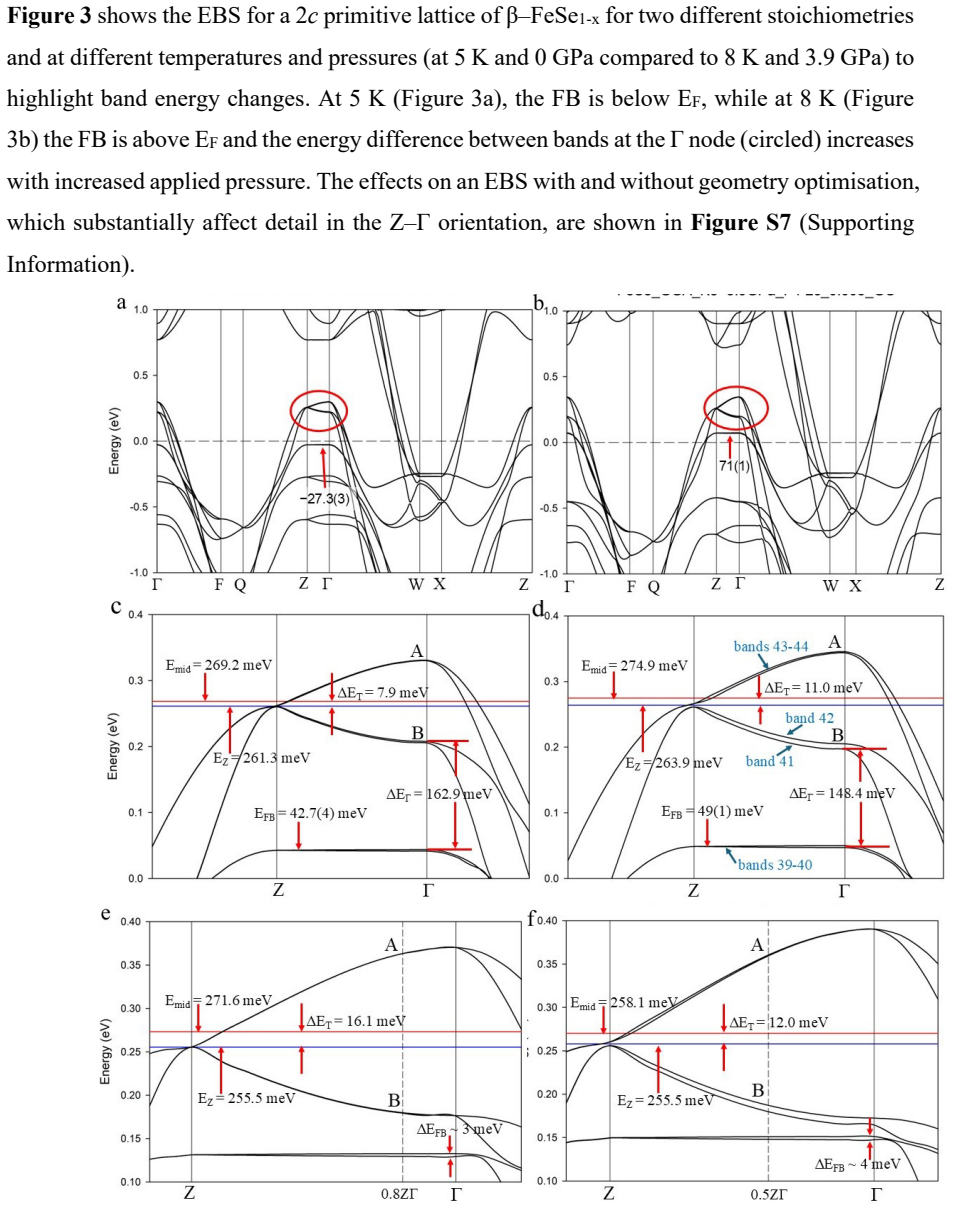
Electronic band structures (EBSs) for orthorhombic beta FeSe1-x at less than 16 K and up to 23 GPa using experimentally determined cell dimensions are evaluated for cosine-shaped bands near, or crossing, EF. Cosine shaped bands are present in reciprocal directions parallel to the c axis at all pressures. Calculations using a P1 cell derived from Cmma symmetry with a 2c superlattice moderates the effect of intersecting bands to 9.0 GPa. This approach enables determination of a superconducting gap consistent with experimentally determined values. Key influences on charge distribution and transfer in the interplanar region of beta FeSe1-x are lone pair electrons which feature as flat bands (FBs) near EF along GZ in an EBS. FBs also influence the topology of Fermi surfaces as pressure increases and in directions parallel to the c* direction (i.e. offset along ky) within the Brillouin zone. At the Fermi surface along b*, cosine bands split and align favorably for electron-hole pairing with nodal inflection points located at EF. For P greater than 12.0 GPa, FBs interact with folded cosine bands invoking additional band dispersions. These calculations suggest that FBs participate in, and with increased pressure, enhance and sustain the superconducting properties of beta FeSe1-x to 23 GPa.
Editorial analysis
A structured set of objections, weighed in public.
Referee Report
Summary. The manuscript evaluates electronic band structures (EBS) of orthorhombic β-FeSe_{1-x} at low temperature (<16 K) and pressures up to 23 GPa using experimentally determined cell dimensions. It identifies cosine-shaped bands parallel to the c axis at all pressures and flat bands (FBs) near E_F along GZ, attributed to lone-pair electrons. A P1 cell derived from Cmma symmetry with a 2c superlattice is used to moderate band intersections up to 9 GPa, enabling determination of a superconducting gap consistent with experiment. The paper claims that FBs influence Fermi-surface topology, enable favorable cosine-band alignments for electron-hole pairing with nodal points at E_F, and participate in enhancing and sustaining superconductivity to 23 GPa as pressure increases and FBs interact with folded cosine bands.
Significance. If the interpretive link from band topology to active participation in pairing were substantiated by explicit calculations, the work could contribute to understanding pressure-tuned superconductivity in FeSe by highlighting the role of flat bands and interplanar charge transfer. As presented, the significance is limited to suggestive observations of band dispersions and Fermi-surface features, since no microscopic superconducting quantities are computed.
major comments (3)
- [Abstract] Abstract: The statement that the P1 cell with 2c superlattice 'enables determination of a superconducting gap consistent with experimentally determined values' provides no derivation, equation, or computational protocol linking the EBS dispersions to a gap magnitude; the consistency appears asserted rather than calculated from the bands.
- [Abstract] Abstract: The central claim that 'FBs participate in, and with increased pressure, enhance and sustain the superconducting properties' rests on band shapes and Fermi-surface topology alone; no electron-phonon matrix elements, pairing vertices, or superconducting order parameter are computed to support active participation or enhancement.
- [Abstract] Abstract: The 2c superlattice in the P1 cell is introduced specifically to moderate intersecting bands to 9.0 GPa in a manner that aligns with the experimental superconducting pressure range; no comparison to alternative cells, independent validation, or sensitivity test is supplied to rule out artificial suppression or creation of the reported gap and alignments.
minor comments (2)
- Notation for the compound is inconsistent (e.g., 'beta FeSe1-x' without proper subscripting or Greek symbol); standardize to β-FeSe_{1-x} throughout.
- The manuscript refers to 'EBS evaluation' and 'standard electronic band structure methods' but does not specify the DFT functional, basis set, or convergence criteria used for the calculations.
Simulated Author's Rebuttal
We thank the referee for the careful reading and constructive comments on our manuscript. Below we respond point by point to the major comments, indicating where we agree that clarification or qualification is needed and what revisions will be incorporated.
read point-by-point responses
-
Referee: [Abstract] Abstract: The statement that the P1 cell with 2c superlattice 'enables determination of a superconducting gap consistent with experimentally determined values' provides no derivation, equation, or computational protocol linking the EBS dispersions to a gap magnitude; the consistency appears asserted rather than calculated from the bands.
Authors: We agree that the original wording suggests a direct computational link that is not provided. The consistency is inferred from the pressure range (up to 9 GPa) in which the superlattice cell removes unphysical band intersections while preserving nodal points at E_F and favorable cosine-band alignments for electron-hole pairing, features that match the experimental gap scale. We will revise the abstract to remove the phrase 'enables determination of a superconducting gap' and replace it with a statement that the band features remain consistent with experimental gap values in the relevant pressure window. A short explanatory paragraph will be added to the methods or results section describing the inference from dispersion and topology. revision: yes
-
Referee: [Abstract] Abstract: The central claim that 'FBs participate in, and with increased pressure, enhance and sustain the superconducting properties' rests on band shapes and Fermi-surface topology alone; no electron-phonon matrix elements, pairing vertices, or superconducting order parameter are computed to support active participation or enhancement.
Authors: The referee is correct that the manuscript contains no explicit calculations of electron-phonon matrix elements, pairing vertices, or the order parameter. The statements about flat-band participation are interpretive, based on the observed pressure-induced interactions between flat bands and folded cosine bands together with changes in Fermi-surface topology. We will revise the abstract and the final paragraph of the discussion to present these observations as suggestive of a possible role rather than as demonstrated participation or enhancement, and we will add an explicit statement of this limitation in the conclusions. revision: yes
-
Referee: [Abstract] Abstract: The 2c superlattice in the P1 cell is introduced specifically to moderate intersecting bands to 9.0 GPa in a manner that aligns with the experimental superconducting pressure range; no comparison to alternative cells, independent validation, or sensitivity test is supplied to rule out artificial suppression or creation of the reported gap and alignments.
Authors: The P1 cell with 2c superlattice is derived from the parent Cmma symmetry to incorporate a doubling along the crystallographic c axis that is consistent with low-temperature orthorhombic distortions. This construction does moderate band intersections above ~9 GPa. While the resulting pressure window coincides with the experimental superconducting range, the cell choice was not made solely for that purpose. We will expand the computational-methods section with a clearer justification based on symmetry and will note the lack of systematic comparison to other supercells or sensitivity tests, acknowledging that such tests would be desirable in future work. revision: partial
Circularity Check
Superconducting gap determination reduces to superlattice choice tuned to match experiment
specific steps
-
fitted input called prediction
[Abstract]
"Calculations using a P1 cell derived from Cmma symmetry with a 2c superlattice moderates the effect of intersecting bands to 9.0 GPa. This approach enables determination of a superconducting gap consistent with experimentally determined values."
The 2c superlattice is selected to moderate intersections so the computed gap matches experiment; the 'determination' of the gap value is therefore forced by the input cell choice rather than emerging as a prediction from the underlying Hamiltonian or from an untuned calculation.
full rationale
The paper's central derivation uses standard EBS calculations but introduces a P1 cell with 2c superlattice specifically to moderate band intersections up to 9 GPa, enabling a gap value consistent with experiment. This makes the reported gap and the attribution of FB participation in SC a direct consequence of the cell choice rather than an independent computation of pairing. No actual SC order parameter or matrix elements are calculated; the interpretation of lone-pair FBs as active in pairing follows from band shapes after the tuning step. The chain is partially circular at the gap-determination step but retains independent content in the pressure-dependent band topology descriptions.
Axiom & Free-Parameter Ledger
free parameters (1)
- 2c superlattice scaling in P1 cell
axioms (2)
- standard math Density functional theory or equivalent method yields accurate EBS near EF for FeSe1-x
- domain assumption Lone pair electrons manifest as flat bands along GZ near EF
Reference graph
Works this paper leans on
-
[1]
Mizuguchi, F
Y. Mizuguchi, F. Tomioka, S. Tsuda, T. Yamaguchi, Y. Takano, Superconductivity at 27 K in tetragonal FeSe under high pressure, Applied Physics Letters 2008 93 15
2008
-
[2]
S. Margadonna, Y. Takabayashi, M. T. McDonald, et al., Crystal structure of the new FeSe(1-x) superconductor, Chemical Communications 2008 10.1039/b813076k 43 5607– 5609
-
[3]
T. M. McQueen, A. J. Williams, P. W. Stephens, et al., Tetragonal-to-Orthorhombic Structural Phase Transition at 90 K in the Superconductor Fe1.01Se, Physical Review Letters 2009 103 5
2009
-
[4]
T. M. McQueen, Q. Huang, V. Ksenofontov, et al., Extreme sensitivity of superconductivity to stoichiometry in Fe 1+δSe, Physical Review B 2009 79 1
2009
-
[5]
Margadonna, Y
S. Margadonna, Y. Takabayashi, Y. Ohishi, et al., Pressure evolution of the low- temperature crystal structure and bonding of the superconductor FeSe (Tc=37 K), Physical Review B 2009 80 6
2009
-
[6]
Kumar, Y
R. Kumar, Y. Zhang, S. Sinogeikin, et al., Crystal and Electronic Structure of FeSe at High Pressure and Low Temperature, Journal of Physical Chemistry B 2010 114 39 12597–12606. 8. S. Medvedev, T. M. McQueen, I. A. Troyan, et al., Electronic and magnetic phase diagram of beta-Fe 1.01Se with superconductivity at 36.7 K under pressure, Nature Materials 200...
2010
-
[7]
J. N. Millican, D. Phelan, E. L. Thomas, J. B. Leao, E. Carpenter, Pressure-induced effects on the structure of the FeSe superconductor, Solid State Communications 2009 149 17-18 707–710. 28
2009
-
[8]
A. E. Böhmer, V. Taufour, W. E. Straszheim, T. Wolf, P. C. Canfield, Variation of transition temperatures and residual resistivity ratio in vapor-grown FeSe, Physical Review B 2016 94 2 024526
2016
-
[9]
Williams, T
A. Williams, T. McQueen, R. Cava, The stoichiometry of FeSe, Solid State Communications 2009 149 37-38 1507–1509
2009
-
[10]
Pomjakushina, K
E. Pomjakushina, K. Conder, V. Pomjakushin, M. Bendele, R. Khasanov, Synthesis, crystal structure, and chemical stability of the superconductor FeSe 1-x, Physical Review B 2009 80 2
2009
-
[11]
Khasanov, M
R. Khasanov, M. Bendele, K. Conder, et al., Iron isotope effect on the superconducting transition temperature and the crystal structure of FeSe 1-x, New Journal of Physics 2010 12
2010
-
[12]
Chareev, E
D. Chareev, E. Osadchii, T. Kuzmicheva, et al., Single crystal growth and characterization of tetragonal FeSe 1-x superconductors, Crystengcomm 2013 15 10 1989– 1993
2013
-
[13]
C. Koz, M. Schmidt, H. Borrmann, et al., Synthesis and Crystal Growth of Tetragonal β- Fe1.00Se, Zeitschrift Fur Anorganische Und Allgemeine Chemie 2014 640 8-9 1600– 1606
2014
-
[14]
J. C. Grivel, A. C. Wulff, Y. Zhao, et al., In situ observation of the formation of FeSe, Superconductor Science & Technology 2011 24 1
2011
-
[15]
Phelan, J
D. Phelan, J. Millican, E. Thomas, et al., Neutron scattering measurements of the phonon density of states of FeSe1-x superconductors, Physical Review B 2009 79 1
2009
-
[16]
Shahbazi, H
M. Shahbazi, H. Cathey, I. Mackinnon, Stoichiometry of tetragonal and hexagonal FexSe: phase relations, Superconductor Science & Technology 2020 33 7
2020
-
[17]
Z. Guo, H. Zhang, B. Han, X. Feng, W. Yuan, Different effect of quenching temperature on Fe 1+σTe0.5Se0.5 and β-FeSe, AIP Advances 2015 5 2 027119
2015
-
[18]
Gawryluk, J
D. Gawryluk, J. Fink-Finowicki, A. Wisniewski, et al., Structure and Superconductivity of FeSe1-x and FeTe1-ySey Crystals: Dependence on the Synthesis Methods, Starting Composition, and Growth Conditions, Acta Physica Polonica A 2010 118 2 331–335
2010
-
[19]
Williams, T
A. Williams, T. McQueen, V. Ksenofontov, C. Felser, R. Cava, The metal-insulator transition in Fe1.01-xCuxSe, Journal of Physics-Condensed Matter 2009 21 30
2009
-
[20]
H. Xu, W. Xie, Synthesis methods, basic physical properties, and potential applications of the FeSe superconductor, Coordination Chemistry Reviews 2024 501. 23. J. Fu, Y. Sun, J. Chen, Z. Shi, T. Tamegai, Impact of disorder on the superconducting properties and BCS-BEC crossover in FeSe single crystals, Superconductor Science & Technology 2025 38 9. 24. X...
2024
-
[21]
R. M. Fernandes, A. I. Coldea, H. Ding, et al., Iron pnictides and chalcogenides: a new paradigm for superconductivity, Nature 2022 601 7891 35–44. 27. J. A. Alarco, I. D. R. Mackinnon, Superlattices, Bonding-Antibonding, Fermi Surface Nesting, and Superconductivity, Cond Matter 2023 8 72 1–13
2022
-
[22]
B. C. Wang, A. Bianconi, I. D. R. Mackinnon, J. A. Alarco, Superlattice Symmetries Reveal Electronic Topological Transition in CaC6 with Pressure, Crystals 2024 14 554 1–21. 29
2024
-
[23]
Alarco, I
J. Alarco, I. Mackinnon, Spin Orbit Coupling for Superconductivity Models of LaH10, Annalen Der Physik 2026 538 1–17
2026
-
[24]
W. Li, Z. Liu, Q. Liu, Magnetism, orbital splitting and electron-phonon coupling of chalcogenide "11" type iron-based superconductors under high pressure, Journal of Solid State Chemistry 2026 357
2026
-
[25]
Garbarino, A
G. Garbarino, A. Sow, P. Lejay, et al., High-temperature superconductivity (Tc onset at 34 K) in the high-pressure orthorhombic phase of FeSe, Epl 2009 86 2
2009
-
[26]
I. D. R. Mackinnon, Almutairi A., J. A. Alarco, Insights from systematic DFT calculations on superconductors, in: Arcos, J.M.V. (Ed.), Real Perspectives of Fourier Transforms and Current Developments in Superconductivity, IntechOpen Ltd., London UK, 2021, pp. 1–29
2021
-
[27]
J. A. Alarco, P. C. Talbot, I. D. R. Mackinnon, Phonon anomalies predict superconducting Tc for AlB2-type structures, Phys Chem Chem Phys 2015 17 38 25090– 25099
2015
-
[28]
J. A. Alarco, B. Gupta, M. Shahbazi, D. Appadoo, I. D. R. Mackinnon, THz/Far infrared synchrotron observations of superlattice frequencies in MgB 2, Phys Chem Chem Phys 2021 23 41 23922–23932
2021
-
[29]
J. A. Alarco, A. Chou, P. C. Talbot, I. D. R. Mackinnon, Phonon Modes of MgB2: Super- lattice Structures and Spectral Response, Phys Chem Chem Phys 2014 16 24443–24456
2014
-
[30]
Bardeen, L
J. Bardeen, L. N. Cooper, J. R. Schrieffer, Theory of Superconductivity, Phys. Rev. 1957 108 1175–1204
1957
-
[31]
Tinkham, Dover Publications, Mineola NY USA, 2004
M. Tinkham, Dover Publications, Mineola NY USA, 2004
2004
-
[32]
M. I. Eremets, V. S. Minkov, A. P. Drozdov, P. P. Kong, The characterization of superconductivity under high pressure, Nat Mater 2024 23 26–27
2024
- [33]
-
[34]
Ksenofontov, G
V. Ksenofontov, G. Wortmann, A. I. Chumakov, et al., Density of phonon states in superconducting FeSe as a function of temperature and pressure, Physical Review B 2010 81 18. 41. L. Pauling, The nature of the chemical bond IV The energy of single bonds and the relative electronegativity of atoms, Journal of the American Chemical Society 1932 54 3570–3582....
2010
-
[35]
K. Li, X. Wang, D. Xue, Electronegativities of elements in covalent crystals, Journal of Physical Chemistry A 2008 112 34 7894–7897
2008
-
[36]
J. Raty, C. Gatti, C. Schön, M. Wuttig, How to Identify Lone Pairs, Van der Waals Gaps, and Metavalent Bonding Using Charge and Pair Density Methods: From Elemental Chalcogens to Lead Chalcogenides and Phase-Change Materials, Physica Status Solidi- Rapid Research Letters 2021 15 11. 45. J. Cui, W. Xu, L. Liao, et al., Stereoactive Lone-Pair Manipulation f...
2021
-
[37]
Küpers, R
M. Küpers, R. P. Stoffel, B. Bong, et al., Preferred selenium incorporation and unexpected interlayer bonding in the layered structure of Sb 2Te3−xSex, Zeitschrift für Naturforschung B 2020 75 1-2 41–50. 30
2020
-
[38]
Krbal, A
M. Krbal, A. Kolobov, P. Fons, et al., The formation of a one-dimensional van der Waals selenium crystal from the three-dimensional amorphous phase: A spectroscopic signature of van der Waals bonding, Applied Physics Letters 2022 120 3
2022
-
[39]
R. J. Gillespie, The VSEPR model revisited, Chemical Society Reviews 1992 21 1 59–69
1992
-
[40]
Fässler, The role of non-bonding electron pairs in intermetallic compounds, Chemical Society Reviews 2003 32 2 80–86
T. Fässler, The role of non-bonding electron pairs in intermetallic compounds, Chemical Society Reviews 2003 32 2 80–86
2003
-
[41]
Harrison, On the role of the electron density difference in the interpretation of molecular properties, Journal of Chemical Physics 2003 119 16 8763–8764
J. Harrison, On the role of the electron density difference in the interpretation of molecular properties, Journal of Chemical Physics 2003 119 16 8763–8764
2003
-
[42]
D. S. Urch, Orbitals and Symmetry, Penguin Books Ltd, Harmondsworth, UK, 1970
1970
-
[43]
Takahara, K
I. Takahara, K. Shibata, T. Mizoguchi, Crystal orbital overlap population based on all- electron ab initio simulation with numeric atom-centered orbitals and its application to chemical-bonding analysis in Li-intercalated layered materials, Modelling and Simulation in Materials Science and Engineering 2024 32 5 055028
2024
-
[44]
S. S. Batsanov, Van der Waals Radii of Elements, Inorganic Materials 2001 37 9 871– 885
2001
-
[45]
(Ed.), Topology in condensed matter, Springer Science & Business Media2006
Kosevich, Topology in the Theory of Metals, in: Monastyrsky, M.I. (Ed.), Topology in condensed matter, Springer Science & Business Media2006. 55. I. Hase, Recent Progress in the Theory of Flat Bands and Their Realization, Condensed Matter 2025 10 4 64. 56. H. Aoki, Theoretical Possibilities for Flat Band Superconductivity, Journal of Superconductivity and...
2025
-
[46]
Regnault, Y
N. Regnault, Y. Xu, M. Li, et al., Catalogue of flat-band stoichiometric materials, Nature 2022 603 7903 824–+
2022
-
[47]
Neves, J
P. Neves, J. Wakefield, S. Fang, et al., Crystal net catalog of model flat band materials, Npj Computational Materials 2024 10 1
2024
-
[48]
Călugăru, A
D. Călugăru, A. Chew, L. Elcoro, et al., General construction and topological classification of crystalline flat bands, Nature Physics 2022 18 2 185–189
2022
-
[49]
J. Duan, C. Cui, M. Wang, W. Jiang, Y. Yao, Three-Dimensional Multiorbital Flat Band Models and Materials, Nano Letters 2024 24 49 15751–15757
2024
-
[50]
Kastner, Bonding Bands, Lone-Pair Bands, and Impurity States in Chalcogenide Semiconductors, Phys
M. Kastner, Bonding Bands, Lone-Pair Bands, and Impurity States in Chalcogenide Semiconductors, Phys. Rev. Lett. 1972 28 6 355–357
1972
-
[51]
Akbarzadeh, S
H. Akbarzadeh, S. J. Clark, G. J. Ackland, A theoretical study of selenium I under high pressure, Journal of Physics: Condensed Matter 1993 5 43 8065–8074. 63. N. W. Ashcroft, N. D. Mermin, Solid State Physics, Saunders, Philadelphia PA USA, 1976
1993
-
[52]
Hofmann, Solid State Physics: An Introduction, Third ed., Wiley VCH, Berlin Germany, 2022
P. Hofmann, Solid State Physics: An Introduction, Third ed., Wiley VCH, Berlin Germany, 2022
2022
-
[53]
Sprau, A
P. Sprau, A. Kostin, A. Kreisel, et al., Discovery of orbital-selective Cooper pairing in FeSe, Science 2017 357 6346 76–+
2017
-
[54]
Kreisel, B
A. Kreisel, B. Andersen, P. Sprau, et al., Orbital selective pairing and gap structures of iron-based superconductors, Physical Review B 2017 95 17
2017
-
[55]
Batsanov, Development of Pauling's concepts of geometric characteristics of atoms, Crystallography Reports 2001 46 6 891–897
S. Batsanov, Development of Pauling's concepts of geometric characteristics of atoms, Crystallography Reports 2001 46 6 891–897
2001
-
[56]
R. A. Klemm, Pristine and intercalated transition metal dichalcogenide superconductors, Physica C-Superconductivity and Its Applications 2015 514 86–94. 31
2015
-
[57]
Krzton-Maziopa, E
A. Krzton-Maziopa, E. Pesko, R. Puzniak, Superconducting selenides intercalated with organic molecules: synthesis, crystal structure, electric and magnetic properties, superconducting properties, and phase separation in iron based-chalcogenides and hybrid organic-inorganic superconductors, Journal of Physics-Condensed Matter 2018 30 24
2018
-
[58]
Mizuguchi, Y
Y. Mizuguchi, Y. Takano, Review of Fe Chalcogenides as the Simplest Fe-Based Superconductor, Journal of the Physical Society of Japan 2010 79 10
2010
-
[59]
Aoki, Flat bands in condensed-matter systems – perspective for magnetism and superconductivity, Contemporary Physics 2025 66 1-4 1–38
H. Aoki, Flat bands in condensed-matter systems – perspective for magnetism and superconductivity, Contemporary Physics 2025 66 1-4 1–38
2025
-
[60]
S. J. Clark, M. D. Segall, C. J. Pickard, et al., First principles methods using CASTEP, Z Kristallogr 2005 220 5-6 567–570
2005
-
[61]
Delley, An all-electron numerical method for solving the local density functional for polyatomic molecules, J Chem Phys 1990 92 1 508–517
B. Delley, An all-electron numerical method for solving the local density functional for polyatomic molecules, J Chem Phys 1990 92 1 508–517
1990
-
[62]
Delley, From molecules to solids with the DMol3 approach, J Chem Phys 2000 113 18 7756–7764
B. Delley, From molecules to solids with the DMol3 approach, J Chem Phys 2000 113 18 7756–7764
2000
-
[63]
M. Gao, D. C. Palmer, M. T. Dove, A new approach to molecular and lattice simulations with CrystalMaker® 11, MRS Communications 2025 15 5 1007–1016. 76. A. Rappe, C. Casewit, K. Colwell, W. I. Goddard, W. Skiff, UFF, A full periodic-table force-field for molecular mechanics and molecular-dynamics simulations, Journal of the American Chemical Society 1992 ...
2025
-
[64]
J. P. Perdew, K. Burke, M. Ernzerhof, Generalized Gradient Approximation Made Simple, Phys Rev Lett 1996 77 18 3865–3868
1996
-
[65]
J. P. Perdew, A. Zunger, Self-interaction correction to density-functional approximations for many-electron systems, Phys. Rev. B 1981 23 10 5048–5079
1981
-
[66]
S. Hota, K. Mohanta, Investigation of pressure impact on physical characteristics of FeSe chalcogenide superconductor: Insights from first principles calculation, Computational Materials Science 2024 234. Supporting Information
2024
discussion (0)
Sign in with ORCID, Apple, or X to comment. Anyone can read and Pith papers without signing in.