Recognition: unknown
Understanding and Improving Automated Proof Synthesis for Interactive Theorem Provers
Pith reviewed 2026-05-07 17:46 UTC · model grok-4.3
The pith
Guiding proof search with human expert tactic patterns lets tools prove 8 percent more theorems.
A machine-rendered reading of the paper's core claim, the machinery that carries it, and where it could break.
Core claim
Tactic selections that conform to human expert proof patterns succeed more often than those chosen by purely statistical search. By adding a heuristic that prefers such patterns, the pattern-guided tactic search method improves existing proof synthesis tools without retraining their models.
What carries the argument
Pattern-guided tactic search (PGTS), a heuristic that reorders or filters candidate tactics during search to favor sequences matching observed human expert patterns from proof corpora.
If this is right
- Existing proof synthesizers can be improved by adding the guidance layer without retraining their neural models.
- A measurable fraction of previously unprovable theorems become reachable, raising coverage by roughly one-fifth.
- Generated proofs for complex theorems become shorter and more readable.
- The approach scales to harder statements where pure search currently fails.
Where Pith is reading between the lines
- The finding implies that explicit structural knowledge from human proofs can usefully complement statistical learning in automated reasoning.
- Similar pattern guidance might improve other search-based tasks such as program synthesis or hardware verification.
- If the human patterns prove stable across corpora, future tools could learn or mine them automatically instead of using a fixed heuristic.
Load-bearing premise
The measured gains come specifically from directing search toward human expert patterns rather than from other implementation details or the choice of test theorems.
What would settle it
Applying the same PGTS heuristic to a fresh set of theorems or a different base proof synthesizer and finding no average increase (or a decrease) in proved theorems would falsify the central claim.
Figures




read the original abstract
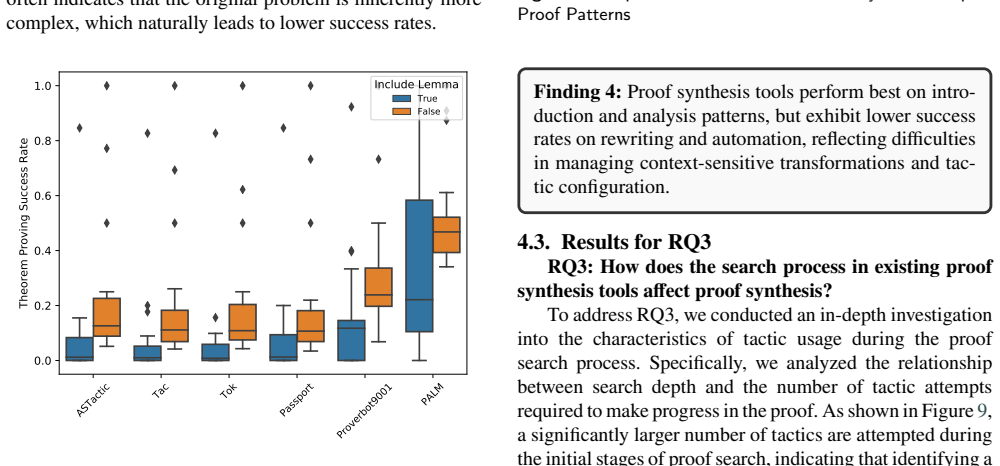
Formal verification using interactive theorem provers ensures high-quality software. However, writing proof scripts for interactive theorem provers is labor-intensive and requires deep expertise. Recent studies have leveraged deep learning to automate theorem proving by learning from manually written proof corpora. Nevertheless, these techniques still achieve limited success rates in proof synthesis. This paper investigates the theorems that current proof synthesis techniques are unable to prove and analyzes their characteristics. Through an in-depth analysis of the proven theorems, proof scripts, and the proof search process, we identify the limitations of existing tools and summarize the key factors influencing proof success rates. Our research provides valuable insights for the future optimization of automated proof tools. Based on our empirical study, we discover that tactic selections conforming to human expert proof patterns are more likely to lead to successful proofs. Inspired by this finding, we propose a pattern-guided tactic search (PGTS) method to heuristically enhance the search process of existing proof synthesis tools. Our evaluation experiments demonstrate that PGTS improves the number of theorems proved by existing proof synthesis tools by an average of 8.05\%, while also achieving an average 20\% increase in previously unproven theorems. Furthermore, PGTS enhances the capability of proof synthesis tools to prove complex theorems and generates more concise proof scripts.
Editorial analysis
A structured set of objections, weighed in public.
Referee Report
Summary. The paper analyzes limitations of existing deep learning-based proof synthesis tools for interactive theorem provers by examining unproven theorems, proof scripts, and search processes. It identifies that tactic selections conforming to human expert proof patterns are more likely to succeed, proposes a Pattern-Guided Tactic Search (PGTS) heuristic to enhance existing tools, and reports that PGTS yields an average 8.05% increase in proved theorems plus a 20% increase in previously unproven theorems, while also improving performance on complex theorems and producing more concise proofs.
Significance. If the empirical claims hold under detailed scrutiny, the work's analysis of proof patterns offers a useful lens for tool improvement in automated formal verification. The identification of human-pattern alignment as a success factor could guide future heuristics even if the specific PGTS gains require further validation.
major comments (2)
- [Abstract and Evaluation section] Abstract and Evaluation section: The central quantitative claims—an average 8.05% improvement in theorems proved and 20% more previously unproven theorems—are stated without any description of the underlying dataset(s), the specific interactive theorem prover, the baseline proof synthesis tools, the total number of theorems, the number of experimental runs, or any statistical tests. This absence prevents verification of the reported gains and their attribution to PGTS.
- [Section on PGTS proposal and evaluation] Section on PGTS proposal and evaluation: The claim that gains arise specifically from guiding toward human expert proof patterns is not supported by an ablation that disables only the pattern heuristic while holding search budget, infrastructure, and other implementation details fixed. Without such isolation, the improvements cannot be confidently attributed to the identified patterns rather than incidental changes in the overall procedure.
minor comments (2)
- [Introduction] The manuscript should define 'human expert proof patterns' and 'pattern-guided tactic search' with concrete examples in the early sections to improve accessibility.
- [Evaluation] Any tables or figures presenting success rates should include standard deviations or confidence intervals and clearly label all baselines and metrics.
Simulated Author's Rebuttal
We thank the referee for the constructive comments. We address each major point below and will incorporate revisions to improve clarity and rigor.
read point-by-point responses
-
Referee: [Abstract and Evaluation section] Abstract and Evaluation section: The central quantitative claims—an average 8.05% improvement in theorems proved and 20% more previously unproven theorems—are stated without any description of the underlying dataset(s), the specific interactive theorem prover, the baseline proof synthesis tools, the total number of theorems, the number of experimental runs, or any statistical tests. This absence prevents verification of the reported gains and their attribution to PGTS.
Authors: The Evaluation section of the manuscript provides the dataset details, the interactive theorem prover, baseline tools, theorem counts, run numbers, and experimental protocol. However, we agree the abstract should be self-contained. We will revise the abstract to briefly state the experimental setup, including the prover, dataset size, baselines, number of theorems, runs performed, and any statistical tests. This will facilitate verification without altering the reported results. revision: yes
-
Referee: [Section on PGTS proposal and evaluation] Section on PGTS proposal and evaluation: The claim that gains arise specifically from guiding toward human expert proof patterns is not supported by an ablation that disables only the pattern heuristic while holding search budget, infrastructure, and other implementation details fixed. Without such isolation, the improvements cannot be confidently attributed to the identified patterns rather than incidental changes in the overall procedure.
Authors: We acknowledge that the current evaluation compares PGTS-augmented tools against unmodified baselines but does not isolate the pattern heuristic via a controlled ablation that holds search budget, infrastructure, and all other factors fixed. To strengthen attribution of gains specifically to the human-pattern guidance, we will add such an ablation study to the revised manuscript. revision: yes
Circularity Check
No circularity in empirical analysis and heuristic evaluation
full rationale
The paper conducts an independent empirical analysis of proof scripts, search processes, and unproven theorems to identify human-expert pattern correlations, then implements PGTS as a heuristic inspired by that observation and measures success-rate gains directly against baselines. No equations, self-definitions, fitted parameters presented as predictions, or load-bearing self-citations appear in the derivation; the reported 8.05% and 20% improvements are external experimental outcomes, not reductions to the input analysis.
Axiom & Free-Parameter Ledger
Reference graph
Works this paper leans on
-
[1]
Reliability in software-intensive systems: challenges, solutions, and future perspectives
Francisco Henrique Ferreira, Elisa Yumi Nakagawa, and Ro- drigo Pereira dos Santos. Reliability in software-intensive systems: challenges, solutions, and future perspectives. In2021 47th Euromi- cro Conference on Software Engineering and Advanced Applications (SEAA), pages 54–61. IEEE, 2021
2021
-
[2]
Towards an understanding of reliability of software-intensive systems-of-systems.Information and Software Technology, 158:107186, 2023
Francisco Henrique Cerdeira Ferreira, Elisa Yumi Nakagawa, and Rodrigo Pereira dos Santos. Towards an understanding of reliability of software-intensive systems-of-systems.Information and Software Technology, 158:107186, 2023
2023
-
[3]
Software reliability engineering: A roadmap
Michael R Lyu. Software reliability engineering: A roadmap. In Future of Software Engineering (FOSE’07) , pages 153–170. IEEE, 2007
2007
-
[4]
Software reliability assessment with OR applications , volume 364
PK Kapur, Hoang Pham, Anshu Gupta, PC Jha, et al. Software reliability assessment with OR applications , volume 364. Springer, 2011
2011
-
[5]
sel4: Formal verification of an os kernel
Gerwin Klein, Kevin Elphinstone, Gernot Heiser, June Andronick, David Cock, Philip Derrin, Dhammika Elkaduwe, Kai Engelhardt, Rafal Kolanski, Michael Norrish, et al. sel4: Formal verification of an os kernel. InProceedings of the ACM SIGOPS 22nd symposium on Operating systems principles, pages 207–220, 2009
2009
-
[6]
Formal verification of a realistic compiler.Communi- cations of the ACM, 52(7):107–115, 2009
Xavier Leroy. Formal verification of a realistic compiler.Communi- cations of the ACM, 52(7):107–115, 2009
2009
-
[7]
Productivity for proof engineering
Mark Staples, Ross Jeffery, June Andronick, Toby Murray, Gerwin Klein, and Rafal Kolanski. Productivity for proof engineering. In Proceedings of the 8th ACM/IEEE International Symposium on Empirical Software Engineering and Measurement,pages1–4,2014
2014
-
[8]
A survey of formal verification approaches for practical systems
Qiao Zhang, Danyang Zhuo, and James Wilcox. A survey of formal verification approaches for practical systems
-
[9]
InERTS 2016: Embedded Real Time Software and Systems, 8th European Congress, 2016
Xavier Leroy, Sandrine Blazy, Daniel Kästner, Bernhard Schommer, MarkusPister,andChristianFerdinand.Compcert-aformallyverified optimizing compiler. InERTS 2016: Embedded Real Time Software and Systems, 8th European Congress, 2016
2016
-
[10]
Formalverificationof a constant-time preserving c compiler.Proceedings of the ACM on Programming Languages, 4(POPL):1–30, 2019
GillesBarthe,SandrineBlazy,BenjaminGrégoire,RémiHutin,Vin- centLaporte,DavidPichardie,andAlixTrieu. Formalverificationof a constant-time preserving c compiler.Proceedings of the ACM on Programming Languages, 4(POPL):1–30, 2019
2019
-
[11]
understanding and improving automated proof synthesis for interactive theorem provers
Manqing Zhang, Lingru Zhou, Bingxu Xiao, Yunwei Dong, and Yepang Liu. Replication package for “understanding and improving automated proof synthesis for interactive theorem provers”.https: //github.com/zmqgeek/PGTS, 2025
2025
-
[12]
Learningtoprovetheoremsviainteracting with proof assistants
KaiyuYangandJiaDeng. Learningtoprovetheoremsviainteracting with proof assistants. In International Conference on Machine Learning, pages 6984–6994. PMLR, 2019
2019
-
[13]
Tactok: Semantics- aware proof synthesis
Emily First, Yuriy Brun, and Arjun Guha. Tactok: Semantics- aware proof synthesis. Proceedings of the ACM on Programming Languages, 4(OOPSLA):1–31, 2020
2020
-
[14]
Passport:Improvingautomatedformal verification using identifiers
Alex Sanchez-Stern, Emily First, Timothy Zhou, Zhanna Kaufman, YuriyBrun,andTaliaRinger. Passport:Improvingautomatedformal verification using identifiers. ACM Transactions on Programming Languages and Systems, 45(2):1–30, 2023
2023
-
[15]
Generating correctness proofs with neural networks
Alex Sanchez-Stern, Yousef Alhessi, Lawrence Saul, and Sorin Lerner. Generating correctness proofs with neural networks. In Proceedings of the 4th ACM SIGPLAN International Workshop on Machine Learning and Programming Languages, pages 1–10, 2020
2020
-
[16]
Proof au- tomation with large language models
Minghai Lu, Benjamin Delaware, and Tianyi Zhang. Proof au- tomation with large language models. In Proceedings of the 39th IEEE/ACM International Conference on Automated Software Engi- neering, pages 1509–1520, 2024
2024
-
[17]
Prefixspan: Mining sequential patterns efficiently by prefix-projected pattern growth
Jiawei Han, Jian Pei, Behzad Mortazavi-Asl, Helen Pinto, Qiming Chen, Umeshwar Dayal, and Meichun Hsu. Prefixspan: Mining sequential patterns efficiently by prefix-projected pattern growth. In proceedings of the 17th international conference on data engineering, pages 215–224. IEEE Piscataway, NJ, USA, 2001
2001
-
[18]
Mining sequentialpatternsbypattern-growth:Theprefixspanapproach
Jian Pei, Jiawei Han, Behzad Mortazavi-Asl, Jianyong Wang, Helen Pinto, Qiming Chen, Umeshwar Dayal, and Mei-Chun Hsu. Mining sequentialpatternsbypattern-growth:Theprefixspanapproach. IEEE Transactions on knowledge and data engineering,16(11):1424–1440, M. Zhang, L. Zhou, B. Xiao et al.:Preprint submitted to Elsevier Page 16 of 17 Journal of Systems and S...
2004
-
[19]
Miningcomparativesentencesfromsocialmedia text
FabíolaSFPereira. Miningcomparativesentencesfromsocialmedia text. In Workshop on interactions between data mining and natural language processing (DMNLP) co-located with European conference on machine learning and principles and practice of knowledge discov- ery in databases (ECML/PKDD), pages 41–48, 2015
2015
-
[20]
Diversity-driven automated formal verification
Emily First and Yuriy Brun. Diversity-driven automated formal verification. In Proceedings of the 44th International Conference on Software Engineering, pages 749–761, 2022
2022
-
[21]
Cobblestone: A Divide-and-Conquer Approach for Automating Formal Verification
Saketh Ram Kasibatla, Arpan Agarwal, Yuriy Brun, Sorin Lerner, Talia Ringer, and Emily First. Cobblestone: Iterative automation for formal verification.arXiv preprint arXiv:2410.19940, 2024
work page internal anchor Pith review Pith/arXiv arXiv 2024
-
[22]
Thor: Wielding hammers to integrate language mod- els and automated theorem provers.Advances in Neural Information Processing Systems, 35:8360–8373, 2022
Albert Qiaochu Jiang, Wenda Li, Szymon Tworkowski, Konrad Czechowski, Tomasz Odrzygóźdź, Piotr Miłoś, Yuhuai Wu, and Mateja Jamnik. Thor: Wielding hammers to integrate language mod- els and automated theorem provers.Advances in Neural Information Processing Systems, 35:8360–8373, 2022
2022
-
[23]
Three years of ex- perience with sledgehammer, a practical link between automatic and interactive theorem provers
Lawrence C Paulsson and Jasmin C Blanchette. Three years of ex- perience with sledgehammer, a practical link between automatic and interactive theorem provers. InProceedings of the 8th International Workshop on the Implementation of Logics (IWIL-2010), Yogyakarta, Indonesia. EPiC, volume 2, 2012
2010
-
[24]
Learning-assisted automated reasoning with flyspeck.Journal of Automated Reasoning , 53:173– 213, 2014
Cezary Kaliszyk and Josef Urban. Learning-assisted automated reasoning with flyspeck.Journal of Automated Reasoning , 53:173– 213, 2014
2014
-
[25]
Hammer for coq: Automation for dependent type theory.Journal of automated reasoning, 61:423– 453, 2018
Łukasz Czajka and Cezary Kaliszyk. Hammer for coq: Automation for dependent type theory.Journal of automated reasoning, 61:423– 453, 2018
2018
-
[26]
Baldur: Whole-proof generation and repair with large language models
Emily First, Markus N Rabe, Talia Ringer, and Yuriy Brun. Baldur: Whole-proof generation and repair with large language models. In Proceedings of the 31st ACM Joint European Software Engineering Conference and Symposium on the Foundations of Software Engineer- ing, pages 1229–1241, 2023
2023
-
[27]
Leandojo: Theorem proving with retrieval-augmented language models
KaiyuYang,AidanSwope,AlexGu,RahulChalamala,PeiyangSong, Shixing Yu, Saad Godil, Ryan J Prenger, and Animashree Anandku- mar. Leandojo: Theorem proving with retrieval-augmented language models. Advances in Neural Information Processing Systems , 36: 21573–21612, 2023
2023
-
[28]
Zhongxin Liu, Xin Xia, Ahmed E Hassan, David Lo, Zhenchang Xing, and Xinyu Wang. Neural-machine-translation-based commit message generation: how far are we? In Proceedings of the 33rd ACM/IEEE international conference on automated software engi- neering, pages 373–384, 2018
2018
-
[29]
Data quality matters:Acasestudyondatalabelcorrectnessforsecuritybugreport prediction
Xiaoxue Wu, Wei Zheng, Xin Xia, and David Lo. Data quality matters:Acasestudyondatalabelcorrectnessforsecuritybugreport prediction. IEEE Transactions on Software Engineering,48(7):2541– 2556, 2021
2021
-
[30]
Deep learning based vulnerability detection: Are we there yet? IEEE Transactions on Software Engineering,48(9):3280–3296,2021
Saikat Chakraborty, Rahul Krishna, Yangruibo Ding, and Baishakhi Ray. Deep learning based vulnerability detection: Are we there yet? IEEE Transactions on Software Engineering,48(9):3280–3296,2021
2021
-
[31]
What makes a good commit message? InProceedings of the 44th International Conference on Software Engineering,pages2389– 2401, 2022
Yingchen Tian, Yuxia Zhang, Klaas-Jan Stol, Lin Jiang, and Hui Liu. What makes a good commit message? InProceedings of the 44th International Conference on Software Engineering,pages2389– 2401, 2022
2022
-
[32]
Revisiting, benchmarking and exploring api recommendation: How far are we?IEEE Transactions on Software Engineering, 49(4):1876–1897, 2022
Yun Peng, Shuqing Li, Wenwei Gu, Yichen Li, Wenxuan Wang, Cuiyun Gao, and Michael R Lyu. Revisiting, benchmarking and exploring api recommendation: How far are we?IEEE Transactions on Software Engineering, 49(4):1876–1897, 2022
2022
-
[33]
Revisitinglearning- basedcommitmessagegeneration
JinhaoDong,YilingLou,DanHao,andLinTan. Revisitinglearning- basedcommitmessagegeneration. In 2023 IEEE/ACM 45th Interna- tional Conference on Software Engineering (ICSE) , pages 794–805. IEEE, 2023
2023
-
[34]
An empirical study of deep learning models for vulnerability detection
BenjaminSteenhoek,MdMahbuburRahman,RichardJiles,andWei Le. An empirical study of deep learning models for vulnerability detection. In 2023 IEEE/ACM 45th International Conference on Software Engineering (ICSE), pages 2237–2248. IEEE, 2023
2023
-
[35]
Automaticcommitmessagegeneration: A critical review and directions for future work.IEEE Transactions on Software Engineering, 50(4):816–835, 2024
Yuxia Zhang, Zhiqing Qiu, Klaas-Jan Stol, Wenhui Zhu, Jiaxin Zhu, YingchenTian,andHuiLiu. Automaticcommitmessagegeneration: A critical review and directions for future work.IEEE Transactions on Software Engineering, 50(4):816–835, 2024
2024
-
[36]
Learning-based models for vulnerability detection: An extensive study
Chao Ni, Liyu Shen, Xiaodan Xu, Xin Yin, and Shaohua Wang. Learning-based models for vulnerability detection: An extensive study. arXiv preprint arXiv:2408.07526, 2024. M. Zhang, L. Zhou, B. Xiao et al.:Preprint submitted to Elsevier Page 17 of 17
discussion (0)
Sign in with ORCID, Apple, or X to comment. Anyone can read and Pith papers without signing in.