Recognition: unknown
Practical lower bounds for hybrid quantum interior point methods in linear programming
Pith reviewed 2026-05-08 04:05 UTC · model grok-4.3
The pith
Hybrid quantum interior point methods do not provide practical advantages over classical solvers for linear programming.
A machine-rendered reading of the paper's core claim, the machinery that carries it, and where it could break.
Core claim
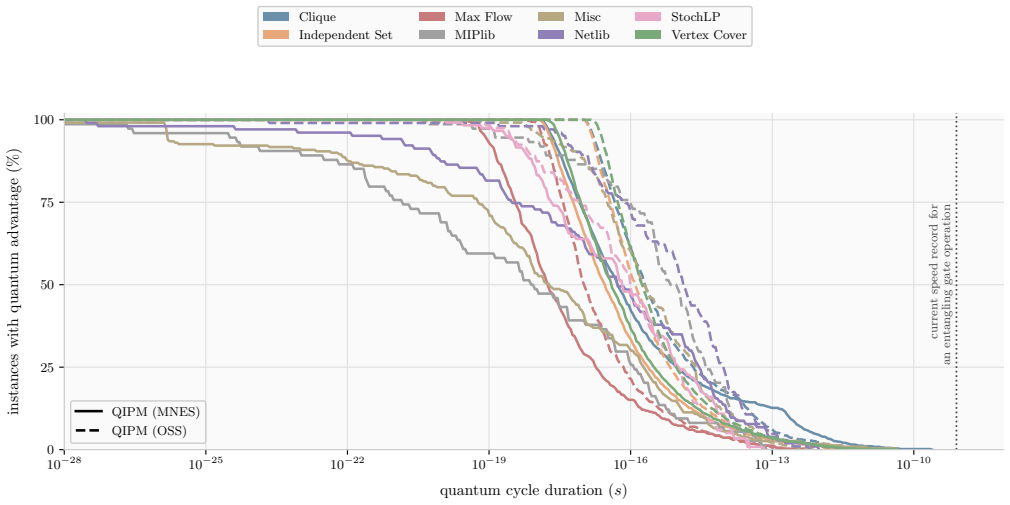
Equipping hybrid quantum interior point methods with a Chebyshev-based quantum linear solver and using either modified normal equation or orthogonal subspace formulations for the Newton systems leads to quantum runtime lower bounds that surpass classical solver runtimes on all instances tested from diverse linear programming families, regardless of the quantum cycle duration assumed.
What carries the argument
The exclusion analysis that produces rigorous lower bounds on quantum runtime from the complexity of the quantum linear solver, the dimensions of the linear systems, and the iteration count of the interior point method.
If this is right
- No practical advantage exists for these hybrid quantum interior point methods on realistic linear programming problems.
- The conclusion is independent of the specific Newton system formulation used.
- Significant improvements in quantum linear solver performance would be required to change the outcome.
- Broad testing on varied problem instances is needed to establish whether quantum methods can be useful in practice.
Where Pith is reading between the lines
- The discrepancy between theoretical asymptotic improvements and practical performance may apply to other hybrid quantum approaches for optimization tasks.
- Hardware improvements in quantum cycle times alone are unlikely to suffice without advances in algorithm design.
- Lower bound techniques of this type could be useful for screening other proposed quantum algorithms for practical relevance.
- Attention might shift toward developing fully quantum methods or different hybridizations for linear programming.
Load-bearing premise
That the quantum linear solver achieves close to its theoretical best-case performance with minimal overhead in the hybrid setting and that the Newton systems can be solved without extra costs beyond the linear system solves.
What would settle it
A measured runtime for the quantum component on a realistic linear programming instance that falls below the calculated lower bound, or a complete hybrid run that finishes faster than classical methods on such an instance.
Figures


read the original abstract
Quantum interior point methods (QIPMs) promise polynomial speed-ups over classical solvers for linear programming by outsourcing the solution of Newton linear systems to quantum linear solvers (QLSAs). However, asymptotic speed-ups do not necessarily translate to practical advantages on realistic problem instances. In this work, I evaluate whether practical advantage of a standard hybrid QIPM pipeline can already be excluded relative to the classical open-source solver HiGHS on a broad and diverse collection of LP instances spanning eight problem families, including public benchmark libraries, such as MIPlib, and relaxations of combinatorial optimisation problems. Following the hybrid benchmarking paradigm initiated by Cade et al., I derive rigorous lower bounds on the quantum runtime under a series of highly benevolent assumptions and compare them against classical runtimes. I equip the QIPMs with the best-performing functional QLSA, the Chebyshev-based method, as identified by Lefterovici et al., and evaluate two Newton system formulations proposed by Mohammadisiahroudi et al.: the modified normal equation system and the orthogonal subspace system. The exclusion analysis yields a consistent negative picture: across all instances and for any realistic quantum cycle duration, the quantum runtime lower bounds already exceed the classical runtimes, establishing that these hybrid QIPMs will offer no practical advantage over good classical solvers for realistic linear programming instances.
Editorial analysis
A structured set of objections, weighed in public.
Referee Report
Summary. The paper derives rigorous lower bounds on the total quantum runtime of hybrid QIPMs for linear programming, using the Chebyshev-based QLSA applied to the modified normal equation and orthogonal subspace Newton systems. These bounds are computed under a series of highly benevolent assumptions (including optimistic QLSA performance and hardware parameters) and compared against HiGHS runtimes on a broad collection of LP instances from eight families (including MIPLIB and combinatorial relaxations). The central claim is that the quantum lower bounds exceed classical runtimes for any realistic quantum cycle duration, excluding practical advantage for these hybrid methods on realistic instances.
Significance. If the lower-bound derivations hold under the stated assumptions, the work provides a concrete, instance-level exclusion result that bridges asymptotic quantum speed-up claims with practical benchmarking. It strengthens the hybrid benchmarking paradigm of Cade et al. by incorporating the best-performing functional QLSA and two specific Newton formulations, offering falsifiable predictions about when (or whether) such hybrids can compete with mature classical solvers.
major comments (2)
- [§4] §4 (QLSA precision and IPM convergence): The lower-bound derivation adopts a fixed or instance-independent precision tolerance ε for the Chebyshev QLSA (e.g., relative error 10^{-10} or similar). Standard IPM analyses require the Newton-step accuracy to scale at least as fast as the current barrier parameter μ or duality gap to preserve centrality and guarantee O(√n log(1/ε)) iterations; a fixed ε independent of iteration progress risks either non-convergence or the need for additional safeguards (adaptive precision or extra iterations), which would strictly increase the true quantum cost above the reported lower bound.
- [§3.2] §3.2 and Table 2 (quantum cycle duration and hardware assumptions): The exclusion holds 'for any realistic quantum cycle duration,' yet the manuscript does not provide a quantitative justification or sensitivity analysis for the threshold separating 'realistic' from 'unrealistic' cycle times (e.g., based on current or near-term superconducting or trapped-ion gate times). Because cycle duration is the sole free parameter, an explicit mapping from hardware literature to the chosen range is needed to make the 'no practical advantage' claim load-bearing.
minor comments (3)
- [§2.1] §2.1: The eight problem families are mentioned in the abstract but should be enumerated with explicit instance counts and sources in the main text for reproducibility.
- [Figure 3] Figure 3 (runtime comparison plots): Axis labels and legends should explicitly state the units (seconds) and the exact quantum cycle durations used in each curve.
- Reference list: The citation to Lefterovici et al. for the Chebyshev QLSA should include the arXiv identifier or full bibliographic details.
Simulated Author's Rebuttal
We thank the referee for the constructive and detailed comments. We address each major comment point by point below, providing clarifications and noting the revisions that will be incorporated.
read point-by-point responses
-
Referee: [§4] §4 (QLSA precision and IPM convergence): The lower-bound derivation adopts a fixed or instance-independent precision tolerance ε for the Chebyshev QLSA (e.g., relative error 10^{-10} or similar). Standard IPM analyses require the Newton-step accuracy to scale at least as fast as the current barrier parameter μ or duality gap to preserve centrality and guarantee O(√n log(1/ε)) iterations; a fixed ε independent of iteration progress risks either non-convergence or the need for additional safeguards (adaptive precision or extra iterations), which would strictly increase the true quantum cost above the reported lower bound.
Authors: We appreciate this observation on IPM convergence requirements. Our lower-bound analysis deliberately employs a fixed, conservative precision of 10^{-10} under the benevolent assumptions stated in the manuscript. This value is smaller than the accuracy needed in the final IPM iterations for the instances considered, and we assume convergence holds without extra iterations. If adaptive precision or additional safeguards prove necessary, the actual quantum runtime would exceed our reported lower bound, which would only strengthen the exclusion result. In the revised manuscript we will add a short clarifying paragraph in §4 explaining this choice and its implications for the lower-bound validity. revision: partial
-
Referee: [§3.2] §3.2 and Table 2 (quantum cycle duration and hardware assumptions): The exclusion holds 'for any realistic quantum cycle duration,' yet the manuscript does not provide a quantitative justification or sensitivity analysis for the threshold separating 'realistic' from 'unrealistic' cycle times (e.g., based on current or near-term superconducting or trapped-ion gate times). Because cycle duration is the sole free parameter, an explicit mapping from hardware literature to the chosen range is needed to make the 'no practical advantage' claim load-bearing.
Authors: We agree that an explicit mapping and sensitivity analysis would improve transparency. In the revised version we will expand §3.2 with a dedicated paragraph that (i) states the considered range of cycle durations (1 ns to 10 μs), (ii) provides a sensitivity plot or table showing how the exclusion threshold varies across this range, and (iii) cites recent hardware literature on superconducting-qubit and trapped-ion gate times to justify the 'realistic' regime. This will make the claim fully load-bearing without altering the core numerical results. revision: yes
Circularity Check
No significant circularity in derivation chain
full rationale
The paper derives lower bounds on quantum runtime for hybrid QIPMs from cited external QLSA performance (Chebyshev method) and hardware assumptions, then compares the resulting bounds directly against measured classical runtimes from the independent HiGHS solver across benchmark instances. No load-bearing step reduces the central claim to a self-definition, a fitted parameter renamed as prediction, or a self-citation chain; the cited works on benchmarking paradigms and Newton formulations are external and the comparison uses independent data sources. The exclusion result follows from this non-tautological comparison rather than construction from the target conclusion.
Axiom & Free-Parameter Ledger
free parameters (1)
- quantum cycle duration
axioms (1)
- domain assumption The Chebyshev-based QLSA and the two Newton system formulations achieve their stated asymptotic performance on the chosen instances.
Reference graph
Works this paper leans on
-
[1]
Realistic Runtime Analysis for Quantum Simplex Computation,
S. Ammann, M. Hess, D. Ramacciotti, S. P. Fekete, P. L. A. Goedicke et al., “Realistic Runtime Analysis for Quantum Simplex Computation,” 2023, [arXiv preprint arXiv:2311.09995]
-
[2]
Fast Quantum Subroutines for the Simplex Method,
G. Nannicini, “Fast Quantum Subroutines for the Simplex Method,” Oper. Res., vol. 72, no. 2, pp. 763–780, 2024. [Online]. Available: https://doi.org/10.1287/opre.2022.2341
-
[3]
End-To-End Resource Analysis for Quantum Interior-Point Methods and Portfolio Optimization,
A. M. Dalzell, B. D. Clader, G. Salton, M. Berta, C. Y . Linet al., “End-To-End Resource Analysis for Quantum Interior-Point Methods and Portfolio Optimization,”PRX Quantum, vol. 4, no. 4, p. 040325,
-
[4]
Available: https://doi.org/10.1103/prxquantum.4.040325
[Online]. Available: https://doi.org/10.1103/prxquantum.4.040325
-
[5]
Beyond Asymptotic Scaling: Comparing Functional Quantum Linear Solvers,
A. Lefterovici, M. Perk, D. Ramacciotti, A. F. Rotundo, S. E. Skelton et al., “Beyond Asymptotic Scaling: Comparing Functional Quantum Linear Solvers,”IEEE Trans. Quantum Eng., vol. 7, pp. 1–26, 2026. [Online]. Available: https://doi.org/10.1109/tqe.2026.3674210
-
[6]
Improvements to Quantum Interior Point Method for Linear Optimization,
M. Mohammadisiahroudi, Z. Wu, B. Augustino, A. Carr, and T. Terlaky, “Improvements to Quantum Interior Point Method for Linear Optimization,”ACM Trans. Quantum Comput., vol. 6, no. 1, pp. 1–24, 2025. [Online]. Available: https://doi.org/10.1145/3702244
-
[7]
M. Mohammadisiahroudi, R. Fakhimi, Z. Wu, and T. Terlaky, “An Inexact Feasible Interior Point Method for Linear Optimization with High Adaptability to Quantum Computers,”SIAM J. Optim., vol. 35, no. 4, pp. 2203–2233, 2025. [Online]. Available: https: //doi.org/10.1137/23m1589414
-
[8]
Quantifying Grover speed-ups beyond asymptotic analysis,
C. Cade, M. Folkertsma, I. Niesen, and J. Weggemans, “Quantifying Grover speed-ups beyond asymptotic analysis,” Quantum, vol. 7, p. 1133, 2023. [Online]. Available: https://doi.org/10.22331/q-2023-10-10-1133
-
[9]
G. B. Dantzig,Origins of the simplex method. Association for Computing Machinery, 1990, pp. 141–151. [Online]. Available: https://doi.org/10.1145/87252.88081
-
[10]
A new polynomial-time algorithm for linear programming,
N. Karmarkar, “A new polynomial-time algorithm for linear programming,”Combinatorica, vol. 4, no. 4, pp. 373–395, 1984. [Online]. Available: https://doi.org/10.1007/bf02579150
-
[11]
A Comparison of the Original and Revised Simplex Methods,
H. M. Wagner, “A Comparison of the Original and Revised Simplex Methods,”Oper. Res., vol. 5, no. 3, pp. 361–369, 1957. [Online]. Available: https://doi.org/10.1287/opre.5.3.361
-
[12]
The dual method of solving the linear programming problem,
C. E. Lemke, “The dual method of solving the linear programming problem,”Nav. Res. Logist. Q., vol. 1, no. 1, pp. 36–47, 1954. [Online]. Available: https://doi.org/10.1002/nav.3800010107
-
[13]
Parallelizing the Dual Revised Simplex Method
Q. Huangfu and J. A. J. Hall, “Parallelizing the dual revised simplex method,”Math. Program. Comput., vol. 10, no. 1, pp. 119–142, 2017. [Online]. Available: https://doi.org/10.1007/s12532-017-0130-5
-
[14]
A factorisation-based regularised interior point method using the augmented system,
F. Zanetti and J. Gondzio, “A factorisation-based regularised interior point method using the augmented system,” 2025, [arXiv preprint arXiv:2508.04370]
-
[15]
A polynomial-time algorithm, based on Newton's method, for linear programming
J. Renegar, “A polynomial-time algorithm, based on Newton’s method, for linear programming,”Math. Program., vol. 40-40, no. 1-3, pp. 59–93, 1988. [Online]. Available: https://doi.org/10.1007/bf01580724
-
[16]
S. Mehrotra, “On the Implementation of a Primal-Dual Interior Point Method,”SIAM J. Optim., vol. 2, no. 4, pp. 575–601, 1992. [Online]. Available: https://doi.org/10.1137/0802028
-
[17]
A Quantum Interior Point Method for LPs and SDPs,
I. Kerenidis and A. Prakash, “A Quantum Interior Point Method for LPs and SDPs,”ACM Trans. Quantum Comput., vol. 1, no. 1, pp. 1–32, 2020. [Online]. Available: https://doi.org/10.1145/3406306
-
[18]
A preconditioned inexact infeasible quantum interior point method for linear optimization,
Z. Wu, X. Yang, and T. Terlaky, “A preconditioned inexact infeasible quantum interior point method for linear optimization,”Comput. Optim. Appl., vol. 93, no. 3, pp. 1225–1257, 2025. [Online]. Available: https://doi.org/10.1007/s10589-025-00750-4
-
[19]
Signature of grav ity waves in the polarization of the mi- crowave background
A. W. Harrow, A. Hassidim, and S. Lloyd, “Quantum Algorithm for Linear Systems of Equations,”Phys. Rev. Lett., vol. 103, no. 15, p. 150502, 2009. [Online]. Available: https://doi.org/10.1103/physrevlett. 103.150502
-
[20]
Childs, Robin Kothari, and Rolando D
A. M. Childs, R. Kothari, and R. D. Somma, “Quantum Algorithm for Systems of Linear Equations with Exponentially Improved Dependence on Precision,”SIAM J. Comput., vol. 46, no. 6, pp. 1920–1950, 2017. [Online]. Available: https://doi.org/10.1137/16m1087072
-
[21]
A. Gilyén, Y . Su, G. H. Low, and N. Wiebe, “Quantum singular value transformation and beyond: exponential improvements for quantum matrix arithmetics,” inProceedings of the 51st Annual ACM SIGACT Symposium on Theory of Computing, 2019, pp. 193–204. [Online]. Available: https://doi.org/10.1145/3313276.3316366
-
[22]
Quantum algorithms for systems of linear equations inspired by adiabatic quantum computing,
Y . Suba¸ sı, R. D. Somma, and D. Orsucci, “Quantum Algorithms for Systems of Linear Equations Inspired by Adiabatic Quantum Computing,”Phys. Rev. Lett., vol. 122, no. 6, p. 060504, 2019. [Online]. Available: https://doi.org/10.1103/physrevlett.122.060504
-
[23]
Faster quantum and classical SDP approximations for quadratic binary optimization,
F. G.S L. Brandão, R. Kueng, and D. Stilck França, “Faster quantum and classical SDP approximations for quadratic binary optimization,”Quantum, vol. 6, p. 625, 2022. [Online]. Available: https://doi.org/10.22331/q-2022-01-20-625
-
[24]
F. Henze, V . Tran, B. Ostermann, R. Kueng, T. d. Wolffet al., “Solving quadratic binary optimization problems using quantum SDP methods: Non-asymptotic running time analysis,” 2025, [arXiv preprint arXiv:2502.15426]
-
[25]
C. Roos, T. Terlaky, and J. Vial,Interior Point Methods for Linear Optimization. New York: Springer, 2005. [Online]. Available: https://doi.org/10.1007/b100325
-
[26]
Towards understanding CG and GMRES through examples,
E. Carson, J. Liesen, and Z. Strakoš, “Towards understanding CG and GMRES through examples,”Linear Algebr. its Appl., vol. 692, pp. 241– 291, 2024. [Online]. Available: https://doi.org/10.1016/j.laa.2024.04.003
-
[27]
Efficient Use of Quantum Linear System Algorithms in Inexact Infeasible IPMs for Linear Optimization,
M. Mohammadisiahroudi, R. Fakhimi, and T. Terlaky, “Efficient Use of Quantum Linear System Algorithms in Inexact Infeasible IPMs for Linear Optimization,”J. Optim. Theory Appl., vol. 202, no. 1, pp. 146–183, 2024. [Online]. Available: https://doi.org/10.1007/ s10957-024-02452-z
2024
-
[28]
Convergence Analysis of the Inexact Infeasible Interior-Point Method for Linear Optimization,
G. Al-Jeiroudi and J. Gondzio, “Convergence Analysis of the Inexact Infeasible Interior-Point Method for Linear Optimization,”J. Optim. Theory Appl., vol. 141, no. 2, pp. 231–247, 2008. [Online]. Available: https://doi.org/10.1007/s10957-008-9500-5
-
[29]
Quantum linear system solvers: A survey of algorithms and applications
M. E. S. Morales, L. Pira, P. Schleich, K. Koor, P. C. S. Costa et al., “Quantum Linear System Solvers: A Survey of Algorithms and Applications,” 2024, [arXiv preprint arXiv:2411.02522]
-
[30]
A. M. Childs and N. Wiebe, “Hamiltonian simulation using linear combinations of unitary operations,”Quantum Inf. Comput., vol. 12, no. 11&12, pp. 901–924, 2012. [Online]. Available: https://doi.org/10.26421/qic12.11-12-1
-
[31]
G. Brassard, P. Høyer, M. Mosca, and A. Tapp, “Quantum amplitude amplification and estimation,” inQuantum computation and information (Washington, DC, 2000). Providence, RI: American Mathematical Sociecty, 2002, pp. 53–74. [Online]. Available: https: //doi.org/10.1090/conm/305/05215
-
[32]
A. Ambainis, “Variable time amplitude amplification and a faster quan- tum algorithm for solving systems of linear equations,” 2010, [arXiv preprint arXiv:1010.4458]
-
[33]
Quantum tomography using state-preparation unitaries,
J. van Apeldoorn, A. Cornelissen, A. Gilyén, and G. Nannicini, “Quantum tomography using state-preparation unitaries,” in Proceedings of the 2023 Annual ACM-SIAM Symposium on Discrete Algorithms (SODA). Society for Industrial and Applied Mathematics, 2023, pp. 1265–1318. [Online]. Available: https://doi.org/10.1137/1.9781611977554.ch47
-
[34]
Iterative Refinement in Floating Point,
C. B. Moler, “Iterative Refinement in Floating Point,”J. ACM, vol. 14, no. 2, pp. 316–321, 1967. [Online]. Available: https: //doi.org/10.1145/321386.321394
-
[35]
H. Huang, R. Kueng, and J. Preskill, “Predicting many properties of a quantum system from very few measurements,”Nat. Phys., vol. 16, no. 10, pp. 1050–1057, 2020. [Online]. Available: https: //doi.org/10.1038/s41567-020-0932-7
-
[36]
J. Haah, A. W. Harrow, Z. Ji, X. Wu, and N. Yu, “Sample-optimal tomography of quantum states,”IEEE Trans. Inf. Theory, vol. 63, no. 9, pp. 1–1, 2017. [Online]. Available: https://doi.org/10.1109/tit. 2017.2719044
work page doi:10.1109/tit 2017
-
[37]
A two-qubit gate between phosphorus donor electrons in silicon,
Y . He, S. K. Gorman, D. Keith, L. Kranz, J. G. Keizeret al., “A two-qubit gate between phosphorus donor electrons in silicon,” Nature, vol. 571, no. 7765, pp. 371–375, 2019. [Online]. Available: https://doi.org/10.1038/s41586-019-1381-2
discussion (0)
Sign in with ORCID, Apple, or X to comment. Anyone can read and Pith papers without signing in.