Recognition: unknown
Gravitational waves of extreme-mass-ratio inspirals in a rotating black hole with Dehnen dark matter halo
Pith reviewed 2026-05-08 02:09 UTC · model grok-4.3
The pith
A Dehnen dark matter halo around a rotating black hole shifts the amplitude and phase of gravitational waves from extreme-mass-ratio inspirals, with the mismatch growing as halo mass and black hole spin increase.
A machine-rendered reading of the paper's core claim, the machinery that carries it, and where it could break.
Core claim
In the spacetime of a rotating black hole with a Dehnen dark matter halo, extreme-mass-ratio inspirals radiate gravitational waves whose amplitude and phase differ noticeably from those in the Kerr geometry, with the waveform mismatch between the two cases increasing as the dark matter mass parameter and the black hole spin grow.
What carries the argument
The Sasaki-Nakamura transformation of the separated Teukolsky-type radial equation in the DMBH metric, which converts the perturbation problem into a form that yields the energy and angular momentum fluxes governing orbital evolution and waveform generation.
If this is right
- The dark matter halo alters the total energy and angular momentum fluxes, changing the rate at which the small object inspirals.
- The modified orbital evolution produces distinct time-dependent trajectories compared with the Kerr case.
- The two gravitational wave polarizations extracted from the metric perturbations exhibit systematic amplitude and phase shifts.
- The detector strain response shows a mismatch that scales directly with both the dark matter mass parameter and the central black hole spin.
- These differences remain detectable even when the halo parameters stay within astrophysically plausible ranges.
Where Pith is reading between the lines
- The same waveform comparison could be repeated for other dark matter density profiles to identify which ones produce the largest observable deviations.
- If space-based detectors record an EMRI signal, ignoring the halo contribution could bias the inferred black hole spin and mass.
- The mismatch growth with spin suggests that rapidly rotating supermassive black holes offer the strongest targets for testing dark matter effects through gravitational waves.
- Extending the calculation to include the halo's effect on the innermost stable orbit would give a sharper prediction for when the inspiral enters the strong-field regime.
Load-bearing premise
The background metric of the rotating black hole with Dehnen dark matter halo permits clean separation of variables in the linearized Newman-Penrose equations so that the resulting Sasaki-Nakamura equation accurately captures the radiation reaction for the chosen halo parameters.
What would settle it
A direct numerical evaluation of the mismatch for a concrete EMRI trajectory with a fixed nonzero Dehnen mass parameter and black hole spin that yields no increase relative to the Kerr waveform would contradict the reported effect.
Figures


read the original abstract
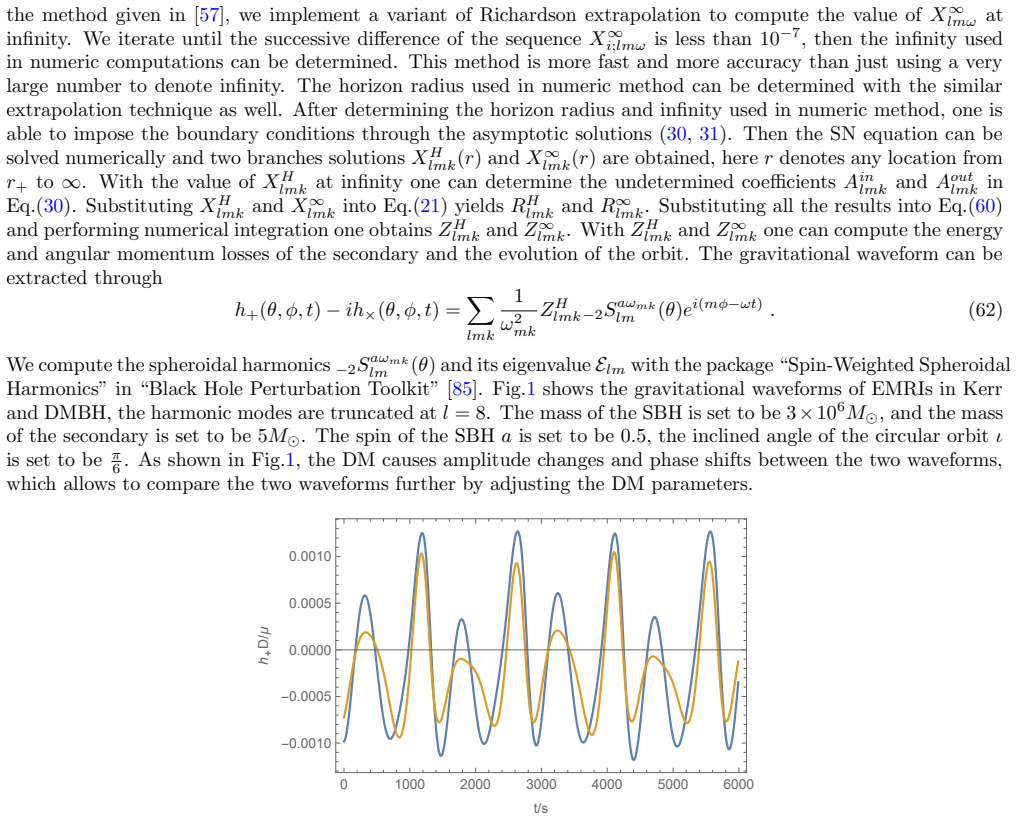
Extreme Mass Ratio Inspirals (EMRIs) are among the key targe sources for the space-based gravitational wave (GW) detectors. The waveforms of the EMRIs are highly sensitive to the types of the central supermassive black hole (SBH) and can serve as a novel sensitive tool to probe the background spacetime. In this work, we compute GWs radiated from EMRIs in the backgrounds of Kerr black hole and rotating black hole with Dehnen-type dark matter halo (DMBH). Following the Teukolsky prescription, we obtain the perturbed equations for curvature tensor from the Newman-Penrose (NP) equations, and for the DMBH we obtain the radial and angular equations through separation of variables. To solve the equations with numerical method we apply the Sasaki-Nakamura (SN) transformation to convert the Teykolsky-type equation into the SN equation. We study the radiation reaction of GWs by computing the energy flux and angular momentum flux at infinity and at the horizon. The orbital evolution is then derived from the total fluxes. We extract the two polarizations of GWs by solving the equation numerically. By comparing the waveforms of Kerr and DMBH, it is found that the DM halo induces noticeable changes in both the amplitude and phase of GWs. We compute the strain of GW detector with the response function and evaluate the mismatch between the waveforms of Kerr and DMBH. The results show that the mismatch increases with the mass parameter of DM halo and the spin of the SBH.
Editorial analysis
A structured set of objections, weighed in public.
Referee Report
Summary. The paper computes gravitational waveforms from extreme-mass-ratio inspirals (EMRIs) around both a Kerr black hole and a rotating black hole with an embedded Dehnen dark matter halo (DMBH). It derives the linearized Newman-Penrose equations following the Teukolsky approach, separates variables to obtain radial and angular equations, applies the Sasaki-Nakamura transformation, computes energy and angular-momentum fluxes at infinity and the horizon, evolves the orbital parameters under radiation reaction, generates the two GW polarizations, and quantifies the mismatch between Kerr and DMBH waveforms, reporting that the DM halo produces noticeable amplitude and phase shifts that grow with halo mass parameter and black-hole spin.
Significance. If the derivation is valid, the work supplies concrete, falsifiable predictions for how a Dehnen halo modifies EMRI signals, offering a potential probe of dark-matter distributions with LISA-class detectors. The mismatch scaling with halo mass and spin is a clear, testable signature.
major comments (1)
- [Abstract / derivation of perturbed equations] Abstract and derivation section: The manuscript applies the Teukolsky formalism (originally derived for vacuum Petrov type-D spacetimes with R_μν=0) directly to the DMBH metric, which is sourced by a non-zero Dehnen halo stress-energy tensor. No explicit check is provided that the additional Ricci-sourced terms in the linearized NP Bianchi identities either vanish or remain negligible for the chosen halo parameters; if they survive, the separated radial equation, SN potential, and extracted fluxes contain systematic errors that scale with halo mass, undermining the reported amplitude/phase shifts and mismatch results.
minor comments (2)
- [Abstract] Abstract: typo 'targe' should be 'target'; 'Teykolsky' should be 'Teukolsky'.
- [Numerical methods / results] The manuscript should include explicit convergence tests, error budgets, and verification that the separated equations remain regular at the horizon for the DMBH case.
Simulated Author's Rebuttal
We thank the referee for their careful reading and constructive comments on our manuscript. We address the single major comment point by point below and will revise the paper accordingly to strengthen the justification of our approach.
read point-by-point responses
-
Referee: [Abstract / derivation of perturbed equations] Abstract and derivation section: The manuscript applies the Teukolsky formalism (originally derived for vacuum Petrov type-D spacetimes with R_μν=0) directly to the DMBH metric, which is sourced by a non-zero Dehnen halo stress-energy tensor. No explicit check is provided that the additional Ricci-sourced terms in the linearized NP Bianchi identities either vanish or remain negligible for the chosen halo parameters; if they survive, the separated radial equation, SN potential, and extracted fluxes contain systematic errors that scale with halo mass, undermining the reported amplitude/phase shifts and mismatch results.
Authors: We agree that the Teukolsky formalism was derived under the assumption of a vacuum background (R_μν = 0). Our manuscript follows the Newman-Penrose equations to obtain the perturbed curvature equations and then separates variables for the DMBH metric. However, the current text does not explicitly estimate the size of the additional terms proportional to the background Ricci tensor sourced by the Dehnen halo. For the small values of the DM mass parameter adopted in our numerical examples, these extra terms are suppressed relative to the leading vacuum contributions in the relevant radial domain. In the revised manuscript we will add a dedicated paragraph (or short subsection) in the derivation section that provides an order-of-magnitude estimate of the Ricci-sourced corrections, demonstrating that they remain negligible compared with the terms retained in the separated radial and angular equations for the halo parameters and orbital radii we consider. This addition will clarify the regime of validity of the reported waveforms and mismatch values. revision: yes
Circularity Check
No circularity: standard forward computation of waveforms on fixed DMBH background
full rationale
The paper's derivation chain consists of (1) adopting a fixed rotating DMBH metric, (2) applying the Teukolsky NP formalism to obtain linearized equations, (3) separating variables to obtain radial/angular equations, (4) performing SN transformation, (5) numerically solving for fluxes at infinity/horizon, (6) integrating orbital evolution from those fluxes, and (7) extracting polarizations and computing mismatch against Kerr. All steps are direct numerical evaluation from the input metric parameters; no output quantity (flux, phase shift, or mismatch) is fed back to adjust inputs or parameters. No self-citation is invoked to justify uniqueness theorems or to close a definitional loop. The mismatch scaling with halo mass and spin is a computed observable, not a fitted or renamed input. The derivation is therefore self-contained against external benchmarks.
Axiom & Free-Parameter Ledger
free parameters (2)
- DM halo mass parameter
- black-hole spin parameter
axioms (2)
- domain assumption Linearized Newman-Penrose equations on a fixed background metric admit separation into radial and angular ordinary differential equations.
- standard math The Sasaki-Nakamura transformation converts the Teukolsky radial equation into a form suitable for numerical integration without introducing spurious singularities.
invented entities (1)
-
rotating black hole with Dehnen dark matter halo (DMBH) metric
no independent evidence
Reference graph
Works this paper leans on
-
[1]
B. P. Abbottet al.[LIGO Scientific and Virgo],Observation of Gravitational Waves from a Binary Black Hole Merger,Phys. Rev. Lett.116, no.6, 061102 (2016) [arXiv:1602.03837 [gr-qc]]
work page internal anchor Pith review arXiv 2016
-
[2]
B. P. Abbottet al.[LIGO Scientific and Virgo],GW151226: Observation of Gravitational Waves from a 22-Solar-Mass Binary Black Hole Coalescence,Phys. Rev. Lett.116, no.24, 241103 (2016) [arXiv:1606.04855 [gr-qc]]
work page Pith review arXiv 2016
-
[3]
S. Sigurdsson,Estimating the detectable rate of capture of stellar mass black holes by massive central black holes in normal galaxies, Class. Quant. Grav.14, 1425-1429 (1997) [arXiv:astro-ph/9701079 [astro-ph]]
-
[4]
S. Sigurdsson and M. J. Rees,Capture of stellar mass compact objects by massive black holes in galactic cusps,Mon. Not. Roy. Astron. Soc.284, 318 (1997) [arXiv:astro-ph/9608093 [astro-ph]]
- [5]
-
[6]
K. Glampedakis and D. Kennefick,Zoom and whirl: Eccentric equatorial orbits around spinning black holes and their evolution under gravitational radiation reaction,Phys. Rev. D66, 044002 (2002) [arXiv:gr-qc/0203086 [gr-qc]]
- [7]
- [8]
-
[9]
C. Munna and C. R. Evans,Post-Newtonian expansion of the spin-precession invariant for eccentric-orbit nonspinning extreme- mass-ratio inspirals to 9PN and e16,Phys. Rev. D106, no.4, 044058 (2022) [arXiv:2206.04085 [gr-qc]]
-
[10]
M. Kerachian, L. Polcar, V. Skoup´ y, C. Efthymiopoulos and G. Lukes-Gerakopoulos,Action-angle formalism for extreme mass ratio inspirals in Kerr spacetime,Phys. Rev. D108, no.4, 044004 (2023) [arXiv:2301.08150 [gr-qc]]
-
[11]
T. Takahashi, H. Omiya and T. Tanaka,Evolution of binary systems accompanying axion clouds in extreme mass ratio inspirals, Phys. Rev. D107, no.10, 103020 (2023) [arXiv:2301.13213 [gr-qc]]
- [12]
-
[13]
Glampedakis,Extreme mass ratio inspirals: LISA’s unique probe of black hole gravity,Class
K. Glampedakis,Extreme mass ratio inspirals: LISA’s unique probe of black hole gravity,Class. Quant. Grav.22, S605-S659 (2005) [arXiv:gr-qc/0509024 [gr-qc]]
-
[14]
Science with the space-based interferometer LISA. V: Extreme mass-ratio inspirals
S. Babak, J. Gair, A. Sesana, E. Barausse, C. F. Sopuerta, C. P. L. Berry, E. Berti, P. Amaro-Seoane, A. Petiteau and A. Klein,Science with the space-based interferometer LISA. V: Extreme mass-ratio inspirals,Phys. Rev. D95, no.10, 103012 (2017) [arXiv:1703.09722 [gr-qc]]
work page Pith review arXiv 2017
-
[15]
C. Munna and C. R. Evans,Eccentric-orbit extreme-mass-ratio-inspiral radiation: Analytic forms of leading-logarithm and subleading-logarithm flux terms at high PN orders,Phys. Rev. D100, no.10, 104060 (2019) [arXiv:1909.05877 [gr-qc]]
-
[16]
K. Destounis, A. Kulathingal, K. D. Kokkotas and G. O. Papadopoulos,Gravitational-wave imprints of compact and galactic-scale environments in extreme-mass-ratio binaries,Phys. Rev. D107, no.8, 084027 (2023) [arXiv:2210.09357 [gr-qc]]
-
[17]
L. Barack and C. Cutler,LISA capture sources: Approximate waveforms, signal-to-noise ratios, and parameter estimation accu- racy,Phys. Rev. D69, 082005 (2004) [arXiv:gr-qc/0310125 [gr-qc]]
- [18]
- [19]
- [20]
- [21]
- [22]
- [23]
- [24]
-
[25]
F. Zhang and P. A. Seoane,Coevolution of Nuclear Star Clusters and Massive Black Holes: Extreme-mass-ratio Inspirals,Astro- phys. J.999, no.2, 224 (2026) [arXiv:2510.10821 [astro-ph.GA]]
-
[26]
J. D. Liu, W. B. Han and H. Tagawa,Probing Active Galactic Nuclei and Measuring the Hubble constant with Extreme-Mass-Ratio Inspirals, [arXiv:2604.10942 [gr-qc]]
work page internal anchor Pith review Pith/arXiv arXiv
- [27]
-
[28]
C. M. Will,Gravitational Radiation from Binary Systems in Alternative Metric Theories of Gravity: Dipole Radiation and the Binary Pulsar,Astrophys. J.214, 826-839 (1977)
1977
-
[29]
C. M. Will and H. W. Zaglauer,Gravitational Radiation, Close Binary Systems, and the Brans-dicke Theory of Gravity,Astrophys. J.346, 366 (1989)
1989
-
[30]
E. Barausse and K. Yagi,Gravitation-Wave Emission in Shift-Symmetric Horndeski Theories,Phys. Rev. Lett.115, no.21, 211105 (2015) [arXiv:1509.04539 [gr-qc]]
- [31]
-
[32]
J. Gair and N. Yunes,Approximate Waveforms for Extreme-Mass-Ratio Inspirals in Modified Gravity Spacetimes,Phys. Rev. D 84, 064016 (2011) [arXiv:1106.6313 [gr-qc]]
- [33]
- [34]
-
[35]
M. Rahman, S. Kumar and A. Bhattacharyya,Gravitational wave from extreme mass-ratio inspirals as a probe of extra dimensions, JCAP01, 046 (2023) 5doi:10.1088/1475-7516/2023/01/046 [arXiv:2212.01404 [gr-qc]]
- [36]
-
[37]
K. Meng, J. Zhao, M. Deng, C. Li and N. Yang,Gravitational waves from extreme mass ratio inspirals around rotating black holes surrounded by dark matter halo,Phys. Lett. B868, 139630 (2025)
2025
- [38]
-
[39]
H. Gong, S. Long, X. J. Wang, Z. Xia, J. P. Wu and Q. Pan,Gravitational waveforms from periodic orbits around a novel regular black hole, [arXiv:2509.23318 [gr-qc]]
work page internal anchor Pith review Pith/arXiv arXiv
- [40]
-
[41]
S. Lu, H. J. Lin, T. Zhu, Y. X. Liu and X. Zhang,Gravitational radiations from periodic orbits around a black hole in the effective field theory extension of general relativity,Eur. Phys. J. C86, no.3, 283 (2026) [arXiv:2512.11911 [gr-qc]]
work page internal anchor Pith review Pith/arXiv arXiv 2026
- [42]
- [43]
- [44]
- [45]
- [46]
-
[47]
A. K. Drukier, K. Freese and D. N. Spergel,Detecting Cold Dark Matter Candidates,Phys. Rev. D33, 3495-3508 (1986)
1986
-
[48]
N. Dalal and C. S. Kochanek,Direct detection of CDM substructure,Astrophys. J.572, 25-33 (2002) [arXiv:astro-ph/0111456 [astro-ph]]
-
[49]
K. Abazajian, G. M. Fuller and W. H. Tucker,Direct detection of warm dark matter in the X-ray,Astrophys. J.562, 593-604 (2001) [arXiv:astro-ph/0106002 [astro-ph]]
-
[50]
Detection of (dark) matter concentrations via weak gravitational lensing
P. Schneider,Detection of (dark) matter concentrations via weak gravitational lensing,Mon. Not. Roy. Astron. Soc.283, 837-853 (1996) [arXiv:astro-ph/9601039 [astro-ph]]
work page Pith review arXiv 1996
- [51]
-
[52]
A. Del Popolo and M. Le Delliou, Galaxies9, no.4, 123 (2021) doi:10.3390/galaxies9040123 [arXiv:2209.14151 [astro-ph.CO]]
-
[53]
Dark Matter Self-interactions and Small Scale Structure
S. Tulin and H. B. Yu,Dark Matter Self-interactions and Small Scale Structure,Phys. Rept.730, 1-57 (2018) [arXiv:1705.02358 [hep-ph]]
work page Pith review arXiv 2018
-
[54]
Dehnen,A Family of Potential-Density Pairs for Spherical Galaxies and Bulges,Mon
W. Dehnen,A Family of Potential-Density Pairs for Spherical Galaxies and Bulges,Mon. Not. Roy. Astron. Soc.265, 250 (1993)
1993
- [55]
-
[56]
Gravitational wave snapshots of generic extreme mass ratio inspirals
S. Drasco and S. A. Hughes,Gravitational wave snapshots of generic extreme mass ratio inspirals,Phys. Rev. D73, no.2, 024027 (2006) [erratum: Phys. Rev. D88, no.10, 109905 (2013); erratum: Phys. Rev. D90, no.10, 109905 (2014)] [arXiv:gr-qc/0509101 [gr-qc]]. 16
work page Pith review arXiv 2006
-
[57]
S. A. Hughes,The Evolution of circular, nonequatorial orbits of Kerr black holes due to gravitational wave emission,Phys. Rev. D 61, no.8, 084004 (2000) [erratum:Phys. Rev. D63, no.4, 049902 (2001); erratum:Phys. Rev. D65, no.6, 069902 (2002); erratum: Phys. Rev. D67, no.8, 089901 (2003); erratum:Phys. Rev. D78, no.10, 109902 (2008); erratum:Phys. Rev. D9...
-
[58]
Cutler, D
C. Cutler, D. Kennefick and E. Poisson,Gravitational radiation reaction for bound motion around a Schwarzschild black hole, Phys. Rev. D50, 3816-3835 (1994)
1994
-
[59]
Tanaka, M
T. Tanaka, M. Shibata, M. Sasaki, H. Tagoshi and T. Nakamura,Gravitational wave induced by a particle orbiting around a Schwarzschild black hole,Prog. Theor. Phys.90, 65-84 (1993)
1993
-
[60]
Shibata,Gravitational Waves Induced by a Particle Orbiting around a Rotating Black Hole: Effect of Orbital Precession,
M. Shibata,Gravitational Waves Induced by a Particle Orbiting around a Rotating Black Hole: Effect of Orbital Precession,
-
[61]
Tagoshi,Post Newtonian expansion of gravitational waves from a particle in slightly eccentric orbit around a rotating black hole,Prog
H. Tagoshi,Post Newtonian expansion of gravitational waves from a particle in slightly eccentric orbit around a rotating black hole,Prog. Theor. Phys.93, 307-333 (1995) [erratum:Prog. Theor. Phys.118, 577-579 (2007)]
1995
-
[62]
Poisson,Gravitational radiation from a particle in circular orbit around a black hole
E. Poisson,Gravitational radiation from a particle in circular orbit around a black hole. 1: Analytical results for the nonrotating case,Phys. Rev. D47, 1497-1510 (1993)
1993
-
[63]
Cutler, E
C. Cutler, E. Poisson, G. J. Sussman and L. S. Finn,Gravitational radiation from a particle in circular orbit around a black hole. 2: Numerical results for the nonrotating case,Phys. Rev. D47, 1511-1518 (1993)
1993
-
[64]
Apostolatos, D
T. Apostolatos, D. Kennefick, E. Poisson and A. Ori,Gravitational radiation from a particle in circular orbit around a black hole. 3: Stability of circular orbits under radiation reaction,Phys. Rev. D47, 5376-5388 (1993)
1993
-
[65]
Poisson,Gravitational radiation from a particle in circular orbit around a black hole
E. Poisson,Gravitational radiation from a particle in circular orbit around a black hole. 4: Analytical results for the slowly rotating case,Phys. Rev. D48, 1860-1863 (1993)
1993
-
[66]
E. Poisson and M. Sasaki,Gravitational radiation from a particle in circular orbit around a black hole. 5: Black hole absorption and tail corrections,Phys. Rev. D51, 5753-5767 (1995) [arXiv:gr-qc/9412027 [gr-qc]]
-
[67]
H. Tagoshi and M. Sasaki,Post Newtonian expansion of gravitational waves from a particle in circular orbit around a Schwarzschild black hole,Prog. Theor. Phys.92, 745-772 (1994) [arXiv:gr-qc/9405062 [gr-qc]]
-
[68]
M. Shibata, M. Sasaki, H. Tagoshi and T. Tanaka,Gravitational waves from a particle orbiting around a rotating black hole: PostNewtonian expansion,Phys. Rev. D51, 1646-1663 (1995) [arXiv:gr-qc/9409054 [gr-qc]]
- [69]
-
[70]
Y. Jiang and W. B. Han,New high-performing method for solving the homogeneous Teukolsky equation,Phys. Rev. D113, no.2, 024001 (2026) [arXiv:2507.15363 [gr-qc]]
- [71]
- [72]
-
[73]
C. Chen and J. Jing,Radiation fluxes of gravitational, electromagnetic, and scalar perturbations in type-D black holes: an exact approach,JCAP11, 070 (2023) [arXiv:2307.14616 [gr-qc]]
-
[74]
S. A. Teukolsky,Perturbations of a rotating black hole. 1. Fundamental equations for gravitational electromagnetic and neutrino field perturbations,Astrophys. J.185, 635-647 (1973)
1973
-
[75]
W. H. Press and S. A. Teukolsky,Perturbations of a Rotating Black Hole. II. Dynamical Stability of the Kerr Metric,Astrophys. J.185, 649-674 (1973)
1973
-
[76]
S. A. Teukolsky and W. H. Press,Perturbations of a rotating black hole. III - Interaction of the hole with gravitational and electromagnetic radiation,Astrophys. J.193, 443-461 (1974)
1974
-
[77]
A. G. Abacet al.[LIGO Scientific, Virgo and KAGRA],GW250114: Testing Hawking’s Area Law and the Kerr Nature of Black Holes,Phys. Rev. Lett.135, no.11, 111403 (2025) [arXiv:2509.08054 [gr-qc]]
work page internal anchor Pith review arXiv 2025
-
[78]
Newman and R
E. Newman and R. Penrose,An Approach to gravitational radiation by a method of spin coefficients,J. Math. Phys.3, 566-578 (1962)
1962
- [79]
- [80]
discussion (0)
Sign in with ORCID, Apple, or X to comment. Anyone can read and Pith papers without signing in.