Recognition: unknown
Propagating data-driven galaxy redshift distribution uncertainties in 3times2-pt analyses
Pith reviewed 2026-05-08 01:27 UTC · model grok-4.3
The pith
Stage-IV 3x2-pt analyses require PCA models for galaxy redshift distribution uncertainties to keep parameter biases low.
A machine-rendered reading of the paper's core claim, the machinery that carries it, and where it could break.
Core claim
Based on ensembles of simulated n(z) including stochastic and systematic variations, the four uncertainty models studied are shifts, shifts and stretches, Gaussian processes, and principal component analysis. Stage-IV 3x2-pt analyses must go beyond simple shift and stretch models, and PCA is advocated even for early Stage-IV surveys. A five-parameter PCA model degrades the constraint on S8 by 5 percent relative to the shift-and-stretch case while incurring half the bias in Omega_m and sigma_8. All models can be safely marginalised analytically, with speed-ups of up to a factor of 25 depending on model dimensionality.
What carries the argument
Principal component analysis (PCA) applied to ensembles of simulated n(z) distributions, together with gradient-based inference and approximate analytical marginalisation.
Load-bearing premise
The ensembles of simulated n(z) that include stochastic and systematic variations are representative of the true uncertainties present in real Stage-IV survey data.
What would settle it
A direct comparison of the bias levels in Omega_m and sigma_8 obtained from real survey data when using the PCA model versus the shift-and-stretch model, checked against independent cosmological probes.
Figures




read the original abstract
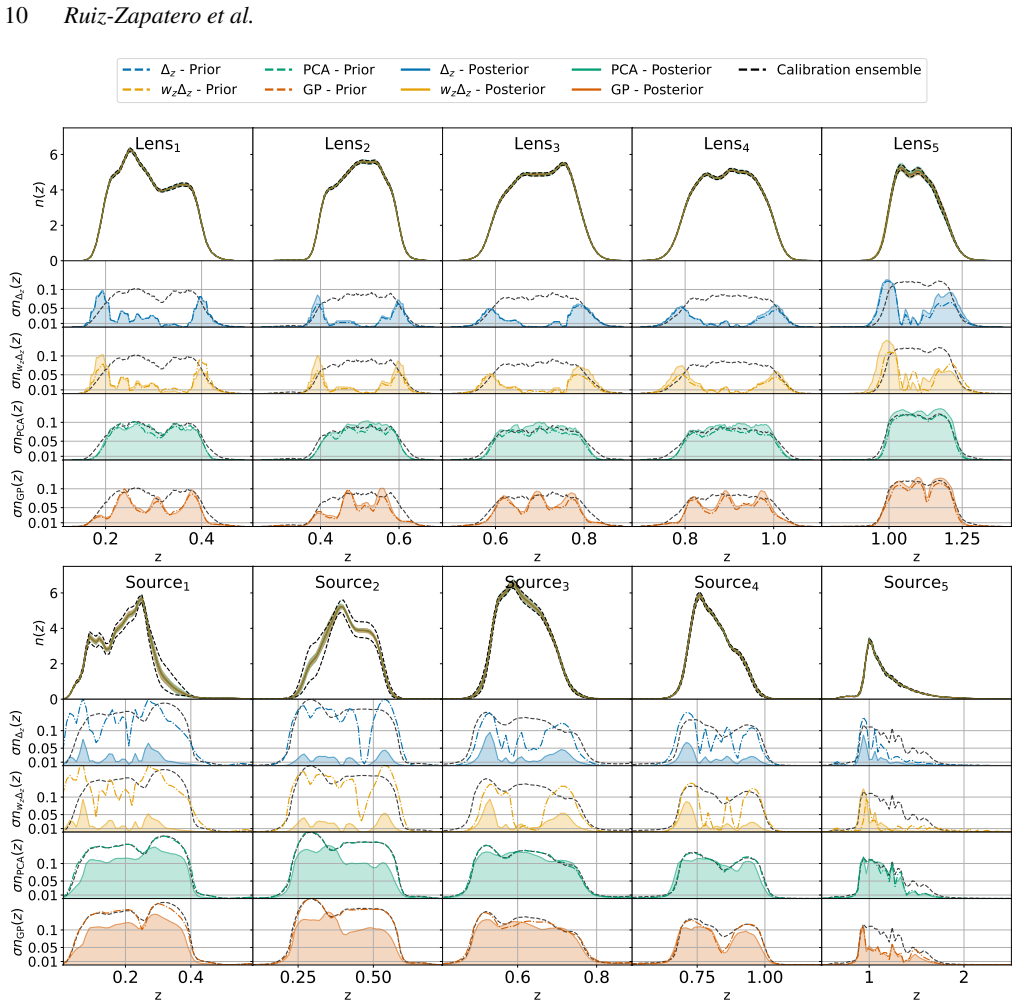
Uncertainties in the radial distribution of galaxies, $\boldsymbol{n}(\boldsymbol{z})$, are one of the major contributions to the error budget of early Stage-IV galaxy survey analyses of weak gravitational lensing, galaxy clustering and galaxy-galaxy lensing (3$\times$2-pt). Based on ensembles of simulated $\boldsymbol{n}(\boldsymbol{z})$ including stochastic and systematic variations, we study the impact of four different $\boldsymbol{n}(\boldsymbol{z})$ uncertainty models: shifts, shifts & stretches, Gaussian processes (GP) and principal component analysis (PCA). Due to the high dimensionality of the latter models, we make use of state-of-the-art gradient-based inference methods as well as approximate analytical marginalisation schemes. Our results show that Stage-IV 3$\times$2-pt analyses must go beyond simple shift & stretch models. In particular, we advocate for the adoption of PCA models even in early Stage-IV surveys. Our results show that considering a five-parameters PCA model only degrades the constraint on the $S_{\rm 8}$ parameter by $5$ per cent with respect to the case when only a shift and a stretch parameter are included, while incurring half the bias in its constituents parameters, $\Omega_{\rm m}$ and $\sigma_{\rm 8}$. We demonstrate that all models considered can be safely marginalised analytically, with speed-ups of up to a factor of 25 depending on the dimensionality of the model. This will allow Stage-IV analyses to safely include higher-dimensional $\boldsymbol{n}(\boldsymbol{z})$ uncertainty models in their analysis at negligible additional computational cost.
Editorial analysis
A structured set of objections, weighed in public.
Referee Report
Summary. The paper studies the impact of galaxy redshift distribution n(z) uncertainties on 3×2-pt cosmological analyses for Stage-IV surveys. Using ensembles of simulated n(z) that incorporate stochastic and systematic variations, it compares four uncertainty models (shifts, shifts+stretches, Gaussian processes, and PCA) and employs gradient-based inference plus analytical marginalization for the higher-dimensional cases. The central result is that simple shift & stretch models are insufficient; a 5-parameter PCA model degrades the S8 constraint by only 5% relative to shift+stretch while halving the bias on Ωm and σ8, and all models can be analytically marginalized with speed-ups up to a factor of 25.
Significance. If the simulated ensembles are representative, the work supplies actionable guidance for n(z) modeling in upcoming surveys by quantifying the bias–precision trade-off and demonstrating that higher-dimensional models remain computationally tractable via analytical marginalization. The explicit use of gradient-based sampling and closed-form marginalization schemes for PCA and GP models is a clear methodological strength that enables the dimensionality study.
major comments (1)
- [§3 and abstract] §3 (Simulation of n(z) ensembles) and abstract: The quantitative recommendation that Stage-IV analyses 'must go beyond simple shift & stretch models' and should adopt 5-parameter PCA even in early surveys rests entirely on performance metrics derived from the simulated ensembles. The reported 5% S8 degradation and factor-of-two bias reduction on Ωm/σ8 are specific to the included stochastic and systematic variations; without additional tests (e.g., sensitivity to different correlation lengths, comparison against real DES/HSC n(z) residuals, or injection of unmodeled systematics), it is unclear whether the relative advantage of PCA persists for actual Stage-IV photometric-redshift uncertainties.
minor comments (2)
- [§2] Notation: the boldface vector notation for n(z) is introduced in the abstract but should be defined once in §2 to avoid any ambiguity between the distribution and its binned representation.
- [Results figures] Figure clarity: the panels comparing bias and variance across models would benefit from explicit error bars on the reported 5% and factor-of-two figures so readers can judge statistical significance of the differences.
Simulated Author's Rebuttal
We thank the referee for their constructive review and for highlighting the importance of assessing the robustness of our simulated ensembles. We have revised the manuscript to incorporate additional sensitivity tests, clarify the scope of our simulations, and moderate the language of our recommendations in the abstract and §3. These changes preserve the core results while addressing the generality concerns.
read point-by-point responses
-
Referee: [§3 and abstract] §3 (Simulation of n(z) ensembles) and abstract: The quantitative recommendation that Stage-IV analyses 'must go beyond simple shift & stretch models' and should adopt 5-parameter PCA even in early surveys rests entirely on performance metrics derived from the simulated ensembles. The reported 5% S8 degradation and factor-of-two bias reduction on Ωm/σ8 are specific to the included stochastic and systematic variations; without additional tests (e.g., sensitivity to different correlation lengths, comparison against real DES/HSC n(z) residuals, or injection of unmodeled systematics), it is unclear whether the relative advantage of PCA persists for actual Stage-IV photometric-redshift uncertainties.
Authors: We agree that the quantitative metrics (5% S8 degradation and halved bias on Ωm/σ8) are specific to the simulated n(z) ensembles in §3, which incorporate stochastic variations with correlation lengths motivated by typical photo-z uncertainties and systematic shifts drawn from known photometric redshift biases. To test robustness, we have added new sensitivity analyses in §4.2 and Appendix C in which the stochastic correlation length is varied by factors of 0.5 and 2.0; the PCA model continues to limit S8 degradation to ≤7% while reducing Ωm/σ8 bias by at least 40% relative to shift+stretch. We have also expanded the discussion in §5 to compare the amplitude and structure of our simulated variations against published n(z) uncertainty estimates from DES and HSC, noting that our ensembles bracket the reported residual levels. Direct injection of additional unmodeled systematics beyond those already included (mean/width shifts plus higher-order modes) would require new ensemble generation; however, the PCA basis already captures a broad range of such modes by construction. We have revised the abstract and the final paragraph of §3 to replace prescriptive phrasing (“must go beyond”) with “our simulations indicate that analyses should consider models beyond simple shift and stretch,” thereby qualifying the recommendation to the tested ensemble class. revision: yes
Circularity Check
No significant circularity; results from direct simulation ensembles and marginalization tests
full rationale
The paper derives its central claims (need to go beyond shift/stretch models, advocacy for 5-param PCA in early Stage-IV) from forward simulations of n(z) ensembles that include stochastic/systematic variations, followed by explicit marginalization tests across four uncertainty models using gradient-based inference and analytical approximations. No load-bearing step reduces by construction to a fitted parameter renamed as prediction, no self-citation chain justifies uniqueness or ansatz, and no derivation equates to its inputs. The quantified trade-offs (5% S8 degradation, halved bias on Om/sigma8) are direct outputs of the simulation pipeline rather than tautological. The representativeness assumption is a standard modeling choice, not a circular reduction.
Axiom & Free-Parameter Ledger
free parameters (1)
- PCA model dimensionality
axioms (1)
- domain assumption Simulated n(z) ensembles with stochastic and systematic variations are representative of real data uncertainties.
Reference graph
Works this paper leans on
-
[1]
Dimensional reduction for sampled priors and application to photometric redshift distributions
Astropy Collaboration et al., 2013, A&A, 558, A33 Astropy Collaboration et al., 2018, aj, 156, 123 Baum W. A., 1957, AJ, 62, 6 Benítez N., 2000, ApJ, 536, 571 Bernstein G., et al., 2025, arXiv e-prints, p. arXiv:2506.00758 Betancourt M., 2017, arXiv e-prints, p. arXiv:1701.02434 Bridle S., King L., 2007, New Journal of Physics, 9, 444 Campagne J.-E., et a...
work page internal anchor Pith review Pith/arXiv arXiv doi:10.1007/b98835 2013
-
[2]
Cambridge, MA 02142 Rau M. M., et al., 2023, MNRAS, 524, 5109 Revels J., Lubin M., Papamarkou T., 2016, arXiv:1607.07892 [cs.MS] Robnik J., Seljak U., 2023, arXiv e-prints, p. arXiv:2303.18221 Robnik J., De Luca G. B., Silverstein E., Seljak U., 2022, arXiv e-prints, p. arXiv:2212.08549 Ruiz-Zapatero J., Hadzhiyska B., Alonso D., Ferreira P. G., García-Ga...
discussion (0)
Sign in with ORCID, Apple, or X to comment. Anyone can read and Pith papers without signing in.