Recognition: unknown
Energy spectrum of magnetic fields from electroweak symmetry breaking
Pith reviewed 2026-05-08 02:44 UTC · model grok-4.3
The pith
Random configurations of an inhomogeneous Higgs field produce an analytic spectrum for magnetic fields generated during electroweak symmetry breaking.
A machine-rendered reading of the paper's core claim, the machinery that carries it, and where it could break.
Core claim
By modeling the Higgs field during electroweak symmetry breaking as random inhomogeneous configurations and imposing statistical isotropy together with causality, the authors obtain an essentially analytic expression for the magnetic-field energy spectrum. This spectrum is obtained without lattice discretization and is shown to agree with a new continuous-field simulation framework that resolves finer scales than previous lattice runs. General correlation functions derived from isotropy and causality are fitted to the simulation outputs and compared directly to the analytic prediction.
What carries the argument
Analytic correlation functions obtained by applying statistical isotropy and causality to random inhomogeneous Higgs field configurations.
If this is right
- The magnetic spectrum becomes available for immediate comparison to simulation data without post-processing adjustments.
- Continuous-field simulations resolve small-scale magnetic structures inaccessible to prior lattice calculations.
- General correlation functions derived from isotropy and causality can be fitted to numerical data and tested against the analytic result.
- The framework removes the need for repeated costly lattice runs when exploring parameter variations in the early Universe.
Where Pith is reading between the lines
- The analytic method could be applied to other cosmological phase transitions where random scalar fields are present.
- The continuous simulation approach may allow tracking of magnetic field evolution over longer times or larger volumes than lattice grids permit.
- If the spectrum holds, it provides a cleaner starting point for evolving primordial fields to later epochs such as recombination.
Load-bearing premise
That random initial Higgs configurations plus statistical isotropy and causality are sufficient to produce a parameter-free analytic spectrum that matches simulations without further tuning.
What would settle it
A high-resolution continuous simulation with the same random initial Higgs conditions that produces a magnetic power spectrum deviating from the analytic formula at wavenumbers accessible to both methods.
Figures

read the original abstract
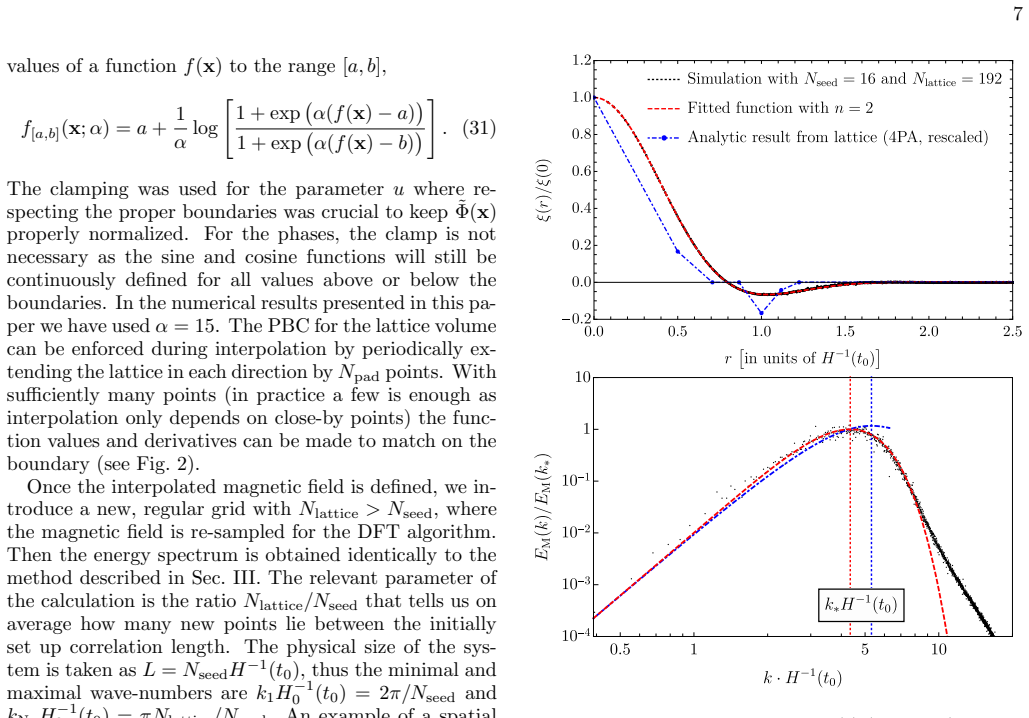
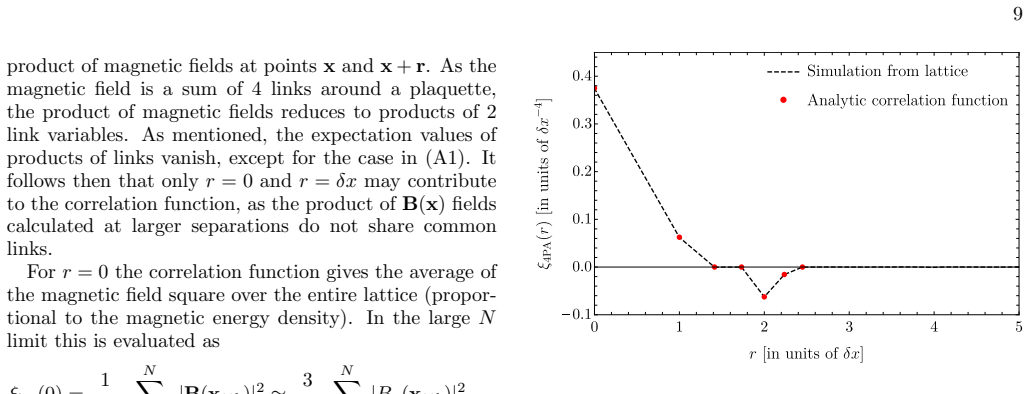
We study the magnetic fields produced in the early Universe during the electroweak symmetry breaking by considering random configurations of an inhomogeneous Higgs field. By exploiting the inherent randomness of the initial configurations the spectrum of the produced magnetic field is essentially analytic, which bypasses the need for costly lattice simulations. On the numerical side, we devise a simulation framework which results in continuous fields capable of resolving the small-scale structure of the fields that was inaccessible for the lattice-based calculation. Finally, by revisiting the effects of statistical isotropy and causality on the spectrum, we define general correlation functions that are then fitted to the simulation data and compared to the analytic results.
Editorial analysis
A structured set of objections, weighed in public.
Referee Report
Summary. The manuscript claims that random configurations of an inhomogeneous Higgs field during electroweak symmetry breaking, combined with statistical isotropy and causality, permit an essentially analytic derivation of the magnetic field energy spectrum. This approach is said to bypass costly lattice simulations. The authors introduce a continuous-field simulation framework to resolve small-scale structures inaccessible to lattice methods and define general correlation functions (from isotropy and causality) that are fitted to the simulation data for comparison with the analytic predictions.
Significance. If the analytic spectrum can be shown to follow directly from the random Higgs configurations without dependence on fitted parameters, the result would be significant for early-Universe cosmology. It would enable efficient, potentially parameter-free predictions of primordial magnetic fields from the electroweak phase transition, reducing reliance on full numerical simulations and aiding constraints on magnetogenesis models. The continuous-field simulation method is a constructive technical contribution that addresses resolution limits of lattice approaches.
major comments (1)
- [Abstract] Abstract: The claim that the spectrum is 'essentially analytic' by exploiting the inherent randomness of initial configurations (thereby bypassing lattice simulations) is in tension with the subsequent step of fitting general correlation functions to simulation data before comparing them to the analytic results. This fit introduces free parameters, so the manuscript must demonstrate (in the derivation section) that the final analytic spectrum is independent of any such calibration and follows solely from the randomness, isotropy, and causality assumptions. Without this clarification the central claim that the approach is essentially analytic and simulation-independent is not yet established.
Simulated Author's Rebuttal
We thank the referee for the careful reading of our manuscript and the constructive major comment. We address it point by point below and have revised the manuscript to improve clarity on the analytic derivation.
read point-by-point responses
-
Referee: [Abstract] Abstract: The claim that the spectrum is 'essentially analytic' by exploiting the inherent randomness of initial configurations (thereby bypassing lattice simulations) is in tension with the subsequent step of fitting general correlation functions to simulation data before comparing them to the analytic results. This fit introduces free parameters, so the manuscript must demonstrate (in the derivation section) that the final analytic spectrum is independent of any such calibration and follows solely from the randomness, isotropy, and causality assumptions. Without this clarification the central claim that the approach is essentially analytic and simulation-independent is not yet established.
Authors: We thank the referee for identifying this point of potential confusion. The analytic derivation in Section 3 proceeds directly from the random inhomogeneous Higgs configurations together with the requirements of statistical isotropy and causality. It yields an explicit functional form for the magnetic-field energy spectrum expressed solely in terms of the Higgs two-point correlation functions; no free parameters or calibration enter at any stage of this derivation. The general correlation functions themselves are constrained by isotropy and causality alone. The fitting step described in Section 4 is performed only after the analytic expression has been obtained: it determines the concrete shape of those correlation functions from the continuous-field simulations and then compares the resulting spectrum against the analytic prediction for validation. The spectrum expression therefore remains independent of the fit; the simulations supply the input functions that could in principle be obtained by other means. To eliminate the tension in the abstract, we have revised the wording to state that the spectrum is derived analytically from the stated assumptions, with the continuous-field simulations used exclusively for validation and to extract the correlation functions. We have also added an explicit paragraph in the derivation section that walks through the steps showing the absence of any calibration parameters. revision: yes
Circularity Check
Analytic spectrum from random Higgs configurations is independent; fitting is only for post-derivation validation against simulations.
full rationale
The paper's central derivation exploits the randomness of initial inhomogeneous Higgs field configurations together with statistical isotropy and causality to obtain an essentially analytic magnetic field spectrum, explicitly bypassing lattice simulations for the spectrum itself. Simulations are introduced separately to resolve small-scale structure and to fit general correlation functions (defined from isotropy/causality) for comparison against the already-derived analytic results. Because the analytic form is obtained directly from the randomness assumption without incorporating fitted parameters or simulation outputs, the load-bearing step does not reduce to its own inputs by construction. No self-citations, uniqueness theorems, or ansatzes from prior author work are invoked in a load-bearing way. The fit serves only as an external check and does not alter or presuppose the analytic prediction.
Axiom & Free-Parameter Ledger
free parameters (1)
- fit parameters for general correlation functions
axioms (1)
- domain assumption Statistical isotropy and causality constrain the form of the magnetic field spectrum
Reference graph
Works this paper leans on
-
[1]
admissible
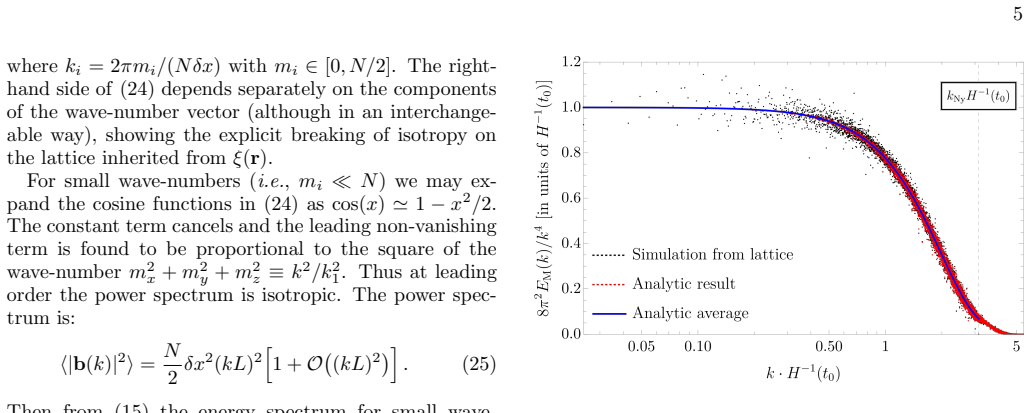
Thus at leading order the power spectrum is isotropic. The power spec- trum is: ⟨|b(k)|2⟩= N 2 δx2(kL)2 h 1 +O (kL)2 i .(25) Then from (15) the energy spectrum for small wave- numbers becomes 8π2 EM(k) k4 =δx 1 +O (kL)2 .(26) This finding is consistent with the causality argument of ref. [23], and completes our proof of the initial mag- netic energy spect...
-
[2]
A. Brandenburg and K. Subramanian, Astrophysical magnetic fields and nonlinear dynamo theory, Phys. Rept.417, 1 (2005), arXiv:astro-ph/0405052
-
[3]
Schober, D
J. Schober, D. Schleicher, C. Federrath, S. Glover, R. S. Klessen, and R. Banerjee, The small-scale dynamo and non-ideal magnetohydrodynamics in primordial star for- mation, The Astrophysical Journal754, 99 (2012)
2012
-
[4]
J. Schober, D. R. G. Schleicher, and R. S. Klessen, Mag- netic Field Amplification in Young Galaxies, Astron. Astrophys.560, A87 (2013), arXiv:1310.0853 [astro- 13 ph.GA]
-
[5]
Evidence for strong extragalactic magnetic fields from Fermi observations of TeV blazars
A. Neronov and I. Vovk, Evidence for strong extra- galactic magnetic fields from Fermi observations of TeV blazars, Science328, 73 (2010), arXiv:1006.3504 [astro- ph.HE]
work page Pith review arXiv 2010
-
[6]
M. Unger and G. R. Farrar, The Coherent Magnetic Field of the Milky Way, Astrophys. J.970, 95 (2024), arXiv:2311.12120 [astro-ph.GA]
-
[7]
Vachaspati, Magnetic fields from cosmological phase transitions, Phys
T. Vachaspati, Magnetic fields from cosmological phase transitions, Phys. Lett. B265, 258 (1991)
1991
-
[8]
The Standard Model cross-over on the lattice
M. D’Onofrio and K. Rummukainen, Standard model cross-over on the lattice, Phys. Rev. D93, 025003 (2016), arXiv:1508.07161 [hep-ph]
work page Pith review arXiv 2016
-
[9]
Vachaspati, Progress on cosmological magnetic fields, Rept
T. Vachaspati, Progress on cosmological magnetic fields, Rept. Prog. Phys.84, 074901 (2021), arXiv:2010.10525 [astro-ph.CO]
-
[10]
R. Banerjee and K. Jedamzik, The Evolution of cosmic magnetic fields: From the very early universe, to recom- bination, to the present, Phys. Rev. D70, 123003 (2004), arXiv:astro-ph/0410032
-
[11]
K. Jedamzik and G. Sigl, The Evolution of the Large- Scale Tail of Primordial Magnetic Fields, Phys. Rev. D 83, 103005 (2011), arXiv:1012.4794 [astro-ph.CO]
-
[12]
T. Vachaspati and A. Brandenburg, Spectra of magnetic fields from electroweak symmetry breaking, Phys. Rev. D111, 043541 (2025), arXiv:2412.00641 [astro-ph.CO]
-
[13]
T. W. B. Kibble, Topology of Cosmic Domains and Strings, J. Phys. A9, 1387 (1976)
1976
-
[14]
T. Patel and T. Vachaspati, Kibble mechanism for elec- troweak magnetic monopoles and magnetic fields, JHEP 01, 059, arXiv:2108.05357 [hep-ph]
-
[15]
Nambu, String-Like Configurations in the Weinberg- Salam Theory, Nucl
Y. Nambu, String-Like Configurations in the Weinberg- Salam Theory, Nucl. Phys. B130, 505 (1977)
1977
-
[16]
T. Patel and T. Vachaspati, Structure of elec- troweak dumbbells, Phys. Rev. D107, 093010 (2023), arXiv:2302.04886 [hep-ph]
-
[17]
T. Patel and T. Vachaspati, Annihilation of electroweak dumbbells, JHEP02, 164, arXiv:2311.00026 [hep-ph]
-
[18]
E. J. Weinberg,Classical solutions in quantum field the- ory: Solitons and Instantons in High Energy Physics, Cambridge Monographs on Mathematical Physics (Cam- bridge University Press, 2012)
2012
-
[19]
Vachaspati and A
T. Vachaspati and A. Achucarro, Semilocal cosmic strings, Phys. Rev. D44, 3067 (1991)
1991
-
[20]
Hindmarsh, Existence and stability of semilocal strings, Phys
M. Hindmarsh, Existence and stability of semilocal strings, Phys. Rev. Lett.68, 1263 (1992)
1992
- [21]
-
[22]
’t Hooft, Magnetic Monopoles in Unified Gauge The- ories, Nucl
G. ’t Hooft, Magnetic Monopoles in Unified Gauge The- ories, Nucl. Phys. B79, 276 (1974)
1974
-
[23]
Corrigan, D
E. Corrigan, D. I. Olive, D. B. Fairlie, and J. Nuyts, Mag- netic Monopoles in SU(3) Gauge Theories, Nucl. Phys. B106, 475 (1976)
1976
-
[24]
R. Durrer and C. Caprini, Primordial magnetic fields and causality, JCAP11, 010, arXiv:astro-ph/0305059
-
[25]
Depending on the specific particle physics model at hand,δxmay take any value up to a maximum at the Hubble radius, which sets a causality bound
Alternatively, one can keepδxas a free parameter and think of it as the correlation length of the BEH field after the EWPT. Depending on the specific particle physics model at hand,δxmay take any value up to a maximum at the Hubble radius, which sets a causality bound
-
[26]
H. S. Abdul-Rahman, M. A. Gdeisat, D. R. Burton, M. J. Lalor, F. Lilley, and C. J. Moore, Fast and ro- bust three-dimensional best path phase unwrapping al- gorithm, Appl. Opt.46, 6623 (2007)
2007
-
[27]
G. Wahba,Spline Models for Observational Data(So- ciety for Industrial and Applied Mathematics, 1990) https://epubs.siam.org/doi/pdf/10.1137/1.9781611970128
-
[28]
The remaining steps are es- sentially trivial
The main point of the derivation is to use Kummer’s transformation for the hypergeometric function which factors out an exponential from the sum and terminates the originally infinite series. The remaining steps are es- sentially trivial
-
[29]
A. Saveliev, K. Jedamzik, and G. Sigl, Time Evolution of the Large-Scale Tail of Non-Helical Primordial Magnetic Fields with Back-Reaction of the Turbulent Medium, Phys. Rev. D86, 103010 (2012), arXiv:1208.0444 [astro- ph.CO]
-
[30]
A. Saveliev, K. Jedamzik, and G. Sigl, Evolution of He- lical Cosmic Magnetic Fields as Predicted by Magneto- hydrodynamic Closure Theory, Phys. Rev. D87, 123001 (2013), arXiv:1304.3621 [astro-ph.CO]
discussion (0)
Sign in with ORCID, Apple, or X to comment. Anyone can read and Pith papers without signing in.