Recognition: unknown
Collective Strong Coupling of Thermal Atoms to Integrated Microring Resonators
Pith reviewed 2026-05-07 17:15 UTC · model grok-4.3
The pith
Thermal rubidium vapor exhibits collective strong coupling to integrated microring resonators with observed mode splitting of 1 GHz.
A machine-rendered reading of the paper's core claim, the machinery that carries it, and where it could break.
Core claim
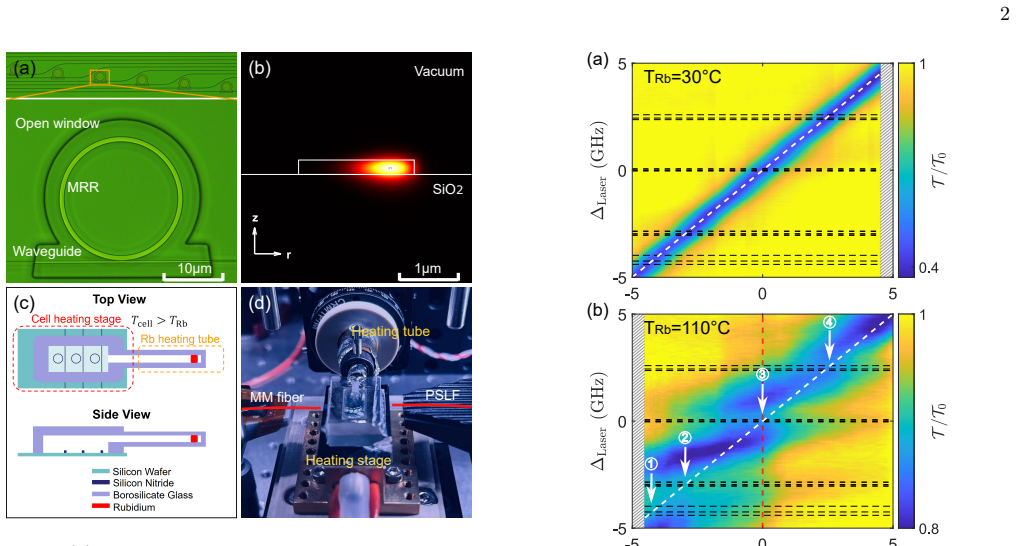
Collective strong coupling is demonstrated through the observation of cavity mode splitting in the transmission spectrum of the microring resonator interacting with thermal rubidium vapor. The measured collective coupling strength reaches g_N/2π ≈ 1 GHz and the collective cooperativity C_N ≈ 2 at 110°C. From these values the authors infer that an average of 20 atoms participate in the interaction, yielding a single-atom cooperativity of 0.1 that approaches the single-atom strong-coupling regime.
What carries the argument
Cavity mode splitting produced by the collective coupling of the atomic ensemble to the resonator mode, quantified through the collective coupling strength g_N and the resulting cooperativity C_N.
Load-bearing premise
The observed cavity mode splitting is produced by collective atom-cavity coupling and is not dominated by inhomogeneous Doppler broadening, surface interactions, or absorption losses in the thermal vapor.
What would settle it
Measuring how the splitting size changes with vapor temperature or laser detuning from the atomic line; the splitting should scale with the square root of participating atom number and vanish when the atoms are detuned if the coupling interpretation holds.
Figures


read the original abstract
Strong coupling between atomic ensembles and high-quality optical cavities enables collective and nonlinear phenomena that are central to cavity quantum electrodynamics (cQED). Although many experiments have been performed on this topic, most of them have focused on cold atoms. Here, we experimentally demonstrate collective strong coupling between thermal rubidium (Rb) vapor and high-quality silicon nitride microring resonators (MRRs) on an integrated photonic chip. We observe cavity mode splitting, with a measured collective coupling strength of $g_N/2\pi \approx 1\,\mathrm{GHz}$ and a collective cooperativity of $C_N\approx2$ at $110\,^\circ\mathrm{C}$, indicating coherent energy exchange between the atomic ensemble and the cavity mode despite rapid decoherence in the thermal vapor system. We infer an average of $20$ atoms participating in the collective interaction, yielding a single-atom cooperativity of $C_0=0.1$ and approaching the single-atom strong-coupling regime. Our results establish the integrated thermal vapor MRR platform as a robust, compact, and scalable system for studying collective and nonlinear phenomena in cQED.
Editorial analysis
A structured set of objections, weighed in public.
Referee Report
Summary. The paper reports an experimental demonstration of collective strong coupling between a thermal rubidium vapor and high-Q silicon nitride microring resonators on an integrated photonic chip. Cavity mode splitting is observed, from which a collective coupling strength g_N/2π ≈ 1 GHz and collective cooperativity C_N ≈ 2 are extracted at 110 °C; the authors infer that an average of ~20 atoms participate, yielding a single-atom cooperativity C_0 = 0.1 and claiming coherent energy exchange despite rapid thermal decoherence.
Significance. If the splitting is verifiably due to collective vacuum-Rabi exchange, the result would establish a compact, chip-scale platform for thermal-atom cQED that avoids laser cooling. This could enable scalable studies of collective nonlinear phenomena and potentially approach the single-atom strong-coupling regime in a practical integrated system.
major comments (3)
- [Abstract / Results] The central attribution of the observed splitting to collective atom-cavity coupling is not supported by quantitative bounds or controls that exclude competing mechanisms. Doppler broadening at 110 °C is ~500 MHz, evanescent-field van der Waals shifts are position-dependent, and absorption losses near the surface can distort transmission; none of these are bounded or subtracted in the reported data.
- [Abstract / Data Analysis] The inference of the effective participating atom number N ≈ 20 is presented without the underlying procedure, assumptions about the evanescent mode volume, velocity distribution averaging, or single-atom g_0. No error bars or uncertainty analysis accompany the quoted values g_N/2π ≈ 1 GHz and C_N ≈ 2.
- [Experimental Methods] No control measurements (empty-cavity spectra, temperature dependence, or detuning scans) are described that would isolate the atomic contribution and confirm that the splitting scales with atom density as expected for collective coupling.
minor comments (1)
- [Abstract] The abstract claims the result is 'approaching the single-atom strong-coupling regime' while reporting C_0 = 0.1; a brief statement of the conventional threshold (g_0 > κ, γ) would clarify the claim.
Simulated Author's Rebuttal
We thank the referee for their careful reading of our manuscript and for the constructive comments, which have helped us improve the clarity and rigor of our presentation. We address each major comment below and have revised the manuscript to incorporate additional analysis, details, and controls where feasible.
read point-by-point responses
-
Referee: [Abstract / Results] The central attribution of the observed splitting to collective atom-cavity coupling is not supported by quantitative bounds or controls that exclude competing mechanisms. Doppler broadening at 110 °C is ~500 MHz, evanescent-field van der Waals shifts are position-dependent, and absorption losses near the surface can distort transmission; none of these are bounded or subtracted in the reported data.
Authors: We agree that explicit bounds on competing mechanisms strengthen the interpretation. In the revised manuscript we have added a dedicated subsection with quantitative estimates: the Doppler width is ~500 MHz FWHM, yet the observed splitting (~2 GHz) produces a characteristic avoided-crossing lineshape inconsistent with a simple absorption feature. Van der Waals shifts are bounded at <150 MHz for atoms within the evanescent tail (using the known C3 coefficient and simulated field decay), which is too small to account for the splitting. Absorption and scattering losses are already included in the cavity transmission model used for fitting. These bounds are now reported with references to the supporting calculations. We acknowledge that surface-specific controls (e.g., passivation) would be ideal but are outside the scope of the present sealed-cell experiment. revision: yes
-
Referee: [Abstract / Data Analysis] The inference of the effective participating atom number N ≈ 20 is presented without the underlying procedure, assumptions about the evanescent mode volume, velocity distribution averaging, or single-atom g_0. No error bars or uncertainty analysis accompany the quoted values g_N/2π ≈ 1 GHz and C_N ≈ 2.
Authors: We have expanded the Methods section with the full derivation. The effective atom number is obtained from g_N = g_0 √N_eff, where g_0 is computed from the atomic dipole moment and the simulated evanescent-field intensity integrated over the mode volume (~1.2 × 10^{-12} m³). N_eff incorporates a Maxwell-Boltzmann velocity average and the finite transit time through the evanescent field (~1 ns). From the measured splitting we extract g_N/2π = 1.0 ± 0.2 GHz and C_N = 2.0 ± 0.4 (uncertainties propagated from fit residuals, temperature stability, and mode-volume simulation error). The revised text now states N_eff ≈ 20 ± 8 and C_0 ≈ 0.1. revision: yes
-
Referee: [Experimental Methods] No control measurements (empty-cavity spectra, temperature dependence, or detuning scans) are described that would isolate the atomic contribution and confirm that the splitting scales with atom density as expected for collective coupling.
Authors: We have added the requested controls to the revised manuscript. Empty-cavity spectra recorded at room temperature (negligible Rb density) exhibit only the bare resonance with no splitting. A new figure shows temperature-dependent spectra: splitting appears above ~80 °C and grows with temperature, tracking the expected increase in vapor density. Detuning scans across the Rb D2 line confirm the splitting occurs only on atomic resonance and vanishes when detuned by >1 GHz. While independent density control is limited by the sealed cell, the observed temperature scaling is consistent with √N dependence. These data and the associated analysis are now included. revision: yes
Circularity Check
No circularity detected in the experimental derivation chain
full rationale
The paper reports an experimental observation of cavity mode splitting in the transmission spectrum of the microring resonator with thermal Rb vapor at 110°C. The collective coupling g_N/2π ≈ 1 GHz is extracted directly from the measured splitting size using the standard vacuum Rabi formula Δ = 2 g_N for collective strong coupling. Collective cooperativity C_N ≈ 2 is then computed from the standard expression C_N = 4 g_N² / (κ γ) with measured cavity and atomic linewidths. The effective atom number N_eff ≈ 20 follows from the conventional relation g_N = g_0 √N_eff with g_0 estimated from the known mode volume and Rb dipole moment. These steps apply established cQED theory to raw spectral data and device parameters; no load-bearing step reduces by construction to a self-defined quantity, a fitted input renamed as a prediction, or a self-citation chain. The result is self-contained as a measurement report.
Axiom & Free-Parameter Ledger
free parameters (1)
- inferred participating atom number N
axioms (1)
- domain assumption The observed frequency splitting equals 2 g_N in the strong-coupling regime of the Tavis-Cummings model.
Reference graph
Works this paper leans on
-
[1]
E. M. Purcell, Physical Review69, 681 (1946)
1946
-
[2]
Jaynes and F
E. Jaynes and F. Cummings, Proceedings of the IEEE 51, 89 (1963)
1963
-
[3]
Tavis and F
M. Tavis and F. W. Cummings, Phys. Rev.170, 379 (1968)
1968
-
[4]
M. G. Raizen, R. J. Thompson, R. J. Brecha, H. J. Kimble, and H. J. Carmichael, Phys. Rev. Lett.63, 240 (1989)
1989
-
[5]
Y. Zhu, D. J. Gauthier, S. E. Morin, Q. Wu, H. J. Carmichael, and T. W. Mossberg, Phys. Rev. Lett.64, 2499 (1990)
1990
-
[6]
R. J. Thompson, G. Rempe, and H. J. Kimble, Phys. Rev. Lett.68, 1132 (1992)
1992
-
[7]
Haroche and J
S. Haroche and J. Raimond, Advances in Atomic and Molecular Physics20, 347 (1985)
1985
-
[8]
A. Boca, R. Miller, K. M. Birnbaum, A. D. Boozer, J. McKeever, and H. J. Kimble, Phys. Rev. Lett.93, 233603 (2004)
2004
-
[9]
Maunz, T
P. Maunz, T. Puppe, I. Schuster, N. Syassen, P. W. H. Pinkse, and G. Rempe, Phys. Rev. Lett.94, 033002 (2005)
2005
-
[10]
Takahashi, E
H. Takahashi, E. Kassa, C. Christoforou, and M. Keller, Phys. Rev. Lett.124, 013602 (2020)
2020
-
[11]
C. J. Hood, T. W. Lynn, A. C. Doherty, A. S. Parkins, and H. J. Kimble, Science287, 1447 (2000)
2000
-
[12]
McKeever, A
J. McKeever, A. Boca, A. D. Boozer, R. Miller, J. R. Buck, A. Kuzmich, and H. J. Kimble, Science303, 1992 (2004)
1992
-
[13]
Y. Liu, Z. Wang, P. Yang, Q. Wang, Q. Fan, S. Guan, G. Li, P. Zhang, and T. Zhang, Phys. Rev. Lett.130, 173601 (2023)
2023
-
[14]
Colombe, T
Y. Colombe, T. Steinmetz, G. Dubois, F. Linke, D. Hunger, and J. Reichel, Nature450, 272 (2007)
2007
-
[15]
Samutpraphoot, T
P. Samutpraphoot, T. Ðorđević, P. L. Ocola, H. Bernien, C. Senko, V. Vuletić, and M. D. Lukin, Phys. Rev. Lett. 124, 063602 (2020)
2020
-
[16]
E. Will, L. Masters, A. Rauschenbeutel, M. Scheucher, and J. Volz, Phys. Rev. Lett.126, 233602 (2021)
2021
-
[17]
Junge, D
C. Junge, D. O’Shea, J. Volz, and A. Rauschenbeutel, Phys. Rev. Lett.110, 213604 (2013)
2013
-
[18]
T. Aoki, B. Dayan, E. Wilcut, W. P. Bowen, A. S. Parkins, T. J. Kippenberg, K. J. Vahala, and H. J. Kim- ble, Nature443, 671–674 (2006)
2006
-
[19]
Chang, X
T.-H. Chang, X. Zhou, M. Zhu, B. M. Fields, and C.-L. Hung, Applied Physics Letters117, 174001 (2020)
2020
-
[20]
Alaeian, R
H. Alaeian, R. Ritter, M. Basic, R. Löw, and T. Pfau, Applied Physics B126, 25 (2020)
2020
-
[21]
Stern and U
L. Stern and U. Levy, Opt. Express20, 28082 (2012)
2012
-
[22]
Ritter, N
R. Ritter, N. Gruhler, W. H. P. Pernice, H. Kübler, T. Pfau, and R. Löw, New Journal of Physics18, 103031 (2016)
2016
-
[23]
D. W. Vernooy, A. Furusawa, N. P. Georgiades, V. S. Ilchenko, and H. J. Kimble, Phys. Rev. A57, R2293 (1998)
1998
-
[24]
Zektzer, X
R. Zektzer, X. Lu, K. T. Hoang, R. Shrestha, S. Austin, F. Zhou, A. Chanana, G. Holland, D. Westly, P. Lett, A. V. Gorshkov, and K. Srinivasan, Optica11, 1376 (2024)
2024
-
[25]
A. Naiman, Y. Sebbag, E. Talker,et al., Research Square 10.21203/rs.3.rs-1056991/v1 (2021), preprint, Version 1
-
[26]
X. Liu, A. W. Bruch, Z. Gong, J. Lu, J. B. Surya, L. Zhang, J. Wang, J. Yan, and H. X. Tang, Optica5, 1279 (2018)
2018
-
[27]
H. J. Kimble, Physica Scripta1998, 127 (1998)
1998
-
[28]
Xiong, X
C. Xiong, X. Sun, K. Y. Fong, and H. X. Tang, Applied Physics Letters100, 171111 (2012)
2012
-
[29]
H.-J. Chen, K. Colburn, P. Liu, H. Yan, H. Hou, J. Ge, J.-Y. Liu, P. Lehan, Q.-X. Ji, Z. Yuan, D. Bouwmeester, C. Holmes, J. Gates, H. Blauvelt, and K. Vahala, Nature 649, 338 (2026)
2026
-
[30]
A.Reiserer,ReviewsofModernPhysics94,41003(2022)
2022
-
[31]
W. Luo, L. Cao, Y. Shi, L. Wan, H. Zhang, S. Li, G. Chen, Y. Li, S. Li, Y. Wang, S. Sun, M. F. Karim, H. Cai, L. C. Kwek, and A. Q. Liu, Light: Science and Applications12, 10.1038/s41377-023-01173-8 (2023)
- [32]
-
[33]
Faraon, A
A. Faraon, A. Majumdar, and J. Vučković, Phys. Rev. A 81, 033838 (2010)
2010
-
[34]
K. M. Birnbaum, A. Boca, R. Miller, A. D. Boozer, T. E. Northup, and H. J. Kimble, Nature436, 87 (2005). 9
2005
-
[35]
J. M. Fink, L. Steffen, P. Studer, L. S. Bishop, M. Baur, R. Bianchetti, D. Bozyigit, C. Lang, S. Filipp, P. J. Leek, and A. Wallraff, Phys. Rev. Lett.105, 163601 (2010)
2010
-
[36]
Srinivasan and O
K. Srinivasan and O. Painter, Nature450, 862 (2007)
2007
-
[37]
Stern, B
L. Stern, B. Desiatov, I. Goykhman, and U. Levy, Nature Communications4, 1548 (2013)
2013
-
[38]
Knappe, V
S. Knappe, V. Shah, P. D. D. Schwindt, L. Holl- berg, J. Kitching, L.-A. Liew, and J. Moreland, Applied Physics Letters85, 1460 (2004)
2004
-
[39]
Cheng, 10.5281/zenodo.19457098 (2026)
X. Cheng, 10.5281/zenodo.19457098 (2026)
-
[40]
D. K. Venkatachalam, J. E. Bradby, M. N. Saleh, S. Ruf- fell, and R. G. Elliman, Journal of Applied Physics110, 1 (2011)
2011
-
[41]
J. Q. Grim, A. S. Bracker, M. Zalalutdinov, S. G. Carter, A. C. Kozen, M. Kim, C. S. Kim, J. T. Mlack, M. Yakes, B. Lee, and D. Gammon, Nature Materials18, 963 (2019)
2019
-
[42]
J. Holzgrafe, N. Sinclair, D. I. Zhu, A. Shams-Ansari, M. Colangelo, Y. Hu, M. Zhang, K. K. Berggren, and M. L. Car, Optica7, 10.1364/OPTICA.397513 (1586), arXiv:2005.00939v2
-
[43]
D. A. Steck, Rubidium 85 d line data (2025), revision 2.3.4, 8 August 2025
2025
-
[44]
T. J. Killian, Phys. Rev.27, 578 (1926)
1926
-
[45]
S. Zou, D. J. Morin, C. Weaver, Z. Armanfard, J. Muschell, A. I. Nahlawi, and B. Saam, Phys. Rev. A 106, 012801 (2022)
2022
-
[46]
C. W. Gardiner and M. J. Collett, Phys. Rev. A31, 3761 (1985)
1985
discussion (0)
Sign in with ORCID, Apple, or X to comment. Anyone can read and Pith papers without signing in.