Recognition: unknown
Search for associated production of a Higgs boson and two vector bosons via vector boson scattering at sqrt{s} = 13 TeV
Pith reviewed 2026-05-07 17:10 UTC · model grok-4.3
The pith
The VVHH coupling modifier is excluded outside 0.40 to 1.60 at 95% CL by a new vector boson scattering search.
A machine-rendered reading of the paper's core claim, the machinery that carries it, and where it could break.
Core claim
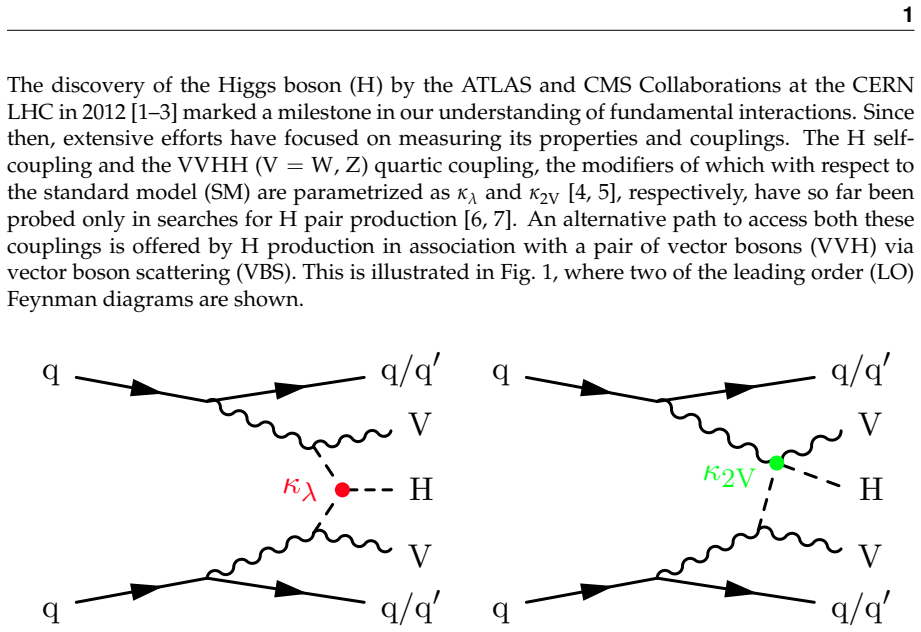
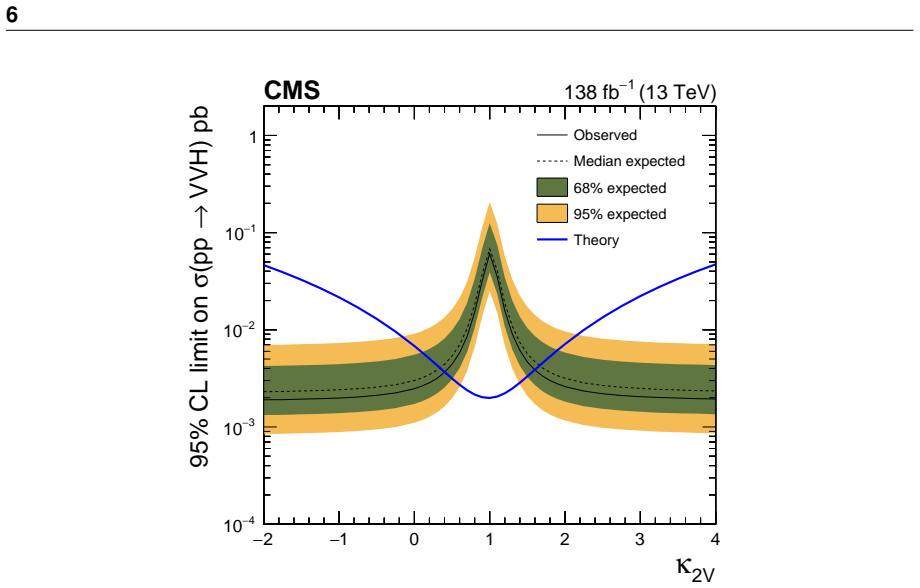
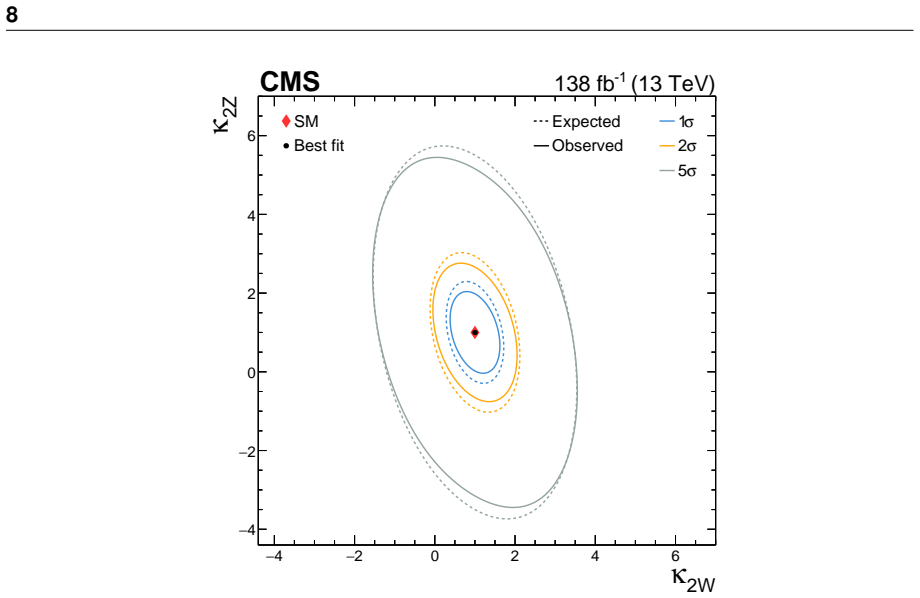
Using 138 fb^{-1} of 13 TeV data, the search excludes the VVHH process at 95% CL for observed (expected) values of the coupling modifier κ_VV outside 0.40 < κ_VV < 1.60 (0.34 < κ_VV < 1.66), assuming standard-model values for all other couplings. Separate limits are placed on κ_2W and κ_2Z, and on the allowed region in the two-dimensional κ_2W-κ_2Z plane.
What carries the argument
The effective coupling modifier κ_VV that rescales the strength of the direct interaction between two vector bosons and the Higgs boson.
If this is right
- The VVHH interaction can be tested independently of other Higgs couplings.
- Separate constraints are obtained on the individual modifiers κ_2W and κ_2Z.
- The allowed region in the κ_2W-κ_2Z plane is delimited by the data.
- This channel opens a new experimental window on quartic Higgs-vector boson couplings.
Where Pith is reading between the lines
- Deviations of κ_VV from unity would signal physics beyond the standard model that modifies the Higgs-vector boson sector.
- Higher-luminosity LHC runs can tighten the interval around the standard-model value of 1.
- The same final-state signatures could be combined with other Higgs measurements to reduce model dependence.
Load-bearing premise
All other Higgs couplings are fixed to their standard-model values.
What would settle it
An observed excess of events in the signal region that is inconsistent with the predicted rate for any κ_VV inside the quoted interval would invalidate the exclusion.
Figures

read the original abstract
A search for Higgs boson (H) production in association with two vector bosons (V = W, Z) via vector boson scattering (VBS) is presented using proton-proton collision data collected at $\sqrt{s}$ = 13 TeV by the CMS experiment, corresponding to an integrated luminosity of 138 fb$^{-1}$. Events containing two forward jets consistent with VBS, a large-radius jet from the decay of a boosted H to a pair of b quarks, and 0, 1, or 2 charged leptons coming from V decays are selected. The process is excluded at 95% CL for observed (expected) values of the VVHH coupling modifier $\kappa_\mathrm{VV}$ outside the interval 0.40 $\lt$ $\kappa_\mathrm{VV}$ $\lt$ 1.60 (0.34 $\lt$ $\kappa_\mathrm{VV}$ $\lt$ 1.66), assuming standard model values for all other couplings, thus establishing a novel probe of the VVHH interaction. Constraints are also set on the individual $\kappa_\mathrm{2W}$ and $\kappa_\mathrm{2Z}$ coupling modifiers, and on the allowed region in the $\kappa_\mathrm{2W}$-$\kappa_\mathrm{2Z}$ plane.
Editorial analysis
A structured set of objections, weighed in public.
Referee Report
Summary. The manuscript reports a search for associated production of a Higgs boson with two vector bosons (V = W, Z) via vector boson scattering in 13 TeV proton-proton collisions collected by CMS with 138 fb^{-1} of integrated luminosity. Events are selected requiring two forward jets consistent with VBS topology, a large-radius jet from the boosted H → bb decay, and 0, 1, or 2 charged leptons from the vector boson decays. The central result is a 95% CL exclusion of the VVHH coupling modifier κ_VV outside the interval 0.40 < κ_VV < 1.60 (observed) and 0.34 < κ_VV < 1.66 (expected) under the assumption that all other couplings take their Standard Model values. Additional limits are set on the individual modifiers κ_2W and κ_2Z and on the allowed region in the κ_2W–κ_2Z plane.
Significance. If the result holds, the analysis provides the first direct experimental constraint on the VVHH quartic coupling in the VBS channel, offering a novel and complementary probe of the Higgs sector that is sensitive to potential new physics contributions. The use of the VBS topology together with boosted Higgs reconstruction is well-matched to the kinematics of the process and leverages the full Run-2 dataset effectively. The paper clearly states the assumption of SM values for other couplings, making the reported interval conditional but unambiguous. Credit is due for the explicit provision of both observed and expected limits and for extending the constraints to the two-dimensional κ_2W–κ_2Z plane.
minor comments (3)
- Abstract: While the exclusion interval is stated clearly, a single sentence summarizing the dominant background estimation technique and the treatment of the leading systematic uncertainties would improve the standalone readability of the abstract without lengthening it appreciably.
- Section 5 (Results): The text refers to the 'signal strength' parameterization but does not explicitly cross-reference the definition of the signal strength modifier used in the likelihood fit; adding a brief reminder of its relation to κ_VV would aid readers.
- Figure 4: The caption for the two-dimensional limit contour should state the assumed values of the other couplings and the exact confidence level (95% CL) to avoid any ambiguity when the figure is viewed in isolation.
Simulated Author's Rebuttal
We thank the referee for the positive assessment of our analysis and the recommendation for minor revision. No major comments were raised in the report.
Circularity Check
No significant circularity; result is data-driven exclusion limit
full rationale
The paper reports a standard experimental search for VBS-associated HH production in 138 fb^{-1} of 13 TeV pp data. Event selection, background estimation, and statistical limits on κ_VV (and κ_2W, κ_2Z) are obtained by comparing observed yields in signal regions to Monte Carlo predictions under the stated assumption that all other couplings equal their SM values. No equation or self-citation reduces the reported interval to a fitted parameter by construction, nor does any uniqueness theorem or ansatz from prior author work serve as the load-bearing justification. The explicit conditioning on SM values for other couplings is stated in the abstract and does not create an internal loop.
Axiom & Free-Parameter Ledger
axioms (1)
- domain assumption Standard-model values for all couplings other than κ_VV, κ_2W, and κ_2Z
Reference graph
Works this paper leans on
-
[1]
ATLAS Collaboration, “Observation of a new particle in the search for the standard References 9 model Higgs boson with the ATLAS detector at the LHC”,Phys. Lett. B716(2012) 1, doi:10.1016/j.physletb.2012.08.020,arXiv:1207.7214
work page internal anchor Pith review doi:10.1016/j.physletb.2012.08.020 2012
-
[2]
CMS Collaboration, “Observation of a new boson at a mass of 125 GeV with the CMS experiment at the LHC”,Phys. Lett. B716(2012) 30, doi:10.1016/j.physletb.2012.08.021,arXiv:1207.7235
-
[3]
Observation of a new boson with mass near 125 GeV in pp collisions at √s=7 and 8 TeV
CMS Collaboration, “Observation of a new boson with mass near 125 GeV in pp collisions at √s=7 and 8 TeV”,JHEP06(2013) 081, doi:10.1007/JHEP06(2013)081,arXiv:1303.4571
-
[4]
Handbook of LHC Higgs cross sections: 3. Higgs properties
LHC Higgs Cross Section Working Group, S. Heinemeyer et al., “Handbook of LHC Higgs cross sections: 3. Higgs properties”, CERN Report CERN-2013-004, 2013. doi:10.5170/CERN-2013-004,arXiv:1307.1347
-
[5]
LHC Higgs Cross Section Working Group, D. de Florian et al., “Handbook of LHC Higgs cross sections: 4. Deciphering the nature of the Higgs sector”, CERN Report CERN-2017-002-M, 2016.doi:10.23731/CYRM-2017-002,arXiv:1610.07922
-
[6]
CMS Collaboration, “Combination of searches for nonresonant Higgs boson pair production in proton-proton collisions at √s= 13 TeV”, 2025.arXiv:2510.07527. Submitted to Journal of Physics G
-
[7]
ATLAS Collaboration, “Combination of searches for Higgs boson pair production in pp collisions at √s= 13 TeV with the ATLAS detector”,Phys. Rev. Lett.133(2024) 101801, doi:10.1103/PhysRevLett.133.101801,arXiv:2406.09971
-
[8]
J. Alwall et al., “The automated computation of tree-level and next-to-leading order differential cross sections, and their matching to parton shower simulations”,JHEP07 (2014) 079,doi:10.1007/JHEP07(2014)079,arXiv:1405.0301
-
[9]
CMS Collaboration, “Search for Higgs boson pair production with one associated vector boson in proton-proton collisions at √s=13 TeV”,JHEP10(2024) 061, doi:10.1007/JHEP10(2024)061,arXiv:2404.08462
-
[10]
The CMS experiment at the CERN LHC
CMS Collaboration, “The CMS experiment at the CERN LHC”,JINST3(2008) S08004, doi:10.1088/1748-0221/3/08/S08004
-
[11]
Development of the CMS detector for the CERN LHC Run 3
CMS Collaboration, “Development of the CMS detector for the CERN LHC Run 3”, JINST19(2024) P05064,doi:10.1088/1748-0221/19/05/P05064, arXiv:2309.05466
-
[12]
Performance of the CMS Level-1 trigger in proton-proton collisions at √s=13 TeV
CMS Collaboration, “Performance of the CMS Level-1 trigger in proton-proton collisions at √s=13 TeV”,JINST15(2020) P10017,doi:10.1088/1748-0221/15/10/P10017, arXiv:2006.10165
-
[13]
CMS Collaboration, “The CMS trigger system”,JINST12(2017) P01020, doi:10.1088/1748-0221/12/01/P01020,arXiv:1609.02366
-
[14]
Performance of the CMS high-level trigger during LHC Run 2
CMS Collaboration, “Performance of the CMS high-level trigger during LHC Run 2”, JINST19(2024) P11021,doi:10.1088/1748-0221/19/11/P11021, arXiv:2410.17038. 10
-
[15]
Electron and photon reconstruction and identification with the CMS experiment at the CERN LHC
CMS Collaboration, “Electron and photon reconstruction and identification with the CMS experiment at the CERN LHC”,JINST16(2021) P05014, doi:10.1088/1748-0221/16/05/P05014,arXiv:2012.06888
-
[16]
CMS Collaboration, “Performance of the CMS muon detector and muon reconstruction with proton-proton collisions at √s=13 TeV”,JINST13(2018) P06015, doi:10.1088/1748-0221/13/06/P06015,arXiv:1804.04528
work page internal anchor Pith review doi:10.1088/1748-0221/13/06/p06015 2018
-
[17]
Description and performance of track and primary-vertex reconstruction with the CMS tracker
CMS Collaboration, “Description and performance of track and primary-vertex reconstruction with the CMS tracker”,JINST9(2014) P10009, doi:10.1088/1748-0221/9/10/P10009,arXiv:1405.6569
-
[18]
Particle-flow reconstruction and global event description with the CMS detector
CMS Collaboration, “Particle-flow reconstruction and global event description with the CMS detector”,JINST12(2017) P10003,doi:10.1088/1748-0221/12/10/P10003, arXiv:1706.04965
work page internal anchor Pith review doi:10.1088/1748-0221/12/10/p10003 2017
-
[19]
CMS Collaboration, “Performance of reconstruction and identification ofτleptons decaying to hadrons andν τ in pp collisions at √s=13 TeV”,JINST13(2018) P10005, doi:10.1088/1748-0221/13/10/P10005,arXiv:1809.02816
-
[20]
Jet energy scale and resolution in the CMS experiment in pp collisions at 8 TeV
CMS Collaboration, “Jet energy scale and resolution in the CMS experiment in pp collisions at 8 TeV”,JINST12(2017) P02014, doi:10.1088/1748-0221/12/02/P02014,arXiv:1607.03663
-
[21]
CMS Collaboration, “Performance of missing transverse momentum reconstruction in proton-proton collisions at √s=13 TeV using the CMS detector”,JINST14(2019) P07004,doi:10.1088/1748-0221/14/07/P07004,arXiv:1903.06078
-
[22]
Technical proposal for the Phase-II upgrade of the Compact Muon Solenoid
CMS Collaboration, “Technical proposal for the Phase-II upgrade of the Compact Muon Solenoid”, CMS Technical Proposal CERN-LHCC-2015-010, CMS-TDR-15-02, 2015
2015
-
[23]
ECAL 2016 refined calibration and Run2 summary plots
CMS Collaboration, “ECAL 2016 refined calibration and Run2 summary plots”, CMS Detector Performance Summary CMS-DP-2020-021, 2020
2016
-
[24]
CMS Collaboration, “Measurement of the Higgs boson production rate in association with top quarks in final states with electrons, muons, and hadronically decaying tau leptons at √s=13 TeV”,Eur. Phys. J. C81(2021) 378, doi:10.1140/epjc/s10052-021-09014-x,arXiv:2011.03652
-
[25]
Identification of hadronic tau lepton decays using a deep neural network
CMS Collaboration, “Identification of hadronic tau lepton decays using a deep neural network”,JINST17(2022) P07023,doi:10.1088/1748-0221/17/07/P07023, arXiv:2201.08458
-
[26]
M. Cacciari, G. P . Salam, and G. Soyez, “The anti-kT jet clustering algorithm”,JHEP04 (2008) 063,doi:10.1088/1126-6708/2008/04/063,arXiv:0802.1189
-
[27]
M. Cacciari, G. P . Salam, and G. Soyez, “FastJet user manual”,Eur. Phys. J. C72(2012) 1896,doi:10.1140/epjc/s10052-012-1896-2,arXiv:1111.6097
-
[28]
Pileup mitigation at CMS in 13 TeV data
CMS Collaboration, “Pileup mitigation at CMS in 13 TeV data”,JINST15(2020) P09018, doi:10.1088/1748-0221/15/09/P09018,arXiv:2003.00503
-
[29]
Pileup per particle identification
D. Bertolini, P . Harris, M. Low, and N. Tran, “Pileup per particle identification”,JHEP10 (2014) 059,doi:10.1007/JHEP10(2014)059,arXiv:1407.6013. References 11
-
[30]
H. Qu and L. Gouskos, “ParticleNet: Jet tagging via particle clouds”,Phys. Rev. D101 (2020) 056019,doi:10.1103/PhysRevD.101.056019,arXiv:1902.08570
-
[31]
A. J. Larkoski, S. Marzani, G. Soyez, and J. Thaler, “Soft drop”,JHEP05(2014) 146, doi:10.1007/JHEP05(2014)146,arXiv:1402.2657
-
[32]
Towards an understanding of jet substructure
M. Dasgupta, A. Fregoso, S. Marzani, and G. P . Salam, “Towards an understanding of jet substructure”,JHEP09(2013) 029,doi:10.1007/JHEP09(2013)029, arXiv:1307.0007
-
[33]
Jet substructure as a new Higgs search channel at the LHC
J. M. Butterworth, A. R. Davison, M. Rubin, and G. P . Salam, “Jet substructure as a new Higgs search channel at the LHC”,Phys. Rev. Lett.100(2008) 242001, doi:10.1103/PhysRevLett.100.242001,arXiv:0802.2470
-
[34]
Identification of heavy-flavour jets with the CMS detector in pp collisions at 13 TeV
CMS Collaboration, “Identification of heavy-flavour jets with the CMS detector in pp collisions at 13 TeV”,JINST13(2018) P05011, doi:10.1088/1748-0221/13/05/P05011,arXiv:1712.07158
work page Pith review doi:10.1088/1748-0221/13/05/p05011 2018
-
[35]
Jet flavour classification using DeepJet
E. Bols et al., “Jet flavour classification using DeepJet”,JINST15(2020) P12012, doi:10.1088/1748-0221/15/12/P12012,arXiv:2008.10519
-
[36]
Performance of the DeepJet b tagging algorithm using 41.9 fb −1 of data from proton-proton collisions at 13 TeV with Phase 1 CMS detector
CMS Collaboration, “Performance of the DeepJet b tagging algorithm using 41.9 fb −1 of data from proton-proton collisions at 13 TeV with Phase 1 CMS detector”, CMS Detector Performance Summary CMS-DP-2018-058, 2018
2018
-
[37]
T. Sj ¨ostrand et al., “An introduction to PYTHIA 8.2”,Comput. Phys. Commun.191(2015) 159,doi:10.1016/j.cpc.2015.01.024,arXiv:1410.3012
-
[38]
B. Cabouat and T. Sj ¨ostrand, “Some dipole shower studies”,Eur. Phys. J. C78(2018) 226, doi:10.1140/epjc/s10052-018-5645-z,arXiv:1710.00391
-
[39]
On the maximal use of Monte Carlo samples: re-weighting events at NLO accuracy
O. Mattelaer, “On the maximal use of Monte Carlo samples: re-weighting events at NLO accuracy”,Eur. Phys. J. C76(2016) 674,doi:10.1140/epjc/s10052-016-4533-7, arXiv:1607.00763
-
[40]
A Positive-Weight Next-to-Leading-Order Monte Carlo for Heavy Flavour Hadroproduction
S. Frixione, P . Nason, and G. Ridolfi, “A positive-weight next-to-leading-order Monte Carlo for heavy flavour hadroproduction”,JHEP09(2007) 126, doi:10.1088/1126-6708/2007/09/126,arXiv:0707.3088
work page Pith review doi:10.1088/1126-6708/2007/09/126 2007
-
[41]
A New Method for Combining NLO QCD with Shower Monte Carlo Algorithms
P . Nason, “A new method for combining NLO QCD with shower Monte Carlo algorithms”,JHEP11(2004) 040,doi:10.1088/1126-6708/2004/11/040, arXiv:hep-ph/0409146
work page internal anchor Pith review doi:10.1088/1126-6708/2004/11/040 2004
-
[42]
Matching NLO QCD computations with Parton Shower simulations: the POWHEG method
S. Frixione, P . Nason, and C. Oleari, “Matching NLO QCD computations with parton shower simulations: the POWHEG method”,JHEP11(2007) 070, doi:10.1088/1126-6708/2007/11/070,arXiv:0709.2092
work page internal anchor Pith review doi:10.1088/1126-6708/2007/11/070 2007
-
[43]
A general framework for implementing NLO calculations in shower Monte Carlo programs: the POWHEG BOX
S. Alioli, P . Nason, C. Oleari, and E. Re, “A general framework for implementing NLO calculations in shower Monte Carlo programs: the POWHEG BOX”,JHEP06(2010) 043, doi:10.1007/JHEP06(2010)043,arXiv:1002.2581
work page internal anchor Pith review doi:10.1007/jhep06(2010)043 2010
-
[44]
J. Alwall et al., “Comparative study of various algorithms for the merging of parton showers and matrix elements in hadronic collisions”,Eur. Phys. J. C53(2008) 473, doi:10.1140/epjc/s10052-007-0490-5,arXiv:0706.2569. 12
-
[45]
Extraction and validation of a new set of CMS PYTHIA8 tunes from underlying-event measurements
CMS Collaboration, “Extraction and validation of a new set of CMS PYTHIA8 tunes from underlying-event measurements”,Eur. Phys. J. C80(2020) 4, doi:10.1140/epjc/s10052-019-7499-4,arXiv:1903.12179
-
[46]
Ball, et al., JHEP04, 040 (2015)
NNPDF Collaboration, “Parton distributions for the LHC Run II”,JHEP04(2015) 040, doi:10.1007/JHEP04(2015)040,arXiv:1410.8849
-
[47]
Parton distributions from high-precision collider data
NNPDF Collaboration, “Parton distributions from high-precision collider data”,Eur. Phys. J. C77(2017) 663,doi:10.1140/epjc/s10052-017-5199-5, arXiv:1706.00428
work page Pith review doi:10.1140/epjc/s10052-017-5199-5 2017
-
[48]
GEANT4 Collaboration, “GEANT4—a simulation toolkit”,Nucl. Instrum. Meth. A506 (2003) 250,doi:10.1016/S0168-9002(03)01368-8
-
[49]
Measurement ofσB(W→eν)andσB(Z 0 →e +e−)in ¯ppcollisions at √s=1800 GeV
CDF Collaboration, “Measurement ofσB(W→eν)andσB(Z 0 →e +e−)in ¯ppcollisions at √s=1800 GeV”,Phys. Rev. D44(1991) 29,doi:10.1103/PhysRevD.44.29
-
[50]
Automating the ABCD method with machine learning
G. Kasieczka, B. Nachman, M. D. Schwartz, and D. Shih, “Automating the ABCD method with machine learning”,Phys. Rev. D103(2021) 035021, doi:10.1103/PhysRevD.103.035021,arXiv:2007.14400
-
[51]
Particle Data Group, S. Navas et al., “Review of particle physics”,Phys. Rev. D110 (2024) 030001,doi:10.1103/PhysRevD.110.030001
-
[52]
The CMS statistical analysis and combination tool: COMBINE
CMS Collaboration, “The CMS statistical analysis and combination tool: Combine”, Comput. Softw. Big Sci.8(2024) 19,doi:10.1007/s41781-024-00121-4, arXiv:2404.06614
-
[53]
The RooFit toolkit for data modeling
W. Verkerke and D. Kirkby, “The ROOFITtoolkit for data modeling”, inProc. 13th Int. Conf. on Computing in High Energy and Nuclear Physics (CHEP 2003): La Jolla CA, United States, March 24–28, 2003. 2003.arXiv:physics/0306116
work page Pith review arXiv 2003
-
[54]
L. Moneta et al., “The ROOSTATSproject”, inProc. 13th Int. Workshop on Advanced Computing and Analysis T echniques in Physics Research (ACAT 2010): Jaipur, India, February 22–27, 2010. 2010.arXiv:1009.1003.doi:10.22323/1.093.0057
-
[55]
Precision luminosity measurement in proton-proton collisions at√s=13 TeV in 2015 and 2016 at CMS
CMS Collaboration, “Precision luminosity measurement in proton-proton collisions at√s=13 TeV in 2015 and 2016 at CMS”,Eur. Phys. J. C81(2021) 800, doi:10.1140/epjc/s10052-021-09538-2,arXiv:2104.01927
-
[56]
CMS luminosity measurement for the 2017 data-taking period at√s=13 TeV
CMS Collaboration, “CMS luminosity measurement for the 2017 data-taking period at√s=13 TeV”, CMS Physics Analysis Summary CMS-PAS-LUM-17-004, 2018
2017
-
[57]
CMS luminosity measurement for the 2018 data-taking period at√s=13 TeV
CMS Collaboration, “CMS luminosity measurement for the 2018 data-taking period at√s=13 TeV”, CMS Physics Analysis Summary CMS-PAS-LUM-18-002, 2019
2018
-
[58]
HEPData record for this analysis, 2026.doi:10.17182/hepdata.161535
-
[59]
Supplemental Material
“Supplemental Material”. [URL will be inserted by publisher]. 13 A End Matter A.1 Event selection This section details the event selections used in each channel before multivariate analyses are performed. In the all-hadronic channels, events of interest are collected using triggers based onH T, with thresholds of 800 or 900 GeV for 2016, and 1050 GeV for ...
2016
discussion (0)
Sign in with ORCID, Apple, or X to comment. Anyone can read and Pith papers without signing in.