Recognition: unknown
Quenching of the proton π0p_{3/2}-π0p_{1/2} spin-orbit splitting in ²⁰O and the effect of the tensor force
Pith reviewed 2026-05-07 16:59 UTC · model grok-4.3
The pith
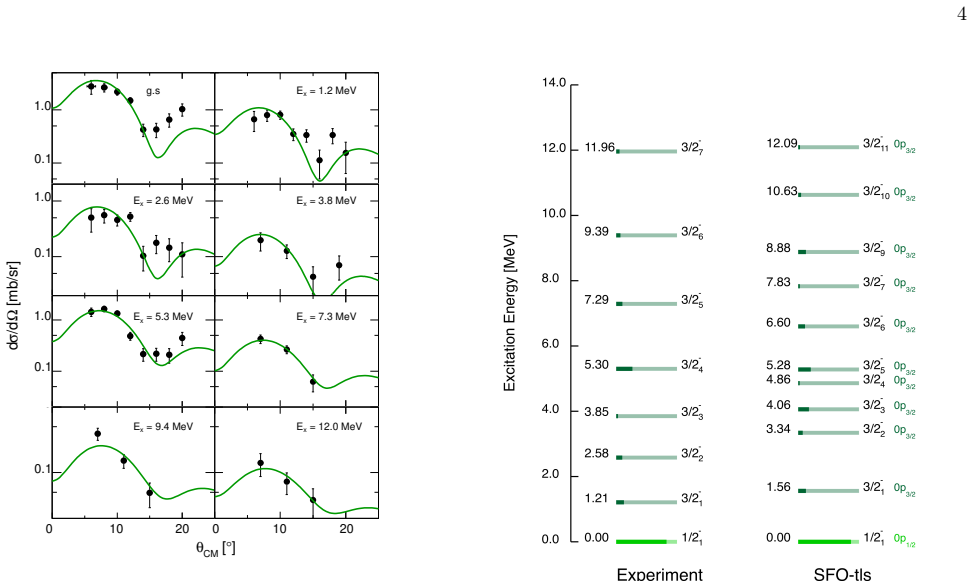
The Z=6 shell gap in oxygen-20 measures 5.30 MeV, showing quenching of the proton spin-orbit splitting as neutrons fill the sd orbitals.
A machine-rendered reading of the paper's core claim, the machinery that carries it, and where it could break.
Core claim
The proton 0p3/2 - 0p1/2 spin-orbit splitting in 20O has been directly extracted as 5.30(14) MeV from the energies and spectroscopic factors of eight p-hole states populated in 19N. This establishes a reduction of the Z=6 shell gap upon addition of neutrons to the sd-valence orbitals, consistent with tensor-force predictions of the SFO-tls interaction while at variance with indications of a large gap in other work.
What carries the argument
The energies and spectroscopic factors of the eight l=1 p-hole states in 19N from the one-proton removal reaction, which determine the proton single-particle energies and their splitting in the parent 20O nucleus.
If this is right
- The Z=6 shell gap decreases as neutrons are added to the sd-valence orbitals.
- The tensor force is the mechanism responsible for quenching the proton spin-orbit splitting.
- The SFO-tls shell-model interaction correctly reproduces the observed reduction.
- Earlier reports of a large Z=6 gap in this region are at variance with this direct measurement.
Where Pith is reading between the lines
- Similar quenching of proton gaps may occur in other closed proton shells when neutrons occupy higher orbitals.
- The reduced gap value would alter predictions for binding energies and drip-line locations in nearby neutron-rich nuclei.
- Mapping the gap evolution in 18O or 22O with the same method could confirm the neutron-number dependence.
Load-bearing premise
The eight identified p-hole states fully represent the single-particle orbitals with the quoted strengths of 86% and 72%, and the one-proton removal reaction cleanly probes the proton orbitals without significant distortions from reaction mechanisms or multi-step processes.
What would settle it
An independent experiment, such as a higher-resolution measurement of the same reaction or a different probe like electron scattering, that extracts a Z=6 shell gap value clearly outside the reported 5.30(14) MeV range would falsify the result.
Figures



read the original abstract
We present the first direct measurement of the Z=6 shell gap in the neutron-rich 20O nucleus. The one-proton removal transfer reaction 2H(20O,3He)19N has been studied using the ACTAR TPC setup at GANIL. The use of ACTAR TPC enabled the measurement of low-cross section proton-removal reactions while preserving resolution. Eight p-hole states with l=1 were identified in 19N accounting for total strengths of 86% and 72% of the 0p3/2 and 0p1/2 single-particle orbitals, respectively. The energies and spectroscopic factors of the measured states allowed to determine the proton spin-orbit splitting 0p3/2 - 0p1/2 in 20O. The Z=6 shell gap has been established to be 5.30(14) MeV. These findings indicate a reduction of the Z=6 shell gap while adding neutrons to the sd-valence orbitals, consistent with the effects of the tensor force predicted by state-of-the-art shell model interaction SFO-tls while at variance with the emergence of a large Z=6 gap observed in other studies.
Editorial analysis
A structured set of objections, weighed in public.
Referee Report
Summary. The paper claims to have performed the first direct measurement of the Z=6 shell gap in the neutron-rich nucleus ^{20}O using the one-proton removal reaction ^{2}H(^{20}O,^{3}He)^{19}N with the ACTAR TPC setup at GANIL. Eight l=1 proton-hole states in ^{19}N were identified, accounting for 86% and 72% of the sum-rule strengths for the 0p_{3/2} and 0p_{1/2} orbitals. The energies and spectroscopic factors were used to determine the proton spin-orbit splitting, establishing the Z=6 shell gap at 5.30(14) MeV. The results suggest a reduction of this gap with increasing neutrons in sd orbitals, consistent with tensor force effects in the SFO-tls interaction but differing from other studies showing a large gap.
Significance. This experimental result, if confirmed, is significant as it provides evidence for the role of the tensor force in modifying shell structure in neutron-rich nuclei, specifically quenching the proton spin-orbit splitting. It addresses discrepancies in the literature regarding the Z=6 gap and supports advanced shell-model calculations. The technical approach using ACTAR TPC to handle low cross sections while maintaining resolution is a strength that could be applicable to other rare-isotope studies.
major comments (2)
- [Results section on strength sums and centroid calculation] The gap determination (5.30(14) MeV) is obtained from energy centroids of the 0p_{3/2} and 0p_{1/2} orbitals weighted by the extracted spectroscopic factors. With only 86% and 72% of the respective sum-rule strengths accounted for by the eight observed states, any unobserved fragments outside the measured excitation range would shift the centroids; the manuscript must quantify this possible shift to justify that the quoted uncertainty fully captures the effect.
- [Experimental methods and DWBA analysis] The spectroscopic factors are extracted assuming a direct one-step transfer mechanism in the (d,^{3}He) reaction. No quantitative assessment of possible multi-step contributions or sensitivity to optical-model parameters is provided, yet these directly impact the strengths used for the gap; this assumption is load-bearing for the central claim.
minor comments (2)
- [Results] The abstract states the gap value but the main text should include a dedicated paragraph or table explicitly listing the eight states with their excitation energies, l assignments, and individual spectroscopic factors for transparency.
- [Discussion] Add a brief comparison plot or table showing the experimental gap against the SFO-tls prediction and the values from the 'other studies' mentioned, to make the consistency/variance claim more quantitative.
Simulated Author's Rebuttal
We thank the referee for the careful and constructive review of our manuscript. The comments highlight important aspects of the analysis that we have addressed by adding quantitative estimates and sensitivity discussions in the revised version. Below we respond point by point to the major comments.
read point-by-point responses
-
Referee: The gap determination (5.30(14) MeV) is obtained from energy centroids of the 0p_{3/2} and 0p_{1/2} orbitals weighted by the extracted spectroscopic factors. With only 86% and 72% of the respective sum-rule strengths accounted for by the eight observed states, any unobserved fragments outside the measured excitation range would shift the centroids; the manuscript must quantify this possible shift to justify that the quoted uncertainty fully captures the effect.
Authors: We agree that the partial sum-rule exhaustion requires explicit quantification of possible centroid shifts from unobserved strength. In the revised manuscript we have added an estimate assuming all missing strength (14% for 0p_{3/2}, 28% for 0p_{1/2}) lies above the measured range at the highest plausible excitation energy (~10 MeV). This yields maximum centroid shifts of 0.05 MeV and 0.08 MeV, respectively—both smaller than the quoted 0.14 MeV uncertainty. The discussion and resulting robustness check have been inserted in the Results section on strength sums and centroid calculation. revision: yes
-
Referee: The spectroscopic factors are extracted assuming a direct one-step transfer mechanism in the (d,^{3}He) reaction. No quantitative assessment of possible multi-step contributions or sensitivity to optical-model parameters is provided, yet these directly impact the strengths used for the gap; this assumption is load-bearing for the central claim.
Authors: We acknowledge that a full coupled-channels treatment of multi-step processes lies beyond the present scope. However, the reaction kinematics and the quality of the DWBA fits to the measured angular distributions support the dominance of the direct mechanism. For optical-model sensitivity we have now performed a systematic variation of the global potential parameters within their accepted uncertainties. The absolute spectroscopic factors change by up to 15%, but the relative strengths that enter the centroid calculation vary by less than 5%, leaving the 5.30(14) MeV gap unchanged within the quoted uncertainty. This analysis and its justification have been added to the Experimental Methods and DWBA Analysis section. revision: partial
Circularity Check
No circularity: direct experimental extraction of Z=6 shell gap from reaction data
full rationale
The central result (Z=6 gap of 5.30(14) MeV) is obtained by forming energy centroids of the 0p3/2 and 0p1/2 orbitals in 20O, weighted by spectroscopic factors extracted from measured 2H(20O,3He)19N cross sections and l=1 assignments in 19N. This is a direct reduction of experimental observables (energies, yields, angular distributions) rather than any self-referential equation, fitted parameter renamed as prediction, or self-citation chain. The paper explicitly notes that the eight states account for only 86% and 72% of sum-rule strength, treating missing fragments as an uncertainty source rather than assuming completeness by construction. Comparison to the SFO-tls interaction is presented only as post-measurement consistency, not as input to the gap value. No load-bearing step reduces to its own inputs.
Axiom & Free-Parameter Ledger
Reference graph
Works this paper leans on
-
[1]
This interpretation is supported by (p,2p) measurements at GSI performed by I
to account for the enhanced collectivity observed in 20C, similar to the 1 p1/2-1p3/2 reduction reported in neutron rich Sr-Zr isotopes [27]. This interpretation is supported by (p,2p) measurements at GSI performed by I. Syndikus et al. [28], which quantified the increase in the proton component of the 2 + state in n-rich carbon isotopes. However, none of...
2020
-
[2]
Galitski and Ian B
V. Galitski and Ian B. Spielman, Nature 494 (2013) 49- 54
2013
-
[3]
Uhlenbeck, S
G.E. Uhlenbeck, S. Goudsmit , Nature 117 (1926) 264
1926
-
[4]
Fabian, and S
I.Žutic, J. Fabian, and S. Das Sarma, Rev. Mod. Phys. 76 (2004) 323
2004
-
[5]
M. G. Mayer , Phys. Rev. 78 (1950) 16
1950
-
[6]
M. G. Mayer , Phys. Rev. 78 (1950) 22
1950
-
[7]
Schiffer et al., Phys
J.P. Schiffer et al., Phys. Rev. Lett. 92(16) (2004), 162501
2004
-
[8]
Gaudefroy et al., Phys
L. Gaudefroy et al., Phys. Rev. Lett. 97 (2006), 092501
2006
-
[9]
Burgunder et al., Phys
G. Burgunder et al., Phys. Rev. Lett. 112 (2014), 042502
2014
-
[10]
Orlandi et al., Phys
R. Orlandi et al., Phys. Lett. B 785 (2018), 615
2018
-
[11]
Chen et al., Phys
J. Chen et al., Phys. Lett. B 853 (2024), 138678
2024
-
[12]
Dobaczewski et al., Phys
J. Dobaczewski et al., Phys. Rev. Lett. 72(7) (1994) 981
1994
-
[13]
Lalazissis et al., Phys
G.A. Lalazissis et al., Phys. Lett. B 418 (1998) 7
1998
-
[14]
Mutschler et al., Nature Phys., 13 (2017), 152-156
A. Mutschler et al., Nature Phys., 13 (2017), 152-156
2017
-
[15]
Todd-Rutel et al., Phys
B.G. Todd-Rutel et al., Phys. Rev. C 69 (2004) 021301(R)
2004
-
[16]
López-Quelle., J
M. López-Quelle., J. Phys. G: Nucl. Part. Phys. 36 (2009) 045105
2009
-
[17]
Grasso and M
M. Grasso and M. Anguiano Phys. Rev. C 92 (2015), 054316
2015
-
[18]
Karakatsanis et al., Phys
K. Karakatsanis et al., Phys. Rev. C 95 (2017), 034318
2017
-
[19]
Sorlin, F
O. Sorlin, F. de Oliveira Santos and J.P. Ebran Phys. Lett. B 809 (2020), 135740
2020
-
[20]
Hamamoto, S.V
I. Hamamoto, S.V. Lukyanov and X.Z. Zhang, Nuc. 6 Phys. A 683 (2001), 255
2001
-
[21]
Kay, C.R
B.P. Kay, C.R. Hoffman and A.O. Macchiavelli, Phys. Rev. Lett. 119 (2017), 182502
2017
-
[22]
Chen, Front
J. Chen, Front. Phys. 13 (2025), 1510848
2025
-
[23]
Otsuka et al., Rev
T. Otsuka et al., Rev. Mod. Phys. 92 (2020), 015002
2020
-
[24]
Dobaczewski et al., Phys
J. Dobaczewski et al., Phys. Rev. C 53 (1996), 2809
1996
-
[25]
Meng and I
J. Meng and I. Tanihata, Nucl. Phys. A 650 (1999), 176
1999
-
[26]
Tran et al., Nature Communications 9 (2018) 1594
D.T. Tran et al., Nature Communications 9 (2018) 1594
2018
-
[27]
Macchiavelli et al., Phys
A.O. Macchiavelli et al., Phys. Rev. C 90(6) (2014), 067305
2014
-
[28]
Federman, S
P. Federman, S. Pittel, A. Etchegoyen, Phys. Lett. B 140(5) (1984), 269-271
1984
-
[29]
Syndikus et al., Phys
I. Syndikus et al., Phys. Lett. B 809 (2020), 135748
2020
-
[30]
Anne and A.C
R. Anne and A.C. Mueller et al., Nucl. Instrum. Meth. B 70 (1992) 276
1992
-
[31]
Roger et al., Nucl
T. Roger et al., Nucl. Instrum. Methods Phys. Res. A 895 (2018) 126
2018
-
[32]
Mauss et al., Nucl
B. Mauss et al., Nucl. Instrum. Methods Phys. Res. A 940 (2019) 498-504
2019
-
[33]
Matta et al., Phys
A. Matta et al., Phys. Rev. C 92 (2015) 041302(R)
2015
-
[34]
Giovinazzo et al., Nucl
J. Giovinazzo et al., Nucl. Instrum. Methods Phys. Res. A 953 (2020) 163184
2020
-
[35]
Lois-Fuentes Ph.D
J. Lois-Fuentes Ph.D. Univ. Santiago de Compostela (2023), http://hdl.handle.net/10347/30947
2023
-
[36]
Wang et al., Chinese Phys
M. Wang et al., Chinese Phys. C 41 (2017) 030003
2017
-
[37]
Catford et al., Nucl
W. Catford et al., Nucl. Phys. A 503 (1989) 263-284
1989
-
[38]
ENSDF, https://www.nndc.bnl.gov/ensdf/
-
[39]
J. A. Tostevin, University of Surrey version of the code TWOFNR (of M. Toyama, M. Igarashi and N. Kishida) and code FRONT: http://nucleartheory.surrey.ac.uk/NPG/code.htm (Accessed 15/08/2025)
2025
-
[40]
W. W. Daehnick, J. D. Childs, and Z. Vrcelj, Phys. Rev. C 21 (1980) 2253
1980
-
[41]
Pang et al., Phys
D.Y. Pang et al., Phys. Rev. C 79 (2009) 024615
2009
-
[42]
Brida, S.C
I. Brida, S.C. Pieper, and R.B. Wiringa, Phys. Rev. C 84 (2011) 024319
2011
-
[43]
Hai et al., Phys
W.L. Hai et al., Phys. Rev. C 110 (2024) 044613
2024
-
[44]
Kameda et al., Nucl
D. Kameda et al., Nucl. Phys. A 734 (2004) 481-484
2004
-
[45]
Baranger, Nucl
M. Baranger, Nucl. Phys. A 149 (1970) 225
1970
-
[46]
Mairle and G.J
G. Mairle and G.J. Wagner , Nucl. Phys. A 258 (1973) 321-327
1973
-
[47]
Bechtold et al., , Phys
V. Bechtold et al., , Phys. Lett. B 72 (1977) 169-172
1977
-
[48]
Mairle et al., , Nucl
G. Mairle et al., , Nucl. Phys. A 280 (1977) 97-108
1977
-
[49]
Leuschner et al., , Phys
M. Leuschner et al., , Phys. Rev. C 70 (1994) 955
1994
-
[50]
Ryckebusch et al., , Phys
J. Ryckebusch et al., , Phys. Lett. B 216 (1989) 252-256
1989
-
[51]
Suzuki, R
T. Suzuki, R. Fujimoto and T. Otsuka, Phys. Rev. C 67 (2003) 044302
2003
-
[52]
Suzuki and T
T. Suzuki and T. Otsuka, Phys. Rev. C 78 (2008) 061301(R)
2008
-
[53]
Otsuka et al., Eur
T. Otsuka et al., Eur. Phys. J. A. 13 (2002) 69-74
2002
-
[54]
Otsuka et al., Phys
T. Otsuka et al., Phys. Rev. Lett. 104 (2010) 012501
2010
-
[55]
Lozano-González et al., Ph.D
M. Lozano-González et al., Ph.D. Thesis University of Santiago de Compostela (2026)
2026
-
[56]
E796-19 Collaboration, E796-19 GANIL dataset, 2022, https://doi.org/10.26143/ganil-2022-e796_19
discussion (0)
Sign in with ORCID, Apple, or X to comment. Anyone can read and Pith papers without signing in.