Recognition: unknown
Generalized flux-weighted boundary walls in kinetic models
Pith reviewed 2026-05-08 01:14 UTC · model grok-4.3
The pith
Generalized boundary reinjection rules produce explicit non-thermal stationary states in collisionless confined systems, with thermal equilibrium only for the standard flux-weighted case.
A machine-rendered reading of the paper's core claim, the machinery that carries it, and where it could break.
Core claim
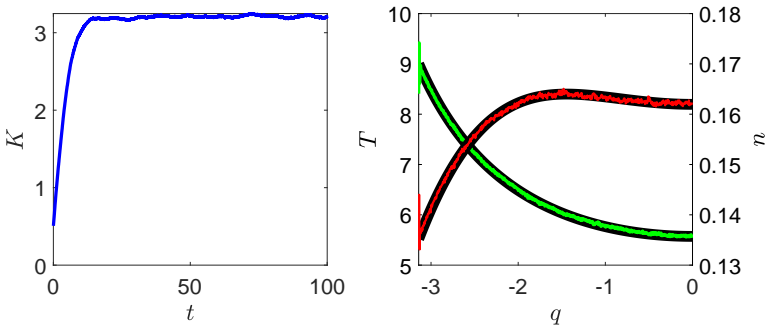
By combining Liouville's theorem with the boundary injection rule, we derive an explicit analytical expression for the stationary distribution function. Thermal equilibrium is recovered only for the standard flux-weighted injection method, while for all other cases the system relaxes to manifestly non-thermal stationary states. The resulting density and temperature profiles exhibit non-trivial spatial structures, including non-monotonic behaviour and temperature gradients induced by the boundary conditions alone.
What carries the argument
The family of generalized boundary injection rules parametrized by an integer n, which sets the velocity distribution imposed on particles reinjected at the walls and is combined with Liouville invariance to fix the stationary distribution.
Load-bearing premise
The system remains strictly collisionless at all times and the prescribed reinjection rules at the boundaries are applied exactly without additional scattering or time-dependent effects.
What would settle it
A particle simulation or measurement that shows a uniform Maxwellian distribution and flat temperature profile for any n other than the standard flux-weighted value would falsify the claim of non-thermal stationary states.
Figures


read the original abstract
We present a technique to investigate the stationary states of a system of a collisionless system confined by an external potential and coupled to boundary reservoirs through prescribed reinjection rules. We consider a family of boundary conditions parametrized by an integer $n$, corresponding to different velocity distributions imposed at the boundaries, generalizing the standard flux-weighted Maxwellian scheme. By combining Liouville's theorem with the boundary injection rule, we derive an explicit analytical expression for the stationary distribution function. This framework provides a direct link between microscopic boundary dynamics and macroscopic stationary profiles. We show that thermal equilibrium is recovered only for the standard flux-weighted injection method, while for all other cases the system relaxes to manifestly non-thermal stationary states. The resulting density and temperature profiles exhibit non-trivial spatial structures, including non-monotonic behaviour and temperature gradients induced by the boundary conditions alone. Analytical predictions for stationary moments are obtained in closed form for representative cases and are nicely reproduced by particle-based numerical simulations.
Editorial analysis
A structured set of objections, weighed in public.
Referee Report
Summary. The paper introduces a parametrized family of boundary reinjection rules (integer n) for a collisionless system in an external potential. Combining Liouville's theorem with the boundary velocity distribution yields an explicit stationary distribution function f(x,v) that is constant along characteristics. The authors show that only the standard flux-weighted Maxwellian injection recovers a uniform thermal equilibrium state; all other n produce non-thermal stationary states featuring non-monotonic density profiles and position-dependent temperatures. Closed-form expressions for the moments are derived for representative n and are reported to agree with particle simulations.
Significance. If the central derivation holds, the work provides a transparent analytic link between microscopic boundary rules and macroscopic stationary profiles in kinetic models. The demonstration that boundary conditions alone can sustain temperature gradients and non-monotonic densities without collisions is a clear, falsifiable result with potential relevance to confined plasmas, trapped gases, and boundary-driven non-equilibrium systems. The supply of closed-form moments together with direct numerical confirmation is a strength.
minor comments (4)
- Abstract, first sentence: 'stationary states of a system of a collisionless system' contains a redundant phrasing that should be corrected for clarity.
- The precise definition of the integer n and the explicit form of the generalized flux-weighted injection rule should be stated in the introduction or §2 before the Liouville application, so that readers can immediately see how n enters the boundary distribution.
- In the numerical validation section, the manuscript should report the number of particles, integration time, and quantitative measure of agreement (e.g., L2 error or maximum deviation) between analytic moments and simulation histograms.
- Figure captions should explicitly list the value(s) of n used and the form of the external potential to improve reproducibility.
Simulated Author's Rebuttal
We thank the referee for the positive and accurate summary of our manuscript, which correctly identifies the central result that only the standard flux-weighted Maxwellian injection recovers thermal equilibrium while other n yield non-thermal states with non-monotonic profiles. We appreciate the recommendation for minor revision.
Circularity Check
No significant circularity
full rationale
The derivation applies Liouville's theorem (standard phase-space conservation for collisionless dynamics) to propagate the chosen boundary injection rule (parametrized by integer n) along characteristics, yielding an explicit stationary f(x,v) that is constant on trajectories. This directly produces the claimed non-thermal profiles and closed-form moments for n ≠ standard flux-weighted case without any parameter fitting, self-referential definition, or load-bearing self-citation. The construction is self-contained against the Vlasov equation plus the stated boundary conditions; numerical confirmation is independent verification rather than circular input.
Axiom & Free-Parameter Ledger
free parameters (1)
- integer n
axioms (1)
- standard math Liouville's theorem: phase-space density is conserved along trajectories in a collisionless system
Reference graph
Works this paper leans on
-
[1]
A. Campa, T. Dauxois, D. Fanelli, S. Ruffo, Physics of Long- Range Interacting Systems, Oxford University Press, 2014. doi:10.1093/acprof:oso/9780199581931.001.0001. URLhttps://doi.org/10.1093/acprof:oso/9780199581931.001.0001
work page doi:10.1093/acprof:oso/9780199581931.001.0001 2014
-
[2]
Binney, S
J. Binney, S. Tremaine, Galactic Dynamics: Second Edition, Princeton University Press, 2008. URLhttps://books.google.it/books?id=6mF4CKxlbLsC
2008
-
[3]
Levin, R
Y. Levin, R. Pakter, T. N. Teles, Collisionless relaxation in non-neutral plasmas, Phys. Rev. Lett. 100 (2008) 040604. 16
2008
-
[4]
T. N. Teles, R. Pakter, Y. Levin, Emittance growth and halo formation in the relaxation of mismatched beams, Phys. Rev. ST Accel. Beams 13 (2010) 114202. doi:10.1103/PhysRevSTAB.13.114202. URLhttps://link.aps.org/doi/10.1103/PhysRevSTAB.13.114202
-
[5]
2012, Physics Reports, 515, 227, doi: https://doi.org/10.1016/j.physrep.2012.02.001 17
F. Bouchet, A. Venaille, Statistical mechanics of two-dimensional and geophysical flows, Physics Reports 515 (5) (2012) 227–295, statistical mechanics of two-dimensional and geophysical flows. doi:https://doi.org/10.1016/j.physrep.2012.02.001. URLhttps://www.sciencedirect.com/science/article/pii/S0370157312000518
-
[6]
S. Schütz, G. Morigi, Prethermalization of atoms due to photon- mediated long-range interactions, Physical Review Letters 113 (20) (2014) 203002. doi:10.1103/PhysRevLett.113.203002
-
[7]
S. Gupta, L. Casetti, Surprises from quenches in long-range interacting systems: temperature inversion and cooling, New Journal of Physics 18 (10) (2016) 103051. doi:10.1088/1367-2630/18/10/103051
-
[8]
, year = 1967, month = jan, volume =
D. Lynden-Bell, Statistical Mechanics of Violent Relaxation in Stellar Systems, Monthly Notices of the Royal Astronomical Society 136 (1) (1967) 101–121. arXiv:https://academic.oup.com/mnras/article- pdf/136/1/101/8075239/mnras136-0101.pdf, doi:10.1093/mnras/136.1.101. URLhttps://doi.org/10.1093/mnras/136.1.101
-
[9]
H. E. Kandrup, Violent relaxation, phase mixing, and gravitational landau damping, The Astrophysical Journal 500 (1) (1998) 120–128. doi:10.1086/305721
-
[10]
I. Arad, D. Lynden-Bell, Inconsistency in theories of violent relaxation, Monthly Notices of the Royal Astronomical Society 361 (2005) 385–395. doi:10.1111/j.1365-2966.2005.09133.x
-
[11]
P.-H. Chavanis, Coarse-grained distributions and superstatistics, Phys- ica A: Statistical Mechanics and its Applications 359 (2006) 177–212. doi:10.1016/j.physa.2005.06.043
-
[12]
P.-H. Chavanis, Quasi-stationary states and incomplete violent relaxation in systems with long-range interactions, Physica A: 17 Statistical Mechanics and its Applications 365 (1) (2006) 102– 107, fundamental Problems of Modern Statistical Mechanics. doi:https://doi.org/10.1016/j.physa.2006.01.006. URLhttps://www.sciencedirect.com/science/article/pii/S037...
-
[13]
L. Beraldo e Silva, M. Valluri, The discreteness-driven relaxation of collisionless gravitating systems: entropy evolution and the nyquist– shannon theorem, The Astrophysical Journal 872 (1) (2019) 20. doi:10.3847/1538-4357/aaf8a7
-
[14]
L. Barbieri, P. Di Cintio, G. Giachetti, A. Simon-Petit, L. Casetti, Symplectic coarse graining approach to the dynamics of spherical self- gravitating systems, Monthly Notices of the Royal Astronomical Society 512 (2) (2022) 3015–3029. doi:10.1093/mnras/stac477
-
[15]
T. N. Teles, R. Pakter, Y. Levin, Phase transitions in the hmf model: be- yond the waterbag initial distributions, Journal of Statistical Mechanics: Theory and Experiment (2025) 073205doi:10.1088/1742-5468/adec63
-
[16]
L. Beraldo e Silva, M. Valluri, E. Vasiliev, K. Hattori, W. de Siqueira Pe- dra, K. J. Daniel, Minimum-entropy constraints on galactic poten- tials, The Astrophysical Journal 990 (2) (2025) 109. doi:10.3847/1538- 4357/adf1e3
-
[17]
S. Lepri, R. Livi, A. Politi, Thermal conduction in classical low-dimensional lattices, Physics Reports 377 (1) (2003) 1–80. doi:https://doi.org/10.1016/S0370-1573(02)00558-6. URLhttps://www.sciencedirect.com/science/article/pii/S0370157302005586
-
[18]
Degl’Innocenti, Elementi di Meccanica dei Fluidi, Termodinamica e Fisica Statistica, Springer Milan, 2019
E. Degl’Innocenti, Elementi di Meccanica dei Fluidi, Termodinamica e Fisica Statistica, Springer Milan, 2019. URLhttps://books.google.it/books?id=GNShDwAAQBAJ
2019
-
[19]
R. Livi, P. Politi, Nonequilibrium Statistical Physics: A Modern Perspective, Cambridge University Press, 2017. doi:10.1017/9781107278974
-
[20]
J. D. Scudder, On the causes of temperature change in inhomogeneous low-densityastrophysicalplasmas, TheAstrophysicalJournal398(1992)
1992
-
[21]
URLhttps://doi.org/10.1086/171858 18
doi:10.1086/171858. URLhttps://doi.org/10.1086/171858 18
-
[22]
J. D. Scudder, Why all stars should possess circumstellar tem- perature inversions, The Astrophysical Journal 398 (1992) 319. doi:10.1086/171859. URLhttps://doi.org/10.1086/171859
-
[23]
L. Barbieri, L. Casetti, A. Verdini, S. Landi, Temperature inversion in a gravitationally bound plasma: Case of the solar corona, A&A 681 (2024) L5. doi:10.1051/0004-6361/202348373
-
[24]
L. Barbieri, L. Casetti, A. Verdini, S. Landi, Temperature and density profiles in the corona of main-sequence stars induced by stochastic heat- ing in the chromosphere (2024). arXiv:2411.07868. URLhttps://arxiv.org/abs/2411.07868
-
[25]
L.-N. Hau, C.-K. Chang, M. Lazar, S. Poedts, Boltzmann–poisson theory of nonthermal self-gravitating gases, cold dark matter, and solar atmosphere, The Astrophysical Journal 981 (1) (2025) 18. doi:10.3847/1538-4357/ada76f. URLhttps://dx.doi.org/10.3847/1538-4357/ada76f
-
[26]
L. Barbieri, P. Démoulin, Kinetic collisionless model of the so- lar transition region and corona with spatially intermittent heating, A&Adoi:10.1051/0004-6361/202557356. URLhttp://dx.doi.org/10.1051/0004-6361/202557356
-
[27]
U. Banik, A. Bhattacharjee, Non-thermal particle acceleration in multi-species kinetic plasmas: universal power-law distribution functions and temperature inversion in the solar corona (2026). doi:10.48550/ARXIV.2601.03344. URLhttps://arxiv.org/abs/2601.03344
work page internal anchor Pith review doi:10.48550/arxiv.2601.03344 2026
-
[28]
J. W. Chamberlain, Interplanetary Gas.II. Expansion of a Model Solar Corona., The Astrophysical Journal 131 (1960) 47. doi:10.1086/146805
-
[29]
J. C. Brandt, J. P. Cassinelli, Interplanetary gas xi. an exospheric model of the solar wind, Icarus 5 (1–6) (1966) 47–63. doi:10.1016/0019- 1035(66)90007-8
-
[30]
Jockers, Solar Wind Models Based on Exospheric Theory, Astronomy & Astrophysics 6 (1970) 219
K. Jockers, Solar Wind Models Based on Exospheric Theory, Astronomy & Astrophysics 6 (1970) 219. 19
1970
-
[31]
J.Lemaire, M.Scherer, Kineticmodelsofthesolarwind, JournalofGeo- physical Research 76 (31) (1971) 7479. doi:10.1029/JA076i031p07479
-
[32]
Maksimovic, V
M. Maksimovic, V. Pierrard, J. F. Lemaire, A kinetic model of the solar wind with Kappa distribution functions in the corona., Astronomy & Astrophysics 324 (1997) 725–734
1997
-
[33]
I. Zouganelis, M. Maksimovic, N. Meyer-Vernet, H. Lamy, K. Issautier, A Transonic Collisionless Model of the Solar Wind, The Astrophysical Journal 606 (1) (2004) 542–554. doi:10.1086/382866
-
[34]
C. Vocks, C. Salem, R. P. Lin, G. Mann, Electron halo and strahl for- mation in the solar wind by resonant interaction with whistler waves, The Astrophysical Journal 627 (1) (2005) 540. doi:10.1086/430119. URLhttps://doi.org/10.1086/430119
-
[35]
V. Pierrard, M. Lazar, R. Schlickeiser, Evolution of the electron distri- bution function in the whistler wave turbulence of the solar wind, Solar Physics 269 (2) (2011) 421–438. doi:10.1007/s11207-010-9700-7. URLhttp://dx.doi.org/10.1007/s11207-010-9700-7
-
[36]
M. Péters de Bonhome, V. Pierrard, F. Bacchini, A kinetic model of solar wind acceleration driven by ambipolar electric potential and velocity-space diffusion, Astronomy & Astrophysics 697 (2025) A104. doi:10.1051/0004-6361/202554250. URLhttp://dx.doi.org/10.1051/0004-6361/202554250
-
[37]
A. Vinogradov, M. Lazar, I. Zouganelis, V. Pierrard, S. Poedts, Kinetic- based macro-modeling of the solar wind at large heliocentric distances: Kappa electrons at the exobase, Journal of Geophysical Research: Space Physics 131 (2) (2026) e2025JA034770, e2025JA034770 2025JA034770. arXiv:https://agupubs.onlinelibrary.wiley.com/doi/pdf/10.1029/2025JA034770,...
-
[38]
W. Fundamenski, TOPICAL REVIEW: Parallel heat flux limits in the tokamak scrape-off layer, Plasma Physics and Controlled Fusion 47 (11) (2005) R163–R208. doi:10.1088/0741-3335/47/11/R01
-
[39]
D. Tskhakaya, F. Subba, X. Bonnin, D. P. Coster, W. Fundamenski, R. A. Pitts, JET EFDA Contributors, On Kinetic Effects during Parallel 20 Transport in the SOL, Contributions to Plasma Physics 48 (1-3) (2008) 89–93. doi:10.1002/ctpp.200810015
-
[40]
H. Bufferand, G. Ciraolo, P. Ghendrih, S. Lepri, R. Livi, Particle model for nonlocal heat transport in fusion plasmas, Physical Review E 87 (2). doi:10.1103/physreve.87.023102. URLhttp://dx.doi.org/10.1103/PhysRevE.87.023102
-
[41]
G. Ciraolo, H. Bufferand, P. Di Cintio, P. Ghendrih, S. Lepri, R. Livi, Y. Marandet, E. Serre, P. Tamain, M. Valentinuzzi, Fluid and ki- netic modelling for non-local heat transport in magnetic fusion de- vices, Contributions to Plasma Physics 58 (6–8) (2018) 457–464. doi:10.1002/ctpp.201700222. URLhttp://dx.doi.org/10.1002/ctpp.201700222
-
[42]
D. Moulton, R. A. Pitts, X. Bonnin, Non-monotonic energy flux density profiles at the ITER divertor entrance, Nuclear Fusion 66 (1) (2026) 016024. doi:10.1088/1741-4326/ae1751
-
[43]
S. Lepri, R. Livi, A. Politi, Heat conduction in chains of nonlinear oscillators, Phys. Rev. Lett. 78 (1997) 1896–1899. doi:10.1103/PhysRevLett.78.1896. URLhttps://link.aps.org/doi/10.1103/PhysRevLett.78.1896
-
[44]
C. Giardiná, R. Livi, A. Politi, M. Vassalli, Finite Thermal Conductivity in 1D Lattices, Phys.Rev.Letters 84 (10) (2000) 2144–2147. arXiv:chao- dyn/9910023, doi:10.1103/PhysRevLett.84.2144
-
[45]
Z. Liu, B. Li, Heat conduction in simple networks: The effect of in- terchain coupling, Phys.Rev.E 76 (5) (2007) 051118. arXiv:0803.0096, doi:10.1103/PhysRevE.76.051118
-
[46]
S. Lepri, C. Mejía-Monasterio, A. Politi, A stochastic model of anoma- lous heat transport: analytical solution of the steady state, Journal of Physics A: Mathematical and Theoretical 42 (2) (2008) 025001. doi:10.1088/1751-8113/42/2/025001. URLhttps://doi.org/10.1088/1751-8113/42/2/025001
-
[47]
Knotting statistics for polygons in lattice tubes
S. Lepri, C. Mejía-Monasterio, A. Politi, Nonequilibrium dynamics of a stochastic model of anomalous heat transport, Journal of Physics A: 21 Mathematical and Theoretical 43 (6) (2010) 065002. doi:10.1088/1751- 8113/43/6/065002. URLhttps://doi.org/10.1088/1751-8113/43/6/065002
-
[48]
S. Iubini, S. Lepri, R. Livi, A. Politi, Off-equilibrium langevin dy- namics of the discrete nonlinear schrödinger chain, Journal of Statis- tical Mechanics: Theory and Experiment 2013 (08) (2013) P08017. doi:10.1088/1742-5468/2013/08/P08017. URLhttps://doi.org/10.1088/1742-5468/2013/08/P08017
-
[49]
S. Iubini, S. Lepri, R. Livi, G.-L. Oppo, A. Politi, A chain, a bath, a sink, and a wall, Entropy 19 (9). doi:10.3390/e19090445. URLhttps://www.mdpi.com/1099-4300/19/9/445
-
[50]
S. Iubini, P. Di Cintio, S. Lepri, R. Livi, L. Casetti, Heat transport in oscillator chains with long-range interactions coupled to thermal reser- voirs, Physical Review E 97 (3). doi:10.1103/physreve.97.032102. URLhttp://dx.doi.org/10.1103/PhysRevE.97.032102
-
[51]
F. Andreucci, S. Lepri, S. Ruffo, A. Trombettoni, Classical and quantum harmonic mean-field models coupled intensively and ex- tensively with external baths, SciPost Phys. Core 5 (2022) 036. doi:10.21468/SciPostPhysCore.5.3.036. URLhttps://scipost.org/10.21468/SciPostPhysCore.5.3.036
-
[52]
F. Andreucci, S. Lepri, S. Ruffo, A. Trombettoni, Nonequilibrium steady statesoflong-rangecoupledharmonicchains, PhysicalReviewE108(2). doi:10.1103/physreve.108.024115. URLhttp://dx.doi.org/10.1103/PhysRevE.108.024115
-
[53]
G. Benenti, S. Lepri, R. Livi, Anomalous Heat Transport in Classical Many-Body Systems: Overview and Perspectives, Frontiers in Physics 8 (2020) 292. arXiv:2009.08305, doi:10.3389/fphy.2020.00292
-
[54]
R. Tehver, F. Toigo, J. Koplik, J. R. Banavar, Thermal walls in computer simulations, Phys. Rev. E 57 (1998) R17–R20. doi:10.1103/PhysRevE.57.R17. URLhttps://link.aps.org/doi/10.1103/PhysRevE.57.R17
-
[55]
S. Landi, F. G. E. Pantellini, On the temperature profile and heat flux in the solar corona: Kinetic simulations, A&A 372 (2) (2001) 686–701. 22 doi:10.1051/0004-6361:20010552. URLhttps://doi.org/10.1051/0004-6361:20010552
-
[56]
S. Landi, F. Pantellini, Kinetic simulations of the solar wind from the subsonic to the supersonic regime, Astronomy & Astrophysics 400 (2) (2003) 769–778. doi:10.1051/0004-6361:20021822. URLhttp://dx.doi.org/10.1051/0004-6361:20021822
-
[57]
S. Landi, L. Matteini, F. Pantellini, On the competition between radial expansion and coulomb collisions in shaping the electron velocity distri- bution function: Kinetic simulations, The Astrophysical Journal 760 (2) (2012) 143. doi:10.1088/0004-637X/760/2/143. URLhttps://doi.org/10.1088/0004-637X/760/2/143
-
[58]
L. Berčič, S. Landi, M. Maksimović, The interplay between ambipo- lar electric field and coulomb collisions in the solar wind accelera- tion region, Journal of Geophysical Research: Space Physics 126 (3). doi:10.1029/2020ja028864. URLhttp://dx.doi.org/10.1029/2020JA028864
-
[59]
S. Lepri, G. Ciraolo, P. Di Cintio, J. Gunn, R. Livi, Kinetic and hydrodynamic regimes in multi-particle-collision dynamics of a one- dimensional fluid with thermal walls, Phys. Rev. Res. 3 (2021) 013207. doi:10.1103/PhysRevResearch.3.013207. URLhttps://link.aps.org/doi/10.1103/PhysRevResearch.3.013207
-
[60]
L. Barbieri, E. Papini, P. Di Cintio, S. Landi, A. Verdini, L. Casetti, Temperature inversion in a confined plasma atmosphere: coarse-grained effect of temperature fluctuations at its base, Journal of Plasma Physics 90 (5) (2024) 905900511. doi:10.1017/S0022377824000849
-
[61]
L. Barbieri, S. Landi, L. Casetti, A. Verdini, Extended tempo- ral coarse-graining in a stratified and confined plasma under ther- mal fluctuations, Journal of Plasma Physics 91 (5) (2025) E134. doi:10.1017/S0022377825100809
-
[62]
R. Luo, Q. Zhang, G. Lin, S. Lepri, Heat conduction in low-dimensional electron gases without and with a magnetic field, Physical Review E 111 (2025) 014116. doi:10.1103/PhysRevE.111.014116. 23
-
[63]
L. Barbieri, Self-consistent generation of the ambipolar electric field in collisionless plasmas via multi-mode electrostatics, Journal of Plasma Physics 91 (5) (2025) E135. doi:10.1017/S0022377825100810
-
[64]
R. Luo, S. Lepri, Multi-particle-collision simulation of heat transfer in low-dimensional fluids, Entropy 27 (5). doi:10.3390/e27050455. URLhttps://www.mdpi.com/1099-4300/27/5/455
-
[65]
Cowan, Statistical Data Analysis, Clarendon Press, 1998
G. Cowan, Statistical Data Analysis, Clarendon Press, 1998. URLhttps://books.google.it/books?id=ff8ZyW0nlJAC
1998
-
[66]
A. Quarteroni, R. Sacco, F. Saleri, Numerical Mathematics, Springer New York, 2007. doi:10.1007/b98885. URLhttp://dx.doi.org/10.1007/b98885
-
[67]
Goldstein, C
H. Goldstein, C. Poole, J. Safko, Classical Mechanics, Addison Wesley, 2002. URLhttps://books.google.it/books?id=tJCuQgAACAAJ
2002
-
[68]
Nicholson, Introduction to Plasma Theory, Wiley, 1983
D. Nicholson, Introduction to Plasma Theory, Wiley, 1983. URLhttps://books.google.it/books?id=fyRRAAAAMAAJ
1983
-
[69]
J. Candy, W. Rozmus, A symplectic integration algorithm for separable hamiltonian functions, Journal of Computational Physics 92 (1) (1991) 230–256. doi:10.1016/0021-9991(91)90299-z. URLhttps://doi.org/10.1016/0021-9991(91)90299-z
-
[70]
W. H. Press, S. A. Teukolsky, W. T. Vetterling, B. P. Flannery, Numer- ical Recipes 3rd Edition: The Art of Scientific Computing, Cambridge University Press, 2007. 24
2007
discussion (0)
Sign in with ORCID, Apple, or X to comment. Anyone can read and Pith papers without signing in.