Recognition: unknown
An axion framework for Particle-in-Cell codes with Monte-Carlo sampling: emission, absorption, and detailed balance in plasmas
Pith reviewed 2026-05-07 17:11 UTC · model grok-4.3
The pith
OSIRIS PIC code gains axion macroparticles and Monte Carlo channels that match analytic emissivities while recovering detailed balance.
A machine-rendered reading of the paper's core claim, the machinery that carries it, and where it could break.
Core claim
An axion macroparticle species is added to OSIRIS together with Poisson macro-event sampling and unbiased weight rescaling for screened Primakoff conversion, Compton-like photoproduction, and thermal bremsstrahlung; each channel is equipped with an inverse absorption operator that satisfies detailed balance with a thermal bath, optional conservative cell-local energy-momentum feedback, and temperature-field evolution, as confirmed by percent-level agreement with Raffelt-style analytic emissivities and by convergence to steady-state axion populations in homogeneous tests.
What carries the argument
Axion macroparticle species with Poisson macro-event sampling and unbiased weight rescaling for the three production channels, together with channel-specific inverse absorption operators constructed to satisfy detailed balance with a thermal bath.
If this is right
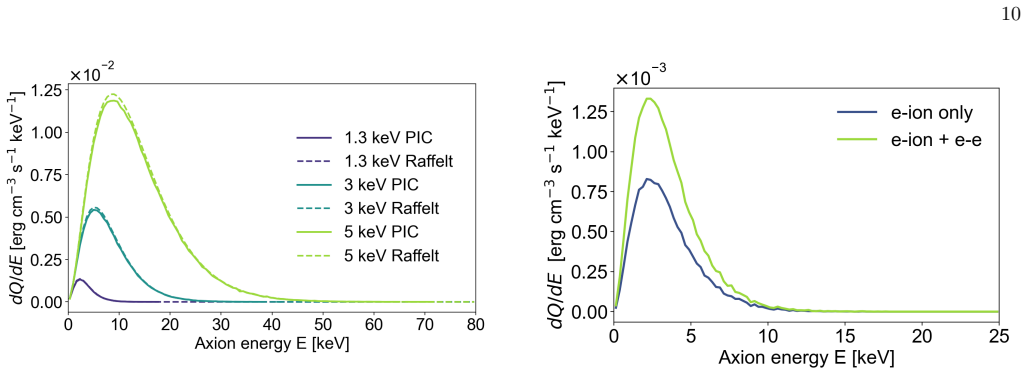
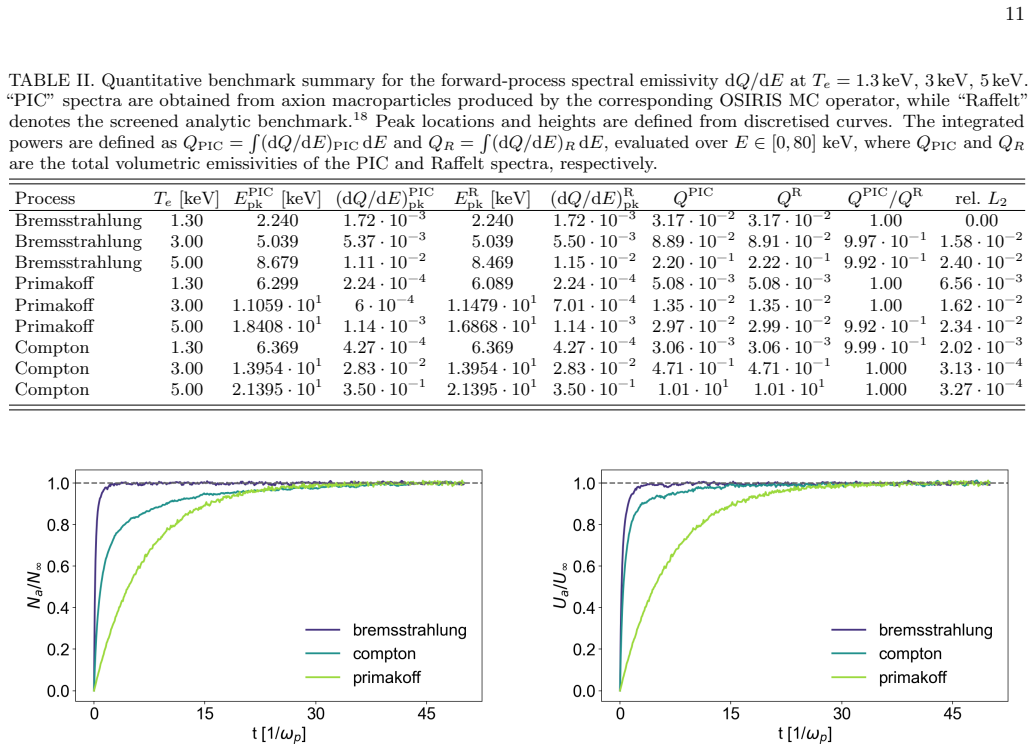
- Integrated axion power agrees with screened analytic results to the percent level for all three channels at the tested temperatures.
- Spectral peak positions in the emissivities are reproduced accurately.
- Axion population and total axion energy converge to stable steady-state values when forward and inverse operators operate together.
- The framework supplies a validated starting point for kinetic simulations of axion production, absorption, and transport in high-energy-density plasmas.
Where Pith is reading between the lines
- Once feedback is validated, the same operators could be used to follow axion transport through inhomogeneous or time-varying plasmas where static analytic formulas no longer apply.
- Coupling the axion module to existing OSIRIS QED processes would allow direct simulation of axion-photon conversion in strong electromagnetic fields.
- The method opens the possibility of testing whether axion yields in dynamic, multi-dimensional plasmas deviate from the uniform-plasma approximations used in current phenomenology.
Load-bearing premise
The inverse absorption operators will continue to satisfy detailed balance without numerical artifacts once optional energy-momentum feedback and temperature evolution become active inside non-uniform, dynamic, multi-dimensional plasmas.
What would settle it
A simulation of a spatially varying plasma with active feedback and evolving temperature in which the axion number or total energy drifts away from the expected thermal equilibrium value would falsify the detailed-balance implementation.
Figures



read the original abstract
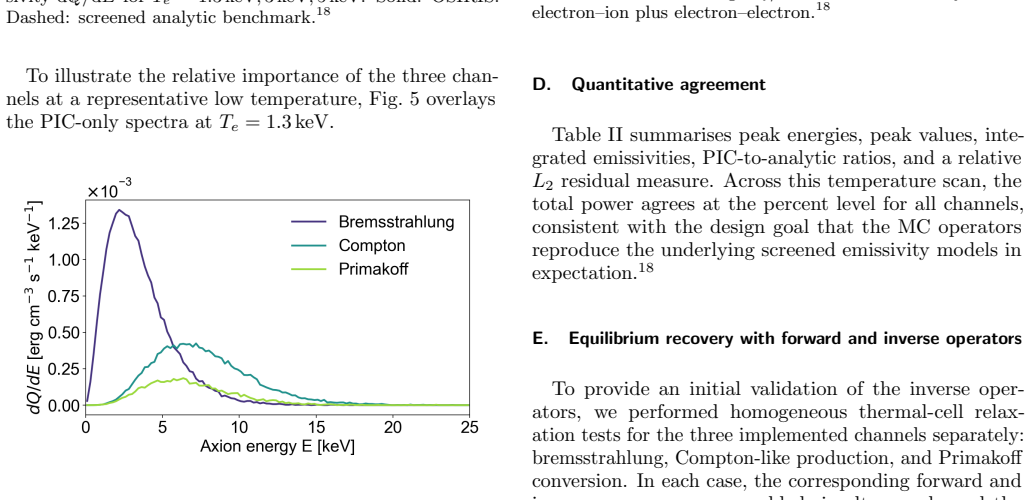
We present an extension of the OSIRIS particle-in-cell (PIC) code that introduces an axion macroparticle species and three axion-production channels commonly used in thermal-plasma axion phenomenology: screened Primakoff conversion $(\gamma + Z \leftrightarrow a + Z)$, Compton-like photoproduction on electrons in a blackbody photon bath $(\gamma + e \to a + e)$, and thermal axion bremsstrahlung from electron-ion and electron-electron scattering $(e + Z \to e + Z + a$ and $e + e \to e + e + a)$. The package is integrated into the existing OSIRIS quantum-electrodynamics (QED) Monte Carlo infrastructure and provides Poisson macro-event sampling with unbiased weight rescaling for variance control. Optional modules implement conservative cell-local energy and momentum feedback and temperature-field evolution, and each channel includes an inverse absorption operator constructed to satisfy detailed balance with a thermal bath. We benchmark forward spectral emissivities for uniform plasmas at $T_e = 1.3~\mathrm{keV}$, $3~\mathrm{keV}$, and $5~\mathrm{keV}$ against screened analytic results based on Raffelt-style calculations, finding percent-level agreement in integrated power for all channels and good reproduction of spectral peak positions. In addition, homogeneous relaxation tests with forward and inverse operators enabled show that, for all three implemented channels, the axion population and total axion energy evolve toward stable steady-state values, providing an initial validation of detailed-balance recovery in the inverse-process implementation. These results establish a foundation for kinetic simulations of axion production, absorption, and transport in high-energy-density plasmas, while more extensive validation of feedback physics and fully dynamic multidimensional coupled scenarios remains future work.
Editorial analysis
A structured set of objections, weighed in public.
Referee Report
Summary. The paper extends the OSIRIS PIC code with an axion macroparticle species and three production channels (screened Primakoff conversion, Compton-like photoproduction, and thermal bremsstrahlung) integrated into the existing QED Monte-Carlo infrastructure. It implements Poisson macro-event sampling with unbiased weight rescaling, optional conservative cell-local energy-momentum feedback and temperature evolution, and inverse absorption operators constructed to satisfy detailed balance with a thermal bath. Benchmarks compare forward spectral emissivities for uniform plasmas at T_e = 1.3 keV, 3 keV, and 5 keV against independent screened analytic Raffelt-style results, reporting percent-level agreement in integrated power and good spectral shape reproduction. Homogeneous relaxation tests with forward and inverse operators enabled demonstrate evolution of axion population and energy to stable steady-state values.
Significance. If the implementation is correct, this provides a useful foundation for kinetic PIC simulations of axion emission, absorption, and transport in high-energy-density plasmas, extending standard QED Monte-Carlo methods to axion phenomenology. Credit is due for the use of independent analytic benchmarks rather than self-fitting, the demonstration of relaxation to steady state in homogeneous cases, and the explicit note that feedback and fully dynamic validation remain future work. The conservative feedback modules and variance-controlled sampling are positive design choices that could enable new studies once extended.
major comments (1)
- [Abstract] Abstract: The claim that the results 'establish a foundation for kinetic simulations of axion production, absorption, and transport in high-energy-density plasmas' is undercut by the immediate qualification that 'more extensive validation of feedback physics and fully dynamic multidimensional coupled scenarios remains future work.' The inverse operators are stated to satisfy detailed balance with a fixed thermal bath, but no test is provided (or claimed) for cases where local temperature evolves due to the optional energy-momentum feedback; this is the load-bearing assumption for dynamic use.
minor comments (3)
- [Methods] The methods section would benefit from a short pseudocode snippet or flowchart illustrating the Poisson event sampling, weight rescaling, and how forward/inverse operators are paired for each channel.
- [Results] Figure captions for the spectral emissivity benchmarks should explicitly list the three temperatures (1.3 keV, 3 keV, 5 keV) and identify which channel (Primakoff, Compton, bremsstrahlung) is shown in each panel.
- [Introduction] Add a brief sentence in the introduction or methods citing the original Raffelt papers used for the analytic benchmark expressions.
Simulated Author's Rebuttal
We thank the referee for the thoughtful review and constructive feedback on our manuscript. We agree that the abstract's phrasing should be adjusted to more precisely reflect the scope of the presented validation. We address the major comment below and will make a minor revision to the abstract and related text.
read point-by-point responses
-
Referee: The claim that the results 'establish a foundation for kinetic simulations of axion production, absorption, and transport in high-energy-density plasmas' is undercut by the immediate qualification that 'more extensive validation of feedback physics and fully dynamic multidimensional coupled scenarios remains future work.' The inverse operators are stated to satisfy detailed balance with a fixed thermal bath, but no test is provided (or claimed) for cases where local temperature evolves due to the optional energy-momentum feedback; this is the load-bearing assumption for dynamic use.
Authors: We agree with the referee that the abstract claim should be qualified more carefully. The current validation demonstrates percent-level agreement for forward emissivities against analytic benchmarks and shows relaxation to steady state when forward and inverse operators act on a fixed thermal bath. The inverse operators are constructed to enforce detailed balance locally with the bath temperature, but we have not yet performed tests in which the optional conservative feedback module evolves the local temperature self-consistently. We will revise the abstract to read that the results 'provide a foundation' rather than 'establish a foundation,' and we will add a clarifying sentence in the conclusions section noting that full validation of the coupled feedback dynamics with evolving temperature remains future work. This is a textual clarification only; the implementation and existing benchmarks are unchanged. revision: yes
Circularity Check
No circularity: benchmarks rely on independent external analytics
full rationale
The paper implements axion macroparticle handling and Monte-Carlo operators in OSIRIS, then benchmarks forward spectral emissivities directly against screened analytic results from Raffelt-style calculations (external to the present work) and demonstrates relaxation to steady state in homogeneous tests. No derivation step reduces a claimed prediction or first-principles result to a quantity defined by the simulation's own fitted parameters, self-citations, or ansatz smuggled via prior author work. The inverse operators are constructed to satisfy detailed balance by design, but this is an implementation choice whose validation is shown via independent benchmarks rather than tautological self-consistency. The central claims therefore remain self-contained against external references.
Axiom & Free-Parameter Ledger
axioms (2)
- domain assumption The plasma is treated as uniform and in thermal equilibrium with a blackbody photon bath for benchmark cases.
- domain assumption The inverse absorption operators satisfy detailed balance when paired with the forward emission operators in a thermal bath.
invented entities (1)
-
axion macroparticle species
no independent evidence
Reference graph
Works this paper leans on
- [1]
-
[2]
Extremes 9, 067204 (2024)
An, Xiangyan and Chen, Min and Liu, Jianglai and Sheng, Zhengming and Zhang, Jie, ``Modeling of axion and electromagnetic fields interaction in particle-in-cell simulations,'' Matter Radiat. Extremes 9, 067204 (2024)
2024
-
[3]
and others, ``Conceptual design of the International Axion Observatory (IAXO),'' JINST 9, T05002 (2014)
Armengaud, E. and others, ``Conceptual design of the International Axion Observatory (IAXO),'' JINST 9, T05002 (2014)
2014
-
[4]
and others (CAST Collaboration), ``New CAST Limit on the Axion--Photon Interaction,'' Nat
Anastassopoulos, V. and others (CAST Collaboration), ``New CAST Limit on the Axion--Photon Interaction,'' Nat. Phys. 13, 584--590 (2017)
2017
-
[5]
High Energy Phys
di Cortona, Giovanni Grilli and Hardy, Edward and Pardo Vega, Javier and Villadoro, Giovanni, ``The QCD axion, precisely,'' J. High Energy Phys. 2016(01), 034 (2016)
2016
-
[6]
Dine, Michael and Fischler, Willy and Srednicki, Mark, ``A Simple Solution to the Strong CP Problem with a Harmless Axion,'' Phys. Lett. B 104, 199--202 (1981)
1981
-
[7]
and others (ADMX Collaboration), ``Search for Invisible Axion Dark Matter with the Axion Dark Matter Experiment,'' Phys
Du, N. and others (ADMX Collaboration), ``Search for Invisible Axion Dark Matter with the Axion Dark Matter Experiment,'' Phys. Rev. Lett. 120, 151301 (2018)
2018
-
[8]
Elkina, N. V. and Fedotov, A. M. and Kostyukov, I. Yu. and Legkov, M. V. and Narozhny, N. B. and Nerush, E. N. and Ruhl, H., ``QED effects in the interaction of ultrarelativistic electrons with an intense electromagnetic field,'' Phys. Rev. ST Accel. Beams 14, 054401 (2011)
2011
-
[9]
i m, Ne \
Fedeli, Luca and Za \"i m, Ne \"i l and Sainte-Marie, Antonin and Th \'e venet, Maxence and Huebl, Axel and Myers, Andrew and Vay, Jean-Luc and Vincenti, Henri, ``PICSAR-QED: a Monte Carlo module to simulate strong-field quantum electrodynamics in particle-in-cell codes for exascale architectures,'' New J. Phys. 24(2), 025009 (2022)
2022
-
[10]
Fonseca, R. A. and Silva, L. O. and Tsung, F. S. and Decyk, V. K. and Lu, W. and Ren, C. and Mori, W. B. and Deng, S. and Lee, S. and Katsouleas, T. and Adam, J. C., ``OSIRIS: A Three-Dimensional, Fully Relativistic Particle in Cell Code for Modeling Plasma Based Accelerators,'' in Computational Science -- ICCS 2002, Lecture Notes in Computer Science 2331...
2002
-
[11]
and Irastorza, Igor G
Graham, Peter W. and Irastorza, Igor G. and Lamoreaux, Steven K. and Lindner, Axel and van Bibber, Karl A., ``Experimental Searches for the Axion and Axion-Like Particles,'' Annu. Rev. Nucl. Part. Sci. 65, 485--514 (2015)
2015
-
[12]
and Fonseca, Ricardo A
Grismayer, Thomas and Vranic, Marija and Martins, Joana L. and Fonseca, Ricardo A. and Silva, Luis O., ``Laser absorption via quantum electrodynamics cascades in counter propagating laser pulses,'' Phys. Plasmas 23, 056706 (2016)
2016
-
[13]
Irastorza, I. G. and Redondo, J., ``New experimental approaches in the search for axion-like particles,'' Prog. Part. Nucl. Phys. 102, 89--159 (2018)
2018
-
[14]
E., ``Weak-Interaction Singlet and Strong CP Invariance,'' Phys
Kim, J. E., ``Weak-Interaction Singlet and Strong CP Invariance,'' Phys. Rev. Lett. 43, 103--107 (1979)
1979
-
[15]
Particle Data Group, ``Review of Particle Physics,'' Prog. Theor. Exp. Phys. 2024(8), 083C01 (2024)
2024
-
[16]
Peccei, R. D. and Quinn, Helen R., ``CP Conservation in the Presence of Pseudoparticles,'' Phys. Rev. Lett. 38, 1440--1443 (1977)
1977
-
[17]
Primakoff, H., ``Photo-Production of Neutral Mesons in Nuclear Electric Fields and the Mean Life of the Neutral Meson,'' Phys. Rev. 81, 899--899 (1951)
1951
-
[18]
Raffelt, Georg G., ``Astrophysical axion bounds diminished by screening effects,'' Phys. Rev. D 33, 897--909 (1986)
1986
-
[19]
Ridgers, C. P. and Kirk, J. G. and Duclous, R. and Blackburn, T. G. and Brady, C. S. and Bennett, K. and Arber, T. D. and Bell, A. R., ``Modelling gamma-ray photon emission and pair production in high-intensity laser--matter interactions,'' J. Comput. Phys. 260, 273--285 (2014)
2014
-
[20]
Shifman, M. A. and Vainshtein, A. I. and Zakharov, V. I., ``Can Confinement Ensure Natural CP Invariance of Strong Interactions?'' Nucl. Phys. B 166, 493--506 (1980)
1980
-
[21]
Sikivie, Pierre, ``Invisible axion search methods,'' Rev. Mod. Phys. 93, 015004 (2021)
2021
-
[22]
Weinberg, Steven, ``A New Light Boson?'' Phys. Rev. Lett. 40, 223--226 (1978)
1978
-
[23]
Wilczek, Frank, ``Problem of Strong P and T Invariance in the Presence of Instantons,'' Phys. Rev. Lett. 40, 279--282 (1978)
1978
-
[24]
R., ``On possible suppression of the axion hadron interactions,'' Sov
Zhitnitsky, A. R., ``On possible suppression of the axion hadron interactions,'' Sov. J. Nucl. Phys. 31, 260--262 (1980)
1980
-
[25]
Haghighat, Alireza and Wagner, John C., ``Monte Carlo variance reduction with deterministic importance functions,'' Prog. Nucl. Energy 42(1), 25--53 (2003)
2003
-
[26]
Booth, Thomas E., ``Common misconceptions in Monte Carlo particle transport,'' Appl. Radiat. Isot. 70(7), 896--909 (2012)
2012
-
[27]
Legrady, Daniel and Kotlyar, Dan and Shwageraus, Eugene, ``Population-based variance reduction for dynamic Monte Carlo,'' Ann. Nucl. Energy 149, 107752 (2020)
2020
-
[28]
Beyer, K. A. and Marocco, G. and Danson, C. and Bingham, R. and Gregori, G., ``Parametric co-linear axion photon instability,'' Phys. Lett. B 839, 137759 (2023)
2023
-
[29]
Halliday, Jack W. D. and Marocco, Giacomo and Beyer, Konstantin A. and Heaton, Charles and Nakatsutsumi, Motoaki and Preston, Thomas R. and Arrowsmith, Charles D. and Baehtz, Carsten and Goede, Sebastian and Humphries, Oliver and Laso Garcia, Alejandro and Plackett, Richard and Svensson, Pontus and Vacalis, Georgios and Wark, Justin and Wood, Daniel and Z...
2025
-
[30]
Di Luzio, Luca and Giannotti, Maurizio and Nardi, Enrico and Visinelli, Luca, ``The landscape of QCD axion models,'' Phys. Rep. 870, 1--117 (2020)
2020
-
[31]
and Bastrakov, S
Gonoskov, A. and Bastrakov, S. and Efimenko, E. and Ilderton, A. and Marklund, M. and Meyerov, I. and Muraviev, A. and Sergeev, A. and Surmin, I. and Wallin, E., ``Extended particle-in-cell schemes for physics in ultrastrong laser fields: Review and developments,'' Phys. Rev. E 92(2), 023305 (2015)
2015
-
[32]
L., Fonseca, R
Grismayer, T., Vranic, M., Martins, J. L., Fonseca, R. A., and Silva, L. O., ``Seeded QED cascades in counterpropagating laser pulses,'' Phys. Rev. E 95, 023210 (2017)
2017
-
[33]
A., and Silva, L
Del Gaudio, F., Grismayer, T., Fonseca, R. A., and Silva, L. O., ``Compton scattering in particle-in-cell codes,'' J. Plasma Phys. 86, 905860516 (2020)
2020
-
[34]
Amaro, \'O., Badiali, C., and Martinez, B., ``Neural network sampling of Bethe-Heitler process in particle-in-cell codes,'' J. Comput. Phys. 553, 114707 (2026)
2026
-
[35]
A., and Silva, L
Grismayer, T., Torres, R., Carneiro, P., Cruz, F., Fonseca, R. A., and Silva, L. O., ``Quantum Electrodynamics vacuum polarization solver,'' New J. Phys. 23, 095005 (2021)
2021
-
[36]
Zhang, Z., Aboushelbaya, R., Ouatu, I., Denis, E., James, A., Timmis, R. J. L., Von Der Leyen, M. W., Torres, R., Grismayer, T., and Silva, L. O., ``Computational modelling of the semi-classical quantum vacuum in 3D,'' Commun. Phys. 8, 224 (2025)
2025
discussion (0)
Sign in with ORCID, Apple, or X to comment. Anyone can read and Pith papers without signing in.