Recognition: unknown
Hawking Temperature, Sparsity and Energy Emission Rate of Dark Matter Halo Regular Black Holes
Pith reviewed 2026-05-08 02:09 UTC · model grok-4.3
The pith
A dark matter halo around a regular black hole reduces its Hawking temperature and energy emission rate while creating a range of stable sizes marked by a Davies phase transition.
A machine-rendered reading of the paper's core claim, the machinery that carries it, and where it could break.
Core claim
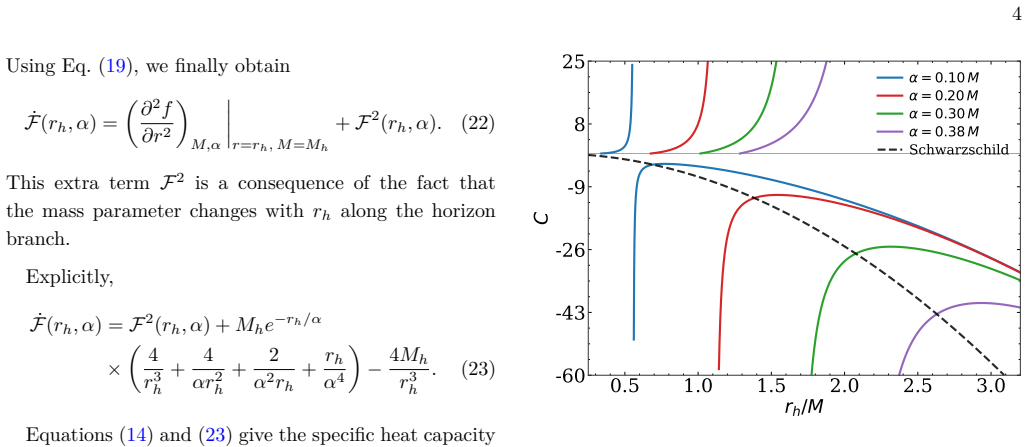
In the spacetime of a regular black hole sourced by an Einasto dark matter density profile, the Hawking temperature and energy emission rate are suppressed relative to the Schwarzschild black hole, the sparsity parameter of the Hawking flux is higher, and the specific heat capacity is positive for a finite range of horizon radii, indicating a thermodynamically stable phase whose boundary corresponds to a Davies-type phase transition.
What carries the argument
The regular black hole metric sourced by the Einasto dark matter density profile, which modifies the geometry and permits closed-form derivation of thermodynamic quantities and emission rates using standard semiclassical methods.
If this is right
- The dark matter environment makes the Hawking flux more intermittent than in the vacuum Schwarzschild case.
- A finite interval of horizon radii exists where the black hole is thermodynamically stable due to positive specific heat.
- The edge of this stable interval corresponds to a Davies-type phase transition.
- The energy emission rate is lower than the standard black hole result for any given horizon radius.
Where Pith is reading between the lines
- Such modified evaporation could alter the lifetime and final stages of black holes at galactic centers where dark matter densities are high.
- The increased sparsity might produce distinct temporal signatures in high-energy observations that distinguish halo-embedded black holes from isolated ones.
- The existence of a stable phase could influence accretion or merger dynamics for supermassive black holes in dark-matter-rich galaxies.
Load-bearing premise
The spacetime is described by a regular black hole metric sourced by the Einasto dark matter density profile, and the standard semiclassical formulas for Hawking temperature and emission rate apply without modification from the dark matter or regularity conditions.
What would settle it
Measure whether the Hawking radiation from a candidate black hole in a dense dark matter environment exhibits the predicted lower temperature, reduced emission rate, and higher sparsity compared to the isolated Schwarzschild case for the same mass.
Figures



read the original abstract
In this paper, we investigate the thermodynamic and radiative properties of a regular black hole sourced by a dark matter halo described by the Einasto density profile. The closed-form expressions for the Hawking temperature, specific heat capacity, sparsity parameter of Hawking flux, and the spectral energy emission rate were obtained. All these are examined as a function of the characteristic scale parameter $\alpha$ of the dark matter distribution and compared with the standard Schwarzschild results. We show that the presence of a dark matter halo suppresses both the Hawking temperature and energy emission rate relative to the standard black hole result. Crucially, the specific heat capacity can be positive for a finite range of horizon radii, signaling a thermodynamically stable phase; the boundary of this stable region defines a Davies-type phase transition. The sparsity parameter is higher than in the standard black hole, indicating that the dark matter environment makes the Hawking flux even more intermittent.
Editorial analysis
A structured set of objections, weighed in public.
Referee Report
Summary. The manuscript derives closed-form expressions for the Hawking temperature, specific heat capacity, sparsity parameter of the Hawking flux, and spectral energy emission rate for a regular black hole metric sourced by the Einasto dark matter density profile. These quantities are examined as functions of the characteristic scale parameter α and compared to the Schwarzschild case. The analysis concludes that the dark matter halo suppresses both the Hawking temperature and energy emission rate, permits a finite range of horizon radii with positive specific heat (indicating a thermodynamically stable phase bounded by a Davies-type phase transition), and elevates the sparsity parameter relative to the vacuum black hole.
Significance. If the derivations hold and the standard semiclassical formulas apply without modification, the work supplies explicit analytic results demonstrating how an extended dark matter halo can induce thermodynamic stability and alter radiative intermittency for black holes. The closed-form expressions constitute a strength, enabling direct parametric studies without numerical methods and potentially informing models of supermassive black holes in galactic environments.
major comments (1)
- The central claims (suppressed T_H, positive C over a finite r_h interval, elevated sparsity, and reduced emission rate) rest on computing T = f'(r_h)/(4π) from the metric f(r) = 1 - 2M(r)/r with M(r) obtained by integrating the Einasto density, then inserting this T into the standard Stefan-Boltzmann or greybody emission formulas. The manuscript must explicitly verify that the resulting stress-energy tensor satisfies the Einstein equations for a static spherically symmetric spacetime (including any pressure components required by regularity at r = 0) and that the near-horizon Killing horizon structure remains unmodified by the distributed source, with no additional surface terms affecting the temperature or mode normalization.
minor comments (3)
- The abstract states that closed-form expressions were obtained; these should be written out explicitly in the main text (e.g., for T_H(α, r_h) and the emission rate) rather than left implicit, to facilitate immediate checking against the Schwarzschild limits.
- The precise definition and normalization of the sparsity parameter η should be stated in full, including its dependence on T and r_h, because different conventions appear in the Hawking radiation literature.
- A short paragraph confirming that the Einasto-sourced metric is asymptotically flat (M(r) → M as r → ∞) and that the dark matter halo does not alter the asymptotic vacuum used for the Hawking flux calculation would improve clarity.
Simulated Author's Rebuttal
We thank the referee for the positive summary and for identifying a point that strengthens the manuscript. We address the major comment below by clarifying the construction of the metric and committing to an explicit verification.
read point-by-point responses
-
Referee: The central claims (suppressed T_H, positive C over a finite r_h interval, elevated sparsity, and reduced emission rate) rest on computing T = f'(r_h)/(4π) from the metric f(r) = 1 - 2M(r)/r with M(r) obtained by integrating the Einasto density, then inserting this T into the standard Stefan-Boltzmann or greybody emission formulas. The manuscript must explicitly verify that the resulting stress-energy tensor satisfies the Einstein equations for a static spherically symmetric spacetime (including any pressure components required by regularity at r = 0) and that the near-horizon Killing horizon structure remains unmodified by the distributed source, with no additional surface terms affecting the temperature or mode normalization.
Authors: We agree that an explicit verification improves clarity. The metric is constructed by integrating the Einasto density profile to obtain the enclosed mass M(r) = 4π ∫_0^r ρ_Einasto(s) s² ds, yielding f(r) = 1 - 2M(r)/r. For a static spherically symmetric spacetime this automatically satisfies the Einstein equations G_μν = 8π T_μν, where the energy density component is the input ρ(r) and the radial and tangential pressures p_r(r), p_t(r) are determined directly from the Einstein tensor components (specifically from the tt, rr, and θθ equations). The Einasto profile guarantees finite central density and the resulting pressures remain finite at r = 0, satisfying the regularity conditions for a nonsingular center. We will add an appendix in the revised version that explicitly computes the three independent Einstein-tensor components, derives the corresponding p_r and p_t, and confirms G_μν = 8π T_μν. The Hawking temperature follows from the standard surface-gravity formula T = κ/2π with κ = f'(r_h)/2 evaluated at the Killing horizon; this expression holds for any static spherically symmetric metric possessing a Killing horizon and does not acquire extra surface terms when the matter source is smooth and distributed (as opposed to a thin shell). Because the Einasto-sourced stress-energy is regular everywhere, the near-horizon geometry and mode normalization remain unmodified, so the usual semiclassical emission formulas apply without alteration. revision: yes
Circularity Check
No circularity: standard thermodynamic formulas applied to metric derived from external Einasto profile
full rationale
The paper integrates the given Einasto density to obtain M(r), constructs the metric function f(r), then inserts into the textbook expressions T = f'(r_h)/(4π), C = dM/dT, and the usual greybody-integrated emission rate and sparsity estimator η. α enters only as an external scale from the density profile; no parameter is fitted to the target observables and then renamed a prediction. No self-citation chain or ansatz is load-bearing for the central results. The derivation is therefore self-contained once the metric is accepted.
Axiom & Free-Parameter Ledger
free parameters (1)
- α
axioms (2)
- domain assumption A regular black-hole metric exists that is sourced by the Einasto dark-matter halo density profile.
- domain assumption Standard semiclassical Hawking radiation formulas (T = κ/2π, Stefan-Boltzmann emission, etc.) remain valid in the presence of the dark-matter halo.
Reference graph
Works this paper leans on
-
[1]
B. P. Abbottet al., Phys. Rev. Lett.116, 061102 (2016)
2016
-
[2]
Abbottet al., Phys
R. Abbottet al., Phys. Rev. D112, 084080 (2025)
2025
-
[3]
C. M. Will, Liv. Rev. Relativ.17, 4 (2014)
2014
-
[4]
Yunes, X
N. Yunes, X. Siemens, and K. Yagi, Living Reviews in Relativity28, 3 (2025)
2025
-
[5]
Akiyamaet al.(Event Horizon Telescope), Astrophys
K. Akiyamaet al.(Event Horizon Telescope), Astrophys. J Lett.875, L1 (2019)
2019
-
[6]
Akiyamaet al.(Event Horizon Telescope), Astrophys
K. Akiyamaet al.(Event Horizon Telescope), Astrophys. J Lett.930, L12 (2022)
2022
-
[7]
Gondolo and J
P. Gondolo and J. Silk, Phys. Rev. Lett.83, 1719 (1999)
1999
-
[8]
K. Eda, Y. Itoh, S. Kuroyanagi, and J. Silk, Phys. Rev. Lett.110, 221101 (2013)
2013
-
[9]
N. Bar, K. Blum, T. Lacroix, and P. Panci, JCAP2019 (07), 045
-
[10]
K. J. Mack, J. P. Ostriker, and M. Ricotti, The Astro- physical Journal665, 1277 (2007)
2007
-
[11]
A.AkilandQ.Ding,JournalofCosmologyandAstropar- ticle Physics2023(09), 011
-
[12]
Kadota, J
K. Kadota, J. H. Kim, P. Ko, and X.-Y. Yang, Phys. Rev. D109, 015022 (2024)
2024
-
[13]
J. C. Aurrekoetxea, K. Clough, J. Bamber, and P. G. Ferreira, Phys. Rev. Lett.132, 211401 (2024)
2024
-
[14]
Q. Ding, M. He, and V. Takhistov, Astrophys. J981, 62 (2025)
2025
-
[15]
K. Eda, Y. Itoh, S. Kuroyanagi, and J. Silk, Phys. Rev. D91, 044045 (2015)
2015
-
[16]
Ghodla, JCAP2025(02), 036
S. Ghodla, JCAP2025(02), 036
-
[17]
Y. Chen, P.-P. Wang, B. Wang, R. Luo, and C.-G. Shao, Universe12, 48 (2026), arXiv:2603.07158 [gr-qc]
- [18]
-
[19]
Al-Badawi and F
A. Al-Badawi and F. Ahmed, Eur. Phys. J C86, 139 (2026)
2026
-
[20]
Ahmed, A
F. Ahmed, A. Al-Badawi, and I. Sakalli, Eur. Phys. J C 85, 984 (2025)
2025
-
[21]
Al-Badawi and S
A. Al-Badawi and S. Shaymatov, Chin. Phys. C49, 055101 (2025)
2025
-
[22]
Al-Badawi and S
A. Al-Badawi and S. Shaymatov, Commu. Theor. Phys. 77, 035402 (2025)
2025
-
[23]
Al-Badawi, S
A. Al-Badawi, S. Shaymatov, and Y. Sekhmani, JCAP 2025(02), 014
2025
-
[24]
Einasto, Trudy Astrofizicheskogo Instituta Alma-Ata 5, 87 (1965)
J. Einasto, Trudy Astrofizicheskogo Instituta Alma-Ata 5, 87 (1965)
1965
-
[25]
Einasto and U
J. Einasto and U. Haud, Astron. & Astrophys.223, 89 (1989)
1989
-
[26]
Springel, J
V. Springel, J. Wang, M. Vogelsberger, A. Ludlow, A. Jenkins, A. Helmi, J. F. Navarro, C. S. Frenk, and S. D. M. White, MNRAS391, 1685 (2008)
2008
-
[27]
J. F. Navarro, A. Ludlow, V. Springel, J. Wang, M. Vo- gelsberger, S. D. M. White, A. Jenkins, C. S. Frenk, and A. Helmi, MNRAS402, 21 (2010)
2010
-
[28]
Roszkowski, E
L. Roszkowski, E. M. Sessolo, and S. Trojanowski, Rep. Prog. Phys.81, 066201 (2018)
2018
-
[29]
A. A. Dutton and A. V. Macciò, MNRAS441, 3359 (2014)
2014
-
[30]
Catena and P
R. Catena and P. Ullio, JCAP2010(08), 004
-
[31]
J. F. Navarro, C. S. Frenk, and S. D. M. White, Astro- phys. J490, 493 (1997)
1997
-
[32]
Bertone, D
G. Bertone, D. Hooper, and J. Silk, Phys. Rep.405, 279 (2005)
2005
-
[33]
Hernquist, Astrophys
L. Hernquist, Astrophys. J356, 359 (1990)
1990
-
[34]
R. A. Konoplya and A. Zhidenko, Phys. Rev. D113, 043011 (2026)
2026
-
[35]
D112, 083014 (2025), arXiv:2509.03301 [gr-qc]
R.A.Konoplya, Z.Stuchlík,andA.Zhidenko,Phys.Rev. D112, 083014 (2025), arXiv:2509.03301 [gr-qc]
-
[36]
Skvortsova, (2026), arXiv:2603.28415 [gr-qc]
M. Skvortsova, (2026), arXiv:2603.28415 [gr-qc]
-
[37]
S. W. Hawking, Commun. Math. Phys.43, 199 (1975)
1975
-
[38]
F. Gray, S. Schuster, A. Van-Brunt, and M. Visser, Class. Quantum Grav.33, 115003 (2016)
2016
-
[39]
Hod, Physics Letters B756, 133 (2016)
S. Hod, Physics Letters B756, 133 (2016)
2016
-
[40]
S.Hod,TheEuropeanPhysicalJournalC75,329(2015)
2015
-
[41]
Y.-P. Hu, F. Pan, and X.-M. Wu, Physics Letters B772, 553 (2017)
2017
-
[42]
Schuster,Black Hole Evaporation: Sparsity in Ana- logue and General Relativistic Space-Times, Ph.D
S. Schuster,Black Hole Evaporation: Sparsity in Ana- logue and General Relativistic Space-Times, Ph.D. the- sis, Victoria University of Wellington, Wellington, New Zealand (2018), arXiv:1901.05648 [gr-qc]
-
[43]
M.Visser, F.Gray, S.Schuster,andA.Van-Brunt,inThe Fourteenth Marcel Grossmann Meeting(World Scientific,
-
[44]
J. M. Bardeen, B. Carter, and S. W. Hawking, Commun. Math. Phys.31, 161 (1973)
1973
-
[45]
R. M. Wald,Quantum Field Theory in Curved Spacetime and Black Hole Thermodynamics(University of Chicago Press, 1994)
1994
-
[46]
J. D. Bekenstein, Physical Review D7, 2333 (1973)
1973
-
[47]
S. W. Hawking and D. N. Page, Commun. Math. Phys. 87, 577 (1983)
1983
-
[48]
P. C. W. Davies, Proc. R. Soc. A353, 499 (1977)
1977
-
[49]
Smarr, Physical Review Letters30, 71 (1973)
L. Smarr, Physical Review Letters30, 71 (1973)
1973
-
[50]
Perlick and O
V. Perlick and O. Y. Tsupko, Physics Reports947, 1 (2022)
2022
-
[51]
P. V. P. Cunha and C. A. R. Herdeiro, Gen. Relativ. Grav.50, 42 (2018)
2018
-
[52]
Mashhoon, Phys
B. Mashhoon, Phys. Rev. D7, 2807 (1973)
1973
-
[53]
Sanchez, Phys
N. Sanchez, Phys. Rev. D18, 1030 (1978). 8
1978
-
[54]
Décanini, G
Y. Décanini, G. Esposito-Farèse, and A. Folacci, Phys. Rev. D83, 044032 (2011)
2011
-
[55]
Wei and Y.-X
S.-W. Wei and Y.-X. Liu, JCAP2013(11), 063
discussion (0)
Sign in with ORCID, Apple, or X to comment. Anyone can read and Pith papers without signing in.