Recognition: unknown
Floquet engineering of tight-binding Hamiltonians in momentum space lattices
Pith reviewed 2026-05-07 17:19 UTC · model grok-4.3
The pith
Quantum resonances in a shaken rotor allow analytical programming of tight-binding Hamiltonians in momentum-space lattices.
A machine-rendered reading of the paper's core claim, the machinery that carries it, and where it could break.
Core claim
Exploiting quantum resonances of a periodically driven rotor within the Floquet framework, first-order time-dependent perturbation theory produces analytical mappings from lattice modulation to effective tight-binding parameters, with explicit solutions for several resonances. Optimal-control techniques further improve multi-period Floquet fidelity. The scheme is realized experimentally with a Bose-Einstein condensate of rubidium-87 atoms in a dynamically modulated optical lattice, enabling direct simulation of the Rice-Mele model together with band-structure measurements, topological edge states, momentum Bloch oscillations, and superlattice configurations of controlled periodicity.
What carries the argument
Quantum resonances of the periodically driven rotor in the Floquet picture, which map driving amplitudes and frequencies to tight-binding parameters via first-order time-dependent perturbation theory.
If this is right
- Explicit resonance solutions allow direct selection of effective hopping and potential strengths without numerical search.
- Several distinct resonances open different accessible ranges of tight-binding parameters.
- Optimal-control pulses extend coherent evolution times while preserving the target effective Hamiltonian.
- Superlattice periodicities and topological features become experimentally tunable through the same driving protocol.
Where Pith is reading between the lines
- The resonance approach may reduce the experimental complexity of creating programmable simulators by replacing static lattice engineering with time-periodic modulation.
- Similar driving protocols could be tested for interacting or higher-dimensional momentum-space models.
- Time-dependent or Floquet-engineered topological phases might be reachable by varying the resonance condition during evolution.
Load-bearing premise
First-order time-dependent perturbation theory remains accurate for the driving amplitudes and frequencies used, without higher-order processes or experimental imperfections such as decoherence becoming dominant.
What would settle it
If the measured band structure or edge-state localization in the realized Rice-Mele model deviates quantitatively from the tight-binding parameters predicted by the derived analytical resonance relations, the first-order Floquet mapping would be falsified.
Figures



read the original abstract
Quantum simulation with ultracold atoms provides a versatile platform to emulate condensed-matter models. In particular, momentum-space lattices enable the realization of programmable tight-binding Hamiltonians. Here, we generalize this approach by exploiting quantum resonances of a periodically driven (shaken) rotor within the Floquet framework. Using first-order time-dependent perturbation theory, we derive analytical relations between the lattice modulation and the effective tight-binding parameters, and identify explicit solutions for several resonances. We further apply optimal-control techniques to enhance the multi-period Floquet fidelity and extend the accessible parameter regimes. Experimentally, we implement this scheme with a Bose-Einstein condensate of rubidium-87 atoms in a dynamically modulated optical lattice. We demonstrate the simulation of the Rice-Mele model, including band-structure measurements and topological edge states, as well as momentum Bloch oscillations, and superlattice configurations with controlled periodicity. Our results establish quantum resonances as a powerful resource for Floquet engineering of tight-binding models in momentum space.
Editorial analysis
A structured set of objections, weighed in public.
Referee Report
Summary. The manuscript generalizes momentum-space lattice quantum simulation by exploiting quantum resonances in a periodically driven (shaken) rotor under the Floquet framework. Using first-order time-dependent perturbation theory, the authors derive analytical relations mapping lattice modulation parameters to effective tight-binding Hamiltonian coefficients, identify explicit resonance solutions, and apply optimal-control methods to improve multi-period Floquet fidelity. Experimentally, they implement the scheme with a 87Rb BEC in a dynamically modulated optical lattice and demonstrate simulation of the Rice-Mele model (band structure, topological edge states), momentum-space Bloch oscillations, and controlled-periodicity superlattices.
Significance. If the first-order perturbative mapping remains accurate for the chosen parameters and the experimental data quantitatively support the predicted effective Hamiltonians, the work supplies an analytically tractable route to programmable tight-binding models in momentum space. This strengthens Floquet engineering capabilities in ultracold-atom platforms by combining explicit resonance solutions with optimal-control extensions, potentially enabling more complex or higher-fidelity simulations than purely numerical approaches.
major comments (3)
- [Theory section (derivation of effective parameters)] The central claim rests on first-order time-dependent perturbation theory yielding accurate effective tight-binding parameters, yet the manuscript provides no quantitative validation (e.g., comparison of the derived effective Hamiltonian to the exact Floquet operator or to numerical time-evolution for the experimental modulation amplitudes and frequencies). This is load-bearing for both the analytical relations and the Rice-Mele demonstrations.
- [Experimental results and figures showing band structure / edge states] Experimental section: band-structure measurements and edge-state observations are presented without error bars, without quantitative fits to the analytically predicted tight-binding parameters, and without explicit checks that higher-order processes remain negligible at the chosen driving strengths. This weakens support for the claim that the first-order mapping is experimentally realized.
- [Optimal-control subsection] The optimal-control protocol is invoked to extend accessible regimes, but no details are given on the cost function, the resulting fidelity improvement factor, or a direct comparison of fidelity with versus without control for the multi-period evolution used in the demonstrations.
minor comments (2)
- [Throughout (theory vs. experiment)] Notation for the effective hopping and on-site terms should be unified between the theoretical expressions and the experimental fitting procedures to avoid ambiguity when comparing theory to data.
- [Theory section] The manuscript would benefit from a brief table summarizing the resonance conditions and the corresponding analytical expressions for the effective parameters.
Simulated Author's Rebuttal
We thank the referee for their careful reading and constructive comments on our manuscript. We address each major comment point by point below. We have revised the manuscript to provide the requested quantitative validations, improved data presentation, and additional methodological details.
read point-by-point responses
-
Referee: [Theory section (derivation of effective parameters)] The central claim rests on first-order time-dependent perturbation theory yielding accurate effective tight-binding parameters, yet the manuscript provides no quantitative validation (e.g., comparison of the derived effective Hamiltonian to the exact Floquet operator or to numerical time-evolution for the experimental modulation amplitudes and frequencies). This is load-bearing for both the analytical relations and the Rice-Mele demonstrations.
Authors: We agree that explicit quantitative validation strengthens the central claims. In the revised manuscript, we have added a new subsection in the Theory section that directly compares the effective tight-binding parameters obtained from first-order time-dependent perturbation theory to those extracted from numerical computation of the exact Floquet operator. This comparison is performed for the specific modulation amplitudes and frequencies used in the experiments, showing agreement to within a few percent. We also include a discussion of the validity regime and the magnitude of higher-order corrections. revision: yes
-
Referee: [Experimental results and figures showing band structure / edge states] Experimental section: band-structure measurements and edge-state observations are presented without error bars, without quantitative fits to the analytically predicted tight-binding parameters, and without explicit checks that higher-order processes remain negligible at the chosen driving strengths. This weakens support for the claim that the first-order mapping is experimentally realized.
Authors: We thank the referee for highlighting these presentation issues. In the revised manuscript, we have updated the experimental figures to include error bars on all data points, accounting for both statistical and systematic uncertainties. We now provide quantitative fits of the measured band structures and edge-state properties to the analytically predicted tight-binding parameters, with fitted values agreeing with predictions within experimental uncertainty. Additionally, we have added an analysis estimating the contribution of higher-order processes, showing they are suppressed by more than an order of magnitude for the chosen driving strengths and frequencies. revision: yes
-
Referee: [Optimal-control subsection] The optimal-control protocol is invoked to extend accessible regimes, but no details are given on the cost function, the resulting fidelity improvement factor, or a direct comparison of fidelity with versus without control for the multi-period evolution used in the demonstrations.
Authors: We agree that further details on the optimal-control protocol are warranted. In the revised manuscript, we have expanded the Optimal-Control subsection to explicitly define the cost function (the infidelity between the target multi-period Floquet operator and the realized evolution). We report the achieved fidelity improvement (from ~0.82 without control to ~0.97 with optimal control for the multi-period sequences in the demonstrations) and include a direct comparison of fidelity versus number of periods, with and without control, in a new supplementary figure. These additions clarify how the protocol extends the accessible parameter regimes. revision: yes
Circularity Check
No circularity: standard first-order TDPT derivation from driven rotor Hamiltonian
full rationale
The paper applies first-order time-dependent perturbation theory to the standard time-periodic Hamiltonian of a shaken rotor to obtain analytical mappings from modulation parameters to effective tight-binding couplings and resonance conditions. This is a direct perturbative expansion with no fitted parameters renamed as predictions, no self-definitional loops, and no load-bearing reliance on self-citations or prior ansatzes from the same authors. The resulting expressions for the Rice-Mele model and other configurations are independent outputs of the external perturbation theory rather than tautological restatements of the inputs. The derivation chain is therefore self-contained against external benchmarks.
Axiom & Free-Parameter Ledger
axioms (2)
- domain assumption First-order time-dependent perturbation theory accurately describes the driven rotor near the identified resonances
- domain assumption The experimental system remains in the coherent regime where Floquet engineering applies without dominant decoherence
Reference graph
Works this paper leans on
-
[1]
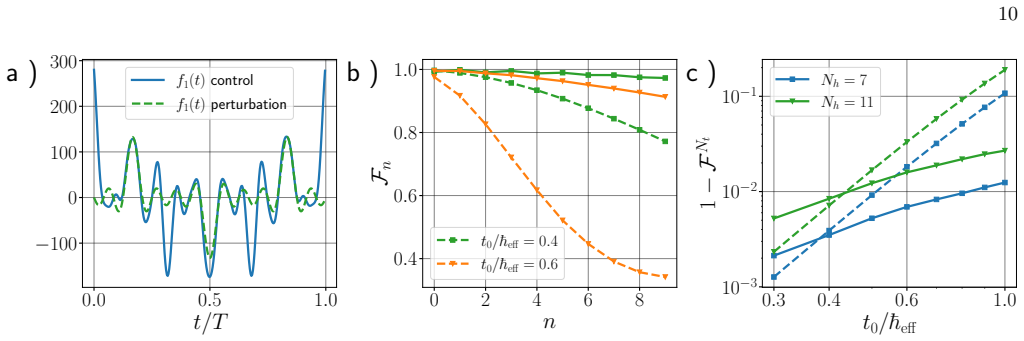
leaves the right-hand side unchanged. The general solution can therefore be written as f(z) = 2e i2πz T(2z) +g(z) +g z+ 1 2 ,(25) wheregis an arbitrary periodic function, andT(z) =P n∈Z t(1) n ei2πnz encodes the target tunnelling ampli- tudes. A particularly simple representative of this family is obtained by choosingg= 0. In that case, f4π(˜t) = 2 X n∈Z ...
-
[2]
R. P. Feynman, Simulating physics with computers, Int. J. Theor. Phys.21, 467 (1982)
1982
-
[3]
Lloyd, Universal Quantum Simulators, Science273, 1073 (1996)
S. Lloyd, Universal Quantum Simulators, Science273, 1073 (1996)
1996
-
[4]
Bloch, J
I. Bloch, J. Dalibard, and W. Zwerger, Many-body physics with ultracold gases, Rev. Mod. Phys.80, 885 (2008)
2008
-
[5]
Georgescu, S
I. Georgescu, S. Ashhab, and F. Nori, Quantum simula- tion, Rev. Mod. Phys.86, 153 (2014)
2014
-
[6]
Gross and I
C. Gross and I. Bloch, Quantum simulations with ultra- cold atoms in optical lattices, Science357, 995 (2017)
2017
-
[7]
Lewenstein, A
M. Lewenstein, A. Sanpera, V. Ahufinger, B. Damski, A. Sen(De), and U. Sen, Ultracold atomic gases in op- tical lattices: mimicking condensed matter physics and beyond, Advances in Physics56, 243 (2007)
2007
-
[8]
Bloch, J
I. Bloch, J. Dalibard, and S. Nascimbene, Quantum sim- ulations with ultracold quantum gases, Nat. Phys.8, 267 (2012)
2012
-
[9]
Sch¨ afer, T
F. Sch¨ afer, T. Fukuhara, S. Sugawa, Y. Takasu, and Y. Takahashi, Tools for quantum simulation with ultra- cold atoms in optical lattices, Nat. Rev. Phys.2, 411 (2020)
2020
-
[10]
Soltan-Panahi, J
P. Soltan-Panahi, J. Struck, P. Hauke, A. Bick, W. Plenkers, G. Meineke, C. Becker, P. Windpassinger, M. Lewenstein, and K. Sengstock, Multi-component quantum gases in spin-dependent hexagonal lattices, Nat. Phys.7, 434–440 (2011)
2011
-
[11]
Tarruell, D
L. Tarruell, D. Greif, T. Uehlinger, G. Jotzu, and T. Esslinger, Creating, moving and merging Dirac points with a Fermi gas in a tunable honeycomb lattice, Nature 483, 302 (2012)
2012
-
[12]
Uehlinger, G
T. Uehlinger, G. Jotzu, M. Messer, D. Greif, W. Hofstet- ter, U. Bissbort, and T. Esslinger, Artificial Graphene with Tunable Interactions, Phys. Rev. Lett.111, 185307 (2013)
2013
-
[13]
Billy, V
J. Billy, V. Josse, Z. Zuo, A. Bernard, B. Hambrecht, P. Lugan, D. Cl´ ement, L. Sanchez-Palencia, P. Bouyer, and A. Aspect, Direct observation of Anderson localiza- tion of matter waves in a controlled disorder, Nature453, 891 (2008)
2008
-
[14]
Roati, C
G. Roati, C. D’Errico, L. Fallani, M. Fattori, C. Fort, M. Zaccanti, G. Modugno, M. Modugno, and M. In- guscio, Anderson localization of a non-interacting Bose- Einstein condensate, Nature453, 895 (2008). 20
2008
-
[15]
Chab´ e, G
J. Chab´ e, G. Lemari´ e, B. Gr´ emaud, D. Delande, P. Szrift- giser, and J. C. Garreau, Experimental Observation of the Anderson Metal-Insulator Transition with Atomic Matter Waves, Phys. Rev. Lett.101, 255702 (2008)
2008
-
[16]
Lemari´ e, H
G. Lemari´ e, H. Lignier, D. Delande, P. Szriftgiser, and J. C. Garreau, Critical State of the Anderson Transition: Between a Metal and an Insulator, Phys. Rev. Lett.105, 090601 (2010)
2010
-
[17]
Sanchez-Palencia and M
L. Sanchez-Palencia and M. Lewenstein, Disordered quantum gases under control, Nat. Phys.6, 87 (2010)
2010
-
[18]
S. S. Kondov, W. R. McGehee, J. J. Zirbel, and B. De- Marco, Three-Dimensional Anderson Localization of Ul- tracold Matter, Science334, 66 (2011)
2011
-
[19]
Jendrzejewski, A
F. Jendrzejewski, A. Bernard, K. M¨ uller, P. Cheinet, V. Josse, M. Piraud, L. Pezz´ e, L. Sanchez-Palencia, A. Aspect, and P. Bouyer, Three-dimensional localiza- tion of ultracold atoms in an optical disordered potential, Nat. Phys.8, 398 (2012)
2012
-
[20]
Shapiro, Cold atoms in the presence of disorder, J
B. Shapiro, Cold atoms in the presence of disorder, J. Phys. A: Math. Theor.45, 143001 (2012)
2012
-
[21]
Semeghini, M
G. Semeghini, M. Landini, P. Castilho, S. Roy, G. Spag- nolli, A. Trenkwalder, M. Fattori, M. Inguscio, and G. Modugno, Measurement of the mobility edge for 3D Anderson localization, Nat. Phys.11, 554 (2015)
2015
-
[22]
D. H. White, T. A. Haase, D. J. Brown, M. D. Hooger- land, M. S. Najafabadi, J. L. Helm, C. Gies, D. Schu- mayer, and D. A. W. Hutchinson, Observation of two- dimensional Anderson localisation of ultracold atoms, Nat. Commun.11, 4942 (2020)
2020
-
[23]
Parity Anomaly
F. D. M. Haldane, Model for a Quantum Hall Effect with- out Landau Levels: Condensed-Matter Realization of the “Parity Anomaly”, Phys. Rev. Lett.61, 2015 (1988)
2015
-
[24]
Jotzu, M
G. Jotzu, M. Messer, R. Desbuquois, M. Lebrat, T. Uehlinger, D. Greif, and T. Esslinger, Experimental realization of the topological Haldane model with ultra- cold fermions, Nature515, 237 (2014)
2014
-
[25]
M. J. Rice and E. J. Mele, Elementary excitations of a linearly conjugated diatomic polymer, Phys. Rev. Lett. 49, 1455 (1982)
1982
-
[26]
D. J. Thouless, Quantization of particle transport, Phys. Rev. B27, 6083 (1983)
1983
-
[27]
Nakajima, T
S. Nakajima, T. Tomita, S. Taie, T. Ichinose, H. Ozawa, L. Wang, M. Troyer, and Y. Takahashi, Topological Thouless pumping of ultracold fermions, Nat. Phys.12, 296 (2016)
2016
-
[28]
Lohse, C
M. Lohse, C. Schweizer, O. Zilberberg, M. Aidelsburger, and I. Bloch, A Thouless quantum pump with ultracold bosonic atoms in an optical superlattice, Nat. Phys.12, 350 (2016)
2016
-
[29]
Citro and M
R. Citro and M. Aidelsburger, Thouless pumping and topology, Nat. Rev. Phys.5, 87 (2023)
2023
-
[30]
Jaksch and P
D. Jaksch and P. Zoller, Creation of effective magnetic fields in optical lattices: The Hofstadter butterfly for cold neutral atoms, New J. Phys.5, 56 (2003)
2003
-
[31]
Aidelsburger, M
M. Aidelsburger, M. Atala, M. Lohse, J. T. Barreiro, B. Paredes, and I. Bloch, Realization of the Hofstadter Hamiltonian with Ultracold Atoms in Optical Lattices, Phys. Rev. Lett.111, 185301 (2013)
2013
-
[32]
Miyake, G
H. Miyake, G. A. Siviloglou, C. J. Kennedy, W. C. Bur- ton, and W. Ketterle, Realizing the Harper Hamiltonian with Laser-Assisted Tunneling in Optical Lattices, Phys. Rev. Lett.111, 185302 (2013)
2013
-
[33]
G.-B. Jo, J. Guzman, C. K. Thomas, P. Hosur, A. Vish- wanath, and D. M. Stamper-Kurn, Ultracold Atoms in a Tunable Optical Kagome Lattice, Phys. Rev. Lett.108, 045305 (2012)
2012
-
[34]
Leung, M
T.-H. Leung, M. N. Schwarz, S.-W. Chang, C. D. Brown, G. Unnikrishnan, and D. Stamper-Kurn, Interaction- Enhanced Group Velocity of Bosons in the Flat Band of an Optical Kagome Lattice, Phys. Rev. Lett.125, 133001 (2020)
2020
-
[35]
Zak, Berry’s phase for energy bands in solids, Phys
J. Zak, Berry’s phase for energy bands in solids, Phys. Rev. Lett.62, 2747 (1989)
1989
-
[36]
Atala, M
M. Atala, M. Aidelsburger, J. T. Barreiro, D. Abanin, T. Kitagawa, E. Demler, and I. Bloch, Direct measure- ment of the Zak phase in topological bloch bands, Nat. Phys.9, 795 (2013)
2013
-
[37]
Cooper, J
N. Cooper, J. Dalibard, and I. Spielman, Topological bands for ultracold atoms, Rev. Mod. Phys.91, 015005 (2019)
2019
-
[38]
Aidelsburger, M
M. Aidelsburger, M. Lohse, C. Schweizer, M. Atala, J. T. Barreiro, S. Nascimbene, N. Cooper, I. Bloch, and N. Goldman, Measuring the Chern number of Hofstadter bands with ultracold bosonic atoms, Nat. Phys.11, 162 (2015)
2015
-
[39]
Asteria, D
L. Asteria, D. T. Tran, T. Ozawa, M. Tarnowski, B. S. Rem, N. Fl¨ aschner, K. Sengstock, N. Goldman, and C. Weitenberg, Measuring quantized circular dichro- ism in ultracold topological matter, Nat. Phys.15, 449 (2019)
2019
-
[40]
Mancini, G
M. Mancini, G. Pagano, G. Cappellini, L. Livi, M. Rider, J. Catani, C. Sias, P. Zoller, M. Inguscio, M. Dalmonte, and L. Fallani, Observation of chiral edge states with neutral fermions in synthetic Hall ribbons, Science349, 1510 (2015)
2015
-
[41]
Stuhl, H.-I
B. Stuhl, H.-I. Lu, L. Aycock, D. Genkina, and I. Spiel- man, Visualizing edge states with an atomic Bose gas in the quantum Hall regime, Science349, 1514 (2015)
2015
-
[42]
A. Celi, P. Massignan, J. Ruseckas, N. Goldman, I. B. Spielman, G. Juzeliunas, and M. Lewenstein, Synthetic gauge fields in synthetic dimensions, Phys. Rev. Lett. 112, 043001 (2014)
2014
-
[43]
Sompet, S
P. Sompet, S. Hirthe, D. Bourgund, T. Chalopin, J. Bibo, J. Koepsell, P. Bojovi´ c, R. Verresen, F. Pollmann, G. Sa- lomon, C. Gross, T. A. Hilker, and I. Bloch, Realizing the symmetry-protected Haldane phase in Fermi–Hubbard ladders, Nature606, 484 (2022)
2022
-
[44]
Chalopin, T
T. Chalopin, T. Satoor, A. Evrard, V. Makhalov, J. Dal- ibard, R. Lopes, and S. Nascimbene, Probing chiral edge dynamics and bulk topology of a synthetic Hall system, Nat. Phys.16, 1017 (2020)
2020
-
[45]
Lignier, C
H. Lignier, C. Sias, D. Ciampini, Y. Singh, A. Zen- esini, O. Morsch, and E. Arimondo, Dynamical control of matter-wave tunneling in periodic potentials, Phys. Rev. Lett.99, 220403 (2007)
2007
-
[46]
Goldman and J
N. Goldman and J. Dalibard, Periodically driven quan- tum systems: Effective hamiltonians and engineered gauge fields, Phys. Rev. X4, 031027 (2014)
2014
-
[47]
Bukov, L
M. Bukov, L. D’Alessio, and A. Polkovnikov, Universal High-Frequency Behavior of Periodically Driven Systems: from Dynamical Stabilization to Floquet Engineering, Advances in Physics64, 139 (2015)
2015
-
[48]
Weitenberg and J
C. Weitenberg and J. Simonet, Tailoring quantum gases by Floquet engineering, Nat. Phys.17, 1342 (2021)
2021
-
[49]
M. S. Rudner and N. H. Lindner, Band structure engi- neering and non-equilibrium dynamics in Floquet topo- logical insulators, Nat. Rev. Phys.2, 229 (2020)
2020
-
[50]
Eckardt, Atomic quantum gases in periodically driven 21 optical lattices, Rev
A. Eckardt, Atomic quantum gases in periodically driven 21 optical lattices, Rev. Mod. Phys.89, 011004 (2017)
2017
-
[51]
Y.-J. Lin, R. L. Compton, K. Jim´ enez-Garc´ ıa, J. V. Porto, and I. B. Spielman, Synthetic magnetic fields for ultracold neutral atoms, Nature462, 628 (2009)
2009
-
[52]
Aidelsburger, M
M. Aidelsburger, M. Atala, S. Nascimb` ene, S. Trotzky, Y.-A. Chen, and I. Bloch, Experimental Realization of Strong Effective Magnetic Fields in an Optical Lattice, Phys. Rev. Lett.107, 255301 (2011)
2011
-
[53]
Dalibard, F
J. Dalibard, F. Gerbier, G. Juzeli¯ unas, and P. ¨Ohberg, Artificial gauge potentials for neutral atoms, Rev. Mod. Phys.83, 1523 (2011)
2011
-
[54]
C. J. Kennedy, W. C. Burton, W. C. Chung, and W. Ketterle, Observation of Bose–Einstein condensation in a strong synthetic magnetic field, Nat. Phys.11, 859 (2015)
2015
-
[55]
Goldman, G
N. Goldman, G. Juzeliunas, P. Ohberg, and I. B. Spiel- man, Light-induced gauge fields for ultracold atoms, Rep. Prog. Phys.77, 126401 (2014)
2014
-
[56]
Kozuma, L
M. Kozuma, L. Deng, E. W. Hagley, J. Wen, R. Lutwak, K. Helmerson, S. L. Rolston, and W. D. Phillips, Co- herent Splitting of Bose-Einstein Condensed Atoms with Optically Induced Bragg Diffraction, Phys. Rev. Lett.82, 871 (1999)
1999
-
[57]
Gadway, Atom-optics approach to studying transport phenomena, Phys
B. Gadway, Atom-optics approach to studying transport phenomena, Phys. Rev. A92, 043606 (2015)
2015
-
[58]
E. J. Meier, F. A. An, and B. Gadway, Atom-optics sim- ulator of lattice transport phenomena, Phys. Rev. A93, 051602 (2016)
2016
-
[59]
D. Xie, W. Gou, T. Xiao, B. Gadway, and B. Yan, Topo- logical characterizations of an extended Su–Schrieffer– Heeger model, npj Quantum Inf.5, 55 (2019)
2019
-
[60]
F. A. An, E. J. Meier, and B. Gadway, Direct observation of chiral currents and magnetic reflection in atomic flux lattices, Science advances3, e1602685 (2017)
2017
-
[61]
E. J. Meier, J. Ang’ong’a, F. A. An, and B. Gadway, Ex- ploring quantum signatures of chaos on a Floquet syn- thetic lattice, Phys. Rev. A100, 013623 (2019)
2019
-
[62]
F. A. An, E. J. Meier, J. Ang’ong’a, and B. Gadway, Correlated dynamics in a synthetic lattice of momentum states, Phys. Rev. Lett.120, 040407 (2018)
2018
-
[63]
B. V. Chirikov, F. M. Izrailev, and D. L. Shepelyansky, Dynamical stochasticity in classical and quantum me- chanics, Sov. Scient. Rev. C2, 209 (1981)
1981
-
[64]
Moore, J
F. Moore, J. Robinson, C. Bharucha, B. Sundaram, and M. Raizen, Atom optics realization of the quantumδ- kicked rotor, Phys. Rev. Lett.75, 4598 (1995)
1995
-
[65]
F. M. Izrailev and D. L. Shepelyanskii, Quantum reso- nance for a rotator in a nonlinear periodic field, Theor. Math. Phys.43, 553 (1980)
1980
-
[66]
C. Ryu, M. F. Andersen, A. Vaziri, M. B. d’Arcy, J. M. Grossman, K. Helmerson, and W. D. Phillips, High- Order Quantum Resonances Observed in a Periodically Kicked Bose-Einstein Condensate, Phys. Rev. Lett.96, 160403 (2006)
2006
-
[67]
D. R. Grempel, R. E. Prange, and S. Fishman, Quantum dynamics of a nonintegrable system, Phys. Rev. A29, 1639 (1984)
1984
-
[68]
Arrouas, N
F. Arrouas, N. Ombredane, L. Gabardos, E. Dionis, N. Dupont, J. Billy, B. Peaudecerf, D. Sugny, and D. Gu´ ery-Odelin, Floquet operator engineering for quan- tum state stroboscopic stabilization, Comptes Rendus. Physique24, 173 (2023)
2023
-
[69]
W. P. Su, J. R. Schrieffer, and A. J. Heeger, Solitons in polyacetylene, Phys. Rev. Lett.42, 1698 (1979)
1979
-
[70]
E. J. Meier, F. An, and B. Gadway, Observation of the topological soliton state in the Su–Schrieffer–Heeger model, Nat. Commun.7, 13986 (2016)
2016
-
[71]
Delplace, D
P. Delplace, D. Ullmo, and G. Montambaux, Zak phase and the existence of edge states in graphene, Phys. Rev. B84, 195452 (2011)
2011
-
[72]
Dupont, G
N. Dupont, G. Chatelain, L. Gabardos, M. Arnal, J. Billy, B. Peaudecerf, D. Sugny, and D. Gu´ ery-Odelin, Quantum State Control of a Bose-Einstein Condensate in an Optical Lattice, PRX Quantum2, 040303 (2021)
2021
-
[73]
M. B. Dahan, E. Peik, J. Reichel, Y. Castin, and C. Sa- lomon, Bloch Oscillations of Atoms in an Optical Poten- tial, Phys. Rev. Lett.76, 10.1103/PhysRevLett.76.4508 (1996)
-
[74]
Z. A. Geiger, K. M. Fujiwara, K. Singh, R. Senaratne, S. V. Rajagopal, M. Lipatov, T. Shimasaki, R. Driben, V. V. Konotop, T. Meier, and D. M. Weld, Observation and Uses of Position-Space Bloch Oscillations in an Ul- tracold Gas, Phys. Rev. Lett.120, 213201 (2018)
2018
-
[75]
Hartmann, F
T. Hartmann, F. Keck, H. J. Korsch, and S. Mossmann, Dynamics of Bloch oscillations, New J. Phys.6, 2 (2004)
2004
-
[76]
Agrawal, S
S. Agrawal, S. N. M. Paladugu, and B. Gadway, Two- dimensional momentum state lattices, PRX Quantum5, 010310 (2024)
2024
-
[77]
Wang and P
J.-T. Wang and P. He, Realizing and detecting topolog- ical phases in momentum-space lattices, Phys. Rev. A 107, 043321 (2023)
2023
-
[78]
Flament, N
E. Flament, N. Ombredane, F. Arrouas, D. Ronco, B. Peaudecerf, D. Sugny, and D. Gu´ ery-Odelin, Unitary transformations using robust optimal control on a cold atom qudit, Phys. Rev. Res.7, 033069 (2025)
2025
discussion (0)
Sign in with ORCID, Apple, or X to comment. Anyone can read and Pith papers without signing in.