Recognition: unknown
The Lieb-Liniger model
Pith reviewed 2026-05-08 08:52 UTC · model grok-4.3
The pith
The Lieb-Liniger model for one-dimensional bosons with contact interactions admits an exact Bethe ansatz solution that yields explicit expressions for energies and spectra in terms of the interaction parameter.
A machine-rendered reading of the paper's core claim, the machinery that carries it, and where it could break.
Core claim
The Lieb-Liniger model describes one-dimensional bosons with contact interactions. This many-body system admits an exact solution in terms of the Bethe ansatz. Some of the exact and perturbative results for this model are reviewed. Particular attention is devoted to the explicit evaluation, in terms of the interaction parameter, of physical quantities that can be formally exactly extracted from the Bethe ansatz solution. Another goal of this review is to stress exact relations between various quantities. The technical developments are explained in detail. The most relevant experimental realisations of the studied problems are eventually discussed. This review also contains several new ics:
What carries the argument
The Bethe ansatz, which constructs the exact eigenstates from superpositions of plane waves whose rapidities satisfy a set of transcendental equations parameterized by the dimensionless interaction strength gamma.
If this is right
- Explicit series expansions for the ground-state energy become available in both weak- and strong-coupling limits and can be used directly for thermodynamics.
- Exact identities connect the energy to other observables such as pressure and sound velocity without further computation.
- The boundary energy for open or periodic systems follows from the same Bethe equations and can be evaluated numerically to arbitrary precision.
- High-energy states with large rapidities produce a continuous spectrum whose density can be compared to time-of-flight images in experiments.
Where Pith is reading between the lines
- The closed-form expressions at arbitrary coupling may enable analytic studies of correlation functions or quench dynamics that remain inaccessible in non-integrable models.
- The demonstrated convergence of the strong-coupling series supplies a benchmark that can guide variational or numerical methods applied to nearby integrable or nearly integrable systems.
- Direct comparison of the predicted boundary energy with finite-size cold-atom data could test the completeness of the Bethe-ansatz description under realistic trap conditions.
Load-bearing premise
The Bethe ansatz supplies a complete set of eigenstates for the Lieb-Liniger Hamiltonian, so that all subsequent explicit evaluations and new calculations can be carried out without missing sectors or extra approximations.
What would settle it
A high-precision measurement or exact numerical diagonalization of the ground-state energy or the high-energy excitation spectrum at a calibrated value of the interaction parameter that deviates from the explicit Bethe-ansatz formulas beyond numerical error.
Figures




read the original abstract
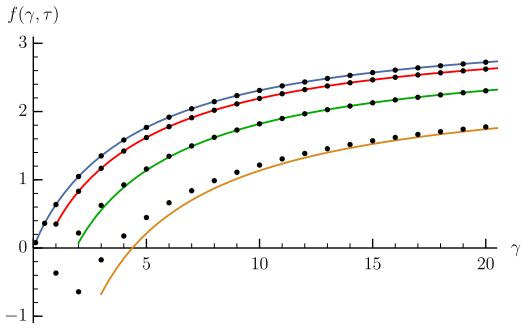
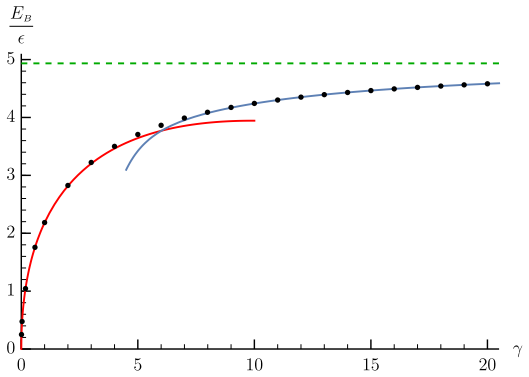
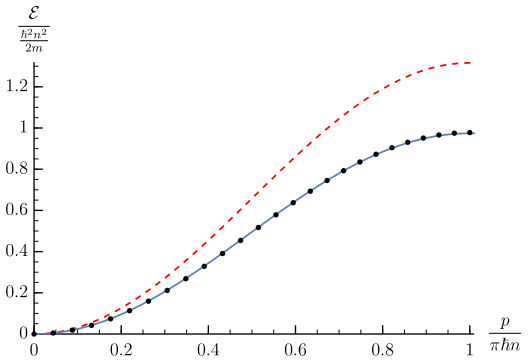
The Lieb-Liniger model describes one-dimensional bosons with contact interactions. This many-body system admits an exact solution in terms of the Bethe ansatz. Some of the exact and perturbative results for this model are reviewed. Particular attention is devoted to the explicit evaluation, in terms of the interaction parameter, of physical quantities that can be formally exactly extracted from the Bethe ansatz solution. Another goal of this review is to stress exact relations between various quantities. The technical developments are explained in detail. The most relevant experimental realisations of the studied problems are eventually discussed. This review also contains several new results such as the study of convergence of the ground-state energy series at strong interactions, the excitation spectrum at high energies, and the evaluation of the boundary energy.
Editorial analysis
A structured set of objections, weighed in public.
Referee Report
Summary. The manuscript reviews the Lieb-Liniger model of one-dimensional bosons with contact interactions. It states that the model admits an exact solution via the Bethe ansatz, reviews exact and perturbative results for quantities such as the ground-state energy and excitation spectrum, emphasizes explicit evaluations in terms of the interaction parameter and exact relations between quantities, provides detailed technical explanations, discusses experimental realizations, and presents new results on the convergence of the strong-coupling ground-state energy series, the high-energy excitation spectrum, and the boundary energy.
Significance. If the derivations and new calculations are correct, this review would serve as a useful reference in the field of integrable quantum gases. The Lieb-Liniger model is paradigmatic for Bethe-ansatz techniques with direct relevance to ultracold-atom experiments in one dimension. Compiling explicit expressions, analyzing series convergence at strong coupling, and treating boundary effects extends the practical utility of the solution while the focus on exact relations and technical details aids clarity for theorists and experimentalists.
minor comments (2)
- The abstract and introduction should more explicitly delineate which parts of the manuscript contain the new results (convergence study, high-energy spectrum, boundary energy) versus reviews of established material.
- Notation for the interaction parameter and related quantities (e.g., c, gamma) should be checked for consistency across sections and equations.
Simulated Author's Rebuttal
We thank the referee for their positive assessment of our manuscript reviewing the Lieb-Liniger model, its Bethe-ansatz solution, and the new results on series convergence, high-energy spectrum, and boundary energy. We appreciate the recognition of its potential utility as a reference for theorists and experimentalists working with integrable quantum gases. The recommendation is for minor revision, but no specific major comments were provided in the report.
Circularity Check
No significant circularity
full rationale
This is a review paper whose central premise is the established fact that the Lieb-Liniger Hamiltonian with repulsive contact interactions is exactly solvable by the Bethe ansatz (a result originating in the 1963 Lieb-Liniger paper and subsequent literature). All subsequent explicit evaluations of ground-state energy, excitation spectrum, boundary energy, and series convergence are presented as direct extractions or extensions from that external solution rather than quantities defined in terms of the paper's own fitted outputs or self-referential predictions. No self-definitional steps, fitted-input predictions, or load-bearing self-citation chains appear; the new results remain independent computations within the standard framework.
Axiom & Free-Parameter Ledger
axioms (1)
- domain assumption The Bethe ansatz yields the complete set of eigenstates and eigenvalues for the Lieb-Liniger Hamiltonian with delta-function interactions.
Reference graph
Works this paper leans on
-
[1]
Girardeau M 1960J. Math. Phys.1516
-
[2]
Rev.1301605 85
Lieb E H and Liniger W 1963Phys. Rev.1301605 85
-
[3]
Rev.1301616
Lieb E H 1963Phys. Rev.1301616
-
[4]
Yang C N and Yang C P 1969J. Math. Phys.101115
-
[5]
Korepin V E, Bogoliubov N M and Izergin A G 1993Quantum Inverse Scattering Method and Correlation Functions(Cambridge, England: Cambridge University Press)
-
[6]
Haldane F D M 1981Phys. Rev. Lett.471840
-
[7]
Affleck I 1986Phys. Rev. Lett.56746
-
[8]
Bl ¨ote H W J, Cardy J L and Nightingale M P 1986Phys. Rev. Lett.56742
-
[9]
Paredes B, Widera A, Murg V , Mandel O, F¨olling S, Cirac I, Shlyapnikov G V , H¨ansch T W and Bloch I 2004Nature429277
-
[10]
Kinoshita T, Wenger T and Weiss D S 2004Science3051125
-
[11]
Caux J S and Calabrese P 2006Phys. Rev. A74031605(R)
-
[12]
Kinoshita T, Wenger T and Weiss D S 2006Nature440900
-
[13]
Rigol M, Dunjko V , Yurovsky V and Olshanii M 2007Phys. Rev. Lett.98050405
-
[14]
Castro-Alvaredo O A, Doyon B and Yoshimura T 2016Phys. Rev. X6041065
-
[15]
Bertini B, Collura M, De Nardis J and Fagotti M 2016Phys. Rev. Lett.117207201
-
[16]
Ristivojevic Z 2014Phys. Rev. Lett.113015301
-
[17]
Ristivojevic Z and Matveev K A 2016Phys. Rev. B94024506
-
[18]
Petkovi ´c A and Ristivojevic Z 2018Phys. Rev. Lett.120165302
-
[19]
Ristivojevic Z 2019Phys. Rev. B100081110(R)
-
[20]
Reichert B, Astrakharchik G E, Petkovi ´c A and Ristivojevic Z 2019Phys. Rev. Lett.123 250602
-
[21]
Reichert B, Petkovi ´c A and Ristivojevic Z 2019Phys. Rev. B100235431
-
[22]
Reichert B and Ristivojevic Z 2020Phys. Rev. Research2013289
-
[23]
Ristivojevic Z 2021Phys. Rev. A104052218
-
[24]
Ristivojevic Z 2022Phys. Rev. A105013327
-
[25]
Ristivojevic Z 2022Phys. Rev. A106062216
-
[26]
Ristivojevic Z 2023Phys. Rev. Lett.130020401
-
[27]
Petkovi ´c A and Ristivojevic Z 2023Phys. Rev. B108174510
-
[28]
Panfil M and Ristivojevic Z 2025Phys. Rev. Lett.135020408
-
[29]
Tolra B L, O’Hara K M, Huckans J H, Phillips W D, Rolston S L and Porto J V 2004Phys. Rev. Lett.92190401
-
[30]
Haller E, Rabie M, Mark M J, Danzl J G, Hart R, Lauber K, Pupillo G and N ¨agerl H C 2011 Phys. Rev. Lett.107230404
2011
-
[31]
Gaudin M 2014The Bethe Wavefunction(Cambridge, England: Cambridge University Press) 86
-
[32]
Takahashi M 1999Thermodynamics of One-Dimensional Solvable Models(Cambridge, Eng- land: Cambridge University Press)
-
[33]
ˇSamaj L and Bajnok Z 2013Introduction to the Statistical Physics of Integrable Many-body Systems(Cambridge, England: Cambridge University Press)
-
[34]
Franchini F 2017An Introduction to Integrable Techniques for One-Dimensional Quantum Systems(Cham: Springer)
-
[35]
Eckle H P 2019Models of Quantum Matter(Oxford, England: Oxford University Press)
-
[36]
Sutherland B 2004Beautiful models(World Scientific, Singapore)
-
[37]
Bouchoule I and Dubail J 2022J. Stat. Mech.2022014003
-
[38]
Zwerger W 2022 The Lieb–Liniger gas with cold atomsThe Physics and Mathematics of Elliott Liebvol II (Berlin: EMS Press) p 629
2022
-
[39]
Cazalilla M A, Citro R, Giamarchi T, Orignac E and Rigol M 2011Rev. Mod. Phys.831405
-
[40]
Jiang Y Z, Chen Y Y and Guan X W 2015Chin. Phys. B24050311
-
[41]
Imambekov A, Schmidt T L and Glazman L I 2012Rev. Mod. Phys.841253
-
[42]
Giamarchi T 2003Quantum Physics in One Dimension(Clarendon Press, Oxford)
-
[43]
Guan X W, Batchelor M T and Lee C 2013Rev. Mod. Phys.851633
-
[44]
Forrester P J, Frankel N E and Makin M I 2006Phys. Rev. A74043614
-
[45]
Takahashi M 1975Progr. Theor. Phys.53386
-
[46]
Popov V N 1977Theor. Math. Phys.30222
-
[47]
Tracy C A and Widom H 2016J. Phys. A: Math. Theor.49294001
-
[48]
Comp.68351
Ferguson H R P, Bailey D H and Arno S 1999Math. Comp.68351
-
[49]
Borwein J M and Lison ˇek P 2000Discrete Math.21765
-
[50]
Abramowitz M and Stegun I A 1972Handbook of Mathematical Functions(Dover, New York)
-
[51]
Prolhac S 2017J. Phys. A: Math. Theor.50144001
-
[52]
Lang G 2018Correlations in Low-Dimensional Quantum GasesSpringer Theses (Springer International Publishing)
-
[53]
V olin D 2011J. Phys. A: Math. Theor.44124003
-
[54]
Mari ˜no M and Reis T 2019J. Stat. Phys.1771148
-
[55]
Guan X W and Batchelor M T 2011J. Phys. A: Math. Theor.44102001
-
[56]
Mercer G N and Roberts A J 1990SIAM J. Appl. Math.501547
-
[57]
Mickens R E 2015Difference Equations: Theory, Applications and Advanced Topics(Chap- man and Hall/CRC, New York)
-
[58]
Davies B 1990Physica A167433
-
[59]
Gangardt D M and Shlyapnikov G V 2003Phys. Rev. Lett.90010401 87
-
[60]
Pozsgay B 2011J. Stat. Mech.2011P11017
-
[61]
Bastianello A, Piroli L and Calabrese P 2018Phys. Rev. Lett.120190601
-
[62]
Kormos M, Chou Y Z and Imambekov A 2011Phys. Rev. Lett.107230405
-
[63]
Cheianov V V , Smith H and Zvonarev M B 2006Phys. Rev. A73051604(R)
-
[64]
Phys.579
Gangardt D M and Shlyapnikov G V 2003New J. Phys.579
-
[65]
Phys.18055014
Nandani E, R ¨omer R A, Tan S and Guan X W 2016New J. Phys.18055014
-
[66]
Pustilnik M and Matveev K A 2014Phys. Rev. B89100504(R)
-
[67]
Pustilnik M and Matveev K A 2015Phys. Rev. B92195146
-
[68]
Rozhkov A V 2005Eur. Phys. J. B47193
-
[69]
Popov V N 1972Theor. Math. Phys.11478
-
[70]
Mattis D C and Lieb E H 1965J. Math. Phys.6304
-
[71]
Kulish P P, Manakov S V and Faddeev L D 1976Theor. Math. Phys.28615
-
[72]
Cheon T and Shigehara T 1999Phys. Rev. Lett.822536
-
[73]
Khodas M, Pustilnik M, Kamenev A and Glazman L I 2007Phys. Rev. Lett.99110405
-
[74]
Granet E, Bertini B and Essler F H L 2022Phys. Rev. Lett.128021604
-
[75]
Core7047
Kerr M L, De Rosi G and Kheruntsyan K 2024SciPost Phys. Core7047
-
[76]
De Rosi G, Massignan P, Lewenstein M and Astrakharchik G E 2019Phys. Rev. Research1 033083
-
[77]
Kozlowski K K 2014Lett. Math. Phys.10455
-
[78]
Gaudin M 1971Phys. Rev. A4386
-
[79]
Pitaevskii L and Stringari S 2016Bose-Einstein Condensation and Superfluidity(Oxford: Oxford University Press)
-
[80]
Oelkers N, Batchelor M T, Bortz M and Guan X W 2006J. Phys. A: Math. Gen.391073
discussion (0)
Sign in with ORCID, Apple, or X to comment. Anyone can read and Pith papers without signing in.