Recognition: unknown
Bouncing cosmologies from Born-Infeld-type gravity
Pith reviewed 2026-05-08 01:52 UTC · model grok-4.3
The pith
Embedding Born-Infeld electrodynamics in five-dimensional gravity yields a ghost-free f(R,G) theory with many bouncing cosmologies.
A machine-rendered reading of the paper's core claim, the machinery that carries it, and where it could break.
Core claim
We construct a Born-Infeld-type f(R, G) modification of gravity, where G is the Gauss-Bonnet term, by embedding Born-Infeld electrodynamics in a five-dimensional pure modified gravity. This method leads to the correspondence between curvature scalars and electromagnetic field strength scalars -- R↔FμνFμν and G↔(ϵμνρσFμνFρσ)² -- allowing us to replicate the structure of Born-Infeld electrodynamics in the gravitational sector. The resulting Born-Infeld-type gravity is a ghost-free f(R, G) theory which reduces to Einstein gravity in the low energy limit. In this work we focus on bouncing cosmological solutions of such a theory, which require positive spatial curvature. By using both the Jordan-
What carries the argument
The curvature-to-field-strength scalar correspondence obtained from the five-dimensional embedding that replicates the Born-Infeld nonlinear structure in the f(R,G) action.
If this is right
- The theory remains ghost-free at all scales.
- It recovers Einstein gravity in the low-energy limit.
- Bouncing solutions exist in abundance when spatial curvature is positive.
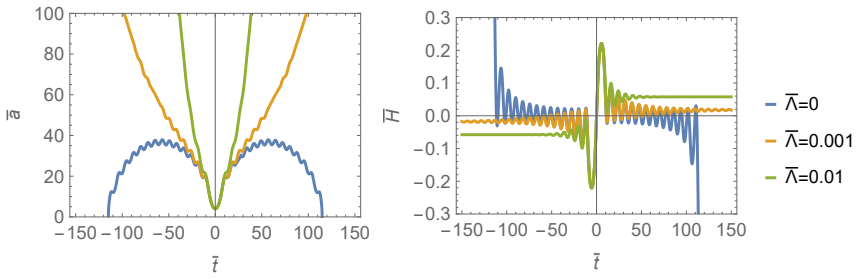
- These solutions exhibit varied asymptotic behaviors and can contain grouped multiple bounces.
Where Pith is reading between the lines
- The multiple-bounce solutions open the possibility of cyclic or quasi-periodic expansion histories that could leave imprints in the cosmic microwave background.
- Adding ordinary matter fields to the action would test whether the bounces survive in more realistic cosmological settings.
- The construction supplies a concrete route to singularity avoidance that stays within a second-order gravitational theory.
Load-bearing premise
Bouncing solutions exist only when spatial curvature is positive, and the construction assumes the five-dimensional embedding produces a consistent ghost-free four-dimensional theory through the stated scalar mappings.
What would settle it
A calculation that reveals ghosts in the linear perturbations around the background solutions or shows that no bouncing trajectories satisfy the field equations for positive curvature would disprove the central claims.
Figures






read the original abstract
We construct a Born-Infeld-type $f(R,{\cal G})$ modification of gravity, where ${\cal G}$ is the Gauss-Bonnet term, by embedding Born-Infeld electrodynamics in a five-dimensional pure modified gravity. This method leads to the correspondence between curvature scalars and electromagnetic field strength scalars -- $R\leftrightarrow F_{\mu\nu}F^{\mu\nu}$ and ${\cal G}\leftrightarrow (\epsilon_{\mu\nu\rho\sigma}F^{\mu\nu}F^{\rho\sigma})^2$ -- allowing us to replicate the structure of Born-Infeld electrodynamics in the gravitational sector. The resulting Born-Infeld-type gravity is a ghost-free $f(R,{\cal G})$ theory which reduces to Einstein gravity in the low energy limit. In this work we focus on bouncing cosmological solutions of such a theory, which require positive spatial curvature. By using both the Jordan and Einstein frame analyses, we find a vast space of bouncing solutions with different asymptotic behaviors, including solutions with multiple bounces grouped together. Observational consequences of such solutions will be investigated in the future.
Editorial analysis
A structured set of objections, weighed in public.
Referee Report
Summary. The paper constructs a Born-Infeld-type f(R, G) gravity theory by embedding Born-Infeld electrodynamics into five-dimensional pure modified gravity, using the correspondences R ↔ F_μν F^μν and G ↔ (ε_μνρσ F^μν F^ρσ)^2. It asserts that the resulting theory is ghost-free and reduces to Einstein gravity at low energies. Focusing on bouncing cosmologies (which require positive spatial curvature), the work identifies a large space of solutions with varied asymptotic behaviors, including multi-bounce configurations, via analyses in both the Jordan and Einstein frames.
Significance. If the embedding procedure rigorously yields a ghost-free f(R, G) theory with the stated low-energy limit, the construction supplies a systematic route to higher-order gravitational modifications that avoid Ostrogradsky instabilities by design. The reported abundance of bouncing solutions then offers concrete non-singular cosmological models whose observational signatures could be explored, extending the literature on modified-gravity bounces.
major comments (2)
- [Abstract / construction section] Abstract and the section describing the 5D embedding: the assertion that the construction produces a ghost-free f(R, G) theory is central to the entire claim, yet the manuscript provides neither the explicit functional form of f(R, G) obtained from the embedding nor a Hamiltonian or perturbative stability analysis confirming the cancellation of Ostrogradsky modes. Without these steps the reduction to Einstein gravity at low energies and the viability of the subsequent cosmological solutions remain unverified.
- [Cosmological solutions] The cosmological solutions section: the statement that bouncing solutions 'require positive spatial curvature' and that a 'vast space' of such solutions (including multi-bounce families) exists is presented without the explicit Friedmann equations, the range of integration constants or parameters that realize them, or any linear perturbation analysis around the bounces to establish stability.
minor comments (1)
- [Abstract] The abstract refers to future observational work; a brief pointer to existing constraints on bouncing cosmologies (e.g., from CMB or gravitational waves) would help situate the results.
Simulated Author's Rebuttal
We thank the referee for the careful reading and constructive comments on our manuscript. We address each major point below and will revise the manuscript to incorporate additional explicit details where appropriate.
read point-by-point responses
-
Referee: [Abstract / construction section] Abstract and the section describing the 5D embedding: the assertion that the construction produces a ghost-free f(R, G) theory is central to the entire claim, yet the manuscript provides neither the explicit functional form of f(R, G) obtained from the embedding nor a Hamiltonian or perturbative stability analysis confirming the cancellation of Ostrogradsky modes. Without these steps the reduction to Einstein gravity at low energies and the viability of the subsequent cosmological solutions remain unverified.
Authors: We agree that an explicit functional form would improve clarity. The construction proceeds by substituting the correspondences R ↔ F_μν F^μν and G ↔ (ε_μνρσ F^μν F^ρσ)^2 into the Born-Infeld electrodynamics Lagrangian, yielding an f(R, G) of the form f(R, G) = β² (1 - sqrt(1 - (R + G/β²))) or its direct analogue; we will insert this expression and the intermediate steps from the 5D embedding in the revised construction section. The ghost-free property follows by design from the BI structure, which avoids higher-derivative instabilities in its electromagnetic counterpart, together with the known absence of Ostrogradsky ghosts in the resulting fourth-order theory when the auxiliary-field formulation is used. We will add a short paragraph referencing this mechanism and the low-energy expansion that recovers the Einstein-Hilbert term plus higher-order corrections suppressed by the BI scale. revision: yes
-
Referee: [Cosmological solutions] The cosmological solutions section: the statement that bouncing solutions 'require positive spatial curvature' and that a 'vast space' of such solutions (including multi-bounce families) exists is presented without the explicit Friedmann equations, the range of integration constants or parameters that realize them, or any linear perturbation analysis around the bounces to establish stability.
Authors: We accept that the presentation would be strengthened by greater explicitness. In the revised version we will derive and display the modified Friedmann equations in both the Jordan and Einstein frames, obtained by varying the f(R, G) action with respect to the metric for a closed FLRW ansatz (k = +1). We will specify the ranges of the integration constants and the BI scale parameter that produce single-bounce and multi-bounce trajectories, including the conditions under which the Hubble parameter changes sign. While the paper’s primary aim is to demonstrate the existence of a large solution space, we will include a brief linear perturbation analysis around representative bounce points, showing that the scalar and tensor modes remain stable for the parameter choices considered. revision: yes
Circularity Check
No significant circularity; construction and solutions are self-contained
full rationale
The paper defines its Born-Infeld-type f(R,G) theory constructively via the 5D embedding of Born-Infeld electrodynamics, which supplies the scalar correspondences R ↔ FμνFμν and G ↔ (εFF)^2 as an input method rather than a derived output. Bouncing solutions are then obtained by direct analysis of the resulting field equations in both Jordan and Einstein frames for positive spatial curvature, without any fitted parameters, self-referential predictions, or load-bearing self-citations that collapse the central claims back to the inputs. The asserted ghost-freedom and Einstein limit follow from the embedding construction itself and do not constitute a circular loop. This is a standard non-circular theoretical construction.
Axiom & Free-Parameter Ledger
axioms (1)
- ad hoc to paper Embedding Born-Infeld electrodynamics into five-dimensional pure modified gravity produces a valid four-dimensional f(R, G) theory via the stated scalar correspondences
invented entities (1)
-
Born-Infeld-type f(R, G) gravity
no independent evidence
Reference graph
Works this paper leans on
-
[1]
Foundations of the new field theory,
M. Born and L. Infeld, “Foundations of the new field theory,”Proc. Roy. Soc. Lond. A 144no. 852, (1934) 425–451
1934
-
[2]
Born-Infeld-Einstein actions?,
S. Deser and G. W. Gibbons, “Born-Infeld-Einstein actions?,”Class. Quant. Grav.15 (1998) L35–L39,arXiv:hep-th/9803049
-
[3]
Palatini approach to Born-Infeld-Einstein theory and a geometric description of electrodynamics,
D. N. Vollick, “Palatini approach to Born-Infeld-Einstein theory and a geometric description of electrodynamics,”Phys. Rev. D69(2004) 064030,arXiv:gr-qc/0309101
-
[4]
Black hole and cosmological space-times in Born-Infeld-Einstein theory,
D. N. Vollick, “Black hole and cosmological space-times in Born-Infeld-Einstein theory,” arXiv:gr-qc/0601136
-
[5]
Born-Infeld gravity in any dimension,
J. A. Nieto, “Born-Infeld gravity in any dimension,”Phys. Rev. D70(2004) 044042, arXiv:hep-th/0402071
-
[6]
Gravitational analogs of nonlinear Born electrodynamics,
J. A. Feigenbaum, P. G. O. Freund, and M. Pigli, “Gravitational analogs of nonlinear Born electrodynamics,”Phys. Rev. D57(1998) 4738–4744,arXiv:hep-th/9709196
-
[7]
Born regulated gravity in four-dimensions,
J. A. Feigenbaum, “Born regulated gravity in four-dimensions,”Phys. Rev. D58(1998) 124023,arXiv:hep-th/9807114
-
[8]
D. Comelli, “Born-Infeld type gravity,”Phys. Rev. D72(2005) 064018, arXiv:gr-qc/0505088
-
[9]
R. Garcia-Salcedo, T. Gonzalez, C. Moreno, Y. Napoles, Y. Leyva, and I. Quiros, “Asymptotic Properties of a Supposedly Regular (Dirac-Born-Infeld) Modification of General Relativity,”JCAP02(2010) 027,arXiv:0912.5048 [gr-qc]
-
[10]
Born-Infeld-like modified gravity,
S. I. Kruglov, “Born-Infeld-like modified gravity,”Int. J. Theor. Phys.52(2013) 2477–2484,arXiv:1202.4807 [gr-qc]
-
[11]
Y. Aldabergenov, R. Ishikawa, S. V. Ketov, and S. I. Kruglov, “Beyond Starobinsky inflation,”Phys. Rev. D98no. 8, (2018) 083511,arXiv:1807.08394 [hep-th]
-
[12]
Born Infeld inspired modifications of gravity,
J. Beltran Jimenez, L. Heisenberg, G. J. Olmo, and D. Rubiera-Garcia, “Born–Infeld inspired modifications of gravity,”Phys. Rept.727(2018) 1–129,arXiv:1704.03351 [gr-qc]
-
[13]
Zum Unit¨ atsproblem der Physik,
T. Kaluza, “Zum Unit¨ atsproblem der Physik,”Sitzungsber. Preuss. Akad. Wiss. Berlin (Math. Phys. )1921(1921) 966–972,arXiv:1803.08616 [physics.hist-ph]
-
[14]
Quantum Theory and Five-Dimensional Theory of Relativity. (In German and English),
O. Klein, “Quantum Theory and Five-Dimensional Theory of Relativity. (In German and English),”Z. Phys.37(1926) 895–906
1926
-
[15]
Bouncing Cosmologies in Palatini $f(R)$ Gravity
C. Barragan, G. J. Olmo, and H. Sanchis-Alepuz, “Bouncing Cosmologies in Palatini f(R) Gravity,”Phys. Rev. D80(2009) 024016,arXiv:0907.0318 [gr-qc]
work page Pith review arXiv 2009
-
[16]
Bouncing inflation in nonlinearR 2 +R 4 gravitational model,
T. Saidov and A. Zhuk, “Bouncing inflation in nonlinearR 2 +R 4 gravitational model,” Phys. Rev. D81(2010) 124002,arXiv:1002.4138 [hep-th]. 43
-
[17]
Bounce cosmology from $F(R)$ gravity and $F(R)$ bigravity
K. Bamba, A. N. Makarenko, A. N. Myagky, S. Nojiri, and S. D. Odintsov, “Bounce cosmology fromF(R) gravity andF(R) bigravity,”JCAP01(2014) 008, arXiv:1309.3748 [hep-th]
work page Pith review arXiv 2014
-
[18]
Bounce universe from string-inspired Gauss-Bonnet gravity,
K. Bamba, A. N. Makarenko, A. N. Myagky, and S. D. Odintsov, “Bounce universe from string-inspired Gauss-Bonnet gravity,”JCAP04(2015) 001,arXiv:1411.3852 [hep-th]
-
[19]
The bouncing cosmology withF(R) gravity and its reconstructing,
A. R. Amani, “The bouncing cosmology withF(R) gravity and its reconstructing,”Int. J. Mod. Phys. D25no. 06, (2016) 1650071,arXiv:1512.03475 [gr-qc]
-
[20]
Covariant action for bouncing cosmologies in modified Gauss–Bonnet gravity,
I. Terrucha, D. Vernieri, and J. P. S. Lemos, “Covariant action for bouncing cosmologies in modified Gauss–Bonnet gravity,”Annals Phys.404(2019) 39–46,arXiv:1904.00260 [gr-qc]
-
[21]
Bouncing cosmology inf(R,G) gravity by order reduction,
B. J. Barros, E. M. Teixeira, and D. Vernieri, “Bouncing cosmology inf(R,G) gravity by order reduction,”Annals Phys.419(2020) 168231,arXiv:1907.11732 [gr-qc]
-
[22]
Extended matter bounce scenario in ghost freef(R,G) gravity compatible with GW170817,
E. Elizalde, S. D. Odintsov, V. K. Oikonomou, and T. Paul, “Extended matter bounce scenario in ghost freef(R,G) gravity compatible with GW170817,”Nucl. Phys. B954 (2020) 114984,arXiv:2003.04264 [gr-qc]
-
[23]
Towards a smooth unification from an ekpyrotic bounce to the dark energy era,
S. Nojiri, S. D. Odintsov, and T. Paul, “Towards a smooth unification from an ekpyrotic bounce to the dark energy era,”Phys. Dark Univ.35(2022) 100984,arXiv:2202.02695 [gr-qc]
-
[24]
Bouncing Cosmology in Fourth-Order Gravity,
M. Miranda, D. Vernieri, S. Capozziello, and F. S. N. Lobo, “Bouncing Cosmology in Fourth-Order Gravity,”Universe8no. 3, (2022) 161,arXiv:2203.04918 [gr-qc]
-
[25]
Bouncing universe in modified Gauss–Bonnet gravity,
J. K. Singh, Shaily, and K. Bamba, “Bouncing universe in modified Gauss–Bonnet gravity,”Chin. J. Phys.84(2023) 371–380,arXiv:2204.06210 [gr-qc]
-
[26]
A non-singular bouncing cosmology in f(R,T) gravity,
J. K. Singh, Shaily, A. Singh, A. Beesham, and H. Shabani, “A non-singular bouncing cosmology in f(R,T) gravity,”Annals Phys.455(2023) 169382,arXiv:2304.11578 [gr-qc]
-
[27]
Born-Infeld action, supersymmetry and string theory,
A. A. Tseytlin, “Born-Infeld action, supersymmetry and string theory,” arXiv:hep-th/9908105
-
[28]
Many faces of Born-Infeld theory,
S. V. Ketov, “Many faces of Born-Infeld theory,” in7th International Wigner Symposium (Wigsym 7). 8, 2001.arXiv:hep-th/0108189
work page internal anchor Pith review arXiv 2001
-
[29]
Nonlinear Electrodynamics from Quantized Strings,
E. S. Fradkin and A. A. Tseytlin, “Nonlinear Electrodynamics from Quantized Strings,” Phys. Lett. B163(1985) 123–130
1985
-
[30]
Open strings in background gauge fields,
A. Abouelsaood, C. G. Callan, Jr., C. R. Nappi, and S. A. Yost, “Open strings in background gauge fields,”Nucl. Phys. B280(1987) 599–624
1987
-
[31]
The Born-Infeld Action From Conformal Invariance of the Open Superstring,
E. Bergshoeff, E. Sezgin, C. N. Pope, and P. K. Townsend, “The Born-Infeld Action From Conformal Invariance of the Open Superstring,”Phys. Lett. B188(1987) 70
1987
-
[32]
The Born-Infeld Action as the Effective Action in the Open Superstring Theory,
R. R. Metsaev, M. Rakhmanov, and A. A. Tseytlin, “The Born-Infeld Action as the Effective Action in the Open Superstring Theory,”Phys. Lett. B193(1987) 207–212. 44
1987
-
[33]
Selfduality of Born-Infeld action and Dirichlet three-brane of type IIB superstring theory,
A. A. Tseytlin, “Selfduality of Born-Infeld action and Dirichlet three-brane of type IIB superstring theory,”Nucl. Phys. B469(1996) 51–67,arXiv:hep-th/9602064
-
[34]
A New Goldstone multiplet for partially broken supersymmetry,
J. Bagger and A. Galperin, “A New Goldstone multiplet for partially broken supersymmetry,”Phys. Rev. D55(1997) 1091–1098,arXiv:hep-th/9608177
-
[35]
Partial breaking of global D = 4 supersymmetry, constrained superfields, and three-brane actions,
M. Rocek and A. A. Tseytlin, “Partial breaking of global D = 4 supersymmetry, constrained superfields, and three-brane actions,”Phys. Rev. D59(1999) 106001, arXiv:hep-th/9811232
-
[36]
N. Wyllard, “Derivative corrections to the D-brane Born-Infeld action: Nongeodesic embeddings and the Seiberg-Witten map,”JHEP08(2001) 027, arXiv:hep-th/0107185
-
[37]
Scalar-Vector-Tensor Gravity Theories,
L. Heisenberg, “Scalar-Vector-Tensor Gravity Theories,”JCAP10(2018) 054, arXiv:1801.01523 [gr-qc]
-
[38]
Higher derivative scalar-vector-tensor theories from Kaluza-Klein reductions of Horndeski theory,
S. Mironov, A. Shtennikova, and M. Valencia-Villegas, “Higher derivative scalar-vector-tensor theories from Kaluza-Klein reductions of Horndeski theory,”Phys. Rev. D111no. 2, (2025) 024028,arXiv:2408.04626 [hep-th]
-
[39]
Ghost-free, gauge invariant SVT generalizations of Horndeski theory,
S. Mironov, A. Shtennikova, and M. Valencia-Villegas, “Ghost-free, gauge invariant SVT generalizations of Horndeski theory,”Eur. Phys. J. C85no. 12, (2025) 1378, arXiv:2509.16850 [hep-th]. [40]PlanckCollaboration, N. Aghanimet al., “Planck 2018 results. VI. Cosmological parameters,”Astron. Astrophys.641(2020) A6,arXiv:1807.06209 [astro-ph.CO]. [Erratum: A...
-
[40]
Born-Infeld black holes in (A)dS spaces,
R.-G. Cai, D.-W. Pang, and A. Wang, “Born-Infeld black holes in (A)dS spaces,”Phys. Rev. D70(2004) 124034,arXiv:hep-th/0410158
-
[41]
K. Yang, B.-M. Gu, S.-W. Wei, and Y.-X. Liu, “Born–Infeld black holes in 4D Einstein–Gauss–Bonnet gravity,”Eur. Phys. J. C80no. 7, (2020) 662, arXiv:2004.14468 [gr-qc]
-
[42]
Effects of Born–Infeld electrodynamics on black hole shadows,
A. He, J. Tao, P. Wang, Y. Xue, and L. Zhang, “Effects of Born–Infeld electrodynamics on black hole shadows,”Eur. Phys. J. C82no. 8, (2022) 683,arXiv:2205.12779 [gr-qc]
-
[43]
Bouncing cosmologies in geometries with positively curved spatial sections,
J. Haro, “Bouncing cosmologies in geometries with positively curved spatial sections,” Phys. Lett. B760(2016) 605–610,arXiv:1511.05048 [gr-qc]
-
[44]
Non-singular bouncing cosmology with positive spatial curvature and flat scalar potential,
H. Matsui, F. Takahashi, and T. Terada, “Non-singular bouncing cosmology with positive spatial curvature and flat scalar potential,”Phys. Lett. B795(2019) 152–159, arXiv:1904.12312 [gr-qc]
-
[45]
¨O. G¨ ung¨ or and G. D. Starkman, “A classical, non-singular, bouncing universe,”JCAP 04(2021) 003,arXiv:2011.05133 [gr-qc]
- [46]
-
[47]
STOCHASTIC DE SITTER (INFLATIONARY) STAGE IN THE EARLY UNIVERSE,
A. A. Starobinsky, “STOCHASTIC DE SITTER (INFLATIONARY) STAGE IN THE EARLY UNIVERSE,”Lect. Notes Phys.246(1986) 107–126
1986
-
[48]
Nonlinear evolution of long wavelength metric fluctuations in inflationary models,
D. S. Salopek and J. R. Bond, “Nonlinear evolution of long wavelength metric fluctuations in inflationary models,”Phys. Rev. D42(1990) 3936–3962
1990
-
[49]
V. Vennin and A. A. Starobinsky, “Correlation Functions in Stochastic Inflation,”Eur. Phys. J. C75(2015) 413,arXiv:1506.04732 [hep-th]
-
[50]
Meso-inflationary Peccei–Quinn Symmetry Breaking with Nonminimal Coupling,
Y. Aldabergenov, D. Ding, W. Lin, and Y. Wan, “Meso-inflationary Peccei–Quinn Symmetry Breaking with Nonminimal Coupling,”Astrophys. J. Suppl.275no. 1, (2024) 14,arXiv:2406.15818 [hep-th]
-
[51]
Towards Stochastic Inflation in Higher-Curvature Gravity,
Y. Aldabergenov, D. Ding, W. Lin, and Y. Wan, “Towards Stochastic Inflation in Higher-Curvature Gravity,”arXiv:2506.21423 [gr-qc]
work page internal anchor Pith review arXiv
-
[52]
Unified cosmic history in modified gravity: from F(R) theory to Lorentz non-invariant models
S. Nojiri and S. D. Odintsov, “Unified cosmic history in modified gravity: from F(R) theory to Lorentz non-invariant models,”Phys. Rept.505(2011) 59–144, arXiv:1011.0544 [gr-qc]
work page Pith review arXiv 2011
-
[53]
Gravitational lensing by a regular black hole,
E. F. Eiroa and C. M. Sendra, “Gravitational lensing by a regular black hole,”Class. Quant. Grav.28(2011) 085008,arXiv:1011.2455 [gr-qc]
-
[54]
Strong gravitational lensing effects around rotating regular black holes,
M.-Y. Guo, M.-H. Wu, H. Guo, X.-M. Kuang, and F.-Y. Liu, “Strong gravitational lensing effects around rotating regular black holes,”Phys. Lett. B860(2025) 139211, arXiv:2501.00292 [gr-qc]
-
[55]
Circular orbits and observational signatures in regular black hole spacetimes,
A. Errehymy, G. Mustafa, A. S. Rasheed, K. Boshkayev, S. K. Maurya, N. Alessa, and A. H. Abdel-Aty, “Circular orbits and observational signatures in regular black hole spacetimes,”Int. J. Geom. Meth. Mod. Phys.23no. 02, (2026) 2650018
2026
-
[56]
Distinguish Bardeen-like black holes by Gravitational lensing
L. Yuan, C.-H. Hsiao, and Y. Wan, “Distinguish Bardeen-like black holes by Gravitational lensing,”arXiv:2604.11951 [gr-qc]
work page internal anchor Pith review Pith/arXiv arXiv
-
[57]
Gravitational Lensing Signatures of Hayward-like Black Holes
C.-H. Hsiao, L. Yuan, and Y. Wan, “Gravitational Lensing Signatures of Hayward-like Black Holes,”arXiv:2604.14505 [gr-qc]
work page internal anchor Pith review Pith/arXiv arXiv
-
[58]
Cosmological singularity resolution from quantum gravity: the emergent-bouncing universe,
E. Alesci, G. Botta, F. Cianfrani, and S. Liberati, “Cosmological singularity resolution from quantum gravity: the emergent-bouncing universe,”Phys. Rev. D96no. 4, (2017) 046008,arXiv:1612.07116 [gr-qc]
-
[59]
Fluctuations through a Vibrating Bounce,
R. Brandenberger, Q. Liang, R. O. Ramos, and S. Zhou, “Fluctuations through a Vibrating Bounce,”Phys. Rev. D97no. 4, (2018) 043504,arXiv:1711.08370 [hep-th]
-
[60]
Large scale anomalies in the CMB and non-Gaussianity in bouncing cosmologies,
I. Agullo, D. Kranas, and V. Sreenath, “Large scale anomalies in the CMB and non-Gaussianity in bouncing cosmologies,”Class. Quant. Grav.38no. 6, (2021) 065010, arXiv:2006.09605 [astro-ph.CO]
-
[61]
Non-Gaussianity excess problem in classical bouncing cosmologies,
X. Gao, M. Lilley, and P. Peter, “Non-Gaussianity excess problem in classical bouncing cosmologies,”Phys. Rev. D91no. 2, (2015) 023516,arXiv:1406.4119 [gr-qc]
-
[62]
Smoking-gun signatures of bounce cosmology from echoes of relic gravitational waves,
M. Zhu and Y.-F. Cai, “Smoking-gun signatures of bounce cosmology from echoes of relic gravitational waves,”arXiv:2603.13924 [astro-ph.CO]. 46
discussion (0)
Sign in with ORCID, Apple, or X to comment. Anyone can read and Pith papers without signing in.