Recognition: unknown
Underlying mechanisms of phase transitions in scalar-tensor theories
Pith reviewed 2026-05-08 01:53 UTC · model grok-4.3
The pith
The order of scalarization phase transitions is fixed by Landau coefficients computed directly from the energy functional of scalar-tensor theories.
A machine-rendered reading of the paper's core claim, the machinery that carries it, and where it could break.
Core claim
Starting from the nonlinear energy functional of the scalar-tensor theory, the authors reduce it to an effective energy function whose expansion coefficients are precisely the Landau coefficients that govern the transition. The signs and magnitudes of these coefficients then determine whether the transition is first-order or second-order for a chosen coupling function and range of parameters, thereby explaining previously observed but mechanistically unclear behavior and enabling direct prediction of the transition order.
What carries the argument
Reduction of the nonlinear energy functional to an effective energy function, from which the Landau expansion coefficients are extracted to fix the phase transition order.
If this is right
- For each coupling function the sign of the quartic Landau coefficient decides whether the transition is first-order or second-order.
- First-order transitions permit jumps from metastable scalarized states, producing potentially observable signals distinct from second-order cases.
- The method classifies entire families of scalar-tensor models by transition order without requiring full numerical simulations in each case.
- Previously unexplained dependence of transition order on parameters is now traced to the explicit dependence of the derived coefficients on those parameters.
Where Pith is reading between the lines
- The same reduction technique could be applied to other modified-gravity models that exhibit spontaneous symmetry breaking to classify their transition orders uniformly.
- If higher-order terms become important inside neutron-star interiors, the effective-energy-function predictions may require regime-specific corrections before being compared with observations.
- Astrophysical data on compact-object stability or gravitational-wave signatures could directly test which coupling functions are realized by selecting those whose predicted transition orders match the data.
Load-bearing premise
The reduction of the full nonlinear energy functional to an effective energy function captures all relevant physics and yields the correct Landau coefficients without missing higher-order terms that would change the predicted transition order.
What would settle it
A concrete numerical evolution or exact solution of the full nonlinear scalar-tensor equations in a regime where the Landau coefficients predict one transition order yet the actual dynamics exhibit the opposite order would falsify the reduction procedure.
Figures





read the original abstract
Spontaneous scalarization phenomenon in scalar-tensor gravity is known to be a form of phase transition, and it was recently shown that the order of this transition changes depending on the parameters of the theory. There exists a phenomenological description of this result based on Landau theory, but the underlying mechanisms which determine the coefficients of the Landau expansion were unknown. In this study we calculate these coefficients starting from first principles. To this end, we start with an energy functional that describes the nonlinear behavior of the theory, and reduce it to an energy function. This allows us to explain the previously observed, but not well-understood, features of the scalarization phase transition, and enables us to predict which phase transition order will be present for which coupling function or in which regime of the parameter space. The details of the phase transition determine certain astrophysical observables such as signals sourced by transitions from metastable states in first-order scalarization. Thus, predicting these details is an important part of understanding scalarization itself.
Editorial analysis
A structured set of objections, weighed in public.
Referee Report
Summary. The paper claims that spontaneous scalarization in scalar-tensor gravity is a phase transition whose order (first or second) depends on the coupling function and parameters. Starting from the full nonlinear energy functional, the authors reduce it to an effective energy function whose Landau expansion coefficients are computed from first principles; this is said to explain previously observed but unexplained features of the transition and to predict the order for given couplings or regimes, with implications for astrophysical signals from metastable states.
Significance. If the reduction is shown to be complete and uniform, the work supplies a first-principles route to the Landau coefficients, moving beyond phenomenology and enabling concrete predictions for which scalar-tensor models exhibit first-order versus second-order scalarization. This is potentially valuable for interpreting gravitational-wave or electromagnetic signatures associated with transitions between metastable configurations.
major comments (1)
- [reduction procedure] The reduction from the nonlinear energy functional to the effective Landau energy function (the central step that fixes the sign of the quartic coefficient and hence the transition order) must be shown to retain all terms that could affect the sign of the quartic or sixth-order coefficients. If the procedure employs a perturbative expansion around a background, a specific scalar-profile ansatz, or a truncation whose validity is regime-dependent, higher-order or non-local contributions could enter with opposite sign and reverse the predicted order. Explicit verification that the truncation is justified uniformly across the parameter space where first-order transitions are claimed is required.
minor comments (2)
- The abstract states that the energy functional is reduced to an energy function but does not display the resulting effective potential or the explicit expressions for the Landau coefficients; adding one or two key equations would improve immediate readability.
- Notation for the coupling functions and the parameters that control the transition order should be introduced once in the main text and used consistently thereafter.
Simulated Author's Rebuttal
We thank the referee for their careful reading of our manuscript and for the constructive comment on the reduction procedure. We address this point in detail below and are happy to revise the manuscript accordingly to strengthen the presentation of our results.
read point-by-point responses
-
Referee: The reduction from the nonlinear energy functional to the effective Landau energy function (the central step that fixes the sign of the quartic coefficient and hence the transition order) must be shown to retain all terms that could affect the sign of the quartic or sixth-order coefficients. If the procedure employs a perturbative expansion around a background, a specific scalar-profile ansatz, or a truncation whose validity is regime-dependent, higher-order or non-local contributions could enter with opposite sign and reverse the predicted order. Explicit verification that the truncation is justified uniformly across the parameter space where first-order transitions are claimed is required.
Authors: We agree that an explicit demonstration of the completeness of the reduction is essential to support our claims regarding the sign of the quartic coefficient and the resulting transition order. In the manuscript, the reduction proceeds by inserting the leading-order eigenmode solution of the linearized scalar equation into the full nonlinear energy functional and performing the spatial integration to extract the effective coefficients up to sixth order. Higher-order corrections to the scalar profile, which arise from the nonlinear terms in the field equations, contribute only to the effective energy at O(φ^6) and higher when substituted back into the functional; they therefore cannot alter the sign of the quartic term. We have verified this by direct computation of the next-to-leading profile correction for representative values of the coupling parameters. In addition, we have compared the critical points and stability predicted by the reduced Landau function against full numerical minimization of the original energy functional across the parameter regimes where first-order transitions are identified, finding quantitative agreement in both the location of the transition and the presence of metastable states. These explicit checks will be added as a new subsection in the revised manuscript. revision: yes
Circularity Check
No circularity: derivation starts from independent energy functional
full rationale
The paper derives Landau coefficients by reducing the nonlinear energy functional of the scalar-tensor theory to an effective energy function, presented as a first-principles calculation. No self-citations, fitted parameters renamed as predictions, self-definitional steps, or ansatzes smuggled via prior work are indicated. The reduction is load-bearing for determining transition order but is described as an explicit, non-perturbative mapping from the theory's energy functional, which is external to the target result. This is a standard, self-contained derivation with no reduction to inputs by construction.
Axiom & Free-Parameter Ledger
axioms (1)
- domain assumption An energy functional exists that describes the nonlinear behavior of the scalar-tensor theory
Reference graph
Works this paper leans on
-
[1]
Such a function typ- ically exists for the theories of interest to us
Obtain an energyfunctionalwhose variation leads to the solutions of the theory. Such a function typ- ically exists for the theories of interest to us
-
[2]
Its general shape can be found exactly, but its amplitude will be an unknown
Use the leading order of the perturbation theory, or equivalently the linearized scalar field equations, right at the onset of scalarization (at the bifurca- tion point) to find the zero mode. Its general shape can be found exactly, but its amplitude will be an unknown
-
[3]
This provides an energyfunctionwhose argument is the scalar field amplitude from Step 2
Assume the scalar field to be in the form of Step 2, and insert it into the energy functional from Step 1. This provides an energyfunctionwhose argument is the scalar field amplitude from Step 2. IV. ENERGY FUNCTION FRAMEWORK FOR A REALISTIC NEUTRON STAR The main challenge for a relativistic star is the inter- dependence of the metric, the matter density ...
-
[4]
Why do we see first-order scalarization for realistic stars at all?
-
[5]
postdiction
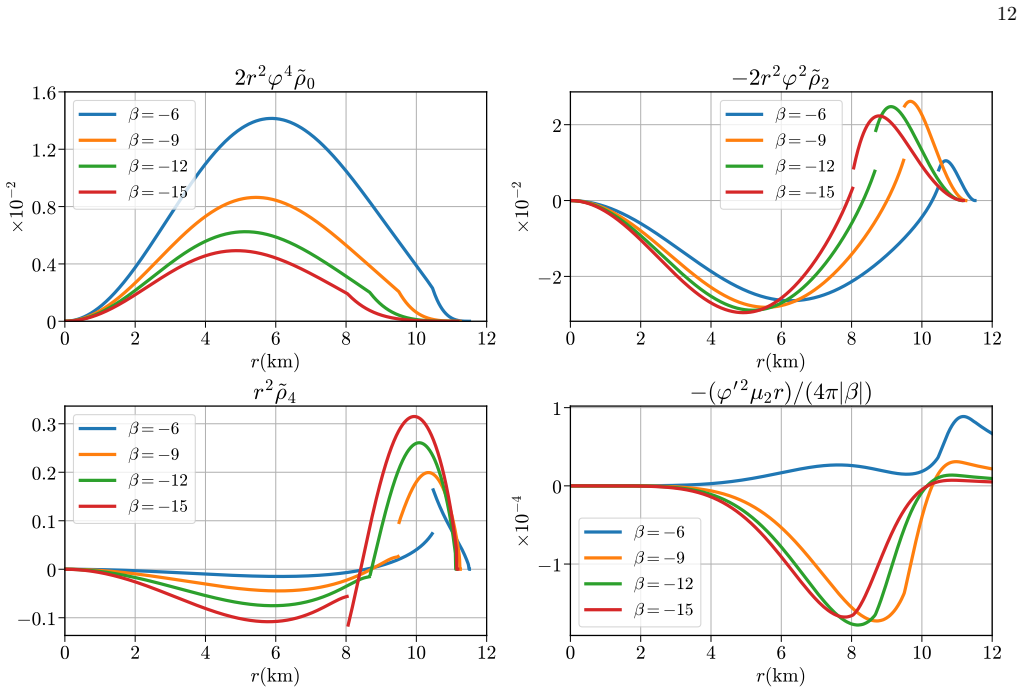
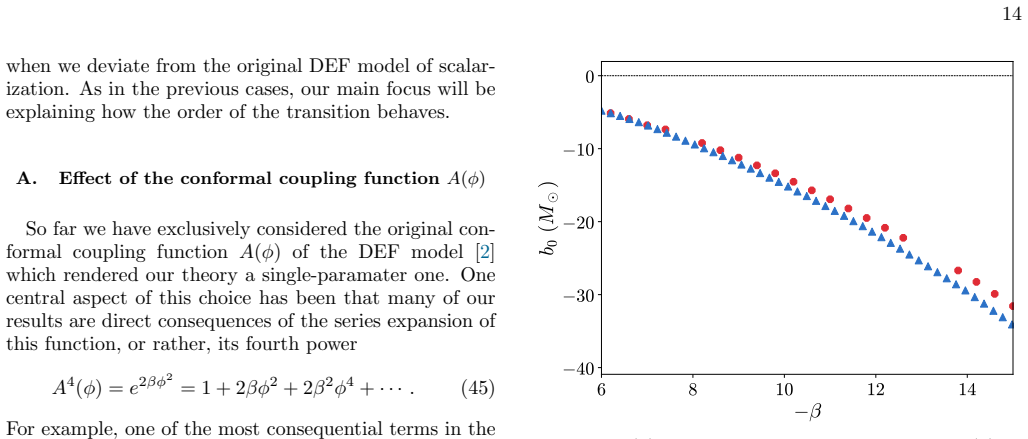
Why does first-order scalarization become the de- fault outcome whenβbecomes sufficiently nega- tive? We already see these facts in Figure 5. What we are after now is gaining an insight tohowb 0(β) arises from a basic physical understanding of ˜ρ0,2,4 andµ 2. To begin with, note that there is an overall factor of |β|2 in Eq. (43), hence whatever value obt...
-
[6]
Fujii and K
Y. Fujii and K. Maeda,The Scalar-Tensor Theory of Gravitation(Cambridge University Press, Cambridge, 2003)
2003
-
[7]
Damour and G
T. Damour and G. Esposito-Far` ese, Nonperturbative strong-field effects in tensor-scalar theories of gravitation, Phys. Rev. Lett.70, 2220 (1993)
1993
- [8]
- [9]
-
[10]
Black holes, gravitational waves and fundamental physics: a roadmap
L. Baracket al., Black holes, gravitational waves and fundamental physics: a roadmap, Class. Quant. Grav. 36, 143001 (2019), arXiv:1806.05195 [gr-qc]
work page Pith review arXiv 2019
- [11]
- [12]
- [13]
-
[14]
Tensor - scalar gravity and binary pulsar experiments,
T. Damour and G. Esposito-Far` ese, Tensor-scalar gravity and binary-pulsar experiments, Phys. Rev. D54, 1474 (1996), arXiv:gr-qc/9602056
- [15]
- [16]
- [17]
-
[18]
C. Herdeiro, H. Huang, J. Kunz, M.-Y. Lai, E. Radu, and D.-C. Zou, Phase Structure of Scalarized Black Holes in Einstein-Scalar-Gauss-Bonnet Gravity (2026), arXiv:2603.24164 [gr-qc]
- [19]
-
[20]
Landau, On the theory of phase transitions, Zh
L. Landau, On the theory of phase transitions, Zh. Eksp. Teor. Fiz.7, 19 (1937)
1937
-
[21]
Plischke and B
M. Plischke and B. Bergersen,Equilibrium Statistical Physics(World Scientific, Singapore, 2006)
2006
-
[22]
Goldenfeld,Lectures on Phase Transitions and the Renormalization Group(CRC Press, Boca Raton, 2018)
N. Goldenfeld,Lectures on Phase Transitions and the Renormalization Group(CRC Press, Boca Raton, 2018)
2018
-
[23]
J. S. Read, C. Markakis, M. Shibata, K. Uryu, J. D. E. Creighton, and J. L. Friedman, Measuring the neutron star equation of state with gravitational wave observa- tions, Phys. Rev. D79, 124033 (2009), arXiv:0901.3258 [gr-qc]
work page Pith review arXiv 2009
-
[24]
Damour and G
T. Damour and G. Esposito-Far` ese, Tensor multiscalar theories of gravitation, Class.Quant.Grav.9, 2093 (1992)
2093
- [25]
- [26]
- [27]
-
[28]
Holmes,Introduction to Perturbation Methods, Texts in Applied Mathematics (Springer New York, 2012)
M. Holmes,Introduction to Perturbation Methods, Texts in Applied Mathematics (Springer New York, 2012)
2012
- [29]
- [30]
- [31]
-
[32]
K. Yagi and N. Yunes, Approximate Universal Relations for Neutron Stars and Quark Stars, Phys. Rept.681, 1 (2017), arXiv:1608.02582 [gr-qc]
- [33]
- [34]
-
[35]
V. Doroshenko, V. F. Suleimanov, G. P¨ uhlhofer, and A. Santangelo, A strangely light neutron star within a supernova remnant, Nature Astronomy6, 1444 (2022), arXiv:2201.10318 [astro-ph.HE]
- [36]
- [37]
- [38]
-
[39]
D. D. Doneva and S. S. Yazadjiev, New Gauss-Bonnet Black Holes with Curvature-Induced Scalarization in Ex- tended Scalar-Tensor Theories, Phys. Rev. Lett.120, 131103 (2018), arXiv:1711.01187 [gr-qc]
work page Pith review arXiv 2018
-
[40]
H. O. Silva, J. Sakstein, L. Gualtieri, T. P. Sotiriou, and E. Berti, Spontaneous scalarization of black holes and compact stars from a Gauss-Bonnet coupling, Phys. Rev. Lett.120, 131104 (2018), arXiv:1711.02080 [gr-qc]. 21
work page Pith review arXiv 2018
-
[41]
C. R. Harris, K. J. Millman, S. J. van der Walt, R. Gom- mers, P. Virtanen, D. Cournapeau, E. Wieser, J. Tay- lor, S. Berg, N. J. Smith, R. Kern, M. Picus, S. Hoyer, M. H. van Kerkwijk, M. Brett, A. Haldane, J. F. del R´ ıo, M. Wiebe, P. Peterson, P. G´ erard-Marchant, K. Shep- pard, T. Reddy, W. Weckesser, H. Abbasi, C. Gohlke, and T. E. Oliphant, Array ...
2020
discussion (0)
Sign in with ORCID, Apple, or X to comment. Anyone can read and Pith papers without signing in.