Recognition: unknown
Uncovering Exotic Paired States in the 2D Spin-Imbalanced Fermi Gas with Neural Wave Functions
Pith reviewed 2026-05-07 17:10 UTC · model grok-4.3
The pith
Neural simulations of the 2D spin-imbalanced Fermi gas reveal an exotic crystal of Cooper pairs at intermediate interaction strengths.
A machine-rendered reading of the paper's core claim, the machinery that carries it, and where it could break.
Core claim
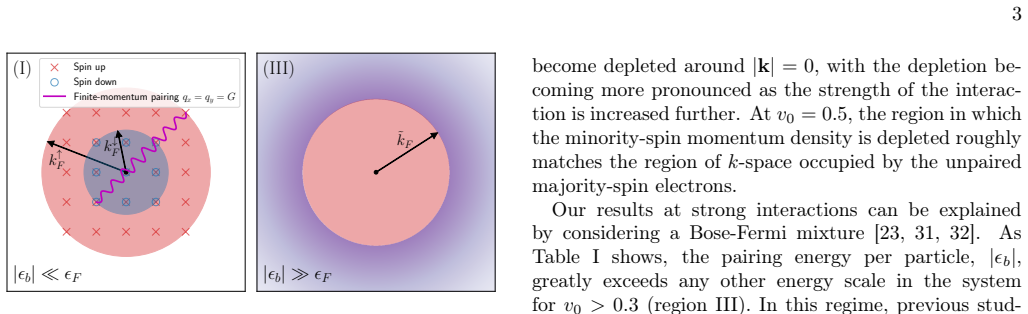
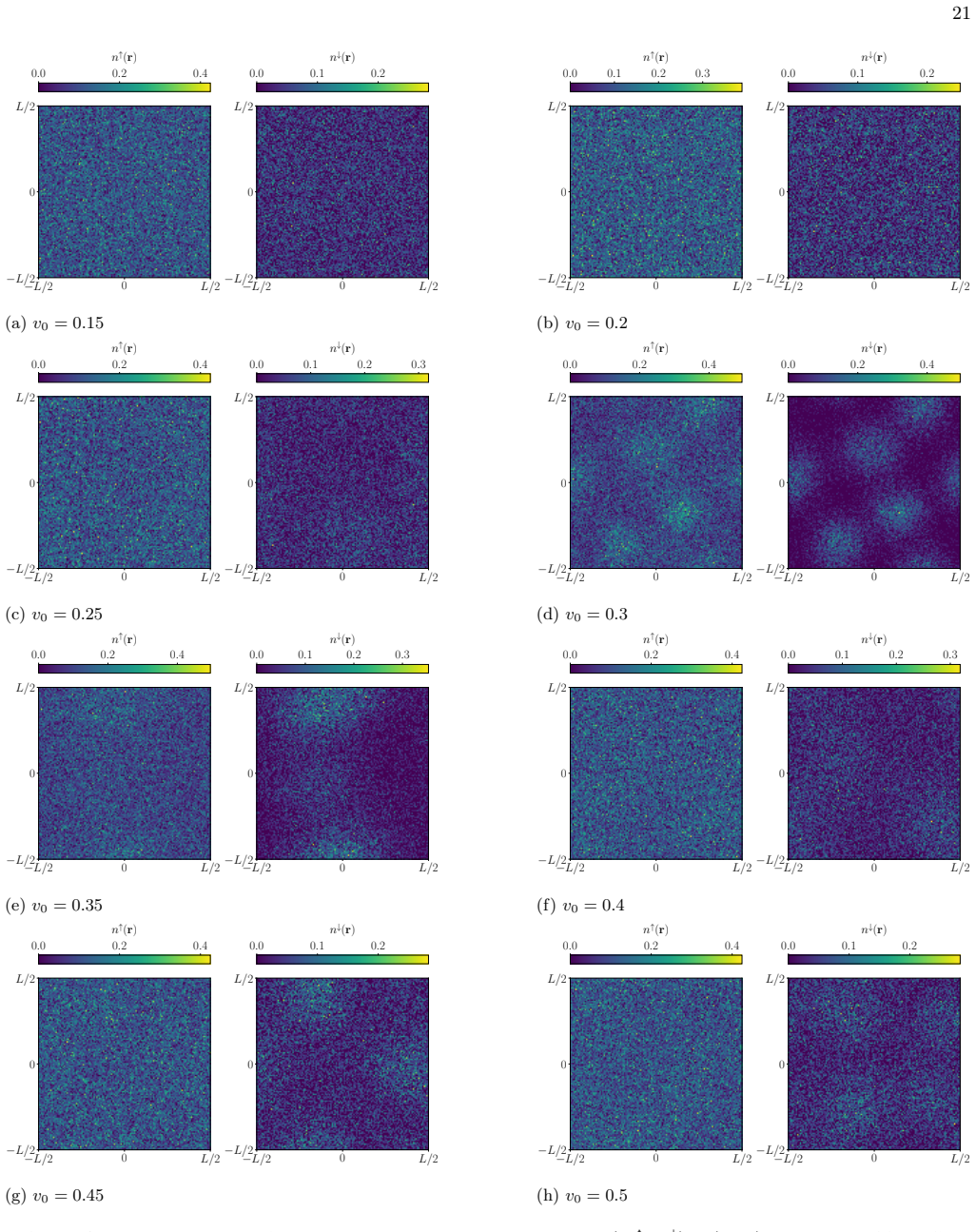
Using variational Monte Carlo with the AGPs FermiNet ansatz, the calculations observe translational symmetry breaking at intermediate interaction strengths, where the system forms an exotic crystal of Cooper pairs in a Fermi fluid of unpaired majority-spin particles. The same method recovers the Fulde-Ferrell-Larkin-Ovchinnikov phase in the weakly interacting BCS limit, a polarized superfluid in the BEC limit, and phase separation when interactions become very strong. The minority-spin momentum density is strongly suppressed inside the momentum region occupied by the unpaired majority particles once pairs are tightly bound.
What carries the argument
The AGPs FermiNet Ansatz, a neural-network variational wave function that is optimized by Monte Carlo sampling to approximate the ground state of the many-body Hamiltonian.
If this is right
- The Fulde-Ferrell-Larkin-Ovchinnikov phase appears in the weakly interacting BCS regime.
- A polarized superfluid is stable in the strongly interacting BEC regime.
- Macroscopic phase separation into regions of tightly bound bosonic pairs and regions of unpaired majority particles occurs at very strong attraction.
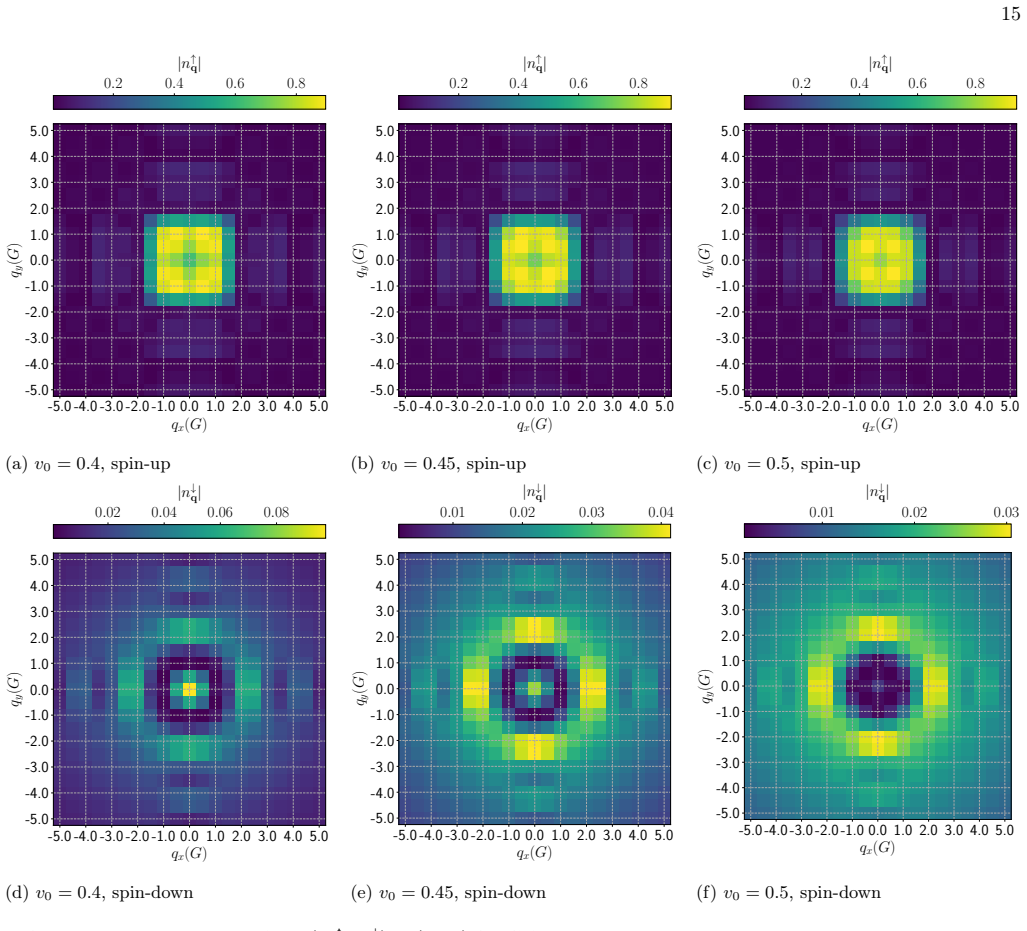
- The minority-spin momentum distribution develops a pronounced hole in the momentum range occupied by the unpaired majority fermions once pairs become tightly bound.
Where Pith is reading between the lines
- The same neural-wave-function approach could be applied to three-dimensional or quasi-two-dimensional imbalanced gases to test whether the crystalline phase survives dimensional crossover.
- Experiments that image pair correlations in two-dimensional Fermi gases at intermediate coupling could search for the predicted density modulation directly.
- The method opens a route to study other conjectured exotic orders, such as supersolid or paired-density-wave states, in quantum gases where conventional ansatzes struggle.
Load-bearing premise
The finite-system AGPs FermiNet wave function optimized by variational Monte Carlo faithfully represents the true ground state without substantial bias from ansatz incompleteness or finite-size effects.
What would settle it
Direct experimental detection of periodic spatial modulation in the pair correlation function or in the local density at the interaction strength and population imbalance where the simulations predict the crystal phase.
Figures








read the original abstract
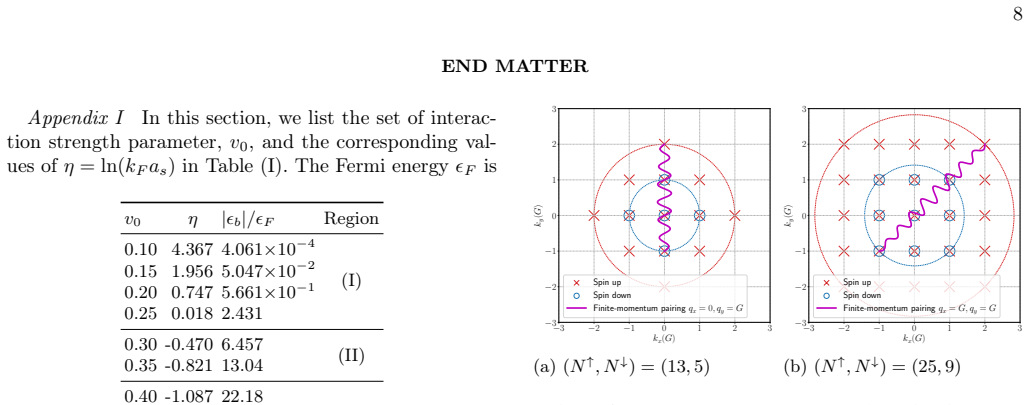
We study the zero-temperature phase diagram of the 2D spin-imbalanced Fermi gas with short-ranged attractive interactions using the recently developed neural network variational Monte Carlo method with the AGPs FermiNet Ansatz. The Fulde-Ferrell-Larkin-Ovchinnikov phase is observed in the weakly interacting BCS limit and a polarised superfluid is seen in the strongly interacting BEC limit. When the interactions are strong, the minority-spin momentum density is reduced almost to zero in the momentum-space region occupied by the unpaired majority-spin electrons. When the interactions are very strong, phase separation occurs, with regions containing bosonic pairs and unpaired regions occupied by the remaining majority-spin particles. In addition, we observe translational symmetry breaking at intermediate interaction strengths, where the system forms an exotic crystal of Cooper pairs in a Fermi fluid of unpaired majority-spin particles. We provide a possible explanation for the formation of the crystalline phase, explain the origins of the k-space momentum-density hole when the pairs are tightly bound, and discuss how our approach opens new directions for future work.
Editorial analysis
A structured set of objections, weighed in public.
Referee Report
Summary. The manuscript applies neural-network variational Monte Carlo with the AGPs FermiNet ansatz to map the zero-temperature phase diagram of the two-dimensional spin-imbalanced Fermi gas with short-range attraction. It reports the Fulde-Ferrell-Larkin-Ovchinnikov phase at weak coupling, a polarized superfluid at strong coupling, near-complete suppression of minority-spin momentum density inside the majority Fermi sea at intermediate-to-strong coupling, phase separation into bosonic-pair and unpaired-majority domains at very strong coupling, and, most notably, spontaneous translational symmetry breaking at intermediate interaction strengths that produces a crystalline lattice of Cooper pairs embedded in a Fermi sea of excess majority particles.
Significance. If the reported translational-symmetry-broken phase survives finite-size extrapolation and ansatz validation, the work would constitute a significant advance: it supplies the first microscopic evidence for an exotic pair crystal in a continuum 2D Fermi gas and demonstrates that unconstrained neural wave functions can discover unanticipated broken-symmetry states without prior bias. The method also yields concrete, falsifiable predictions for momentum distributions and pair-density modulations that could be tested in ultracold-atom experiments.
major comments (3)
- [results on intermediate-coupling regime] The central claim of translational symmetry breaking (abstract and results section) is obtained from a single, unconstrained AGPs FermiNet ansatz optimized at finite particle number. No comparison is presented to a translationally invariant variant of the same ansatz, nor is a finite-size extrapolation of the pair-structure-factor peak height or wave-vector reported; without these controls the observed modulation could be an optimization artifact rather than a thermodynamic-limit property.
- [abstract and methods] The abstract states that the variational Monte Carlo energies supply the phase boundaries, yet no quantitative statistical or systematic error bars, convergence diagnostics with respect to Monte Carlo steps or network parameters, or direct benchmarks against exact diagonalization or diffusion Monte Carlo on small systems are provided. Because VMC furnishes only an upper bound, the location of the reported phase transitions remains sensitive to possible bias in the neural ansatz.
- [strong-coupling momentum distributions] The reported suppression of minority-spin spectral weight inside the majority Fermi sea (strong-coupling regime) is presented as a robust feature, but the manuscript does not quantify how this feature evolves with system size or with the number of hidden units; a residual finite-size effect or ansatz incompleteness could artificially deepen the momentum-space hole.
minor comments (2)
- [figures] Figure captions should explicitly state the particle numbers, twist angles, and network hyperparameters used for each data point so that reproducibility is immediate.
- [methods] The definition of the pair-density operator and the precise procedure for extracting the modulation wave vector should be moved from the supplemental material into the main text.
Simulated Author's Rebuttal
We thank the referee for the careful reading and constructive criticism of our manuscript. We address each major comment in detail below. Where the concerns identify genuine gaps, we have revised the manuscript to incorporate additional controls, diagnostics, and analysis.
read point-by-point responses
-
Referee: [results on intermediate-coupling regime] The central claim of translational symmetry breaking (abstract and results section) is obtained from a single, unconstrained AGPs FermiNet ansatz optimized at finite particle number. No comparison is presented to a translationally invariant variant of the same ansatz, nor is a finite-size extrapolation of the pair-structure-factor peak height or wave-vector reported; without these controls the observed modulation could be an optimization artifact rather than a thermodynamic-limit property.
Authors: We agree that these controls are necessary to establish the robustness of the translational symmetry breaking. In the revised manuscript we add a direct comparison to a translationally invariant variant of the AGPs FermiNet (constructed by enforcing uniform phase factors across particles and averaging over twisted boundary conditions). The symmetry-broken ansatz yields a lower variational energy than the invariant one at the same interaction strength. We also include finite-size extrapolations of the pair-structure-factor peak height and ordering wave-vector for system sizes from N=20 to N=100 particles. The peak height extrapolates to a nonzero value in the thermodynamic limit while the wave-vector remains stable, supporting the crystalline phase as a genuine feature rather than an artifact. revision: yes
-
Referee: [abstract and methods] The abstract states that the variational Monte Carlo energies supply the phase boundaries, yet no quantitative statistical or systematic error bars, convergence diagnostics with respect to Monte Carlo steps or network parameters, or direct benchmarks against exact diagonalization or diffusion Monte Carlo on small systems are provided. Because VMC furnishes only an upper bound, the location of the reported phase transitions remains sensitive to possible bias in the neural ansatz.
Authors: The referee is correct that these quantitative controls were missing from the original submission. We have revised the methods and results sections to report statistical error bars obtained from Monte Carlo sampling variance together with systematic convergence tests versus the number of Monte Carlo steps and network hyperparameters (depth, width, and hidden units). For small systems (N≤8) we now include direct benchmarks against exact diagonalization; where diffusion Monte Carlo data are available we also compare. While VMC energies remain upper bounds, the phase boundaries are determined from crossings of relative energies and from order-parameter diagnostics; we explicitly discuss the residual bias and its effect on transition locations in the revised text. revision: yes
-
Referee: [strong-coupling momentum distributions] The reported suppression of minority-spin spectral weight inside the majority Fermi sea (strong-coupling regime) is presented as a robust feature, but the manuscript does not quantify how this feature evolves with system size or with the number of hidden units; a residual finite-size effect or ansatz incompleteness could artificially deepen the momentum-space hole.
Authors: We acknowledge the need to demonstrate size and ansatz independence. In the revised manuscript we present the minority-spin momentum distribution for system sizes ranging from N=16 to N=64 and for several values of the number of hidden units. The suppression inside the majority Fermi sea becomes sharper with increasing system size and remains stable once the network capacity exceeds a modest threshold, indicating that the feature is physical and tied to the formation of tightly bound pairs. We have also expanded the discussion of the physical origin of the k-space hole. revision: yes
Circularity Check
No circularity: variational Monte Carlo results are independent numerical outputs
full rationale
The paper computes the phase diagram by variationally minimizing the energy of the AGPs FermiNet ansatz via neural VMC for the 2D spin-imbalanced Fermi gas. Observed features (FFLO phase, polarized superfluid, pair crystal at intermediate coupling, phase separation) are extracted from the converged wavefunction properties such as pair density modulations and momentum distributions. No equation or claim reduces a derived quantity to a fitted parameter by construction, nor imports a uniqueness theorem or ansatz choice from self-citation that forces the result. Self-references to prior FermiNet/AGP development supply the computational method but leave the physical observations as falsifiable outputs of the optimization, not tautological redefinitions. The chain is a direct numerical simulation under the variational principle.
Axiom & Free-Parameter Ledger
free parameters (2)
- interaction strength parameter
- spin-imbalance ratio
axioms (2)
- standard math Variational principle: the trial wave function yields an upper bound to the true ground-state energy
- domain assumption The AGPs FermiNet ansatz can represent the relevant pairing and symmetry-breaking correlations with sufficient accuracy
Reference graph
Works this paper leans on
- [1]
-
[2]
W. T. Lou, H. Sutterud, G. Cassella, W. M. C. Foulkes, J. Knolle, D. Pfau, and J. S. Spencer, Physical Review X 14, 021030 (2024)
2024
-
[3]
C. Chin, R. Grimm, P. Julienne, and E. Tiesinga, Re- views of Modern Physics82, 1225 (2010)
2010
-
[4]
Q. Chen, J. Stajic, S. Tan, and K. Levin, Physics Reports 412, 1 (2005)
2005
-
[5]
Zwerger (Springer Berlin Heidelberg, Berlin, Heidel- berg, 2012) pp
M.Randeria, W.Zwerger,andM.Zwierlein,inThe BCS- BEC Crossover and the Unitary Fermi Gas, edited by W. Zwerger (Springer Berlin Heidelberg, Berlin, Heidel- berg, 2012) pp. 1–32
2012
-
[6]
D. C. W. Foo and G. J. Conduit, Physical Review A100, 063602 (2019)
2019
-
[7]
A. E. Feiguin and F. Heidrich-Meisner, Physical Review Letters102, 076403 (2009)
2009
-
[8]
Moreo and D
A. Moreo and D. J. Scalapino, Physical Review Letters 66, 946 (1991)
1991
- [9]
-
[10]
He and P
L. He and P. Zhuang, Physical Review A78, 033613 (2008)
2008
-
[11]
T. K. Koponen, T. Paananen, J.-P. Martikainen, M. R. Bakhtiari, and P. Törmä, New Journal of Physics10, 045014 (2008)
2008
-
[12]
M. J. Wolak, B. Grémaud, R. T. Scalettar, and G. G. Batrouni, Physical Review A86, 023630 (2012)
2012
-
[13]
W. Ong, C. Cheng, I. Arakelyan, and J. E. Thomas, Physical Review Letters114, 110403 (2015)
2015
-
[14]
Mitra, P
D. Mitra, P. T. Brown, P. Schauß, S. S. Kondov, and W. S. Bakr, Physical Review Letters117, 093601 (2016)
2016
-
[15]
Fulde and R
P. Fulde and R. A. Ferrell, Physical Review135, A550 (1964)
1964
-
[16]
A. I. Larkin and Y. N. Ovchinnikov, Zhurnal Eksperi- mental’noi i Teoreticheskoi Fiziki47, 1136 (1964)
1964
-
[17]
Sarma, Journal of Physics and Chemistry of Solids 24, 1029 (1963)
G. Sarma, Journal of Physics and Chemistry of Solids 24, 1029 (1963)
1963
-
[18]
Randeria, J.-M
M. Randeria, J.-M. Duan, and L.-Y. Shieh, Physical Re- view Letters62, 981 (1989)
1989
-
[19]
Randeria, J.-M
M. Randeria, J.-M. Duan, and L.-Y. Shieh, Physical Re- view B41, 327 (1990)
1990
- [20]
-
[21]
M. M. Parish, S. K. Baur, E. J. Mueller, and D. A. Huse, Physical Review Letters99, 250403 (2007)
2007
-
[22]
G. G. Batrouni, M. H. Huntley, V. G. Rousseau, and R. T. Scalettar, Physical Review Letters100, 116405 (2008)
2008
- [23]
-
[24]
Potapova, I
A. Potapova, I. Pilé, T.-C. Yi, R. Mondaini, and E. Burovski, Physical Review A107, 053301 (2023)
2023
-
[25]
E. Y. Loh, J. E. Gubernatis, R. T. Scalettar, S. R. White, D. J. Scalapino, and R. L. Sugar, Physical Review B41, 9301 (1990)
1990
-
[26]
Troyer and U.-J
M. Troyer and U.-J. Wiese, Physical Review Letters94, 170201 (2005)
2005
-
[27]
T.-C.Yi, S.Cheng, I.Pilé, E.Burovski,andR.Mondaini, Physical Review B110, 085131 (2024)
2024
-
[28]
Carleo and M
G. Carleo and M. Troyer, Science355, 602 (2017)
2017
- [29]
-
[30]
Vitali, P
E. Vitali, P. Rosenberg, and S. Zhang, Physical Review Letters128, 203201 (2022)
2022
-
[31]
Pieri and G
P. Pieri and G. C. Strinati, Physical Review Letters96, 150404 (2006)
2006
-
[32]
Y.-i.Shin, A.Schirotzek, C.H.Schunck,andW.Ketterle, Physical Review Letters101, 070404 (2008)
2008
-
[33]
W. M. C. Foulkes, L. Mitas, R. J. Needs, and G. Ra- jagopal, Reviews of Modern Physics73, 33 (2001)
2001
-
[34]
Gao and S
N. Gao and S. Günnemann, inProceedings of the 40th International Conference on Machine Learning, Proceed- ings of Machine Learning Research, Vol. 202, edited by A. Krause, E. Brunskill, K. Cho, B. Engelhardt, S. Sabato, and J. Scarlett (PMLR, 2023) pp. 10708– 10726
2023
-
[35]
K. Choo, A. Mezzacapo, and G. Carleo, Nature Commu- nications11, 2368 (2020)
2020
-
[36]
Hermann, Z
J. Hermann, Z. Schätzle, and F. Noé, Nature Chemistry 12, 891 (2020)
2020
-
[37]
I. von Glehn, J. S. Spencer, and D. Pfau, A Self- Attention Ansatz for Ab-initio Quantum Chemistry (2023), arXiv:2211.13672 [physics]
-
[38]
Cassella, H
G. Cassella, H. Sutterud, S. Azadi, N. D. Drummond, D. Pfau, J. S. Spencer, and W. M. C. Foulkes, Physical Review Letters130, 036401 (2023)
2023
-
[39]
G. Cassella, W. M. C. Foulkes, D. Pfau, and J. S. Spencer, Neural network variational Monte Carlo for positronic chemistry (2024), arXiv:2310.05607 [cond- mat, physics:physics]
-
[40]
Pescia, J
G. Pescia, J. Han, A. Lovato, J. Lu, and G. Carleo, Phys- ical Review Research4, 023138 (2022)
2022
-
[41]
X. Li, C. Fan, W. Ren, and J. Chen, Physical Review Research4, 013021 (2022)
2022
- [42]
-
[43]
Bajdich, L
M. Bajdich, L. Mitas, G. Drobný, L. K. Wagner, and K. E. Schmidt, Physical Review Letters96, 130201 (2006)
2006
-
[44]
Casula, C
M. Casula, C. Attaccalite, and S. Sorella, J. Chem. Phys 121, 7110 (2004)
2004
-
[45]
M. Casula and S. Sorella, The Journal of Chemical Physics119, 6500 (2003), arXiv:cond-mat/0305169
-
[46]
Bouchaud, A
J. Bouchaud, A. Georges, and C. Lhuillier, Journal de Physique49, 553 (1988)
1988
-
[47]
Flügge,Practical Quantum Mechanics(Springer Berlin Heidelberg, Berlin, Heidelberg, 1971)
S. Flügge,Practical Quantum Mechanics(Springer Berlin Heidelberg, Berlin, Heidelberg, 1971)
1971
- [48]
-
[49]
This gives us confidence that the results are qualitatively robust
Although the system simulated is too small to allow us to reliably mitigate finite-size errors by twist aver- aging and/or size-extrapolation techniques, the form of the phase diagram remains the same when we reduce the (already small) system size or change the neural network architecture. This gives us confidence that the results are qualitatively robust
-
[50]
D. S. Petrov, M. A. Baranov, and G. V. Shlyapnikov, Physical Review A67, 031601 (2003)
2003
-
[51]
Bertaina and S
G. Bertaina and S. Giorgini, Physical Review Letters 106, 110403 (2011)
2011
-
[52]
J. S. Spencer, D. Pfau, and contributors, FermiNet (2020)
2020
-
[53]
Google/jax, Google (2024)
2024
-
[54]
Martens and R
J. Martens and R. Grosse, inProceedings of the 32nd In- ternational Conference on Machine Learning, Proceed- ings of Machine Learning Research, Vol. 37, edited by F. Bach and D. Blei (PMLR, Lille, France, 2015) pp. 2408–2417
2015
-
[55]
Botev and J
A. Botev and J. Martens, KFAC-JAX (2022)
2022
-
[56]
Glorot and Y
X. Glorot and Y. Bengio, inProceedings of the Thirteenth International Conference on Artificial Intelligence and Statistics(JMLRWorkshopandConferenceProceedings,
-
[57]
Fermi surfaces
pp. 249–256. 8 END MA TTER Appendix IIn this section, we list the set of interac- tion strength parameter,v 0, and the corresponding val- ues ofη= ln(k F as)in Table (I). The Fermi energyϵF is v0 η|ϵ b|/ϵF Region 0.10 4.367 4.061×10 −4 (I)0.15 1.956 5.047×10 −2 0.20 0.747 5.661×10 −1 0.25 0.018 2.431 0.30 -0.470 6.457 (II)0.35 -0.821 13.04 0.40 -1.087 22....
-
[58]
ˆψα(r1) E (15) ρ(2) αβ(r′ 1,r ′ 2;r 1,r 2) = D ˆψ† α(r′
-
[59]
ˆψβ(r2) ˆψα(r1) E (16) 11 Parameter Value Batch size 4096 Training iterations 3e5 Pretraining iterations None Learning rate(2e4 +t) −1 Local energy clipping 5.0 KFAC Momentum 0 KFAC Covariance moving average decay 0.95 KFAC Norm constraint 1e-3 KFAC Damping 1e-3 MCMC Proposal std. dev. (per dimension) 0.02 MCMC Steps between parameter updates 10 TABLE II:...
-
[60]
drN R |Ψ(R)|2dR ,(23) ρ(2) αβ(r1,r 2;r ′ 1,r ′
=N α R |Ψ(R)|2 Ψ(r′ 1) Ψ(r1) dr2 . . . drN R |Ψ(R)|2dR ,(23) ρ(2) αβ(r1,r 2;r ′ 1,r ′
-
[61]
drN R |Ψ(R)|2dR ,(24) whereαandβdenote the spin species
=N α(Nβ −δ αβ) R |Ψ(R)|2 Ψ(r′ 1,r′ 2) Ψ(r1,r2) dr3 . . . drN R |Ψ(R)|2dR ,(24) whereαandβdenote the spin species. To reduce the effect of the one-body contribution to the TBDM, we use an improved estimator of the TBDM in Eq. (25) that removes the one-body contribution explicitly [48]: ρ(2) αβ(r1,r 2;r ′ 1,r ′
-
[62]
drN R |Ψ(R)|2dR .(25) All of these quantities can then be estimated using Monte Carlo sampling
=N α(Nβ −δ αβ) R |Ψ(R)|2 h Ψ(r′ 1,r′ 2) Ψ(r1,r1) − Ψ(r′ 1,r2) Ψ(r1,r2) Ψ(r1,r′ 2) Ψ(r1,r2) i dr3 . . . drN R |Ψ(R)|2dR .(25) All of these quantities can then be estimated using Monte Carlo sampling. All Data In this section, we present all the results of our simulations, including the momentum densities, the condensate fraction and the one-particle real-s...
discussion (0)
Sign in with ORCID, Apple, or X to comment. Anyone can read and Pith papers without signing in.