Recognition: unknown
Getting large-scale quantum neural networks ready for quantum hardware
Pith reviewed 2026-05-08 03:44 UTC · model grok-4.3
The pith
Quantum neural networks can classify quantum states by measuring an order parameter after training on finite noisy loss data.
A machine-rendered reading of the paper's core claim, the machinery that carries it, and where it could break.
Core claim
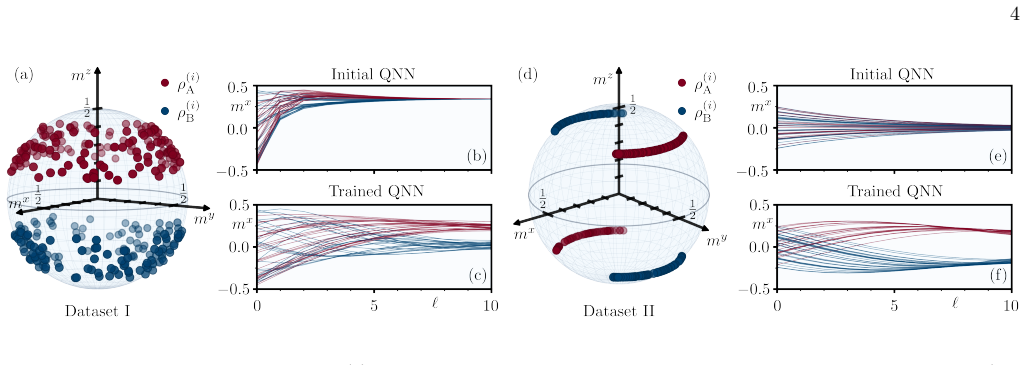
This architecture permits the construction of nontrivial decision boundaries that enable the classification of quantum states through measuring an order parameter, while remaining compatible with direct input from quantum devices and a finite number of noisy loss measurements.
What carries the argument
Parameterized quantum circuits whose dynamics link closely to the evolution of Markovian open many-body quantum systems, enabling training via noisy loss minimization.
If this is right
- The networks can accept quantum data straight from simulators and computers without classical preprocessing.
- Implementation becomes feasible on current noisy intermediate-scale quantum hardware.
- Training remains viable despite the noise inherent in loss estimation on real devices.
Where Pith is reading between the lines
- The same architecture might support other quantum machine learning tasks that rely on order-parameter-like observables.
- Scaling the network size could preserve the noise robustness observed in the open-system analogy.
- Direct hardware deployment might reduce the total number of circuit executions needed compared to generic variational methods.
Load-bearing premise
The link between the neural network dynamics and Markovian open many-body quantum systems supplies practical robustness to noise when only finite noisy loss measurements are available for training.
What would settle it
An experiment in which the network is trained on noisy loss data yet produces only trivial decision boundaries or fails to classify states when an order parameter is measured.
Figures

read the original abstract
Quantum neural networks generalize classical artificial neural networks into the quantum domain. They are formulated as parameterized quantum circuits which are optimized by measuring and minimizing a suitably chosen loss function. The core challenge in understanding, implementing and ultimately using quantum neural networks is that they represent many-body systems with an exponentially large Hilbert space, in combination with a large parameter search space. Moreover, noise -- which is inherent to any quantum measurement -- sets practical limits for the estimation of training loss. Here, we study physics-informed large-scale quantum neural networks that are trained through a finite number of noisy loss function measurements. We show that this architecture permits the construction of nontrivial decision boundaries that enable the classification of quantum states through measuring an order parameter. Our approach can directly process quantum data that is output from quantum simulators and computers and is well suited for implementation on current hardware. Moreover, owed to a close link between the neural network dynamics and the evolution of Markovian open many-body quantum systems, one may expect a certain robustness to noise, which is ubiquitous in the current NISQ era.
Editorial analysis
A structured set of objections, weighed in public.
Referee Report
Summary. The manuscript proposes physics-informed large-scale quantum neural networks formulated as parameterized quantum circuits, trained via minimization of a loss function estimated from a finite number of noisy measurements. The central claims are that the architecture permits construction of nontrivial decision boundaries enabling classification of quantum states by measuring an order parameter, can directly process quantum data from simulators, is suited to NISQ hardware, and may exhibit robustness to noise owing to a dynamical analogy with Markovian open many-body quantum systems.
Significance. If the claims are substantiated with explicit evidence, the work could meaningfully advance practical quantum machine learning by offering an architecture that handles the exponential Hilbert space and shot-noise limitations of large-scale QNNs. The direct compatibility with quantum data output and the physical mapping to open-system evolution represent genuine strengths that could inspire noise-resilient designs. However, the significance is currently limited by the absence of quantitative support for the robustness and classification performance under realistic noise.
major comments (2)
- [§4] §4 (Results on decision boundaries and classification): the claim that the architecture 'permits the construction of nontrivial decision boundaries that enable the classification of quantum states through measuring an order parameter' is stated without accompanying derivations of the loss function, explicit optimization procedure, or numerical evidence (e.g., accuracy metrics or boundary visualizations) showing performance above random guessing. This is load-bearing for the central claim of usable classification.
- [§5] §5 (Noise robustness discussion): the statement that 'one may expect a certain robustness to noise' due to the link with Markovian open many-body systems is presented as an enabling feature for NISQ readiness, yet no perturbative bound on noise-induced drift of the order-parameter estimator, no shot-noise analysis, and no simulations under finite-measurement or decoherence models are supplied. Without these, the hardware-readiness conclusion rests on an unquantified analogy rather than controlled evidence.
minor comments (2)
- [Abstract and §1] The abstract and introduction use several forward-looking phrases ('permits', 'enables', 'one may expect') without immediate cross-references to the supporting sections or equations; adding explicit pointers would improve readability.
- [§2] Notation for the parameterized circuit and the order-parameter observable is introduced without a consolidated table or appendix listing all symbols and their dimensions; this would aid readers working through the large-scale many-body aspects.
Simulated Author's Rebuttal
We thank the referee for their detailed and constructive review of our manuscript. We address each major comment point by point below, providing clarifications drawn from the existing text and committing to specific additions that will strengthen the quantitative support for our claims.
read point-by-point responses
-
Referee: [§4] §4 (Results on decision boundaries and classification): the claim that the architecture 'permits the construction of nontrivial decision boundaries that enable the classification of quantum states through measuring an order parameter' is stated without accompanying derivations of the loss function, explicit optimization procedure, or numerical evidence (e.g., accuracy metrics or boundary visualizations) showing performance above random guessing. This is load-bearing for the central claim of usable classification.
Authors: We appreciate the referee drawing attention to the need for explicit support. The loss function is defined in the manuscript as the expectation value of the order-parameter operator measured on the output of the parameterized circuit, with training performed by minimizing this quantity over circuit parameters via a variational procedure. The nontrivial decision boundaries follow from the ability of the circuit to encode many-body correlations that align measurement statistics with the target order-parameter classification. Nevertheless, we agree that the current version lacks accompanying numerical demonstrations, accuracy metrics, or boundary visualizations. In the revised manuscript we will add small-scale numerical simulations, classification accuracy results, and visualizations of the learned decision boundaries to provide concrete evidence that performance exceeds random guessing. revision: yes
-
Referee: [§5] §5 (Noise robustness discussion): the statement that 'one may expect a certain robustness to noise' due to the link with Markovian open many-body systems is presented as an enabling feature for NISQ readiness, yet no perturbative bound on noise-induced drift of the order-parameter estimator, no shot-noise analysis, and no simulations under finite-measurement or decoherence models are supplied. Without these, the hardware-readiness conclusion rests on an unquantified analogy rather than controlled evidence.
Authors: We concur that the robustness statement would be strengthened by quantitative analysis. The manuscript establishes the dynamical analogy in the section on open-system mapping, showing that the circuit evolution corresponds to a Lindblad master equation whose dissipative terms confer stability. To address the referee's concern directly, the revised version will include a perturbative treatment of noise-induced drift in the order-parameter estimator, an analysis of shot-noise scaling with measurement shots, and numerical simulations that incorporate finite-shot statistics and simple decoherence channels. These additions will convert the analogy into controlled evidence supporting NISQ suitability. revision: yes
Circularity Check
No circularity: architecture and classification claims are independent of inputs
full rationale
The paper proposes a physics-informed QNN architecture and shows it supports nontrivial decision boundaries for quantum state classification via order-parameter measurement. The noise-robustness expectation is framed as a qualitative analogy to Markovian open-system dynamics rather than a fitted parameter or self-referential definition. No equations reduce a claimed prediction to a fitted input by construction, no self-citation chain is load-bearing for the central result, and no ansatz is smuggled via prior self-work. The derivation remains self-contained against external benchmarks of circuit expressivity and measurement statistics.
Axiom & Free-Parameter Ledger
axioms (2)
- domain assumption Quantum neural networks can be represented as parameterized quantum circuits optimized by loss minimization
- standard math Noise is inherent to quantum measurements and limits loss estimation
Reference graph
Works this paper leans on
-
[1]
Biamonte, P
J. Biamonte, P. Wittek, N. Pancotti, P. Rebentrost, N. Wiebe, and S. Lloyd, Quantum machine learning, Na- ture549, 195 (2017)
2017
-
[2]
Schuld and F
M. Schuld and F. Petruccione,Machine Learning with Quantum Computers(Springer, 2021)
2021
-
[3]
Schuld, I
M. Schuld, I. Sinayskiy, and F. Petruccione, An introduc- tion to quantum machine learning, Contemp. Phys.56, 172 (2015)
2015
-
[4]
Schuld and N
M. Schuld and N. Killoran, Is Quantum Advantage the Right Goal for Quantum Machine Learning?, PRX Quan- tum3, 030101 (2022)
2022
-
[5]
Cerezo, G
M. Cerezo, G. Verdon, H.-Y. Huang, L. Cincio, and P. J. Coles, Challenges and opportunities in quantum machine learning, Nat. Comput. Sci.2, 567 (2022)
2022
-
[6]
Rebentrost, M
P. Rebentrost, M. Mohseni, and S. Lloyd, Quantum Sup- port Vector Machine for Big Data Classification, Phys. Rev. Lett.113, 130503 (2014)
2014
-
[7]
Schuld, I
M. Schuld, I. Sinayskiy, and F. Petruccione, The quest for a quantum neural network, Quantum Inf. Process.13, 2567 (2014)
2014
-
[8]
C. M. Bishop and N. M. Nasrabadi,Pattern recognition and machine learning(Springer, New York, 2006)
2006
-
[9]
M. A. Nielsen,Neural Networks and Deep Learning(De- termination Press, 2015)
2015
-
[10]
Goodfellow, Y
I. Goodfellow, Y. Bengio, and A. Courville,Deep Learn- ing(MIT Press, 2016)
2016
-
[11]
LeCun, Y
Y. LeCun, Y. Bengio, and G. Hinton, Deep learning, Na- ture521, 436 (2015)
2015
-
[12]
M. A. Nielsen and I. L. Chuang,Quantum computation and quantum information(Cambridge university press, 2010)
2010
-
[13]
P. W. Shor, Polynomial-time algorithms for prime factor- ization and discrete logarithms on a quantum computer, SIAM J. Comput.26, 1484 (1997)
1997
-
[14]
L. K. Grover, A fast quantum mechanical algorithm for database search, inProc. Annu. ACM Symp. Theory Comput., STOC ’96 (Association for Computing Machin- ery, New York, NY, USA, 1996) pp. 212–219
1996
-
[15]
Killoran, T
N. Killoran, T. R. Bromley, J. M. Arrazola, M. Schuld, N. Quesada, and S. Lloyd, Continuous-variable quantum neural networks, Phys. Rev. Res.1, 033063 (2019)
2019
-
[16]
Mangini, F
S. Mangini, F. Tacchino, D. Gerace, D. Bajoni, and C. Macchiavello, Quantum computing models for arti- ficial neural networks, EPL134, 10002 (2021)
2021
-
[17]
Cerezo, A
M. Cerezo, A. Arrasmith, R. Babbush, S. C. Benjamin, S. Endo, K. Fujii, J. R. McClean, K. Mitarai, X. Yuan, L. Cincio,et al., Variational quantum algorithms, Nat. Rev. Phys.3, 625 (2021)
2021
-
[18]
K. Beer, D. Bondarenko, T. Farrelly, T. J. Osborne, R. Salzmann, D. Scheiermann, and R. Wolf, Training deep quantum neural networks, Nat. Commun.11, 1 (2020)
2020
-
[19]
R. P. Feynman, Simulating physics with computers, Int. J. Theor. Phys.21, 467 (1982)
1982
-
[20]
Lloyd, Universal quantum simulators, Science273, 1073 (1996)
S. Lloyd, Universal quantum simulators, Science273, 1073 (1996)
1996
-
[21]
Sharma, S
K. Sharma, S. Khatri, M. Cerezo, and P. J. Coles, Noise resilience of variational quantum compiling, New J. Phys. 22, 043006 (2020)
2020
-
[22]
Preskill, Quantum computing in the NISQ era and beyond, Quantum2, 79 (2018)
J. Preskill, Quantum computing in the NISQ era and beyond, Quantum2, 79 (2018)
2018
-
[23]
Wecker, M
D. Wecker, M. B. Hastings, and M. Troyer, Progress to- wards practical quantum variational algorithms, Phys. Rev. A92, 042303 (2015)
2015
-
[24]
J. R. McClean, J. Romero, R. Babbush, and A. Aspuru- Guzik, The theory of variational hybrid quantum- classical algorithms, New J. Phys.18, 023023 (2016). 6
2016
-
[25]
X. Pan, Z. Lu, W. Wang, Z. Hua, Y. Xu, W. Li, W. Cai, X. Li, H. Wang, Y.-P. Song,et al., Deep quantum neural networks on a superconducting processor, Nat. Commun. 14, 4006 (2023)
2023
-
[26]
P. J. J. O’Malley, R. Babbush, I. D. Kivlichan, J. Romero, J. R. McClean, R. Barends, J. Kelly, P. Roushan, A. Tranter, N. Ding, B. Campbell, Y. Chen, Z. Chen, B. Chiaro, A. Dunsworth, A. G. Fowler, E. Jef- frey, E. Lucero, A. Megrant, J. Y. Mutus, M. Neeley, C. Neill, C. Quintana, D. Sank, A. Vainsencher, J. Wen- ner, T. C. White, P. V. Coveney, P. J. Lo...
2016
-
[27]
Buonaiuto, F
G. Buonaiuto, F. Gargiulo, G. De Pietro, M. Esposito, and M. Pota, The effects of quantum hardware proper- ties on the performances of variational quantum learning algorithms, Quantum Mach. Intell.6, 9 (2024)
2024
-
[28]
J. R. McClean, S. Boixo, V. N. Smelyanskiy, R. Bab- bush, and H. Neven, Barren plateaus in quantum neural network training landscapes, Nat. Commun.9, 1 (2018)
2018
-
[29]
P. W. Anderson, Infrared catastrophe in fermi gases with local scattering potentials, Phys. Rev. Lett.18, 1049 (1967)
1967
-
[30]
Ragone, B
M. Ragone, B. N. Bakalov, F. Sauvage, A. F. Kemper, C. Ortiz Marrero, M. Larocca, and M. Cerezo, A lie al- gebraic theory of barren plateaus for deep parameterized quantum circuits, Nat. Commun.15, 7172 (2024)
2024
-
[31]
Larocca, S
M. Larocca, S. Thanasilp, S. Wang, K. Sharma, J. Bia- monte, P. J. Coles, L. Cincio, J. R. McClean, Z. Holmes, and M. Cerezo, Barren plateaus in variational quantum computing, Nat. Rev. Phys.7, 174 (2025)
2025
-
[32]
Cerezo, M
M. Cerezo, M. Larocca, D. Garc´ ıa-Mart´ ın, N. L. Diaz, P. Braccia, E. Fontana, M. S. Rudolph, P. Bermejo, A. Ijaz, S. Thanasilp, E. R. Anschuetz, and Z. Holmes, Does provable absence of barren plateaus imply classical simulability?, Nat. Commun.16(2025)
2025
-
[33]
Sharma, M
K. Sharma, M. Cerezo, L. Cincio, and P. J. Coles, Train- ability of Dissipative Perceptron-Based Quantum Neural Networks, Phys. Rev. Lett.128, 180505 (2022)
2022
-
[34]
Cerezo, A
M. Cerezo, A. Sone, T. Volkoff, L. Cincio, and P. J. Coles, Cost function dependent barren plateaus in shal- low parametrized quantum circuits, Nat. Commun.12, 1791 (2021)
2021
-
[35]
Scriva, N
G. Scriva, N. Astrakhantsev, S. Pilati, and G. Maz- zola, Challenges of variational quantum optimization with measurement shot noise, Phys. Rev. A109, 032408 (2024)
2024
-
[36]
D. A. Kreplin and M. Roth, Reduction of finite sam- pling noise in quantum neural networks, Quantum8, 1385 (2024)
2024
-
[37]
Y. Kim, E. Jang, H. Kim, S. Choi, C. Lee, D. Kim, W. Kyoung, K. Shin, and W. W. Ro, Distribution- adaptive dynamic shot optimization for variational quan- tum algorithms, Phys. Rev. Res.7, 043253 (2025)
2025
-
[38]
Kaminishi, T
E. Kaminishi, T. Mori, M. Sugawara, and N. Yamamoto, Impact of measurement noise on escaping saddles in vari- ational quantum algorithms, Sci. Rep.16, 9390 (2026)
2026
-
[39]
Recio-Armengol, J
E. Recio-Armengol, J. Eisert, and J. J. Meyer, Single- shot quantum machine learning, Phys. Rev. A111, 042420 (2025)
2025
-
[40]
Gillman, F
E. Gillman, F. Carollo, and I. Lesanovsky, Using (1+1)D quantum cellular automata for exploring collective effects in large-scale quantum neural networks, Phys. Rev. E 107, L022102 (2023)
2023
-
[41]
Boneberg, F
M. Boneberg, F. Carollo, and I. Lesanovsky, Dissipative quantum many-body dynamics in (1+ 1) D quantum cel- lular automata and quantum neural networks, New J. Phys.25, 093020 (2023)
2023
-
[42]
Boneberg, F
M. Boneberg, F. Carollo, and I. Lesanovsky, Nonlinear classification capability of quantum neural networks due to emergent quantum metastability, Phys. Rev. A111, 062405 (2025)
2025
-
[43]
M. Boneberg, S. Kochsiek, G. Perfetto, and I. Lesanovsky, Training the classification capability of large-scale quantum cellular automata, arXiv:2509.18262 (2025)
-
[44]
Bondarenko and P
D. Bondarenko and P. Feldmann, Quantum autoencoders to denoise quantum data, Phys. Rev. Lett.124, 130502 (2020)
2020
-
[45]
Beer, Quantum neural networks (2022)
K. Beer, Quantum neural networks (2022)
2022
-
[46]
Or´ us, A practical introduction to tensor networks: Matrix product states and projected entangled pair states, Ann
R. Or´ us, A practical introduction to tensor networks: Matrix product states and projected entangled pair states, Ann. Phys.349, 117 (2014)
2014
-
[47]
Paeckel, T
S. Paeckel, T. K¨ ohler, A. Swoboda, S. R. Manmana, U. Schollw¨ ock, and C. Hubig, Time-evolution meth- ods for matrix-product states, Ann. Phys.411, 167998 (2019)
2019
-
[48]
Gillman, F
E. Gillman, F. Carollo, and I. Lesanovsky, Quantum and Classical Temporal Correlations in (1 + 1)D Quantum Cellular Automata, Phys. Rev. Lett.127, 230502 (2021)
2021
-
[49]
Lewenstein, A
M. Lewenstein, A. Gratsea, A. Riera-Campeny, A. Aloy, V. Kasper, and A. Sanpera, Storage capacity and learn- ing capability of quantum neural networks, Quantum Sci. Technol.6, 045002 (2021)
2021
-
[50]
D. F. Locher, L. Cardarelli, and M. M¨ uller, Quantum error correction with quantum autoencoders, Quantum 7, 942 (2023)
2023
- [51]
-
[52]
Lorenzo, F
S. Lorenzo, F. Ciccarello, and G. M. Palma, Compos- ite quantum collision models, Phys. Rev. A96, 032107 (2017)
2017
-
[53]
Ciccarello, Collision models in quantum optics, Quan- tum Meas
F. Ciccarello, Collision models in quantum optics, Quan- tum Meas. Quantum Metrol.4, 53 (2017)
2017
-
[54]
Ciccarello, S
F. Ciccarello, S. Lorenzo, V. Giovannetti, and G. M. Palma, Quantum collision models: Open system dynam- ics from repeated interactions, Phys. Rep.954, 1 (2022)
2022
-
[55]
Cattaneo, G
M. Cattaneo, G. De Chiara, S. Maniscalco, R. Zambrini, and G. L. Giorgi, Collision Models Can Efficiently Sim- ulate Any Multipartite Markovian Quantum Dynamics, Phys. Rev. Lett.126, 130403 (2021)
2021
-
[56]
Cattaneo, G
M. Cattaneo, G. L. Giorgi, R. Zambrini, and S. Manis- calco, A brief journey through collision models for mul- tipartite open quantum dynamics, Open Syst. Inf. Dyn. 29, 2250015 (2022)
2022
-
[57]
Lindblad, On the generators of quantum dynamical semigroups, Commun
G. Lindblad, On the generators of quantum dynamical semigroups, Commun. Math. Phys.48, 119 (1976)
1976
-
[58]
Gorini, A
V. Gorini, A. Kossakowski, and E. C. G. Sudarshan, Completely positive dynamical semigroups of N-level sys- tems, J. Math. Phys.17, 821 (1976)
1976
-
[59]
Breuer and F
H.-P. Breuer and F. Petruccione,The Theory of Open Quantum Systems(Oxford University Press, 2002)
2002
-
[60]
Rivas and S
A. Rivas and S. F. Huelga,Open quantum systems, Vol. 10 (Springer, 2012)
2012
-
[61]
Bartolo, F
N. Bartolo, F. Minganti, W. Casteels, and C. Ciuti, Exact steady state of a kerr resonator with one- and 7 two-photon driving and dissipation: Controllable wigner- function multimodality and dissipative phase transitions, Phys. Rev. A94, 033841 (2016)
2016
-
[62]
Minganti, V
F. Minganti, V. Savona, and A. Biella, Dissipative phase transitions inn-photon driven quantum nonlinear res- onators, Quantum7, 1170 (2023)
2023
-
[63]
S. Lieu, R. Belyansky, J. T. Young, R. Lundgren, V. V. Albert, and A. V. Gorshkov, Symmetry breaking and er- ror correction in open quantum systems, Phys. Rev. Lett. 125, 240405 (2020)
2020
-
[64]
Buˇ ca and T
B. Buˇ ca and T. Prosen, A note on symmetry reductions of the lindblad equation: transport in constrained open spin chains, New J. Phys.14, 073007 (2012)
2012
-
[65]
V. V. Albert and L. Jiang, Symmetries and conserved quantities in lindblad master equations, Phys. Rev. A 89, 022118 (2014)
2014
-
[66]
L. M. Sieberer, M. Buchhold, J. Marino, and S. Diehl, Universality in driven open quantum matter, Rev. Mod. Phys.97, 025004 (2025)
2025
-
[67]
D. C. Rose, K. Macieszczak, I. Lesanovsky, and J. P. Gar- rahan, Metastability in an open quantum Ising model, Phys. Rev. E94, 052132 (2016)
2016
-
[68]
C. Ates, B. Olmos, J. P. Garrahan, and I. Lesanovsky, Dynamical phases and intermittency of the dissipative quantum Ising model, Phys. Rev. A85, 043620 (2012)
2012
-
[69]
Weimer, Variational Principle for Steady States of Dis- sipative Quantum Many-Body Systems, Phys
H. Weimer, Variational Principle for Steady States of Dis- sipative Quantum Many-Body Systems, Phys. Rev. Lett. 114, 040402 (2015)
2015
-
[70]
Rotondo, M
P. Rotondo, M. Marcuzzi, J. P. Garrahan, I. Lesanovsky, and M. M¨ uller, Open quantum generalisation of Hopfield neural networks, J. Phys. A: Math. Theor.51, 115301 (2018)
2018
-
[71]
See Supplemental Material at [URL will be inserted by publisher] for the details about the training and the tensor-network simulations
-
[72]
An overview of gradient descent optimization algorithms
S. Ruder, An overview of gradient descent optimization algorithms, arXiv:1609.04747 (2016)
work page Pith review arXiv 2016
-
[73]
D. P. Kingma and J. Ba, Adam: A method for stochastic optimization, arXiv:1412.6980 (2014)
work page internal anchor Pith review arXiv 2014
-
[74]
Dozat, Incorporating nesterov momentum into adam, inProc
T. Dozat, Incorporating nesterov momentum into adam, inProc. 4th Int. Conf. Learn. Represent. (ICLR)(2016)
2016
-
[75]
S. G. Schirmer and X. Wang, Stabilizing open quantum systems by Markovian reservoir engineering, Phys. Rev. A81, 062306 (2010)
2010
-
[76]
Nigro, On the uniqueness of the steady-state solution of the lindblad–gorini–kossakowski–sudarshan equation, J
D. Nigro, On the uniqueness of the steady-state solution of the lindblad–gorini–kossakowski–sudarshan equation, J. Stat. Mech.: Theory Exp.2019(4), 043202. SUPPLEMENTAL MATERIAL Getting large-scale quantum neural networks ready for quantum hardware Mario Boneberg, 1, Simon Kochsiek 1 and Igor Lesanovsky 1,2 1 Institut f¨ ur Theoretische Physik, Universit¨...
2019
discussion (0)
Sign in with ORCID, Apple, or X to comment. Anyone can read and Pith papers without signing in.