Recognition: unknown
Measurement of muon (anti-)neutrino charged-current quasielastic-like cross section using off-axis NuMI beam at ICARUS
Pith reviewed 2026-05-07 17:07 UTC · model grok-4.3
The pith
ICARUS measures muon neutrino CCQE-like cross sections that agree with multiple event generators.
A machine-rendered reading of the paper's core claim, the machinery that carries it, and where it could break.
Core claim
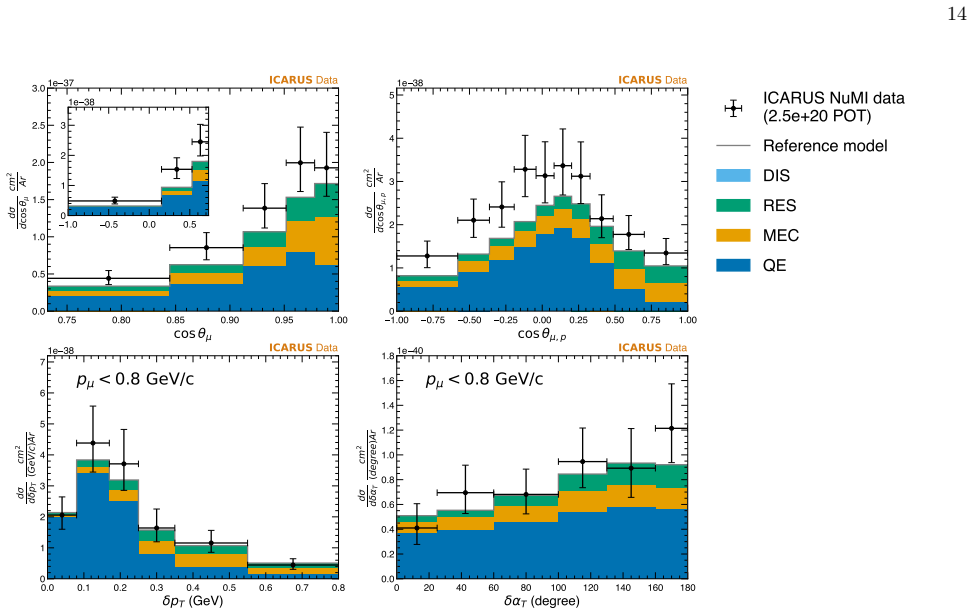
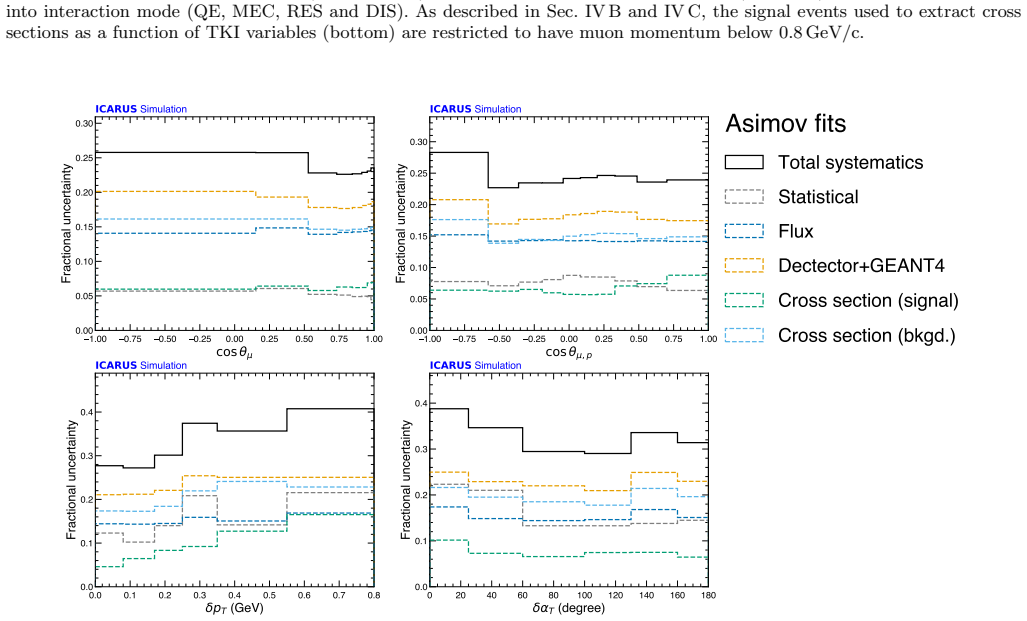
Using off-axis NuMI beam data collected by ICARUS corresponding to 2.5 times 10 to the 20 protons-on-target in neutrino mode, the collaboration extracts flux-averaged differential cross sections for muon (anti-)neutrino charged-current quasielastic-like interactions defined by no pions in the final state. The cross sections are reported in the lepton angle, lepton-proton opening angle, and two transverse kinematic imbalance variables. Predictions from a variety of neutrino event generators agree with the extracted cross sections, but the present uncertainty budget does not supply enough discriminating power to prefer one model.
What carries the argument
Flux-averaged differential cross sections in lepton angle, lepton-proton opening angle, and transverse kinematic imbalance variables for CCQE-like events, extracted after event selection and background subtraction.
If this is right
- These cross sections constrain models of nuclear effects that dominate systematic uncertainties in neutrino oscillation measurements.
- The selected kinematic variables provide direct sensitivity to final-state interactions and Fermi motion inside the nucleus.
- Additional ICARUS data can tighten the uncertainty budget and begin to discriminate among generators.
- The results supply a benchmark for neutrino-nucleus scattering that other experiments can use to validate their interaction models.
Where Pith is reading between the lines
- With more exposure, the same variables could resolve which nuclear model best describes the data.
- Transverse imbalance measurements may highlight interaction mechanisms that current generators treat differently.
- The approach can be extended to separate neutrino and antineutrino samples to search for charge-dependent nuclear effects.
Load-bearing premise
The event selection and background subtraction accurately isolate true CCQE-like events with minimal contamination from other interaction channels or mis-reconstruction.
What would settle it
A future analysis with substantially higher statistics or reduced systematic uncertainties that reveals significant disagreement between the data and all tested neutrino event generators would falsify the claim of agreement.
Figures






read the original abstract
This paper presents the first neutrino cross-section measurement from the ICARUS detector at Fermilab, using NuMI (Neutrinos at the Main Injector) beam data collected from two beam operation periods corresponding to $2.5\times10^{20}$ protons-on-target in neutrino beam mode. The signal is defined by events with no pions produced in the final state, a topology dominated by charged-current quasi-elastic-like (CCQE-like) signatures. The measurement is reported as flux-averaged differential cross sections as functions of kinematic variables that provide sensitivity to the complex nuclear effects which often dominate the systematic uncertainty budgets of neutrino oscillation measurements. Specifically, this work reports cross sections in two angular variables -- the angle of the outgoing lepton and the opening angle between the lepton and leading proton -- and two variables characterizing the kinematic imbalance between the muon and proton in the plane transverse to the incoming neutrino. These results are compared against predictions from a variety of neutrino event generators, with $p$-values calculated between the extracted cross sections and each prediction. Overall, the predictions agree with the data; however, the current budget of uncertainties does not yet provide sufficient discriminating power to favor a specific model.
Editorial analysis
A structured set of objections, weighed in public.
Referee Report
Summary. The paper reports the first neutrino cross-section measurement from the ICARUS detector using 2.5×10^{20} POT of NuMI neutrino-mode beam data. It defines a CCQE-like signal topology (no pions in the final state) and extracts flux-averaged differential cross sections in lepton angle, lepton-proton opening angle, and transverse kinematic imbalance variables. These are compared to predictions from multiple neutrino event generators via p-values, with the conclusion that models agree with the data but current uncertainties lack power to discriminate among them.
Significance. As the inaugural cross-section result from ICARUS, this work supplies new data on nuclear effects in neutrino-nucleus scattering that are directly relevant to systematic uncertainties in oscillation experiments. The choice of kinematic variables sensitive to final-state interactions and the use of p-value comparisons provide a quantitative framework for generator testing, assuming the selected sample purity is robustly established.
major comments (1)
- [Event selection and background subtraction section] Event selection and background subtraction section: The manuscript supplies no quantitative purity estimate, sideband validation, or breakdown of contamination from resonant, DIS, or mis-reconstructed pion events in the no-pion CCQE-like sample. Because the extracted differential cross sections and all subsequent generator comparisons rest on accurate isolation of the intended topology after efficiency correction, even a 10-15% under-subtraction in any bin would shift the reported values and alter the apparent level of agreement.
minor comments (1)
- [Abstract] Abstract and title: The title refers to muon (anti-)neutrino interactions while the text specifies data collection exclusively in neutrino beam mode; this should be clarified for consistency.
Simulated Author's Rebuttal
We thank the referee for their thorough review and for highlighting the importance of clearly documenting the purity and background composition of the CCQE-like sample. We agree that quantitative estimates of contamination and validation procedures are essential for the credibility of the extracted cross sections. Below we address the single major comment point by point and outline the revisions we will make.
read point-by-point responses
-
Referee: The manuscript supplies no quantitative purity estimate, sideband validation, or breakdown of contamination from resonant, DIS, or mis-reconstructed pion events in the no-pion CCQE-like sample. Because the extracted differential cross sections and all subsequent generator comparisons rest on accurate isolation of the intended topology after efficiency correction, even a 10-15% under-subtraction in any bin would shift the reported values and alter the apparent level of agreement.
Authors: We acknowledge that the submitted manuscript does not contain a dedicated quantitative purity estimate, sideband validation, or explicit breakdown of contamination sources (resonant, DIS, and mis-reconstructed pions) for the no-pion CCQE-like selection. In the revised version we will add a new subsection (or expand the existing Event Selection section) that reports: (i) the overall and bin-by-bin purity obtained from the full Monte Carlo simulation, (ii) the fractional contributions from resonant, DIS, and mis-reconstructed pion events, and (iii) validation of the background model using data sidebands (e.g., events with one or more reconstructed pions and events failing the transverse kinematic imbalance cuts). These additions will be accompanied by the corresponding systematic uncertainties. We agree that this information is required to substantiate the robustness of the efficiency-corrected cross sections and the subsequent generator comparisons. revision: yes
Circularity Check
No significant circularity in data-driven cross-section measurement
full rationale
This is a standard experimental measurement paper extracting flux-averaged differential cross sections directly from observed ICARUS detector events after background subtraction, efficiency correction, and unfolding. The signal definition (no pions in final state) is a topological selection on data, not a self-referential fit. Generator comparisons are post-extraction external checks with p-values, and the paper explicitly states insufficient uncertainty budget for model discrimination. No self-definitional equations, fitted inputs renamed as predictions, or load-bearing self-citations appear in the derivation chain. The result is independent of the models it is compared against.
Axiom & Free-Parameter Ledger
axioms (2)
- domain assumption Neutrino interactions are governed by the Standard Model with well-modeled nuclear effects in argon
- domain assumption NuMI beam flux and detector efficiency are independently calibrated to sufficient precision
Reference graph
Works this paper leans on
-
[1]
B. Abiet al.(DUNE), (2020), arXiv:2002.03005 [hep-ex]
-
[2]
R. L. Workmanet al.(Particle Data Group), PTEP 2022, 083C01 (2022)
2022
-
[3]
K. Abeet al.(T2K), Eur. Phys. J. C83, 782 (2023), arXiv:2303.03222 [hep-ex]
- [4]
-
[5]
Alvarez-Rusoet al.(NuSTEC), Prog
L. Alvarez-Rusoet al.(NuSTEC), Prog. Part. Nucl. Phys.100, 1 (2018), arXiv:1706.03621 [hep-ph]
- [6]
-
[7]
R. Gonz´ alez-Jim´ enez, M. B. Barbaro, J. A. Ca- ballero, T. W. Donnelly, N. Jachowicz, G. D. Megias, K. Niewczas, A. Nikolakopoulos, and J. M. Ud´ ıas, Phys- ical Review C101, 10.1103/physrevc.101.015503 (2020)
-
[8]
Gonz´ alez-Jim´ enez, M
R. Gonz´ alez-Jim´ enez, M. B. Barbaro, J. A. Ca- ballero, T. W. Donnelly, N. Jachowicz, G. D. Megias, K. Niewczas, A. Nikolakopoulos, J. W. Van Orden, and J. M. Ud´ ıas, Phys. Rev. C105, 025502 (2022)
2022
-
[9]
McKean, R
J. McKean, R. Gonz´ alez-Jim´ enez, M. Kabirnezhad, J. M. Ud´ ıas, and Y. Uchida, Phys. Rev. D112, 032009 (2025)
2025
-
[10]
Caiet al.(The MINERνA Collaboration), Phys
T. Caiet al.(The MINERνA Collaboration), Phys. Rev. D101, 092001 (2020)
2020
-
[11]
Luet al., Phys
X.-G. Luet al., Phys. Rev. C94, 015503 (2016)
2016
-
[12]
Abratenkoet al.(MicroBooNE Collaboration), Phys
P. Abratenkoet al.(MicroBooNE Collaboration), Phys. Rev. D102, 112013 (2020)
2020
-
[13]
P. Abratenkoet al., Measurement of charged-current muon neutrino-argon interactions without pions in the final state using the microboone detector (2025), arXiv:2507.00921 [hep-ex]
work page internal anchor Pith review Pith/arXiv arXiv 2025
-
[14]
Andersonet al.(ArgoNeuT Collaboration), Phys
C. Andersonet al.(ArgoNeuT Collaboration), Phys. Rev. Lett.108, 161802 (2012)
2012
-
[15]
R. Acciarriet al., A proposal for a three detector short-baseline neutrino oscillation program in the fer- milab booster neutrino beam (2015), arXiv:1503.01520 [physics.ins-det]
-
[16]
Fermi National Accelerator Laboratory (FNAL),Booster Neutrino Flux Prediction at MicroBooNE, Tech. Rep. (Fermi National Accelerator Laboratory (FNAL), Batavia, IL (United States), 2018) MICROBOONE- NOTE-1031-PUB
2018
-
[17]
Aguilaret al., Phys
A. Aguilaret al., Phys. Rev. D64, 112007 (2001). 21 0.75 0.80 0.85 0.90 0.95 1.00 cos 0.0 0.5 1.0 1.5 2.0 2.5 3.0 d dcos cm2 Ar 1e 37 ICARUS Data 1.00 0.75 0.50 0.25 0.00 0.25 0.50 0.75 1.00 cos , p 0 1 2 3 4 5 d dcos , p cm2 Ar 1e 38 ICARUS Data ICARUS NuMI data (2.5e+20 POT) Reference model DIS RES MEC QE 0.0 0.1 0.2 0.3 0.4 0.5 0.6 0.7 0.8 pT (GeV) 0 1...
2001
-
[18]
A. A. Aguilar-Arevaloet al., Phys. Rev. Lett.121, 221801 (2018)
2018
-
[19]
Adamsonet al., Nuclear Instruments and Methods in Physics Research Section A: Accelerators, Spectrometers, Detectors and Associated Equipment806, 279 (2016)
P. Adamsonet al., Nuclear Instruments and Methods in Physics Research Section A: Accelerators, Spectrometers, Detectors and Associated Equipment806, 279 (2016)
2016
-
[20]
Abd Alrahmanet al., Journal of Instrumentation20 (10), P10044
F. Abd Alrahmanet al., Journal of Instrumentation20 (10), P10044
-
[21]
Amerioet al., Nuclear Instruments and Methods in Physics Research Section A: Accelerators, Spectrometers, Detectors and Associated Equipment527, 329 (2004)
S. Amerioet al., Nuclear Instruments and Methods in Physics Research Section A: Accelerators, Spectrometers, Detectors and Associated Equipment527, 329 (2004)
2004
-
[22]
Rubbiaet al., Journal of Instrumentation6, P07011 (2011)
C. Rubbiaet al., Journal of Instrumentation6, P07011 (2011)
2011
-
[23]
P. Abratenkoet al.(ICARUS), Eur. Phys. J. C83, 467 (2023), arXiv:2301.08634 [hep-ex]
-
[25]
Aliagaet al.(MINERνA Collaboration), Phys
L. Aliagaet al.(MINERνA Collaboration), Phys. Rev. D94, 092005 (2016)
2016
-
[26]
Wood, The NuMI neutrino flux prediction at ICARUS (2025), arXiv:2504.08950 [hep-ex]
A. Wood, The NuMI neutrino flux prediction at ICARUS (2025), arXiv:2504.08950 [hep-ex]
-
[27]
The GENIE Neutrino Monte Carlo Generator
C. Andreopouloset al., Nucl. Instrum. Meth. A614, 87 (2010), arXiv:0905.2517 [hep-ph]
work page Pith review arXiv 2010
-
[28]
The GENIE Neutrino Monte Carlo Generator: Physics and User Manual
C. Andreopoulos, C. Barry, S. Dytman, H. Gallagher, T. Golan, R. Hatcher, G. Perdue, and J. Yarba, (2015), arXiv:1510.05494 [hep-ph]
work page Pith review arXiv 2015
-
[29]
O. Hen, G. A. Miller, E. Piasetzky, and L. B. Weinstein, Rev. Mod. Phys.89, 045002 (2017)
2017
-
[30]
L. B. Weinstein, E. Piasetzky, D. W. Higinbotham, J. Gomez, O. Hen, and R. Shneor, Phys. Rev. Lett.106, 052301 (2011)
2011
-
[31]
Nieves, I
J. Nieves, I. R. Simo, and M. J. V. Vacas, Phys. Rev. C 83, 045501 (2011)
2011
-
[32]
A. S. Meyer, M. Betancourt, R. Gran, and R. J. Hill, Phys. Rev. D93, 113015 (2016)
2016
- [33]
-
[34]
Extensions of Superscaling from Relativistic Mean Field Theory: the SuSAv2 Model
R. Gonz´ alez-Jim´ enez, G. D. Megias, M. B. Barbaro, J. A. Caballero, and T. W. Donnelly, Phys. Rev.C90, 035501 (2014), arXiv:1407.8346 [nucl-th]
work page Pith review arXiv 2014
- [35]
-
[36]
I. Ruiz Simo, J. E. Amaro, M. B. Barbaro, A. De Pace, J. A. Caballero, and T. W. Donnelly, J. Phys. G44, 065105 (2017), arXiv:1604.08423 [nucl-th]
-
[37]
I. Ruiz Simo, J. E. Amaro, M. B. Barbaro, A. De Pace, J. A. Caballero, G. D. Megias, and T. W. Donnelly, Phys. Lett.B762, 124 (2016), arXiv:1607.08451 [nucl-th]
-
[38]
Berger and L
C. Berger and L. M. Sehgal, Phys. Rev. D76, 113004 (2007)
2007
-
[39]
K. M. Graczyk and J. T. Sobczyk, Phys. Rev. D79, 079903 (2009)
2009
-
[40]
Rein and L
D. Rein and L. M. Sehgal, Annals of Physics133, 79 (1981)
1981
-
[41]
J. Tena-Vidalet al.(GENIE), Phys. Rev. D104, 072009 (2021), arXiv:2104.09179 [hep-ph]
-
[42]
Bodek and U
A. Bodek and U. K. Yang, Journal of Physics G: Nuclear and Particle Physics29, 1899 (2003)
2003
-
[43]
S. A. Dytman and A. S. Meyer, AIP Conf. Proc.1405, 213 (2011). 22 0.75 0.80 0.85 0.90 0.95 1.00 cos 0.0 0.5 1.0 1.5 2.0 2.5 3.0 d dcos cm2 Ar 1e 37 ICARUS Data 1.00 0.75 0.50 0.25 0.00 0.25 0.50 0.75 1.00 cos , p 0 1 2 3 4 5 d dcos , p cm2 Ar 1e 38 ICARUS Data Data Reference model LQCD z-exp FCCQE A MINERvA z-exp FCCQE A hN2018 FSI NEUT (6.0.3), EDRMF NuW...
2011
-
[44]
Dytman, Y
S. Dytman, Y. Hayato, R. Raboanary, J. T. Sobczyk, J. Tena-Vidal, and N. Vololoniaina, Phys. Rev. D104, 053006 (2021)
2021
-
[45]
L. A. Ahrenset al., Phys. Rev. D35, 785 (1987)
1987
-
[46]
D. Heck, J. Knapp, J. N. Capdevielle, G. Schatz, and T. Thouw,CORSIKA: a Monte Carlo code to simulate extensive air showers.(1998)
1998
-
[47]
Agostinelliet al., Nuclear Instruments and Methods in Physics Research Section A: Accelerators, Spectrometers, Detectors and Associated Equipment506, 250 (2003)
S. Agostinelliet al., Nuclear Instruments and Methods in Physics Research Section A: Accelerators, Spectrometers, Detectors and Associated Equipment506, 250 (2003)
2003
-
[48]
Allisonet al., Nuclear Instruments and Methods in Physics Research Section A: Accelerators, Spectrometers, Detectors and Associated Equipment835, 186 (2016)
J. Allisonet al., Nuclear Instruments and Methods in Physics Research Section A: Accelerators, Spectrometers, Detectors and Associated Equipment835, 186 (2016)
2016
-
[49]
Adamset al.(MicroBooNE), Journal of Instrumenta- tion13(07), P07006
C. Adamset al.(MicroBooNE), Journal of Instrumenta- tion13(07), P07006
-
[50]
Abratenkoet al.(ICARUS), Journal of Instrumenta- tion20(01), P01032, arXiv:2407.11925 [hep-ex]
P. Abratenkoet al.(ICARUS), Journal of Instrumenta- tion20(01), P01032, arXiv:2407.11925 [hep-ex]
-
[51]
Abratenkoet al.(ICARUS), Journal of Instrumenta- tion20(01), P01033, arXiv:2407.12969 [physics]
P. Abratenkoet al.(ICARUS), Journal of Instrumenta- tion20(01), P01033, arXiv:2407.12969 [physics]
-
[52]
J. S. Marshall and M. A. Thomson, The European Phys- ical Journal C75, 439 (2015)
2015
-
[53]
R. Acciari, C. Adams, R. An,et al., Eur. Phys. J. C78, 10.1140/epjc/s10052-017-5481-6 (2018)
-
[54]
A. Abed Abudet al.(DUNE), Eur. Phys. J. C83, 618 (2023), arXiv:2206.14521 [hep-ex]
-
[55]
Ruterborieset al.(MINERνA Collaboration), Phys
D. Ruterborieset al.(MINERνA Collaboration), Phys. Rev. D99, 012004 (2019)
2019
-
[56]
Adamsonet al.(NOvA), Phys
P. Adamsonet al.(NOvA), Phys. Rev. D93, 051104 (2016)
2016
-
[57]
Abratenkoet al., Journal of Instrumentation12(10), P10010–P10010
P. Abratenkoet al., Journal of Instrumentation12(10), P10010–P10010
-
[58]
Bercellieet al.(The MINERvA Collaboration), Phys
A. Bercellieet al.(The MINERvA Collaboration), Phys. Rev. Lett.131, 011801 (2023)
2023
-
[59]
Sultana,Semi-inclusive measurement of charged- currentπ + production in MINERvA forT π+ >0GeV, Ph.D
M. Sultana,Semi-inclusive measurement of charged- currentπ + production in MINERvA forT π+ >0GeV, Ph.D. thesis, University of Rochester (2025)
2025
-
[60]
Abd Alrahmanet al.(ICARUS Collaboration), Phys
F. Abd Alrahmanet al.(ICARUS Collaboration), Phys. Rev. Lett.134, 151801 (2025)
2025
-
[61]
com/LArSoft/larana/blob/develop/larana/ ParticleIdentification/Chi2PIDAlg.cxx
LArSoft, Chi2pidalg.cxx,https://github. com/LArSoft/larana/blob/develop/larana/ ParticleIdentification/Chi2PIDAlg.cxx
-
[62]
A. Lozanoet al., Measurement of charged-currentν µ and ¯νµ cross sections on hydrocarbon in a shallow inelastic scattering region (2025), arXiv:2503.20043 [hep-ex]
-
[63]
Nachtmann, Nuclear Physics B63, 237 (1973)
O. Nachtmann, Nuclear Physics B63, 237 (1973)
1973
-
[64]
M. Gl¨ uck, E. Reya, and A. Vogt, Eur. Phys. J. C5, 461 (1998), arXiv:hep-ph/9806404
-
[65]
Calcutt, C
J. Calcutt, C. Thorpe, K. Mahn, and L. Fields, Journal of Instrumentation16(08), P08042
-
[66]
com/gundam-organization/gundam(2024)
GUNDAM organization, GUNDAM,https://github. com/gundam-organization/gundam(2024)
2024
-
[67]
S. Gardiner, Mathematical methods for neutrino cross- section extraction (2024), arXiv:2401.04065 [hep-ex]
-
[68]
James,Statistical methods in experimental physics (Singapore : World Scientific, 2006)
F. James,Statistical methods in experimental physics (Singapore : World Scientific, 2006). 23
2006
-
[69]
P. C. Hansen, SIAM Review34, 561 (1992), ttps://doi.org/10.1137/1034115
- [70]
- [71]
-
[72]
Caiet al.(MINERvA), Nature614, 48 (2023)
T. Caiet al.(MINERvA), Nature614, 48 (2023)
2023
-
[73]
Golan, J
T. Golan, J. Sobczyk, and J. ˙Zmuda, Nuclear Physics B - Proceedings Supplements229-232, 499 (2012), NEU- TRINO2010
2012
-
[74]
Jianget al.(Jefferson Lab Hall A Collaboration), Phys
L. Jianget al.(Jefferson Lab Hall A Collaboration), Phys. Rev. D105, 112002 (2022)
2022
-
[75]
Llewellyn Smith, Physics Reports3, 261 (1972)
C. Llewellyn Smith, Physics Reports3, 261 (1972)
1972
- [76]
-
[77]
Blattel, V
B. Blattel, V. Koch, and U. Mosel, Reports on Progress in Physics56, 1 (1993)
1993
-
[78]
Hayato and L
Y. Hayato and L. Pickering, The European Physical Journal Special Topics230, 4469 (2021)
2021
-
[79]
B. D. Serot and J. D. Walecka, Adv. Nucl. Phys.16, 1 (1986)
1986
-
[80]
S. S. Wilks, The Annals of Mathematical Statistics9, 60 (1938)
1938
-
[81]
Barlow and C
R. Barlow and C. Beeston, Computer Physics Commu- nications77, 219 (1993)
1993
discussion (0)
Sign in with ORCID, Apple, or X to comment. Anyone can read and Pith papers without signing in.