Recognition: unknown
A simple model of current ramp down in the ITER tokamak
Pith reviewed 2026-05-07 17:43 UTC · model grok-4.3
The pith
A cylindrical model shows ITER's planned 60-second plasma current ramp-down is stable if the plasma starts hot enough, but faster ramps excite 2/1 tearing modes that lock and disrupt.
A machine-rendered reading of the paper's core claim, the machinery that carries it, and where it could break.
Core claim
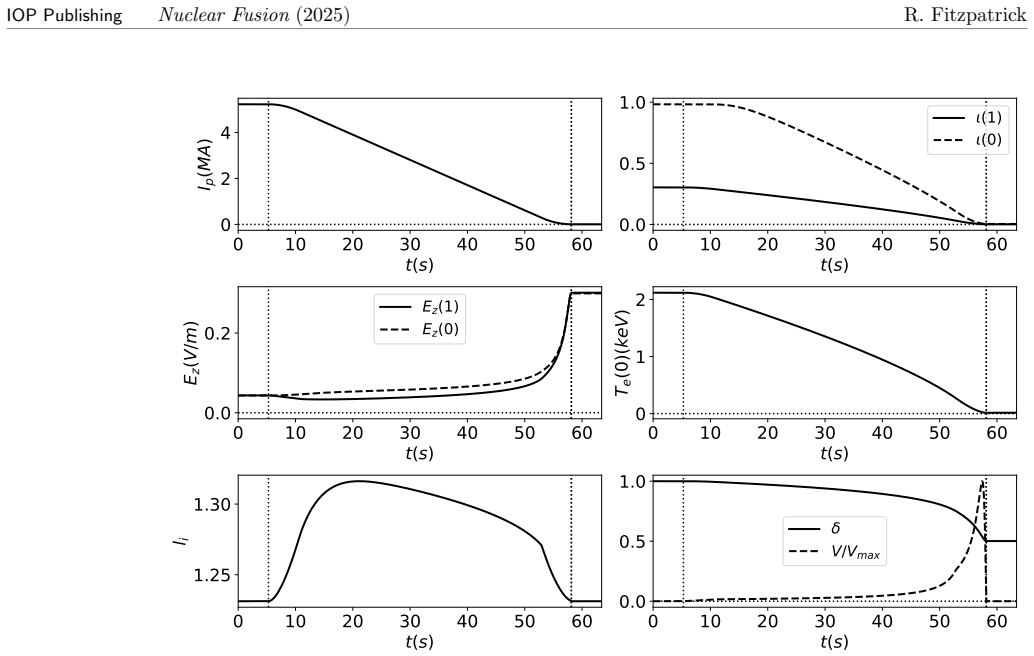
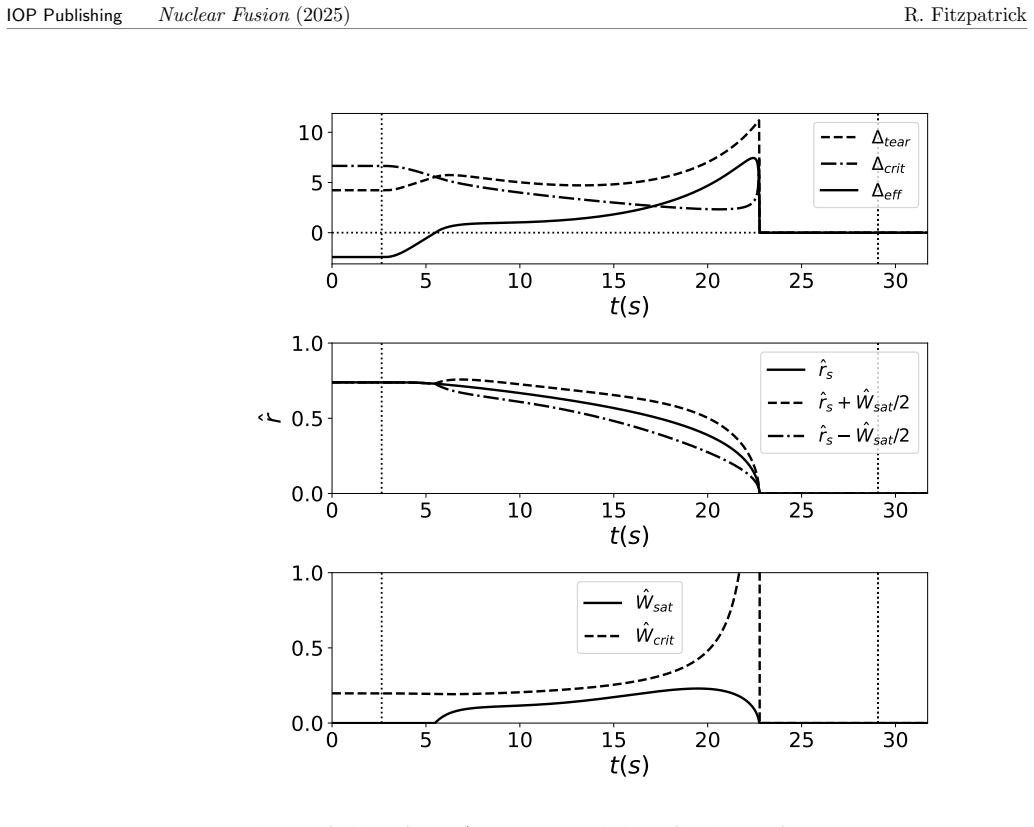
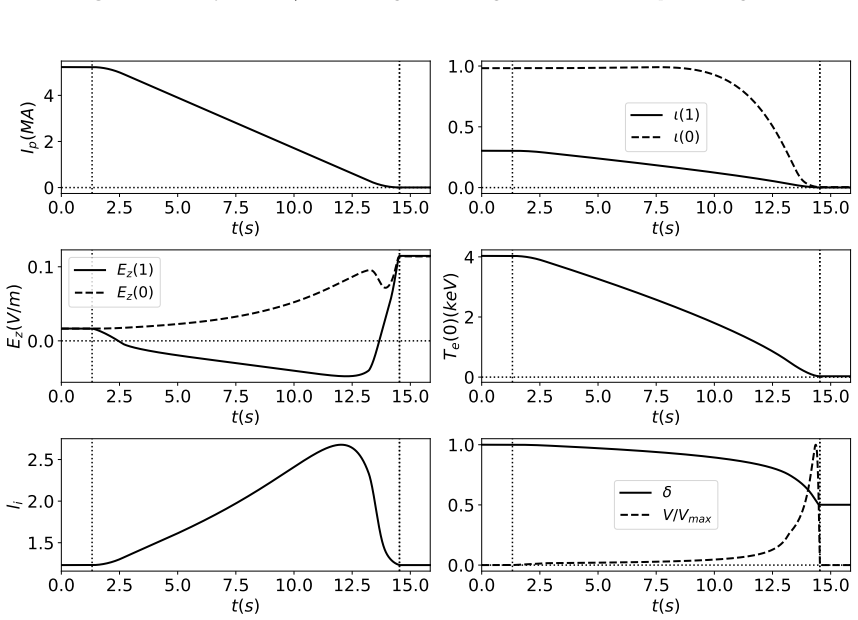
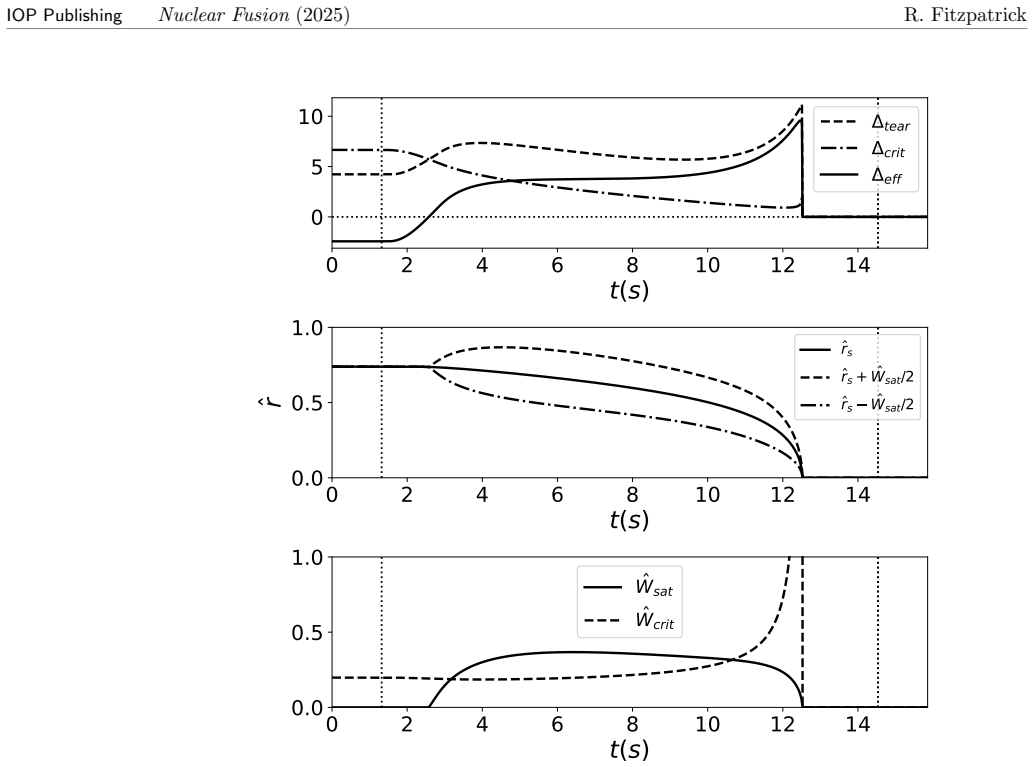
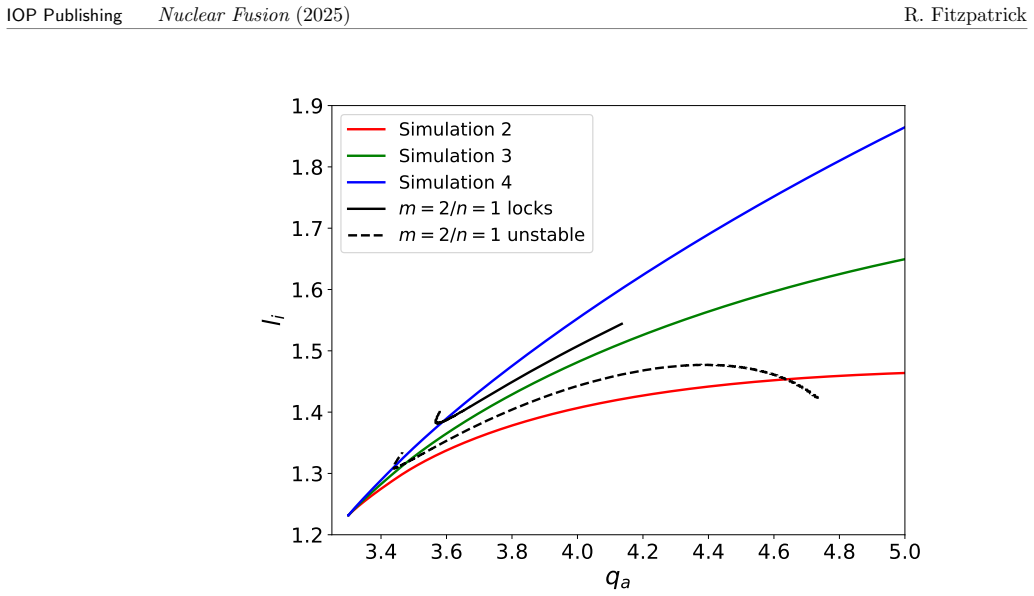
The envisioned 60 second ramp down of the plasma current in ITER is found to be perfectly feasible, provided that the plasma is sufficiently hot at the start of the ramp. However, attempts to ramp down the current on a significantly faster time scale are predicted to excite 2/1 tearing modes that are likely to lock to the vacuum vessel, and trigger a disruption.
What carries the argument
A simple cylindrical geometry model that simulates the plasma current ramp down while calculating the stability of the m=2/n=1 classical tearing mode throughout the process.
If this is right
- The standard 60-second current ramp down in ITER can proceed without exciting unstable modes if the plasma temperature is adequate at the beginning.
- Ramping down the current much faster than 60 seconds will excite the 2/1 tearing mode.
- Excited 2/1 tearing modes are likely to lock to the vacuum vessel and trigger a disruption.
- The plasma must remain sufficiently hot throughout the ramp to keep the mode stable.
Where Pith is reading between the lines
- If the model holds, ITER operators could use it to set safe ramp rates for different initial plasma conditions.
- Similar simple models might apply to other tokamaks for quick assessments of ramp-down stability.
- Full toroidal simulations could test if the cylindrical approximation underestimates or overestimates the risk of mode locking.
- Quantifying the minimum initial temperature required would make the feasibility claim more actionable for experiments.
Load-bearing premise
The model relies on cylindrical geometry and assumes the only unstable mode is the classical m=2/n=1 tearing mode, without accounting for toroidal effects or specifying the exact temperature threshold for stability.
What would settle it
Direct observation in ITER or a similar device of whether 2/1 tearing modes are excited and lock during current ramps faster than 60 seconds, or remain stable in the planned 60-second scenario.
Figures


read the original abstract
The controlled ramp down of the toroidal plasma current in the ITER tokamak is simulated using a simple model that employs cylindrical geometry. The magnetohydrodynamical (MHD) stability of the plasma throughout the whole current ramp is also calculated. The only potentially unstable MHD mode is the m=2/n=1 classical tearing mode. The envisioned 60 second ramp down of the plasma current in ITER is found to be perfectly feasible, provided that the plasma is sufficiently hot at the start of the ramp. However, attempts to ramp down the current on a significantly faster time scale are predicted to excite 2/1 tearing modes that are likely to lock to the vacuum vessel, and trigger a disruption.
Editorial analysis
A structured set of objections, weighed in public.
Referee Report
Summary. The manuscript presents a simple model using cylindrical geometry to simulate the ramp-down of toroidal plasma current in ITER while calculating MHD stability. It concludes that the planned 60-second ramp-down is feasible provided the plasma is sufficiently hot initially, but significantly faster ramps excite the m=2/n=1 classical tearing mode, which is predicted to lock to the vessel and trigger a disruption.
Significance. If the central results hold, the work supplies a transparent, low-complexity tool for scoping current-ramp scenarios in ITER and underscores the role of initial temperature in avoiding tearing-mode locking. The approach is computationally lightweight and could serve as a quick-check complement to full toroidal simulations, but its predictive weight for ITER operation is limited by the untested geometric and physics approximations.
major comments (3)
- [Model description] Model section: the restriction to cylindrical geometry and the classical m=2/n=1 tearing mode is load-bearing for the ITER feasibility claim, yet no quantitative estimate is given of how toroidal curvature, mode coupling, or resistive-wall effects would shift the stability boundaries or growth rates relative to the cylinder.
- [Results] Results on ramp-down feasibility: the phrase 'sufficiently hot' is never turned into a concrete temperature, beta, or resistivity threshold, and no validation data, error estimates, or comparison to toroidal codes are supplied, leaving the 60 s claim without a falsifiable anchor.
- [MHD stability calculation] Stability analysis: the assertion that only the classical 2/1 mode can be unstable omits any check for neoclassical tearing modes driven by bootstrap current or for other toroidal instabilities that become relevant once the current profile evolves during the ramp.
minor comments (2)
- [Abstract] The abstract states conclusions from a simulation but supplies no equations, numerical methods, or grid-resolution details; these should be moved to the main text or a methods subsection for completeness.
- [Model description] Notation for the safety factor, resistivity, and growth-rate normalizations is introduced without a dedicated table or appendix, making it harder to reproduce the stability thresholds.
Simulated Author's Rebuttal
We thank the referee for the constructive and detailed comments, which have helped us improve the clarity and balance of the manuscript. We address each major comment below and have revised the text accordingly to better highlight the model's scope and limitations while preserving its intended role as a simple scoping tool.
read point-by-point responses
-
Referee: Model section: the restriction to cylindrical geometry and the classical m=2/n=1 tearing mode is load-bearing for the ITER feasibility claim, yet no quantitative estimate is given of how toroidal curvature, mode coupling, or resistive-wall effects would shift the stability boundaries or growth rates relative to the cylinder.
Authors: The cylindrical approximation is a deliberate choice to maintain computational simplicity and transparency, consistent with the paper's title and stated purpose as a lightweight complement to full simulations. We agree that toroidal curvature and mode coupling can alter growth rates, typically by factors of order unity according to existing literature. In the revised manuscript we have added a new paragraph in the Discussion section that provides order-of-magnitude estimates drawn from published comparisons between cylindrical and toroidal tearing-mode calculations, while explicitly stating that precise boundary shifts would require dedicated toroidal modeling. revision: partial
-
Referee: Results on ramp-down feasibility: the phrase 'sufficiently hot' is never turned into a concrete temperature, beta, or resistivity threshold, and no validation data, error estimates, or comparison to toroidal codes are supplied, leaving the 60 s claim without a falsifiable anchor.
Authors: We have revised the Results section to report concrete thresholds obtained from our parameter scans: an initial central temperature above approximately 5 keV (with corresponding resistivity below 1.5 times the reference value) permits a stable 60 s ramp. We now include error bands derived from variations in initial profiles and transport coefficients. Direct validation data and side-by-side toroidal-code comparisons remain outside the present scope; we have added a sentence noting this limitation and citing relevant ITER modeling papers that show qualitatively consistent trends. revision: yes
-
Referee: Stability analysis: the assertion that only the classical 2/1 mode can be unstable omits any check for neoclassical tearing modes driven by bootstrap current or for other toroidal instabilities that become relevant once the current profile evolves during the ramp.
Authors: Our resistive-MHD model does not include the bootstrap current, so neoclassical tearing modes are excluded by construction. During current ramp-down the pressure and bootstrap drive both decline, reducing NTM relevance. The revised stability section now explicitly lists these assumptions, explains why classical tearing dominates under the modeled conditions, and references ITER-specific studies on profile evolution and other instabilities to contextualize the limitation. revision: partial
- Direct quantitative comparisons against full toroidal MHD codes or experimental validation datasets, which would necessitate a separate, substantially more resource-intensive study beyond the simple cylindrical model.
Circularity Check
No circularity: forward simulation of ramp-down using standard cylindrical MHD stability
full rationale
The paper describes a direct numerical integration of a simple cylindrical MHD model for the plasma current evolution during ramp-down, followed by an independent stability calculation restricted to the classical m=2/n=1 tearing mode. No parameters are fitted to the target 60 s ramp outcome, no self-citations are invoked as load-bearing uniqueness theorems, and no ansatz or renaming reduces the stability prediction to the input profile by construction. The feasibility statement is an output of the forward run under stated assumptions, not an input.
Axiom & Free-Parameter Ledger
Reference graph
Works this paper leans on
-
[1]
Wesson,Tokamaks, 4th ed., (Oxford University Press, Oxford UK, 2011)
J.A. Wesson,Tokamaks, 4th ed., (Oxford University Press, Oxford UK, 2011)
2011
-
[2]
Jackson, P.A
G.L. Jackson, P.A. Politzer, D.A. Humphreys, T.A. Casper, A.W. Hyatt, J.A. Leuer, J. Lohr, T.C. Luce, M.A. Van Zeeland and J.H. Yu,Understanding and predicting the dynamics of tokamak discharges during startup and rampdown, Phys. Plasmas17, 056116 (2010)
2010
-
[3]
Imbeaux, J
F. Imbeaux, J. Citrin, J. Hobirk, G.M.D. Hogeweij, F. K¨ ochl, V.M. Leonov, S. Miyamoto, Y. Nakamura, V. Parail, G. Pereverzev, et al.,Current ramps in tokamaks: from present experiments to ITER scenarios, Nucl. Fusion51, 083026 (2011)
2011
-
[4]
de Vries, T.C
P.C. de Vries, T.C. Luce, Y.S. Bae, S. Gerhardt, X. Gong, Y. Gribov, D. Humphries, A. Kavin, R.R. Khayrutdinov, C. Kessel, et al.,Multi-machine analysis of termination scenarios with comparison to simulation of controlled shutdown in ITER discharges, Nucl. Fusion58, 026019 (2017)
2017
-
[5]
Van Mulders, O
S. Van Mulders, O. Sauter, C. Contr´ e, F. Felici, R. Fischer, T. P¨ utterich, B. Sieglin, A.A. Teplukhina and ASDEX Upgrade Team,Scenario optimization for the tokamak ramp-down phase in RAPTOR: Part A. analysis and model validation on ASDEX Upgrade, Plasma Phys. Control. Fusion66, 025006 (2023)
2023
-
[6]
Van Mulders, O
S. Van Mulders, O. Sauter, C. Contr´ e, E. Fable, F. Felici, P. Manas, M. Mattei, F. Palermo, M. Siccinio and A.A. Teplukhina,Scenario optimization for the tokamak ramp-down phase in RAPTOR: Part B. safe termination of DEMO plasmas, Plasma Phys. Control. Fusion66, 025007 (2024)
2024
-
[7]
A.M. Wang, A. Pau, C. Rea, O. So, C. Dawson, O. Sauter, M.D. Boyer, A. Vu, C. Galperti, C. Fan, et al.,Learning plasma dynamics and robust rampdown trajectories with predict-first experiments at TCV, Nat. Commun.16, 8877 (2025)
2025
-
[8]
S. Van Mulders and O. Sauter,On the timescales of controlled termination of tokamak plasmas, arXiv:2603.12972v1 (2026)
-
[9]
Freidberg,Ideal magnetohydrodynamic theory of magnetic fusion systems, Rev
J.P. Freidberg,Ideal magnetohydrodynamic theory of magnetic fusion systems, Rev. Mod. Phys.54, 801 (1982)
1982
-
[10]
Kadomtsev,Disruptive instabilities in tokamaks, Sov
B.B. Kadomtsev,Disruptive instabilities in tokamaks, Sov. J. Plasma Phys.1, 289 (1975)
1975
-
[11]
Sweeney, W
R.M. Sweeney, W. Choi, R.J. La Haye, S. Mao, K.E.J. Olofsson and F.A. Volpe,Statistical analysis ofm/n= 2/1locked and quasi-stationary modes with rotating precursors at DIII-D, Nucl. Fusion57, 016019 (2017). 19 IOP PublishingNuclear Fusion(2025) R. Fitzpatrick
2017
-
[12]
G. Sias, B. Cannas, A. Fanni, A. Murari and A. Pau,Locked mode indicator for disruption prediction on JET, Fus. Eng. Design138, 254 (2019)
2019
-
[13]
Fitzpatrick,A simple model of current ramp-up and ramp-down in tokamaks, Nucl
R. Fitzpatrick,A simple model of current ramp-up and ramp-down in tokamaks, Nucl. Fusion 66, 016012 (2025)
2025
-
[14]
Cheng, H.P
C.Z. Cheng, H.P. Furth and A.H. Boozer,MHD stable region of the tokamak, Plasma Phys. Control. Fusion29, 351 (1987)
1987
-
[15]
Huysmans and O
G.T.A. Huysmans and O. Sauter,MHD stability in tokamaks, Plasma Phys. and Control. Fusion45, B159 (2003)
2003
-
[16]
Spitzer, Jr.,Physics of fully ionized gases, (Interscience, New York NY, 1956)
L. Spitzer, Jr.,Physics of fully ionized gases, (Interscience, New York NY, 1956)
1956
-
[17]
Fitzpatrick,Plasma physics: an introduction, 2nd ed., (CRC, Boca Raton FL, 2023)
R. Fitzpatrick,Plasma physics: an introduction, 2nd ed., (CRC, Boca Raton FL, 2023)
2023
-
[18]
Fitzpatrick,Tearing mode dynamics in tokamak plasmas, (IOP, Bristol UK, 2023)
R. Fitzpatrick,Tearing mode dynamics in tokamak plasmas, (IOP, Bristol UK, 2023)
2023
-
[19]
Fusion39, 2175 (1999)
ITER Physics Expert Group on Confinement and Transport,Chapter 2: Plasma confinement and transport, Nucl. Fusion39, 2175 (1999)
1999
-
[20]
Ejima, R.W
S. Ejima, R.W. Callis, J.L. Luxon, R.D. Stambaugh, T.S. Taylor and J.C. Wesley,Volt-second analysis and consumption in Doublet III plasmas, Nucl. Fusion22, 1313 (1982)
1982
-
[21]
Romero and JET-EFDA Contributors,Plasma internal inductance dynamics in a tokamak, Nucl
J.A. Romero and JET-EFDA Contributors,Plasma internal inductance dynamics in a tokamak, Nucl. Fusion50, 115002 (2010)
2010
-
[22]
Ariola and A
M. Ariola and A. Pironti,Magnetic control of tokamak plasmas, 2nd ed. (Springer International, Switzerland, 2016)
2016
-
[23]
De Tommasi, R
G. De Tommasi, R. Albanese, G. Ambrosino, M. Ariola, P.J. Lomas, A. Pironti, F. Sartori and JET-EDFA Contributors,Current, position, and shape control in tokamaks, Fus. Sci. Tech. 59, 486 (2017)
2017
-
[24]
Wesson,Hydromagnetic stability of tokamaks, Nucl
J.A. Wesson,Hydromagnetic stability of tokamaks, Nucl. Fusion18, 87 (1978)
1978
-
[25]
Furth, J
H.P. Furth, J. Killeen and M.N. Rosenbluth,Finite-resistivity instabilities of a sheet pinch, Phys. Fluids6, 459 (1963)
1963
-
[26]
Rutherford,Nonlinear growth of the tearing mode, Phys
P.H. Rutherford,Nonlinear growth of the tearing mode, Phys. Fluids16, 1906 (1973)
1906
-
[27]
Glasser, J.M
A.H. Glasser, J.M. Greene and J.L. Johnson,Resistive instabilities in general toroidal plasma configurations, Phys. Fluids18, 875 (1975). 20 IOP PublishingNuclear Fusion(2025) R. Fitzpatrick
1975
-
[28]
Glasser, J.M
A.H. Glasser, J.M. Greene and J.L. Johnson,Resistive instabilities in a tokamak. Phys. Fluids 19, 567 (1976)
1976
-
[29]
L¨ utjens, J.-F
H. L¨ utjens, J.-F. Luciani and X. Garbet,Global magnetohydrodynamic stability of tokamak plasmas with flow and resistivity, Phys. Plasmas8, 4267 (2001)
2001
-
[30]
Fitzpatrick,Investigation of tearing mode stability near ideal stability boundaries via asymptotic matching techniques, Phys
R. Fitzpatrick,Investigation of tearing mode stability near ideal stability boundaries via asymptotic matching techniques, Phys. Plasmas32, 062509 (2025)
2025
-
[31]
Carrera, R.D
R. Carrera, R.D. Hazeltine and M. Kotschenreuther,Island bootstrap current modification of the nonlinear dynamics of the tearing mode, Phys. Fluids29, 899 (1986)
1986
-
[32]
Fitzpatrick,Helical temperature perturbations associated with tearing modes in tokamak plasmas, Phys
R. Fitzpatrick,Helical temperature perturbations associated with tearing modes in tokamak plasmas, Phys. Plasmas2, 825 (1995)
1995
-
[33]
White, D.A
R.A. White, D.A. Monticello, M.N. Rosenbluth and B.V. Waddell,Saturation of the tearing mode, Phys. Fluids20, 800 (1977)
1977
-
[34]
Hastie, F
R.J. Hastie, F. Militello and F. Porcelli,Nonlinear saturation of the tearing mode, Phys. Rev. Lett.95, 065001 (2005)
2005
-
[35]
Fitzpatrick,Interaction of tearing modes with external structures in cylindrical geometry, Nucl
R. Fitzpatrick,Interaction of tearing modes with external structures in cylindrical geometry, Nucl. Fusion33, 1049 (1993)
1993
-
[36]
Nave and J.A
M.F.F. Nave and J.A. Wesson,Mode locking in tokamaks, Nucl. Fusion30, 2575 (1990)
1990
-
[37]
La Haye, C
R.J. La Haye, C. Paz-Soldan and Y.Q. Liu, Nucl. Fusion57, 014004 (2017)
2017
-
[38]
Fitzpatrick,Theoretical investigation of braking of tearing mode rotation by resistive walls in ITER, Phys
R. Fitzpatrick,Theoretical investigation of braking of tearing mode rotation by resistive walls in ITER, Phys. Plasmas30, 042514 (2023)
2023
-
[39]
Creely, M.J
A.J. Creely, M.J. Greenwald, S.B. Ballinger, D. Brunner, J. Canik, J. Dooly, T. F¨ ulop, D.T. Garnier, R. Granetz, T.K. Gray, et al.,Overview of the SPARC tokamak, J. Plasma Phys.86, 865860502 (2020)
2020
-
[40]
Fusion39, 2137 (1999)
ITER Physics Basis Editors,Chapter 8: MHD stability, operational limits and disruptions, Nucl. Fusion39, 2137 (1999)
1999
-
[41]
Uckan and the ITER Physics Group,International Atomic Energy Agency, ITER Physics Design Guidelines: 1989, (International Atomic Energy Agency, Vienna, 1990)
N.A. Uckan and the ITER Physics Group,International Atomic Energy Agency, ITER Physics Design Guidelines: 1989, (International Atomic Energy Agency, Vienna, 1990)
1989
-
[42]
Glasser, Z.R
A.H. Glasser, Z.R. Wang and J.-K. Park,Computation of resistive instabilities by matched asymptotic expansions, Phys. Plasmas23, 112506 (2016). 21 IOP PublishingNuclear Fusion(2025) R. Fitzpatrick
2016
-
[43]
Park,Parametric dependencies of resonant layer responses across linear, two-fluid, drift-MHD regimes
J.-K. Park,Parametric dependencies of resonant layer responses across linear, two-fluid, drift-MHD regimes. Phys. Plasmas29, 072506 (2022)
2022
-
[44]
Crank and P
J. Crank and P. Nicolson,A practical method for numerical evaluation of solutions of partial differential equations of the heat-conduction type, Math. Proc. Cambridge Philos. Soc.43, 50 (1947)
1947
-
[45]
Smith,Numerical solution of partial differential equations: finite difference methods, (Oxford University Press, Oxford UK, 1965)
G.D. Smith,Numerical solution of partial differential equations: finite difference methods, (Oxford University Press, Oxford UK, 1965). 22
1965
discussion (0)
Sign in with ORCID, Apple, or X to comment. Anyone can read and Pith papers without signing in.