Use case study: benchmarking quantum breadth-first search for maximum flow problems
Pith reviewed 2026-05-08 03:52 UTC · model grok-4.3
The pith
Replacing classical BFS with quantum BFS in maximum flow algorithms would require gate speeds beyond physical limits to achieve practical advantage.
A machine-rendered reading of the paper's core claim, the machinery that carries it, and where it could break.
Core claim
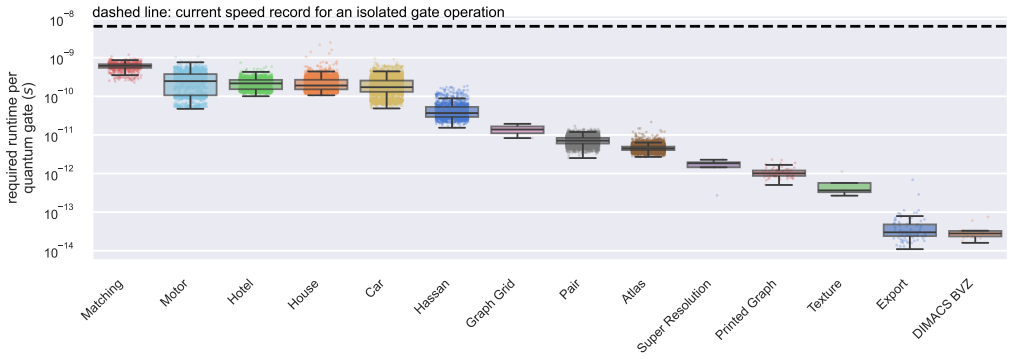
By isolating the runtime of BFS subroutines in classical Dinic's algorithm on standard datasets and analytically estimating the minimum number of quantum cycles required to implement qBFS on the same data, the authors show that practical quantum advantage in maximum flow would necessitate quantum gate operation times that surpass physical limitations.
What carries the argument
The hybrid benchmarking method that logs classical BFS data from Dinic's algorithm and estimates the quantum cycle count for qBFS based on Grover's search to predict end-to-end runtime costs.
If this is right
- Quantum advantage for maximum flow problems of realistic size is not feasible under current or near-term hardware constraints.
- The minimum cycle estimates derived from classical logs set a lower bound on required quantum performance.
- qBFS as a drop-in replacement for classical BFS in optimization pipelines faces fundamental speed limits imposed by physics.
Where Pith is reading between the lines
- Extending the analysis to include error correction and connectivity overheads would likely make the required gate speeds even more demanding.
- This benchmarking approach could be applied to other quantum algorithms for combinatorial problems to identify similar hardware bottlenecks.
- Neighbouring problems like minimum cut or network reliability might share the same quantum runtime scaling challenges.
Load-bearing premise
That the analytically estimated minimum number of quantum cycles for qBFS from classical BFS logs fully captures the runtime without extra costs from circuit compilation, error correction, or hardware connectivity limits.
What would settle it
Demonstrating a quantum hardware implementation of qBFS on a maximum flow instance of realistic size that achieves speedup with gate operation times within known physical bounds would falsify the claim.
Figures
read the original abstract
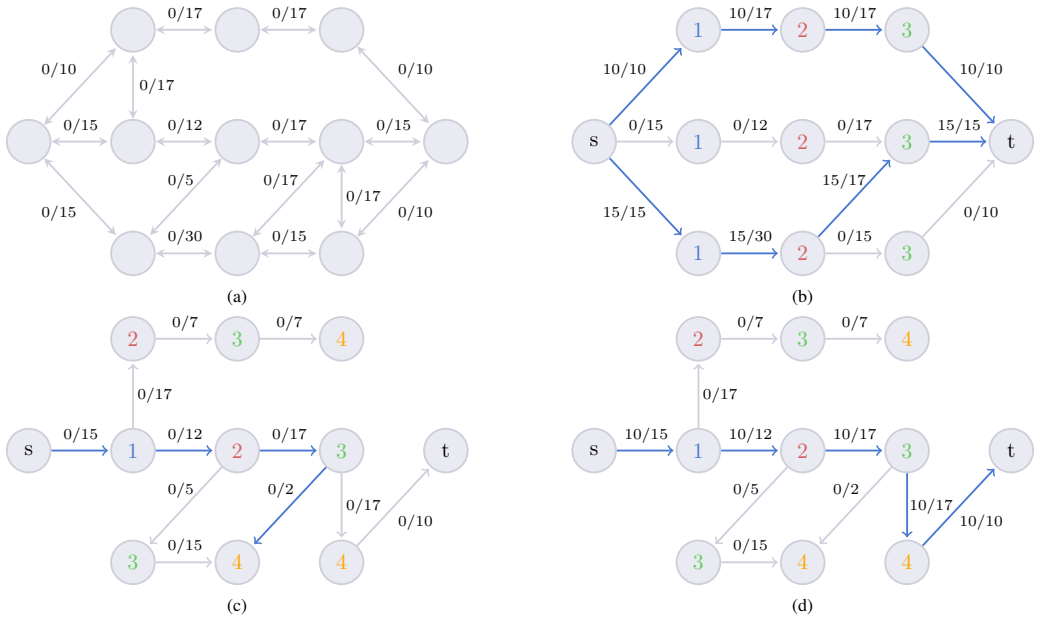
The maximum flow problem asks to find the largest possible flow from a source to a sink in a capacitated network. It arises frequently in scheduling, project selection, and as a core subroutine in broader optimisation tasks. Classically, it can be efficiently solved using Dinic's algorithm, which repeatedly performs breadth-first search (BFS) and blocking flow computations on the graph. As a potential candidate for quantum speedups, these BFS subroutines can be naturally replaced with quantum BFS (qBFS), an instantiation of Grover's search algorithm. In this paper, we evaluate the expected performance of qBFS on standard classical datasets. These instances are too large to be solved directly on current quantum hardware, so we adopt a hybrid benchmarking approach: (i) we run a classical implementation of Dinic's algorithm and isolate the runtime of its BFS subroutines; (ii) we analytically estimate the minimum number of quantum cycles required to implement qBFS, where we use the classically logged data. Our results indicate that achieving a practical quantum advantage for realistic problem sizes would translate to quantum gate operation times surpassing physical limitations.
Editorial analysis
A structured set of objections, weighed in public.
Referee Report
Summary. The manuscript evaluates the potential for quantum advantage in solving maximum flow problems by replacing the BFS subroutine in Dinic's algorithm with quantum BFS (qBFS) based on Grover search. The authors adopt a hybrid approach: they execute a classical implementation of Dinic's algorithm on standard datasets, isolate the runtime contributions of the BFS steps, and derive an analytical lower bound on the number of quantum cycles needed for qBFS using the logged graph data. From this they conclude that practical quantum advantage at realistic problem sizes would require gate operation times exceeding known physical limits.
Significance. If the central estimate holds, the work supplies a concrete, data-driven lower bound on hardware requirements for quantum speed-up in a core graph algorithm, grounded in measured classical performance rather than purely asymptotic analysis. The conservative framing (omitting compilation, error-correction and connectivity overheads) strengthens rather than weakens the negative conclusion, and the use of real-world datasets plus isolation of the subroutine are methodological strengths that could be useful for similar benchmarking studies.
minor comments (4)
- The abstract and §3 describe the cycle-count estimation only at a high level; an explicit formula or pseudocode relating classical BFS iteration counts to the Grover-style quantum cycle lower bound would improve verifiability.
- §4 and the associated tables report point estimates for cycle counts but provide no sensitivity analysis with respect to graph density or BFS iteration variability, which would help readers assess robustness of the physical-limit conclusion.
- Figure 2 caption should explicitly state the units and the precise mapping from classical runtime logs to the plotted quantum-cycle axis.
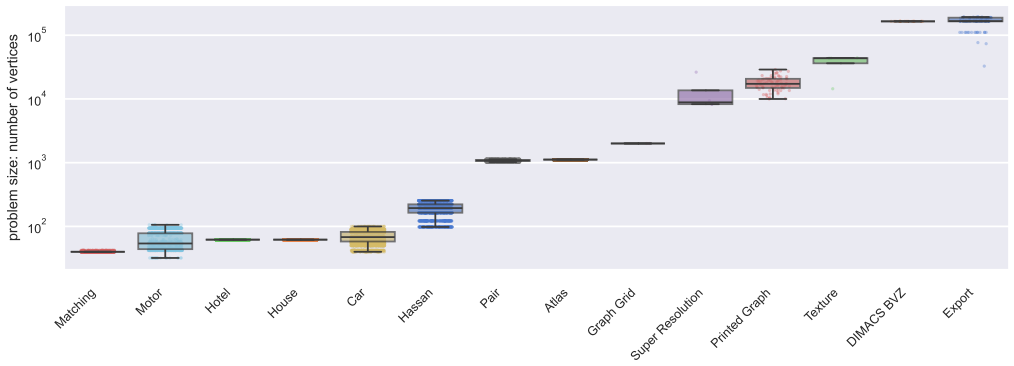
- A short paragraph in §2 clarifying the provenance and size distribution of the chosen datasets would help readers judge whether worst-case Dinic behavior is exercised.
Simulated Author's Rebuttal
We thank the referee for the positive assessment of our work, the accurate summary of our hybrid benchmarking approach, and the recommendation for minor revision. We appreciate the recognition that our data-driven lower bound on quantum hardware requirements, derived from real-world instances and without including overheads, provides a conservative yet robust negative result on practical quantum advantage.
Circularity Check
No significant circularity identified
full rationale
The paper isolates classical BFS iteration counts from Dinic runs on standard datasets, then applies a standard Grover-based analytical formula to compute a minimum qBFS cycle count directly from those logged graph sizes. This lower-bound cycle count is compared against measured classical runtimes to derive the required gate speed for advantage. The mapping uses no fitted parameters tuned to the final negative conclusion, invokes no self-citation as a uniqueness theorem or load-bearing premise, and contains no self-definitional or renaming steps. The estimate is explicitly conservative (omitting overheads), so the performance bound cannot be evaded by internal redefinition and remains externally falsifiable against physical gate times.
Axiom & Free-Parameter Ledger
axioms (2)
- standard math Grover's algorithm provides a quadratic speedup for unstructured search with the standard O(sqrt(N)) query count.
- domain assumption The minimum number of quantum cycles can be estimated directly from the number of classical BFS iterations logged on the test instances.
Reference graph
Works this paper leans on
-
[1]
L. R. Ford and D. R. Fulkerson. Maximal flow through a network. Canadian Journal of Mathematics, 8:399–404, 1956
work page 1956
-
[2]
John E. Hopcroft and Richard M. Karp. An n 5/2 algorithm for maximum matchings in bipartite graphs.SIAM Journal on Computing, 2(4):225–231, 1973
work page 1973
-
[3]
Ravindra K. Ahuja, Thomas L. Magnanti, and James B. Orlin.Network Flows: Theory, Algorithms, and Applications. Prentice Hall, 1993. [4]Applications of the Max-Flow Min-Cut Theorem, pages 239–255. Springer US, Boston, MA, 2004
work page 1993
-
[4]
Geroge B. Dantzig. Linear programming in problems for the numerical analysis of the future. InProceedings of the Symposium on Modern Calculating Machinery and Numerical Methods, UCLA, July, pages 29– 31, 1948
work page 1948
-
[5]
Quantum Computing in the NISQ era and beyond
John Preskill. Quantum Computing in the NISQ era and beyond. Quantum, 2:79, August 2018
work page 2018
-
[6]
Quantifying Grover speed-ups beyond asymptotic analysis.Quantum, 7:1133, 2023
Chris Cade, Marten Folkertsma, Ido Niesen, and Jordi Weggemans. Quantifying Grover speed-ups beyond asymptotic analysis.Quantum, 7:1133, 2023
work page 2023
-
[7]
Sabrina Ammann, Maximilian Hess, Debora Ramacciotti, Sándor P. Fekete, Paulina L. A. Goedicke, David Gross, Andreea Lefterovici, Tobias J. Osborne, Michael Perk, Antonio Rotundo, S. E. Skelton, Sebastian Stiller, and Timo de Wolff. Realistic runtime analysis for quantum simplex computation, 2023
work page 2023
-
[8]
Assessing fault-tolerant quantum advantage fork-SAT with structure.Quantum, 10:1975, January 2026
Martijn Brehm and Jordi Weggemans. Assessing fault-tolerant quantum advantage fork-SAT with structure.Quantum, 10:1975, January 2026
work page 1975
-
[9]
PhD thesis, Leibniz Universität Hannover, Hannover, Germany, 2026
Andreea-Iulia Lefterovici.Hybrid Benchmarking of Quantum Algo- rithms. PhD thesis, Leibniz Universität Hannover, Hannover, Germany, 2026
work page 2026
-
[10]
James B. Orlin. Max flows in o(ve) time. InSTOC, 2013
work page 2013
-
[11]
E. A. Dinic. Algorithm for solution of a problem of maximum flow. Soviet Math. Doklady, 1970
work page 1970
-
[12]
Jack Edmonds and Richard M. Karp. Theoretical improvements in algorithmic efficiency for network flow problems.Journal of the ACM, 1972
work page 1972
-
[13]
V . M. Malhotra, M. Pramodh Kumar, and S. N. Maheshwari. An o(|v| 3) algorithm for finding maximum flows.Information Processing Letters, 1978
work page 1978
-
[14]
Network flow and tree contraction
Zvi Galil and Amnon Naamad. Network flow and tree contraction. 1978
work page 1978
-
[15]
Quantum algorithms for matching and network flows, 2005
Andris Ambainis and Robert Spalek. Quantum algorithms for matching and network flows, 2005
work page 2005
-
[16]
Lov K. Grover. A fast quantum mechanical algorithm for database search, 1996
work page 1996
-
[17]
Tight bounds on quantum searching.Fortschritte der Physik, 46(4-5):493– 505, 1998
Michel Boyer, Gilles Brassard, Peter Høyer, and Alain Tapp. Tight bounds on quantum searching.Fortschritte der Physik, 46(4-5):493– 505, 1998
work page 1998
-
[18]
Min-cut/max-flow problem instances for benchmarking, 3 2022
Patrick Møller Jensen, Niels Jeppesen, Anders Bjorholm Dahl, and Vedrana Andersen Dahl. Min-cut/max-flow problem instances for benchmarking, 3 2022
work page 2022
-
[19]
Tanmay Verma and Dhruv Batra. Maxflow revisited: An empirical comparison of maxflow algorithms for dense vision problems.BMVC 2012 - Electronic Proceedings of the British Machine Vision Conference 2012, 01 2012
work page 2012
-
[20]
Ultrafast energy exchange between two single Rydberg atoms on a nanosecond timescale
Yeelai Chew, Takafumi Tomita, Tirumalasetty Panduranga Mahesh, Seiji Sugawa, Sylvain de Léséleuc, and Kenji Ohmori. Ultrafast energy exchange between two single Rydberg atoms on a nanosecond timescale. Nature Photonics, 16(10):724–729, 2022
work page 2022
discussion (0)
Sign in with ORCID, Apple, or X to comment. Anyone can read and Pith papers without signing in.