Recognition: unknown
Knudsen number as a non-thermal parameter: possible origin of skewness in space plasma distributions
Pith reviewed 2026-05-07 17:36 UTC · model grok-4.3
The pith
The skewness parameter scales proportionally with the Knudsen number in space plasma distributions
A machine-rendered reading of the paper's core claim, the machinery that carries it, and where it could break.
Core claim
By introducing a Krook-like term into the Boltzmann equation to represent collision effects and using the Skew-Kappa distribution to describe the non-thermal electron distribution, the analysis derives expressions for the skewness parameter as a function of plasma parameters and the collision effect, yielding the relation δ ∼ K_N between the skewness parameter and the effective Knudsen number.
What carries the argument
The modified Boltzmann transport equation with a Krook-like collision term applied to the Skew-Kappa distribution, which produces the scaling δ ∼ K_N linking skewness to the effective Knudsen number.
If this is right
- Skewness can serve as a diagnostic for collisionality even in low-density space plasma regimes.
- The derived relation connects microscale distribution asymmetry directly to macroscale plasma transport properties.
- This provides a theoretical basis for interpreting non-Maxwellian features in terms of departure from thermal equilibrium.
Where Pith is reading between the lines
- Spacecraft observations of distribution skewness could be inverted to estimate local Knudsen numbers in the solar wind.
- The scaling might generalize to ion distributions or other astrophysical plasmas with similar near-collisionless conditions.
- Numerical simulations with alternative collision operators could test the robustness of the proportionality.
Load-bearing premise
The Krook-like term accurately represents collision effects in the nearly collisionless solar wind and that the Skew-Kappa distribution is the appropriate functional shape for the non-thermal electron distribution.
What would settle it
If in-situ measurements of solar wind electron velocity distributions show no correlation between the observed skewness parameter and the independently estimated effective Knudsen number.
Figures
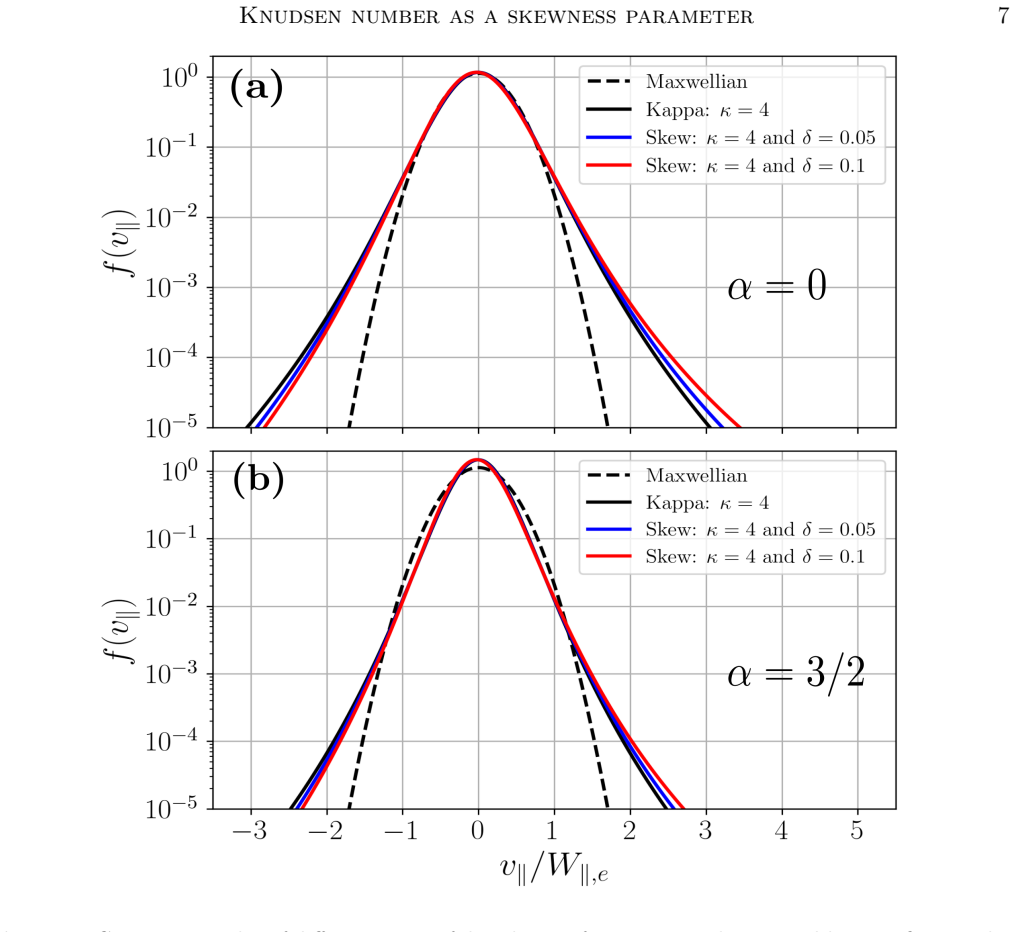


read the original abstract
Non-Maxwellian distributions and their origins in space plasma have attracted significant attention due to their prevalence and impact on various astrophysical and space-related phenomena. This paper presents a theoretical study of the consequences of incorporating a Skew-Kappa distribution to describe the non-thermal electron distribution in the solar wind. By introducing a Krook-like term into the Boltzmann equation to represent collision effects, we investigate the dependence of the skewness parameter on plasma macro-dynamics. Our analysis focuses on understanding the departure from thermal equilibrium and the statistical behavior of the plasma under the influence of collisional processes. By analyzing the Boltzmann transport equation adapted to space plasma, we derive expressions for the skewness parameter as a function of plasma parameters and the collision effect. Our results provide valuable information on the relationship between skewness, collisional dynamics, and the statistical properties of space plasmas, namely $\delta \sim K_N$, the relationship between the skewness parameter and the effective Knudsen number. This study contributes to a deeper understanding of non-Maxwellian distributions and their role in astrophysical and space plasma phenomena.
Editorial analysis
A structured set of objections, weighed in public.
Referee Report
Summary. The paper claims that non-Maxwellian electron distributions in space plasmas such as the solar wind can be described by a Skew-Kappa distribution, and that inserting a Krook-like collision term into the adapted Boltzmann transport equation yields a direct scaling between the skewness parameter δ and the effective Knudsen number K_N, thereby linking skewness to collisional dynamics and macro-scale plasma properties.
Significance. If the scaling is shown to be a genuine dynamical consequence rather than an artifact of the ansatz, the result would supply a concrete non-thermal parameter that connects observed distribution skewness to the degree of collisionality in nearly collisionless plasmas, offering a potentially useful interpretive tool for solar-wind data. The work builds on existing Kappa-distribution literature but its broader impact hinges on demonstrating consistency of the assumed functional form under the full transport operator.
major comments (2)
- [derivation of δ ∼ K_N from adapted Boltzmann equation] The central claim δ ∼ K_N (abstract and the derivation from the Boltzmann equation with Krook term): the scaling appears to follow once the Skew-Kappa ansatz is substituted into the steady-state moment balance, but the manuscript does not demonstrate that this functional form remains approximately preserved when the small collision term is treated perturbatively. In the K_N ≫ 1 regime the Krook operator is weak, so any sustained skewness must be maintained by the space-plasma adaptation terms; without an explicit residual check after substitution, the relation risks being definitional rather than emergent.
- [Boltzmann transport equation with Krook-like term] The choice of the Krook-like operator −ν(f − f_M) to represent collisions (Section on Boltzmann equation adaptation): this operator is known to drive distributions toward Maxwellian, yet the paper retains a Skew-Kappa form with finite δ. The manuscript should show that the residual after inserting δ(K_N) is O(ν) or smaller and does not excite other moments that would invalidate the ansatz at leading order.
minor comments (2)
- [abstract] The abstract is dense and would benefit from a single sentence stating the key modeling assumptions (Skew-Kappa ansatz plus Krook term) before presenting the result.
- [introduction and notation] Notation for the effective Knudsen number K_N and the skewness parameter δ should be defined at first use with explicit reference to the moment definitions used to extract them.
Simulated Author's Rebuttal
We thank the referee for their careful reading and constructive comments on our manuscript. We address each major comment below and outline the revisions we will make to strengthen the analysis.
read point-by-point responses
-
Referee: The central claim δ ∼ K_N (abstract and the derivation from the Boltzmann equation with Krook term): the scaling appears to follow once the Skew-Kappa ansatz is substituted into the steady-state moment balance, but the manuscript does not demonstrate that this functional form remains approximately preserved when the small collision term is treated perturbatively. In the K_N ≫ 1 regime the Krook operator is weak, so any sustained skewness must be maintained by the space-plasma adaptation terms; without an explicit residual check after substitution, the relation risks being definitional rather than emergent.
Authors: We agree that an explicit residual analysis is required to establish that the Skew-Kappa ansatz remains consistent under the perturbative treatment. In the revised manuscript we will add a subsection that substitutes the δ(K_N) scaling back into the adapted Boltzmann equation, performs the perturbative expansion in the weak-collision limit, and verifies that the residual is O(K_N^{-1}) while the space-plasma adaptation terms sustain the skewness moment. This will demonstrate that the reported scaling is a dynamical consequence of the moment balance rather than an artifact of the ansatz. revision: yes
-
Referee: The choice of the Krook-like operator −ν(f − f_M) to represent collisions (Section on Boltzmann equation adaptation): this operator is known to drive distributions toward Maxwellian, yet the paper retains a Skew-Kappa form with finite δ. The manuscript should show that the residual after inserting δ(K_N) is O(ν) or smaller and does not excite other moments that would invalidate the ansatz at leading order.
Authors: We concur that the residual must be shown to remain small and not to drive other moments at leading order. The revised version will contain an explicit calculation of the residual obtained by inserting the Skew-Kappa distribution with δ ∼ K_N into the transport equation. We will demonstrate that this residual is O(ν) and affects primarily the skewness moment, without exciting higher-order moments beyond the perturbative order retained in the analysis. We will also briefly discuss the known limitations of the Krook operator for nearly collisionless plasmas. revision: yes
Circularity Check
No circularity: derivation presented as independent result from Boltzmann+Krook model
full rationale
The abstract states that a Skew-Kappa form is introduced for the electron distribution and a Krook-like collision term is added to the Boltzmann equation, after which expressions for the skewness parameter are derived, yielding the relation δ ∼ K_N. No equations, moment calculations, or steady-state balances are quoted in the provided text that would allow demonstration of a reduction by construction (e.g., δ appearing on both sides of an identity or a fitted parameter relabeled as a prediction). No self-citations, uniqueness theorems, or ansatz smuggling are referenced. The central claim is therefore treated as an output of the adapted transport equation rather than an input, consistent with a self-contained derivation.
Axiom & Free-Parameter Ledger
free parameters (2)
- skewness parameter δ
- effective Knudsen number K_N
axioms (2)
- domain assumption Boltzmann transport equation governs the evolution of the electron distribution in solar wind
- ad hoc to paper Krook-like term is a sufficient representation of collision effects
invented entities (2)
-
Skew-Kappa distribution
no independent evidence
-
effective Knudsen number as non-thermal parameter
no independent evidence
Reference graph
Works this paper leans on
-
[1]
2013, The Astrophysical Journal Letters, 769, L22
Quataert, E. 2013, The Astrophysical Journal Letters, 769, L22
2013
-
[2]
2000, Physica A: Statistical Mechanics and its Applications, 277, 115
Beck, C. 2000, Physica A: Statistical Mechanics and its Applications, 277, 115
2000
-
[3]
S., & Swinney, H
Beck, C., Lewis, G. S., & Swinney, H. L. 2001, Physical Review E, 63, 035303 Berˇ ciˇ c, L., Larson, D., Whittlesey, P., et al. 2020, The Astrophysical Journal, 892, 88
2001
-
[4]
L., Gross, E
Bhatnagar, P. L., Gross, E. P., & Krook, M. 1954, Physical review, 94, 511
1954
-
[5]
2013, Living Reviews in Solar Physics, 10, 1
Bruno, R., & Carbone, V. 2013, Living Reviews in Solar Physics, 10, 1
2013
-
[6]
2018, The Astrophysical Journal Letters, 856, L19
Chasapis, A., Matthaeus, W., Parashar, T., et al. 2018, The Astrophysical Journal Letters, 856, L19
2018
-
[7]
L., Maruca, B., et al
Chhiber, R., Goldstein, M. L., Maruca, B., et al. 2020, The Astrophysical Journal Supplement Series, 246, 31
2020
-
[8]
S., Zenteno-Quinteros, B., & L´ opez, R
Daniel, H., Moya, P. S., Zenteno-Quinteros, B., & L´ opez, R. A. 2024, The Astrophysical Journal, 970, 132
2024
-
[9]
V., Zenteno-Quinteros, Bea, Moya, Pablo S., et al
Eyelade, A. V., Zenteno-Quinteros, Bea, Moya, Pablo S., et al. 2025, A&A, 702, A198, doi: 10.1051/0004-6361/202555368
-
[10]
1978, Journal of Geophysical Research: Space Physics, 83, 5285 Gallo-M´ endez, I., & Moya, P
Feldman, W., Asbridge, J., Bame, S., Gosling, J., & Lemons, D. 1978, Journal of Geophysical Research: Space Physics, 83, 5285 Gallo-M´ endez, I., & Moya, P. S. 2022, Scientific Reports, 12, 1 —. 2023, The Astrophysical Journal, 952, 30
1978
-
[11]
2004, Journal of Geophysical Research: Space Physics, 109
Gosling, J., De Koning, C., Skoug, R., Steinberg, J., & McComas, D. 2004, Journal of Geophysical Research: Space Physics, 109
2004
-
[12]
2020, The Astrophysical Journal Supplement Series, 246, 22
Halekas, J., Whittlesey, P., Larson, D., et al. 2020, The Astrophysical Journal Supplement Series, 246, 22
2020
-
[13]
S., Whittlesey, P
Halekas, J. S., Whittlesey, P. L., Larson, D. E., et al. 2021, Astronomy & Astrophysics, 650, A15
2021
-
[14]
1985, Physical Review Letters, 54, 2608
Hasegawa, A., Mima, K., & Duong-van, M. 1985, Physical Review Letters, 54, 2608
1985
-
[15]
Helander, P., & Sigmar, D. J. 2005, Collisional transport in magnetized plasmas, Vol. 4 (Cambridge university press)
2005
-
[16]
2020, Physics of Plasmas, 27
Husidic, E., Lazar, M., Fichtner, H., Scherer, K., & Astfalk, P. 2020, Physics of Plasmas, 27
2020
-
[17]
2022, The Astrophysical Journal, 927, 159 22Gallo-M ´endez, Vi˜nas, & Moya
Husidic, E., Scherer, K., Lazar, M., Fichtner, H., & Poedts, S. 2022, The Astrophysical Journal, 927, 159 22Gallo-M ´endez, Vi˜nas, & Moya
2022
-
[18]
2023, IEEE Transactions on Plasma Science, 51, 344, doi: 10.1109/TPS.2022.3233808
Jana, B., & Dikshit, B. 2023, IEEE Transactions on Plasma Science, 51, 344, doi: 10.1109/TPS.2022.3233808
-
[19]
2021, Kappa distributions (Springer)
Lazar, M., & Fichtner, H. 2021, Kappa distributions (Springer)
2021
-
[20]
2015, Astronomy & Astrophysics, 582, A124
Lazar, M., Poedts, S., & Fichtner, H. 2015, Astronomy & Astrophysics, 582, A124
2015
-
[21]
2017, Monthly Notices of the Royal Astronomical Society, 464, 564
Lazar, M., Shaaban, S., Poedts, S., & ˇStver´ ak,ˇS. 2017, Monthly Notices of the Royal Astronomical Society, 464, 564
2017
-
[22]
1981, Astrophysical Journal, Part 1, vol
Lin, R., Potter, D., Gurnett, D., & Scarf, F. 1981, Astrophysical Journal, Part 1, vol. 251, Dec. 1, 1981, p. 364-373., 251, 364 L´ opez, R., Lazar, M., Shaaban, S., Poedts, S., &
1981
-
[23]
2020, The Astrophysical Journal Letters, 900, L25 L´ opez, R., Shaaban, S., Lazar, M., et al
Moya, P. 2020, The Astrophysical Journal Letters, 900, L25 L´ opez, R., Shaaban, S., Lazar, M., et al. 2019, The Astrophysical Journal Letters, 882, L8
2020
-
[24]
2005, Journal of Geophysical Research: Space Physics, 110
Maksimovic, M., Zouganelis, I., Chaufray, J.-Y., et al. 2005, Journal of Geophysical Research: Space Physics, 110
2005
-
[25]
A., Qudsi, R
Maruca, B. A., Qudsi, R. A., Alterman, B., et al. 2023, Astronomy & Astrophysics, 675, A196
2023
-
[26]
2016, Physical Review Letters, 116, 245101
Matthaeus, W., Weygand, J., & Dasso, S. 2016, Physical Review Letters, 116, 245101
2016
-
[27]
Nieves-Chinchilla, T., & Vi˜ nas, A. F. 2008, Journal of Geophysical Research: Space Physics, 113
2008
-
[28]
W., Fitzenreiter, R., & Desch, M
Ogilvie, K. W., Fitzenreiter, R., & Desch, M. 2000, Journal of Geophysical Research: Space Physics, 105, 27277
2000
-
[29]
P., De Koning, C
Pagel, C., Gary, S. P., De Koning, C. A., Skoug, R. M., & Steinberg, J. T. 2007, Journal of Geophysical Research: Space Physics, 112
2007
-
[30]
2010, Solar physics, 267, 153
Pierrard, V., & Lazar, M. 2010, Solar physics, 267, 153
2010
-
[31]
1987, Journal of Geophysical Research: Space Physics, 92, 1075
Pilipp, W., Miggenrieder, H., Montgomery, M., et al. 1987, Journal of Geophysical Research: Space Physics, 92, 1075
1987
-
[32]
J., Burch, J
Pollock, C. J., Burch, J. L., Chasapis, A., et al. 2018, Journal of Atmospheric and Solar-Terrestrial Physics, 177, 84
2018
-
[33]
1977, Journal of Geophysics Zeitschrift Geophysik, 42, 561
Rosenbauer, H., Schwenn, R., Marsch, E., et al. 1977, Journal of Geophysics Zeitschrift Geophysik, 42, 561
1977
-
[34]
2003, The Astrophysical Journal, 585, 1147
Salem, C., Hubert, D., Lacombe, C., et al. 2003, The Astrophysical Journal, 585, 1147
2003
-
[35]
2018, Europhysics Letters, 120, 50002
Scherer, K., Fichtner, H., & Lazar, M. 2018, Europhysics Letters, 120, 50002
2018
-
[36]
M., Lazar, M., L´ opez, R
Shaaban, S. M., Lazar, M., L´ opez, R. A., Yoon, P. H., & Poedts, S. 2021, Kappa distributions: From observational evidences via controversial predictions to a consistent theory of nonequilibrium plasmas, 185 ˇStver´ ak,ˇS., Maksimovic, M., Tr´ avn´ ıˇ cek, P. M., et al. 2009, Journal of Geophysical Research: Space Physics, 114 ˇStver´ ak,ˇS., Tr´ avn´ ıˇ...
2021
-
[37]
1988, Journal of statistical physics, 52, 479 Knudsen number as a skewness parameter23
Tsallis, C. 1988, Journal of statistical physics, 52, 479 Knudsen number as a skewness parameter23
1988
-
[38]
Vasyliunas, V. M. 1968, Journal of Geophysical Research, 73, 2839 Vi˜ nas, A. F., Adrian, M. L., Moya, P. S., &
1968
-
[39]
Wendel, D. E. 2015, in AGU Fall Meeting
2015
-
[40]
2015, SH33C–03
Abstracts, Vol. 2015, SH33C–03
2015
-
[41]
2017, Physics of Plasmas, 24, 102305
Wang, L., & Du, J. 2017, Physics of Plasmas, 24, 102305
2017
-
[42]
2018, Physics of Plasmas, 25, 062309
Wang, Y., & Du, J. 2018, Physics of Plasmas, 25, 062309
2018
-
[43]
Zenteno-Quinteros, B., & Moya, P. S. 2022, Frontiers in Physics, 10, doi: 10.3389/fphy.2022.910193
-
[44]
S., Lazar, M., Vi˜ nas, A
Zenteno-Quinteros, B., Moya, P. S., Lazar, M., Vi˜ nas, A. F., & Poedts, S. 2023, The Astrophysical Journal, 954, 184
2023
-
[45]
Zenteno-Quinteros, B., Vi˜ nas, A. F., & Moya, P. S. 2021, The Astrophysical Journal, 923, 180, doi: 10.3847/1538-4357/ac2f9c
discussion (0)
Sign in with ORCID, Apple, or X to comment. Anyone can read and Pith papers without signing in.