Recognition: unknown
Chapman-Enskog calculation of the shear viscosity of quark-gluon plasma including all 2leftrightarrow 2 scatterings at finite temperature
Pith reviewed 2026-05-07 17:20 UTC · model grok-4.3
The pith
The shear viscosity of quark-gluon plasma follows from all 2 to 2 scatterings via a Chapman-Enskog expansion with screened cross sections.
A machine-rendered reading of the paper's core claim, the machinery that carries it, and where it could break.
Core claim
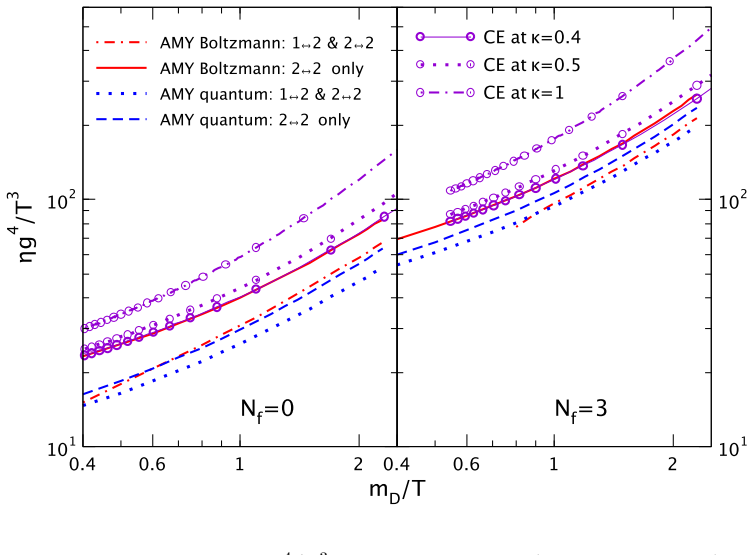
We use the Chapman-Enskog method to derive an analytical expression for the shear viscosity eta of a massless quark-gluon gas at chemical equilibrium with Boltzmann statistics that includes all 2 to 2 scatterings with arbitrary cross sections. When this expression is applied to cross sections from perturbative QCD screened with scaled thermal masses square root of kappa times m sub D and square root of kappa times m sub F, the values of eta g to the fourth over T cubed as a function of m sub D over T at kappa equals 1 are qualitatively similar to but higher than leading-order results from other methods. Setting kappa equals 0.4 yields good agreement, which incorporates the effect of using a1
What carries the argument
The closed-form analytical expression for the shear viscosity in terms of the integrals over the 2 to 2 scattering cross sections.
Load-bearing premise
That scaling the thermal masses by a constant factor of 0.4 properly accounts for the distinction between using thermal masses and using full self-energies to screen the scattering cross sections, along with the assumptions of Boltzmann statistics and chemical equilibrium.
What would settle it
A calculation of the shear viscosity at the QCD transition temperature that uses the complete self-energy expressions in the scattering amplitudes without any scaling adjustment, which would either confirm or contradict the value of 0.15 for the viscosity-to-entropy ratio.
Figures





read the original abstract
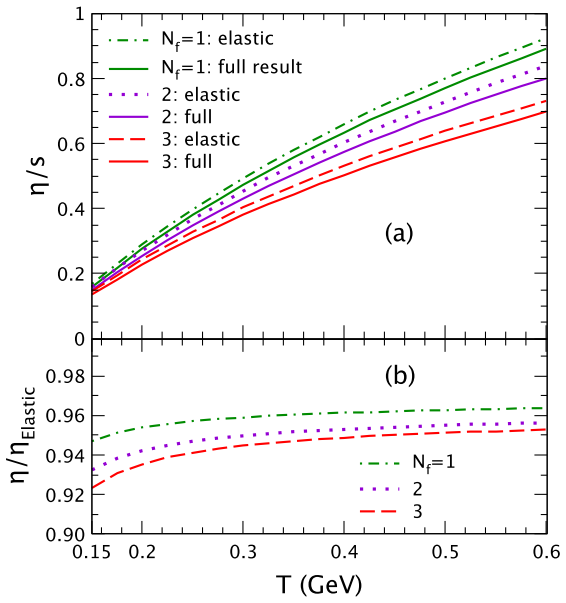
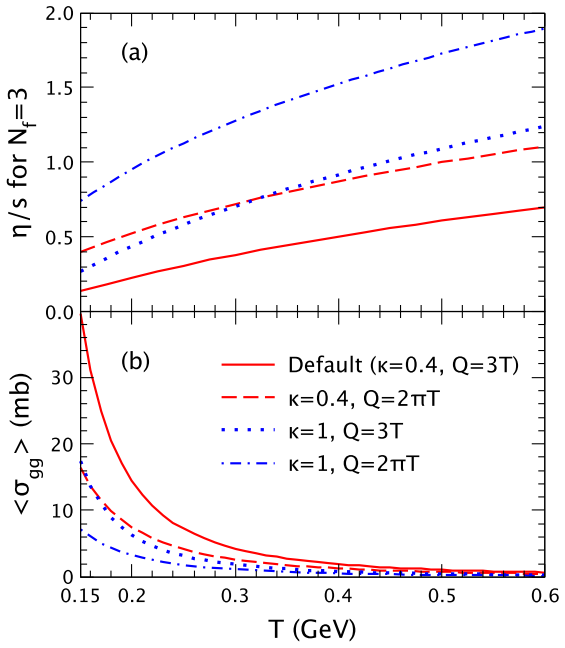
We use the Chapman-Enskog method to investigate the shear viscosity of the quark-gluon plasma with a focus on its relation to parton cross sections. We use the recently obtained analytical expression for the shear viscosity $\eta$ of a massless quark-gluon gas at chemical equilibrium with Boltzmann statistics and all $2\leftrightarrow 2$ scatterings with arbitrary cross sections. Here we apply this general expression to cross sections at finite temperature that are based on perturbative-QCD and screened with scaled thermal masses $\sqrt{\kappa}\,m_D$ and $\sqrt{\kappa}\,m_F$. We find that the Chapman-Enskog results on $\eta \, g^4/T^3$ versus $m_D/T$ at $\kappa=1$ are qualitatively similar to but higher than the corresponding leading-order results from the AMY framework. We then find that using $\kappa=0.4$ allows the Chapman-Enskog results to match well the corresponding AMY results as it includes the effect of using thermal masses (instead of self-energies) to screen the cross sections. In addition, we show that the shear viscosity-to-entropy density ratio $\eta/s$ is very sensitive to the choice of momentum scale $Q$ in the strong coupling, where the choice of $Q=3T$ leads to $\eta/s \sim 0.15$ for $N_f=0$ or 3 at the QCD phase transition temperature $T_c$. These results lay the foundation for mapping parton cross sections to given shear viscosity in parton transport models and QCD effective kinetic theory.
Editorial analysis
A structured set of objections, weighed in public.
Referee Report
Summary. The paper applies a recently derived analytical Chapman-Enskog expression for the shear viscosity η of a massless quark-gluon gas (Boltzmann statistics, chemical equilibrium, all 2↔2 scatterings with arbitrary cross sections) to finite-temperature pQCD matrix elements screened by scaled thermal masses √κ m_D and √κ m_F. It reports that the resulting η g⁴/T³ versus m_D/T curves at κ=1 lie above leading-order AMY results, but that κ=0.4 produces good numerical agreement; it further shows that η/s is highly sensitive to the renormalization scale Q in α_s(Q), with the specific choice Q=3T yielding η/s ∼ 0.15 at T_c for N_f=0 or 3.
Significance. If the scaling procedure can be placed on a firmer footing, the work supplies a practical, semi-analytic route from parton cross sections to transport coefficients that can be directly imported into parton transport models and effective kinetic theory. The reuse of the closed-form CE formula avoids repeated numerical integrations over scattering angles and is therefore computationally efficient. The explicit demonstration of strong Q-dependence also usefully quantifies an often-understated uncertainty in perturbative calculations of η/s near T_c.
major comments (3)
- [Results section (comparison to AMY)] The central numerical agreement with AMY is obtained only after setting κ=0.4; the text states that κ=1 produces values that are 'qualitatively similar but higher' and then selects κ=0.4 to achieve the match. No independent derivation from the difference between thermal-mass propagators and full finite-T self-energy insertions is supplied, so the agreement is achieved by construction rather than predicted.
- [Method and screening prescription] The assumption that a constant rescaling √κ of both m_D and m_F in the t-channel denominators faithfully reproduces the effect of replacing thermal masses by self-energies is introduced without supporting calculation or reference to an explicit self-energy evaluation. This step is load-bearing for the claim that the CE results 'include the effect of using thermal masses (instead of self-energies)'.
- [η/s results and scale dependence] The reported value η/s ∼ 0.15 at T_c is obtained exclusively with the ad-hoc choice Q=3T; the text itself notes the strong sensitivity to Q, yet provides no first-principles argument or matching condition that fixes Q=3T over other plausible scales (e.g., 2T or πT). Because the central phenomenological statement depends on this choice, the result remains conditional on an arbitrary parameter.
minor comments (2)
- [Abstract and figures] The abstract and main text present comparisons to AMY without error bands or uncertainty estimates arising from the numerical evaluation of the CE integrals or from the running of α_s.
- [Introduction and setup] The use of Boltzmann statistics and the assumption of chemical equilibrium for the parton distributions are stated but not quantified; a brief estimate of the size of quantum-statistics corrections or chemical-potential effects at the temperatures of interest would strengthen the applicability statement.
Simulated Author's Rebuttal
We thank the referee for the careful reading and constructive comments on our manuscript. We address each major comment below and indicate planned revisions.
read point-by-point responses
-
Referee: [Results section (comparison to AMY)] The central numerical agreement with AMY is obtained only after setting κ=0.4; the text states that κ=1 produces values that are 'qualitatively similar but higher' and then selects κ=0.4 to achieve the match. No independent derivation from the difference between thermal-mass propagators and full finite-T self-energy insertions is supplied, so the agreement is achieved by construction rather than predicted.
Authors: We acknowledge that κ=0.4 is selected to achieve quantitative agreement with the AMY results, as explicitly stated in the manuscript. This scaling is motivated by the fact that thermal masses in the propagators provide an approximation to the screening from full self-energies, with √κ adjusting for the difference in the t-channel denominators. While we do not supply a new first-principles derivation of the specific numerical value in this work, the choice allows direct comparison between the Chapman-Enskog expression and established AMY results. In the revised manuscript we will expand the discussion to better motivate the value of κ=0.4 and cite relevant literature on similar scaling procedures used in transport calculations. revision: partial
-
Referee: [Method and screening prescription] The assumption that a constant rescaling √κ of both m_D and m_F in the t-channel denominators faithfully reproduces the effect of replacing thermal masses by self-energies is introduced without supporting calculation or reference to an explicit self-energy evaluation. This step is load-bearing for the claim that the CE results 'include the effect of using thermal masses (instead of self-energies)'.
Authors: The scaled thermal-mass prescription is a standard phenomenological approach in the literature for screening pQCD matrix elements at finite temperature. We will add references to prior works that employ analogous rescaling factors for m_D and m_F in the revised version. We do not claim to have performed a new self-energy evaluation here; the scaling serves as a practical means to incorporate medium effects while using the closed-form Chapman-Enskog formula. revision: partial
-
Referee: [η/s results and scale dependence] The reported value η/s ∼ 0.15 at T_c is obtained exclusively with the ad-hoc choice Q=3T; the text itself notes the strong sensitivity to Q, yet provides no first-principles argument or matching condition that fixes Q=3T over other plausible scales (e.g., 2T or πT). Because the central phenomenological statement depends on this choice, the result remains conditional on an arbitrary parameter.
Authors: We agree that Q=3T is a specific choice and that the manuscript already emphasizes the strong sensitivity of η/s to the renormalization scale. In the revision we will make this conditional nature more explicit by stating that η/s ∼ 0.15 corresponds to Q=3T and by adding a short discussion or table illustrating the range of values obtained for other plausible scales (e.g., 2T to 4T). This will clarify the uncertainty without altering the central numerical result. revision: yes
Circularity Check
κ=0.4 is tuned to force agreement with AMY; the reported match reduces to a fitted parameter rather than an independent result from the Chapman-Enskog derivation
specific steps
-
fitted input called prediction
[Abstract]
"We then find that using κ=0.4 allows the Chapman-Enskog results to match well the corresponding AMY results as it includes the effect of using thermal masses (instead of self-energies) to screen the cross sections."
The numerical factor κ=0.4 is introduced and selected after observing that κ=1 produces higher values; it is tuned until the CE output reproduces the AMY leading-order curve. The paper therefore presents the match as a finding that validates the scaling approximation, yet the match is guaranteed once κ is adjusted to that end. No independent derivation of the numerical value 0.4 from the finite-temperature self-energy is supplied.
full rationale
The paper derives a general analytical expression for η in a massless QGP with arbitrary 2↔2 cross sections and then applies it to pQCD cross sections screened by scaled thermal masses √κ m_D and √κ m_F. The central comparison to AMY is achieved only after selecting κ=0.4 specifically so that the numerical values of η g⁴/T³ versus m_D/T align; the text presents this alignment as evidence that the scaling 'includes the effect' of using thermal masses instead of full self-energies. Because κ is not derived from the self-energy but chosen to reproduce the target result, the agreement is forced by construction and does not constitute an independent validation of the approximation. The additional sensitivity of η/s to the arbitrary scale Q in α_s(Q) is noted but does not itself create circularity. The remainder of the derivation (Boltzmann statistics, chemical equilibrium, and the CE integral) is self-contained and does not reduce to the fitted inputs.
Axiom & Free-Parameter Ledger
free parameters (2)
- κ =
0.4
- Q =
3T
axioms (3)
- domain assumption Partons obey Boltzmann statistics
- domain assumption Partons are massless
- domain assumption Chemical equilibrium
Reference graph
Works this paper leans on
-
[1]
17s s+µ 2 D + 12s µ2 D −12 ln 1 + s µ2 D # ,(28) σgq = g4 144πs
lead to cross sections that either diverge at allsor diverge ass→0. For example, the 1/(s t) term in|M q¯q|2 0 of Eq.(16) leads to a R 0 −s dt/tterm inσ q¯q that makes it divergent at all s, while|M gg|2 0 of Eq.(13) leads toσ gg ∝1/sat smallsthat diverges ass→0. Since a main purpose of this study is to allow finite-temperature parton cross sections to be...
-
[2]
Zhang, Comput
B. Zhang, Comput. Phys. Commun.109, 193 (1998)
1998
-
[3]
Z.-W. Lin, C. M. Ko, B.-A. Li, B. Zhang, and S. Pal, Phys. Rev. C72, 064901 (2005)
2005
-
[4]
Xu and C
Z. Xu and C. Greiner, Phys. Rev. Lett.100, 172301 (2008)
2008
-
[5]
Cassing and E
W. Cassing and E. L. Bratkovskaya, Nucl. Phys. A831, 215 (2009)
2009
-
[6]
Plumari, W
S. Plumari, W. M. Alberico, V. Greco, and C. Ratti, Phys. Rev. D84, 094004 (2011)
2011
-
[7]
Kurkela, R
A. Kurkela, R. T¨ ornkvist, and K. Zapp, Eur. Phys. J. C84, 74 (2024)
2024
-
[8]
Y. Nara, A. Jinno, T. Maruyama, K. Murase, and A. Ohnishi, Phys. Rev. C108, 024910 (2023)
2023
-
[9]
Kurkela, A
A. Kurkela, A. Mazeliauskas, J.-F. Paquet, S. Schlichting, and D. Teaney, Phys. Rev. C99, 034910 (2019)
2019
-
[10]
L. P. Csernai, J. I. Kapusta, and L. D. McLerran, Phys. Rev. Lett.97, 152303 (2006)
2006
-
[11]
J. E. Bernhard, J. S. Moreland, and S. A. Bass, Nature Phys.15, 1113 (2019)
2019
-
[12]
L. He, T. Edmonds, Z.-W. Lin, F. Liu, D. Molnar, and F. Wang, Phys. Lett. B753, 506 18 (2016)
2016
-
[13]
Z.-W. Lin, L. He, T. Edmonds, F. Liu, D. Molnar, and F. Wang, Nucl. Phys. A956, 316 (2016)
2016
-
[14]
Kurkela, U
A. Kurkela, U. A. Wiedemann, and B. Wu, Phys. Lett. B783, 274 (2018)
2018
-
[15]
P. B. Arnold, G. D. Moore, and L. G. Yaffe, JHEP11, 001 (2000)
2000
-
[16]
Policastro, D
G. Policastro, D. T. Son, and A. O. Starinets, Phys. Rev. Lett.87, 081601 (2001)
2001
-
[17]
P. B. Arnold, G. D. Moore, and L. G. Yaffe, JHEP05, 051 (2003)
2003
-
[18]
Kovtun, D
P. Kovtun, D. T. Son, and A. O. Starinets, Phys. Rev. Lett.94, 111601 (2005)
2005
-
[19]
H. B. Meyer, Phys. Rev. D76, 101701 (2007)
2007
-
[20]
Ghiglieri, G
J. Ghiglieri, G. D. Moore, and D. Teaney, JHEP03, 179 (2018)
2018
- [21]
-
[22]
Bazavov et al
A. Bazavov et al. (HotQCD), Phys. Lett. B795, 15 (2019)
2019
-
[23]
R. L. Workman et al. (Particle Data Group), PTEP2022, 083C01 (2022)
2022
-
[24]
Blaizot, Nucl
J.-P. Blaizot, Nucl. Phys. A702, 99 (2002)
2002
-
[25]
Laine and Y
M. Laine and Y. Schroder, JHEP03, 067 (2005)
2005
-
[26]
Ohanaka, Master’s thesis at http://hdl.handle.net/10342/14092 (2025)
O. Ohanaka, Master’s thesis at http://hdl.handle.net/10342/14092 (2025)
2025
-
[27]
Huovinen and D
P. Huovinen and D. Molnar, Phys. Rev. C79, 014906 (2009)
2009
-
[28]
N. M. MacKay and Z.-W. Lin, Eur. Phys. J. C82, 918 (2022)
2022
-
[29]
E. W. Kolb and S. Raby, Phys. Rev. D27, 2990 (1983)
1983
-
[30]
G. D. Moore, private communications (2025)
2025
-
[31]
D. A. Teaney,Viscous Hydrodynamics and the Quark Gluon Plasma(2010), pp. 207–266
2010
-
[32]
P. B. Gossiaux and J. Aichelin, Phys. Rev. C78, 014904 (2008)
2008
-
[33]
Plumari, A
S. Plumari, A. Puglisi, F. Scardina, and V. Greco, Phys. Rev. C86, 054902 (2012). 19
2012
discussion (0)
Sign in with ORCID, Apple, or X to comment. Anyone can read and Pith papers without signing in.