Recognition: unknown
Quasilinear flux model consistent with gyrokinetic ordering
Pith reviewed 2026-05-07 17:25 UTC · model grok-4.3
The pith
A quasilinear flux model sets saturation via multiscale gyrokinetic ordering and reproduces nonlinear ion energy fluxes when ion and electron temperature gradients are comparable.
A machine-rendered reading of the paper's core claim, the machinery that carries it, and where it could break.
Core claim
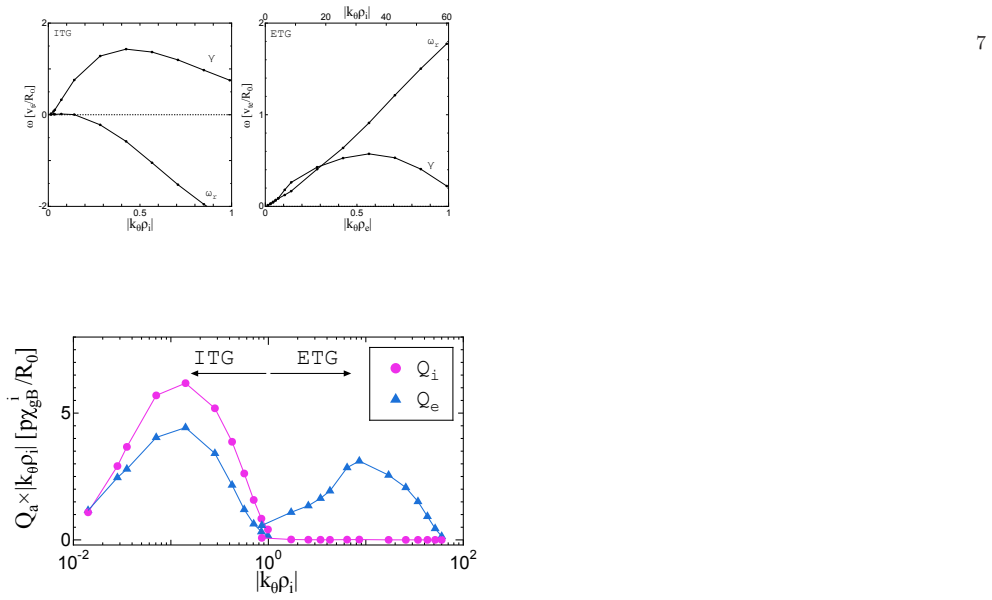
We propose a quasilinear flux model in which the saturation amplitude is uniquely determined using multiscale gyrokinetic ordering relations. The model is fully self-contained within a linear framework and does not rely on calibration against nonlinear simulations or mixing-length estimates. The wavenumber-dependent flux is given in ion gyro-Bohm units with a weighting factor of |k_θ ρ_i|, such that its area integral in the log-linear scale yields the total flux. In systems with comparable ion and electron temperature gradients, the QL ion energy flux reproduces nonlinear simulation results in both its wavenumber dependence and absolute magnitude. We argue that the relation Q_i ~ Q_e, as a閉結
What carries the argument
The quasilinear flux model whose saturation amplitude is fixed by multiscale gyrokinetic ordering relations, yielding wavenumber-dependent fluxes weighted by |k_θ ρ_i| whose log-linear integral equals the total transport.
Where Pith is reading between the lines
- If the flux-conservation assumption holds, the model could allow rapid estimates of total heat transport across wide parameter ranges without full nonlinear runs.
- The persistent electron-scale dominance in the linear QL electron flux points to missing nonlinear mechanisms that shift activity to ion scales in simulations.
- Applying the same ordering-derived saturation to unequal gradient cases would test where linear QL remains predictive and where cascade physics must be added.
Load-bearing premise
The saturation amplitude is uniquely fixed by multiscale gyrokinetic ordering relations and the area-integrated flux is conserved during the nonlinear energy cascade.
What would settle it
A nonlinear gyrokinetic simulation with equal ion and electron temperature gradients whose ion energy flux spectrum or magnitude deviates from the quasilinear prediction would falsify the central claim.
Figures



read the original abstract
We propose a quasilinear (QL) flux model in which the saturation amplitude is uniquely determined using multiscale gyrokinetic ordering relations. The model is fully self-contained within a linear framework and does not rely on calibration against nonlinear simulations or mixing-length estimates. The wavenumber-dependent flux is given in ion gyro-Bohm units with a weighting factor of $|k_\theta \rho_i|$, such that its area integral in the log-linear scale yields the total flux, as employed in multiscale simulations. In systems with comparable ion and electron temperature gradients, the QL ion energy flux reproduces nonlinear simulation results in both its wavenumber dependence and absolute magnitude. In contrast, the QL electron flux is predominantly generated at electron scales, indicating that the shift of electron-scale transport toward ion scales observed in nonlinear Gsimulations is not captured within the present linear framework. We argue that the relation $Q_i\sim Q_e$, obtained as a closed conclusion of the QL model, may be predictive of simulation results if the area-integrated flux is conserved in nonlinear energy cascade process.
Editorial analysis
A structured set of objections, weighed in public.
Referee Report
Summary. The manuscript proposes a quasilinear (QL) flux model for gyrokinetic plasma turbulence in which the saturation amplitude is fixed uniquely by multiscale gyrokinetic ordering relations, rendering the model self-contained within the linear framework with no free parameters or calibration to nonlinear simulations. The wavenumber-dependent flux is expressed in ion gyro-Bohm units using a |k_θ ρ_i| weighting factor whose area integral on a log-linear scale recovers the total flux. For comparable ion and electron temperature gradients, the QL ion energy flux is reported to match nonlinear simulation results in both spectral shape and absolute magnitude, while the QL electron flux remains dominated by electron scales and does not reproduce the nonlinear shift of transport to ion scales. The authors conditionally conclude that the relation Q_i ~ Q_e may be predictive provided the area-integrated flux is conserved through the nonlinear energy cascade.
Significance. If the ordering relations can be shown to fix the saturation amplitude exactly and without hidden nonlinear assumptions, the model would represent a meaningful advance toward parameter-free transport predictions that respect gyrokinetic ordering. The explicit avoidance of mixing-length estimates and calibration, together with direct magnitude comparisons in gyro-Bohm units, are strengths that could reduce reliance on expensive nonlinear runs for multiscale cases.
major comments (2)
- [Abstract] Abstract: The central claim that the saturation amplitude is 'uniquely determined using multiscale gyrokinetic ordering relations' and produces an absolute magnitude match requires an explicit derivation showing how the ordering supplies a numerical prefactor rather than a scaling relation (e.g., |φ_k| ~ γ/k_⊥). Without this step, it is unclear whether the reported agreement with nonlinear ion flux is achieved without implicit calibration or cascade assumptions.
- [Abstract] Abstract (final paragraph): The statement that Q_i ~ Q_e 'may be predictive of simulation results if the area-integrated flux is conserved in nonlinear energy cascade process' introduces an external hypothesis about flux conservation during the cascade. This conservation is not derived from the linear ordering relations and is presented only conditionally, which undercuts the assertion that the model is fully self-contained within the linear framework.
minor comments (2)
- [Abstract] Abstract: 'nonlinear Gsimulations' is presumably a typographical error for 'nonlinear gyrokinetic simulations'; please correct.
- [Abstract] Abstract: The precise meaning of the '|k_θ ρ_i|' weighting factor and how its log-linear area integral yields the total flux should be stated more explicitly, ideally with reference to the relevant equation in the main text.
Simulated Author's Rebuttal
We thank the referee for the careful reading and constructive comments on our manuscript. We address each major comment below and have revised the abstract and added an explicit derivation to clarify the model's foundations.
read point-by-point responses
-
Referee: [Abstract] Abstract: The central claim that the saturation amplitude is 'uniquely determined using multiscale gyrokinetic ordering relations' and produces an absolute magnitude match requires an explicit derivation showing how the ordering supplies a numerical prefactor rather than a scaling relation (e.g., |φ_k| ~ γ/k_⊥). Without this step, it is unclear whether the reported agreement with nonlinear ion flux is achieved without implicit calibration or cascade assumptions.
Authors: We agree that an explicit step-by-step derivation is needed to show how the multiscale gyrokinetic ordering fixes both the scaling and the numerical prefactor for the saturation amplitude. In the manuscript the amplitude is obtained by equating the linear growth rate to the nonlinear E×B decorrelation rate under the gyrokinetic ordering that separates ion and electron scales, with the resulting |φ_k| normalized directly in ion gyro-Bohm units and weighted by |k_θ ρ_i|. To remove any ambiguity we have added a new subsection (Section 3.2) that derives the prefactor from the ordering relations alone, without mixing-length assumptions or calibration to nonlinear data. This derivation confirms that the reported match to the nonlinear ion flux magnitude follows directly from the linear framework. revision: yes
-
Referee: [Abstract] Abstract (final paragraph): The statement that Q_i ~ Q_e 'may be predictive of simulation results if the area-integrated flux is conserved in nonlinear energy cascade process' introduces an external hypothesis about flux conservation during the cascade. This conservation is not derived from the linear ordering relations and is presented only conditionally, which undercuts the assertion that the model is fully self-contained within the linear framework.
Authors: The referee is correct that conservation of the area-integrated flux through the nonlinear cascade is an empirical feature of the simulations and is not derived from the linear ordering relations. The QL model itself remains fully self-contained: it computes Q_i(k) and Q_e(k) independently from linear eigenmodes and the ordering-derived amplitudes. The conditional phrasing was meant only to indicate a possible link to simulation results. We have revised the abstract to state the self-contained nature of the model first and to present the Q_i ~ Q_e relation as its direct output, while moving the cascade-conservation remark to a separate sentence that does not qualify the model's internal consistency. revision: yes
Circularity Check
No significant circularity; derivation self-contained in linear ordering framework
full rationale
The paper states that the saturation amplitude is uniquely determined from multiscale gyrokinetic ordering relations inside a linear framework, with no calibration against nonlinear simulations or mixing-length estimates. The reproduction of nonlinear ion energy flux (both wavenumber dependence and magnitude) is presented as an output validation rather than an input to the model construction. The Qi ~ Qe relation is derived as a closed conclusion conditional on area-integrated flux conservation during the nonlinear cascade, which is not asserted as proven within the linear model but offered as a possible predictive implication. No equations or steps in the abstract reduce the target flux result to a fitted parameter or self-citation by construction; the ordering relations supply the amplitude without evident re-use of the nonlinear target data. This satisfies the criteria for a self-contained derivation.
Axiom & Free-Parameter Ledger
axioms (2)
- domain assumption Multiscale gyrokinetic ordering relations uniquely determine the QL saturation amplitude
- domain assumption Area-integrated flux is conserved in the nonlinear energy cascade
Reference graph
Works this paper leans on
-
[1]
28 here) is a numerical value close to the normal- ized wavenumber at which the growth rates of ITG and ETG attain their maximum. This reflects the generally larger normalized growth rate of ITG modes, which are coupled to trapped electron dynamics, compared with ETG modes, for which the adiabatic-ion approxima- tion is typically valid. On the other hand, ...
-
[2]
Horton, Rev
W. Horton, Rev. Mod. Phys. 71, 735 (1999)
1999
-
[3]
J. W. Connor and H. R. Wilson, Plasma Phys. Control. Fusion 42, 735 (2000)
2000
-
[4]
Staebler, C
G. Staebler, C. Bourdelle, J. Citrin, and R. Waltz, Nucl. Fusion 64, 103001 (2024)
2024
-
[5]
Rewoldt, W
G. Rewoldt, W. M. Tang, and R. J. Hastie, Phys. Fluids 30, 8078 (1987)
1987
-
[6]
Romanelli, Phys
F. Romanelli, Phys. Fluids B 1 , 1018 (1989)
1989
-
[7]
R. E. Waltz, G. M. Staebler, G. W. Hammett, M. Kotschenreuther, and J. A. Konings, Phys. Plasmas 4, 2482 (1997)
1997
-
[8]
Staebler, J
G. Staebler, J. Kinsey, and R. Waltz, Phys. Plasmas 12, 102508 (2005)
2005
-
[9]
Jenko, T
F. Jenko, T. Dannert, and C. Angioni, Plasma Phys. Control. Fusion 47, B195 (2005)
2005
-
[10]
Bourdelle, X
C. Bourdelle, X. Garbet, F. Imbeaux, A. Casati, N. Dubuit, R. Guirlet, and T. Parisot, Phys. Plasmas 14, 112501 (2007)
2007
-
[11]
Citrin, C
J. Citrin, C. Bourdelle, P. Cottier, D. F. Escande, O. D. Gurcan, D. R. Hatch, G. M. D. Hogeweij, F. Jenko, and M. J. Pueschel, Phys. Plasmas 19, 062305 (2012)
2012
-
[12]
Fransson, H
E. Fransson, H. Nordman, P. Strand, and J. Contribu- tors, Phys. Plasmas 29, 112305 (2022)
2022
-
[13]
Stephens, J
C. Stephens, J. Citrin, K. van de Plassch, C. Bourdell, T. Tala, A. Salmi, and F. Jenko, J. Plasma Phys. 90, 905900618 (2024)
2024
-
[14]
Giacomin, D
M. Giacomin, D. Dickinson, W. Dorland, N. R. Mandell, A. Bokshi, F. Casson, H. Dudding, D. Kennedy, B. S. Patel, and C. Roach, J. Plasma Phys. 01, E16 (2025)
2025
-
[15]
A. J. Brizard and T. S. Hahm, Rev. Mod. Phys. 79, 421 (2007)
2007
-
[16]
E. A. Frieman and L. Chen, Phys. Fluids 25, 502 (1982)
1982
-
[17]
G¨ orler and F
T. G¨ orler and F. Jenko, Phys. Rev. Lett. 100, 185002 (2008)
2008
-
[18]
G¨ orler and F
T. G¨ orler and F. Jenko, Phys. Plasmas15, 102508 (2008)
2008
-
[19]
N. T. Howard, C. Holland, A. E. White, M. Greenwald, and J. Candy, Phys. Plasmas 21, 112510 (2014)
2014
-
[20]
J. B. Taylor and R. J. Hastie, Plasma Phys. 10, 479 (1968)
1968
-
[21]
P. J. Catto, W. M. Tang, and D. E. Baldwin, Plasma Phys. 23, 639 (1981)
1981
-
[22]
Rewoldt, W
G. Rewoldt, W. M. Tang, and M. S. Chance, Phys. Fluids 25, 480 (1982)
1982
-
[23]
R. D. Hazeltine and J. D. Meiss, Plasma Confinement (Dover Publications, 1991)
1991
-
[24]
Yamagishi, Phys
O. Yamagishi, Phys. Plasmas 31, 102502 (2024)
2024
-
[25]
Dorland, F
W. Dorland, F. Jenko, M. Kotschenreuther, and B. N. Rogers, Phys. Rev. Lett 85, 5579 (2000)
2000
-
[26]
Z. Lin, T. S. Hahm, W. W. L. W. M. Tang, and R. B. White, Science 281, 1835 (1998)
1998
-
[27]
A. M. Dimits, G. Bateman, M. A. Beer, B. I. Cohen, W. Dorland, G. W. Hammett, C. Kim, J. E. Kinsey, M. Kotschenreuther, A. H. Kritz, L. L. Lao, J. Man- drekas, W. M. Nevins, S. E. Parker, A. J. Redd, D. E. Shumaker, R. Sydora, and J. Weiland, Phys. Plasmas 7, 969 (2000)
2000
-
[28]
B. N. Rogers, W. Dorland, and M. Kotschenreuther, Phys. Rev. Lett 25, 5336 (2000)
2000
-
[29]
Jenko, W
F. Jenko, W. Dorland, M. Kotschenreuther, and B. N. Rogers, Phys. Plasmas 7, 1904 (2000)
1904
-
[30]
W. M. Nevins, S. E. Parker, Y. Chen, J. Candy, A. Dim- its, W. Dorland, G. W. Hammett, and F. Jenko, Phys. Plasmas 14, 084501 (2007)
2007
-
[31]
R. E. Waltz, J. Candy, and M. Fahey, Phys. Plasmas 14, 056116 (2007)
2007
-
[32]
Candy, R
J. Candy, R. E. Waltz, M. R. Fahey, and C. Holland, Plasma Phys. Control. Fusion 49, 1209 (2007)
2007
-
[33]
Yamagishi, N
O. Yamagishi, N. Nakajima, H. Sugama, and Y. Naka- mura, J. Plasma Fusion Res. 6, 222 (2004)
2004
-
[34]
J. W. Connor, R. J. Hastie, and J. B. Taylor, Phys. Rev. Lett 40, 396 (1978)
1978
-
[35]
Yamagishi, Plasma Phys
O. Yamagishi, Plasma Phys. Control. Fusion 60, 045009 (2018)
2018
-
[36]
Staebler, N
G. Staebler, N. T. Howard, J. Candy, J. E. Kinsey, and C. Holland, Nucl. Fusion 57, 066046 (2017)
2017
-
[37]
A. J. Creely, P. Rodriguez-Fernandez, G. D. Conway, S. J. Freethy, N. T. Howard, A. E. White, and the AS- DEX Upgrade Team, Plasma Phys. Control. Fusion 61, 085022 (2019)
2019
-
[38]
I. G. Abel, G. G. Plunk, E. Wang, M. Barnes, S. C. Cowley, W. Dorland, and A. A. Schekochihin, Rep. Prog. Phys. 76, 116201 (2013)
2013
-
[39]
T. S. Hahm, P. H. Diamond, Z. Lin, K. Itoh, and S.-I. Itoh, Plasma Phys. Control. Fusion 46, A323 (2004)
2004
-
[40]
S. P. Hirshman and J. C. Whitson, Phys. Fluids 26, 3553 (1983)
1983
-
[41]
J. E. Kinsey, R. E. Waltz, and J. Candy, Phys. Plasmas 14, 102306 (2007)
2007
-
[42]
Holland, N
C. Holland, N. Howard, and B. Grierson, Nucl. Fusion 57, 066043 (2017)
2017
-
[43]
Howard, C
N. Howard, C. Holland, T. Rhodes, J. Candy, P. Rodriguez-Fernandez, M. Greenwald, A. White, and 6 F. Sciortino, Nucl. Fusion 61, 106002 (2021)
2021
-
[44]
Creely, T
A. Creely, T. G¨ orler, G. Conway, S. Freethy, N. Howard, P. Schneider, A. White, M. Willensdorfer, and T. A. U. Team, Nucl. Fusion 58, 126001 (2018). 10 - 1 100 101 10 2 0 1 2 |kθρi| γ / ω* ETG TEM ITG 10-1 100 101 102 -2 0 2 |kθρi| ωr ω* ITG ETG TEM FIG. 1. Growth rates γ (left) and real frequencies ω r (right) as functions of the normalized wavenum ber...
2018
discussion (0)
Sign in with ORCID, Apple, or X to comment. Anyone can read and Pith papers without signing in.