Recognition: unknown
Influence of Heterogeneity on the Response of Architected Metamaterials
Pith reviewed 2026-05-07 16:21 UTC · model grok-4.3
The pith
Heterogeneity fundamentally changes phase nucleation and macroscopic response in architected metamaterials.
A machine-rendered reading of the paper's core claim, the machinery that carries it, and where it could break.
Core claim
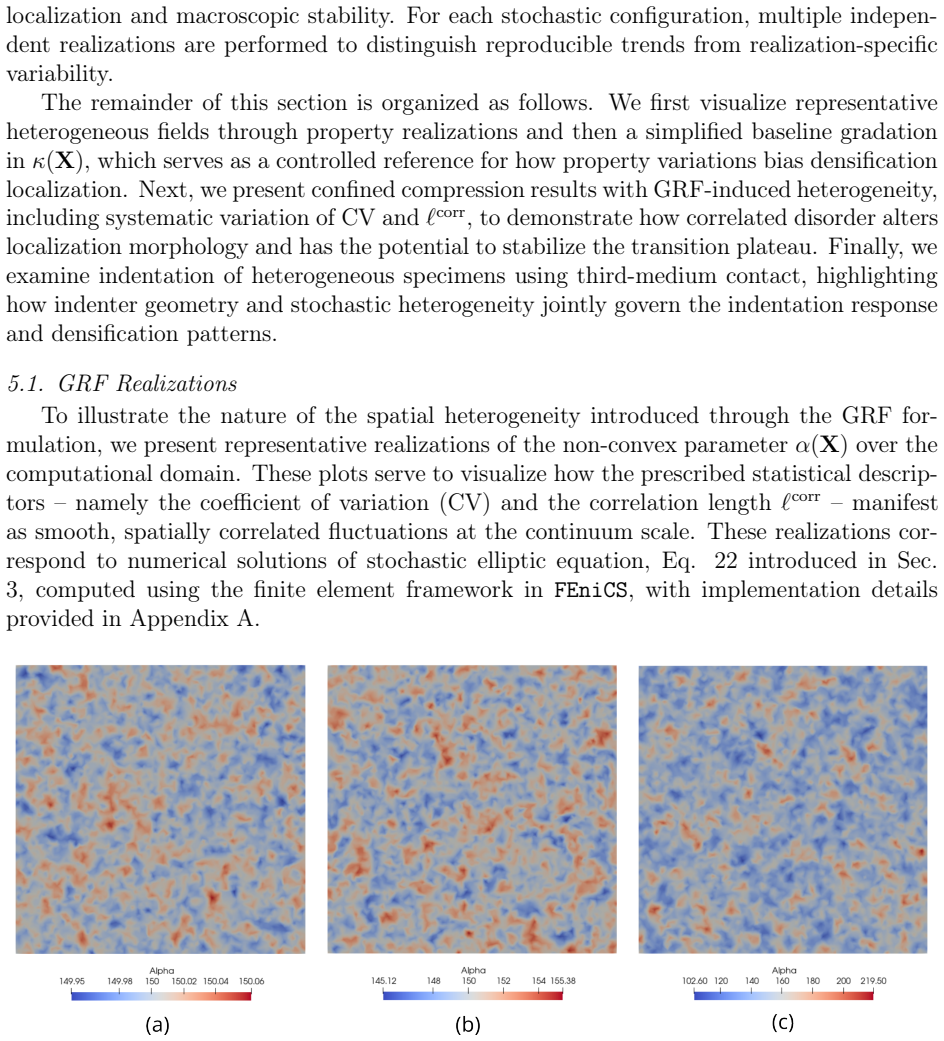
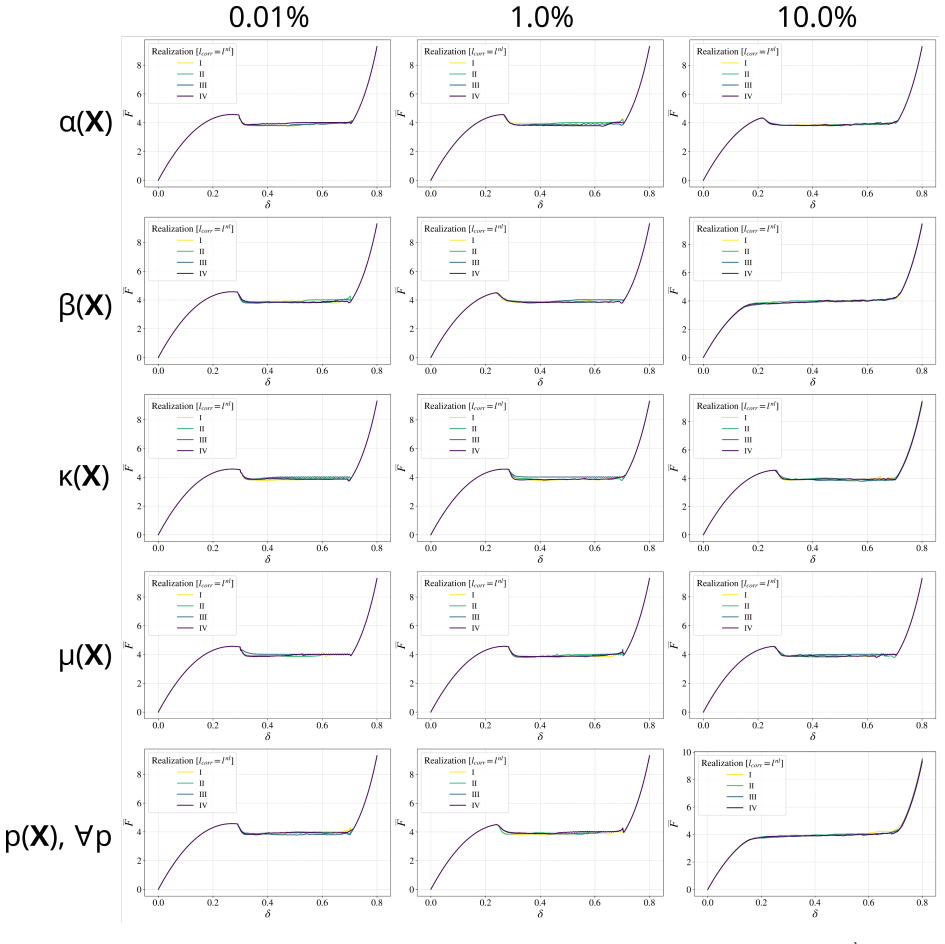
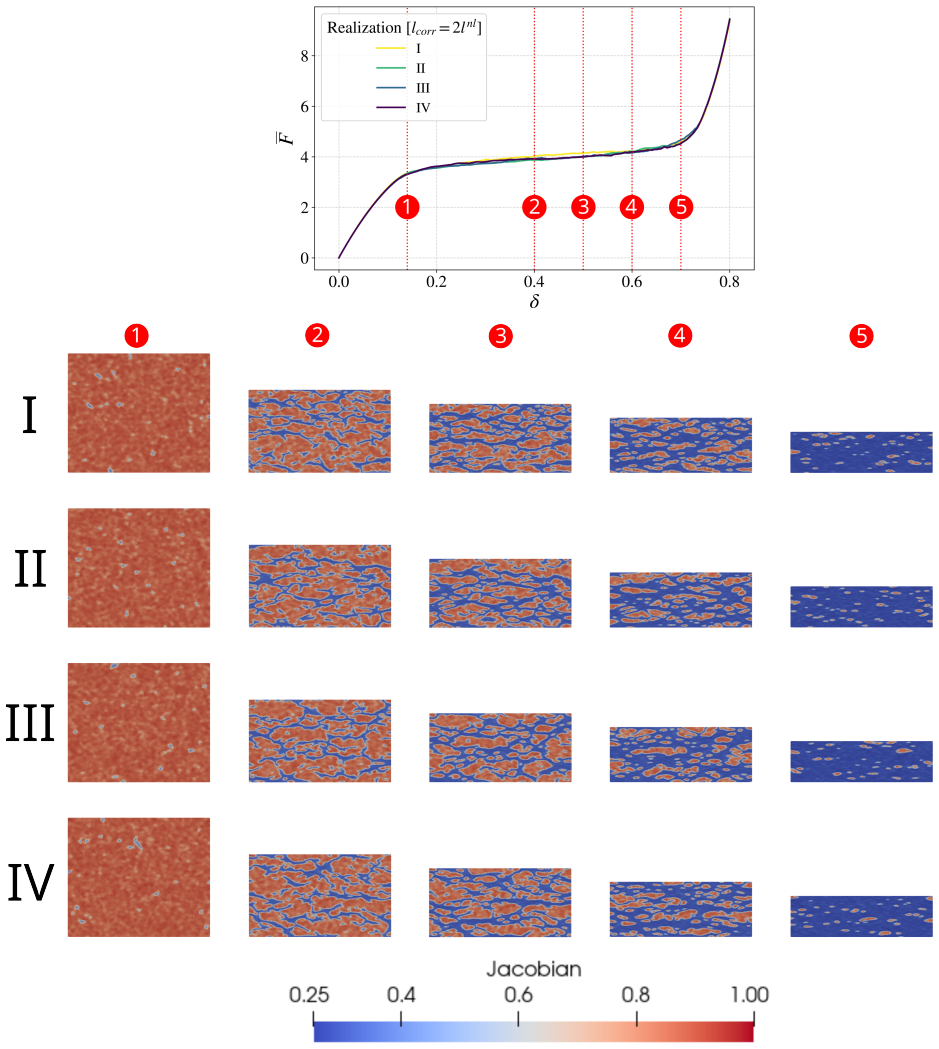
Extending the gradient-enhanced nonlocal continuum formulation by imposing Gaussian random fields on constitutive parameters allows independent control of fluctuation amplitude and spatial correlation through a lengthscale ratio; finite element results establish that such heterogeneity alone alters phase nucleation, localization morphology, and macroscopic features including stability, plateau slope, and the presence of an initial elastic regime.
What carries the argument
A gradient-enhanced nonlocal continuum formulation with Gaussian random fields applied to constitutive parameters, using a ratio of nonlocal lengthscale to correlation lengthscale to control microstructure randomness.
If this is right
- Heterogeneity alters phase nucleation and localization morphology in simulations of confined compression and indentation.
- Material fluctuations can eliminate the initial elastic regime in the macroscopic response.
- The slope of the stress plateau region is influenced by the level of heterogeneity.
- Overall stability of the architected structure changes with stochastic material variations.
- The framework links stochastic variability to instability-driven mechanics for better design understanding.
Where Pith is reading between the lines
- Manufacturers of metamaterials should consider how process-induced randomness affects performance predictions instead of relying on idealized uniform models.
- Adjusting the lengthscale ratio could allow systematic study of defect correlation effects in other architected materials.
- Insights from this approach may extend to predicting variability in biological or soft matter systems that exhibit similar localization phenomena.
Load-bearing premise
The model assumes that Gaussian random fields on constitutive parameters preserve thermodynamic consistency and that the finite element simulations capture the localization effects accurately.
What would settle it
Performing physical compression experiments on metamaterial samples fabricated with controlled levels of material property variation and comparing the observed localization bands and stress-strain curves to the simulation predictions.
Figures




read the original abstract
Architected metamaterials like foams and lattices exhibit complex responses governed by microstructural instabilities, localization, and phase-transition-like phenomena. Their behavior is further affected by heterogeneities inherent in their microstructure often caused through manufacturing processes. In this study we extend a gradient-enhanced, nonlocal continuum formulation to incorporate stochastic material heterogeneity through Gaussian random fields imposed on selected constitutive parameters. The framework enables independent control of both the amplitude and spatial correlation of material fluctuations while preserving thermodynamic consistency and regularization of localization. It also introduces a characteristic lengthscale ratio between the nonlocal and correlation lengthscales, that enables modeling at the limit of random or spatially correlated microstructures. Finite element simulations of confined compression and indentation show that heterogeneity fundamentally alters phase nucleation, localization morphology, and macroscopic response. Overall, the proposed framework provides a unified approach for linking stochastic material variability to instability-driven mechanics in architected metamaterials, enabling improved understanding of imperfection sensitivity, stability and design. It showcases how heterogeneity alone can influence characteristic features of the response, such as stability, slope of the plateau region, and elimination of the initial elastic regime.
Editorial analysis
A structured set of objections, weighed in public.
Referee Report
Summary. The manuscript claims that extending a gradient-enhanced nonlocal continuum formulation to incorporate stochastic material heterogeneity through Gaussian random fields on selected constitutive parameters enables independent control of fluctuation amplitude and spatial correlation, introduces a characteristic lengthscale ratio between nonlocal and correlation lengths, and that finite-element simulations of confined compression and indentation demonstrate heterogeneity fundamentally alters phase nucleation, localization morphology, and macroscopic response features such as stability, plateau slope, and elimination of the initial elastic regime in architected metamaterials.
Significance. If the results hold, the work provides a useful unified framework linking stochastic variability to instability-driven mechanics in metamaterials, with concrete simulation examples showing how heterogeneity alone influences key response characteristics. The independent controls and lengthscale ratio for modeling random versus correlated microstructures represent a modeling strength that could aid design accounting for manufacturing imperfections.
major comments (2)
- [Abstract and model formulation section] Abstract and model formulation section: The claim that the Gaussian random field extension 'preserves thermodynamic consistency and regularization of localization' is load-bearing for the central claim, yet the text provides no description of how negative realizations are prevented or corrected for parameters that must remain positive (e.g., moduli or length-scale coefficients). Unbounded Gaussian fields can produce non-physical values, raising the possibility that reported changes in nucleation and plateau behavior are simulation artifacts rather than genuine heterogeneity effects; explicit truncation, transformation, or post-processing steps are needed to substantiate the assertion.
- [Numerical results section (simulation descriptions)] Numerical results section (simulation descriptions): The demonstrations of altered localization morphology and macroscopic features rely on single or limited realizations without reported statistics across ensembles, error bars, or sensitivity to the lengthscale ratio; this weakens the strength of the 'fundamentally alters' claim, as variability in outcomes could be dominated by particular random field draws rather than systematic heterogeneity influence.
minor comments (2)
- Figure captions for the compression and indentation results could more explicitly state the specific values of amplitude, correlation length, and lengthscale ratio used in each panel to improve reproducibility.
- Notation for the random field parameters (amplitude, correlation) is introduced clearly but could benefit from a dedicated table summarizing the independent controls and their ranges explored.
Simulated Author's Rebuttal
We thank the referee for the constructive feedback and for recognizing the potential utility of our framework. We address each major comment below and indicate the revisions planned for the manuscript.
read point-by-point responses
-
Referee: [Abstract and model formulation section] Abstract and model formulation section: The claim that the Gaussian random field extension 'preserves thermodynamic consistency and regularization of localization' is load-bearing for the central claim, yet the text provides no description of how negative realizations are prevented or corrected for parameters that must remain positive (e.g., moduli or length-scale coefficients). Unbounded Gaussian fields can produce non-physical values, raising the possibility that reported changes in nucleation and plateau behavior are simulation artifacts rather than genuine heterogeneity effects; explicit truncation, transformation, or post-processing steps are needed to substantiate the assertion.
Authors: We acknowledge that the manuscript does not provide an explicit description of the procedure used to ensure non-negative parameter values. In the underlying implementation, a log-normal transformation is applied to the Gaussian field realizations for parameters such as moduli and length-scale coefficients; this maps the unbounded Gaussian to strictly positive values while preserving the prescribed mean and variance. The transformation ensures that the constitutive relations remain thermodynamically consistent and that the nonlocal regularization (via positive internal length scales) is retained. We will revise the model formulation section to include the explicit transformation equations, verification steps, and a brief discussion confirming that the energy functional remains well-posed. revision: yes
-
Referee: [Numerical results section (simulation descriptions)] Numerical results section (simulation descriptions): The demonstrations of altered localization morphology and macroscopic features rely on single or limited realizations without reported statistics across ensembles, error bars, or sensitivity to the lengthscale ratio; this weakens the strength of the 'fundamentally alters' claim, as variability in outcomes could be dominated by particular random field draws rather than systematic heterogeneity influence.
Authors: We agree that ensemble statistics and sensitivity analysis would strengthen the robustness of the claims. The reported simulations employ representative realizations that illustrate the systematic qualitative changes; however, to directly address the concern we have generated additional realizations and will incorporate ensemble-averaged macroscopic responses, standard deviations, and a parametric study of the nonlocal-to-correlation lengthscale ratio in the revised numerical results section. These additions will demonstrate that the observed shifts in nucleation, localization morphology, and features such as plateau slope are consistent effects of heterogeneity. revision: yes
Circularity Check
No circularity: independent model extension with direct simulation outputs
full rationale
The paper extends an existing gradient-enhanced nonlocal formulation by superimposing Gaussian random fields on selected constitutive parameters, introducing independent controls for fluctuation amplitude, spatial correlation length, and the ratio of nonlocal to correlation lengthscales. No quoted equations, derivations, or simulation protocols reduce any claimed outcome (altered nucleation, localization morphology, or macroscopic features) to a fitted parameter or input by construction. The abstract and description present the framework as a direct modeling choice that preserves thermodynamic consistency and regularization properties without invoking self-citations, uniqueness theorems from prior author work, or renaming of known results. Simulations of compression and indentation are treated as forward predictions from the extended model rather than statistical fits to the same data. This constitutes a self-contained extension whose central claims rest on the independent stochastic inputs and finite-element implementation, not on circular reduction.
Axiom & Free-Parameter Ledger
free parameters (3)
- amplitude of material fluctuations
- spatial correlation of material fluctuations
- characteristic lengthscale ratio
axioms (2)
- domain assumption The gradient-enhanced nonlocal continuum formulation regularizes localization and preserves thermodynamic consistency when extended with Gaussian random fields.
- domain assumption Finite element simulations can capture the effects of heterogeneity on phase nucleation and macroscopic response.
Reference graph
Works this paper leans on
-
[1]
Flexible mechanical metamaterials,
K.Bertoldi, V.Vitelli, J.Christensen, M.VanHecke, Flexiblemechanicalmetamaterials 2 (11) 17066.doi:10.1038/natrevmats.2017.66. URLhttps://www.nature.com/articles/natrevmats201766
-
[2]
Z. Lin, L. S. Novelino, H. Wei, N. A. Alderete, G. H. Paulino, H. D. Espinosa, S. Krish- naswamy, Folding at the microscale: Enabling multifunctional 3d origami-architected metamaterials 16 (35) 2002229.doi:10.1002/smll.202002229. URLhttps://onlinelibrary.wiley.com/doi/10.1002/smll.202002229
- [3]
-
[4]
T. Zhao, X. Dang, K. Manos, S. Zang, J. Mandal, M. Chen, G. H. Paulino, Modular chiral origami metamaterials 640 (8060) 931–940.doi:10.1038/s41586-025-08851-0. URLhttps://www.nature.com/articles/s41586-025-08851-0
-
[5]
L. J. Gibson, Mechanical behavior of metallic foams 30 (1) 191–227.doi:10.1146/ annurev.matsci.30.1.191. URLhttps://www.annualreviews.org/doi/10.1146/annurev.matsci.30.1.191
-
[6]
L. Gong, S. Kyriakides, W.-Y. Jang, Compressive response of open-cell foams. part i: Morphology and elastic properties 42 (5) 1355–1379.doi:10.1016/j.ijsolstr.2004. 07.023. URLhttps://linkinghub.elsevier.com/retrieve/pii/S0020768304004305
-
[7]
F. Han, Z. Zhu, J. Gao, Compressive deformation and energy absorbing characteristic of foamed aluminum 29 (10) 2497–2502.doi:10.1007/s11661-998-0221-z. URLhttps://link.springer.com/10.1007/s11661-998-0221-z
-
[8]
E. Andrews, W. Sanders, L. Gibson, Compressive and tensile behaviour of aluminum foams 270 (2) 113–124.doi:10.1016/S0921-5093(99)00170-7. URLhttps://linkinghub.elsevier.com/retrieve/pii/S0921509399001707
-
[9]
N. Mills, H. Zhu, The high strain compression of closed-cell polymer foams 47 (3) 669– 695.doi:10.1016/S0022-5096(98)00007-6. URLhttps://linkinghub.elsevier.com/retrieve/pii/S0022509698000076
-
[10]
V. Deshpande, N. Fleck, Isotropic constitutive models for metallic foams 48 (6) 1253– 1283.doi:10.1016/s0022-5096(99)00082-4. URLhttps://linkinghub.elsevier.com/retrieve/pii/S0022509699000824 39
-
[11]
A. Bastawros, Experimental analysis of deformation mechanisms in a closed-cell alu- minum alloy foam 48 (2) 301–322.doi:10.1016/S0022-5096(99)00035-6. URLhttps://linkinghub.elsevier.com/retrieve/pii/S0022509699000356
-
[12]
S. Bardenhagen, A. Brydon, J. Guilkey, Insight into the physics of foam densification via numerical simulation 53 (3) 597–617.doi:10.1016/j.jmps.2004.09.003. URLhttps://linkinghub.elsevier.com/retrieve/pii/S0022509604001759
-
[13]
P. Schüler, S. F. Fischer, A. Bührig-Polaczek, C. Fleck, Deformation and failure be- haviour of open cell al foams under quasistatic and impact loading 587 250–261. doi:10.1016/j.msea.2013.08.030. URLhttps://linkinghub.elsevier.com/retrieve/pii/S0921509313009155
-
[14]
K. Liu, L. S. Novelino, P. Gardoni, G. H. Paulino, Big influence of small random im- perfections in origami-based metamaterials 476 (2241) 20200236.doi:10.1098/rspa. 2020.0236. URLhttps://royalsocietypublishing.org/doi/10.1098/rspa.2020.0236
-
[15]
S. D. Rapaka, M. Pandey, R. K. Annabattula, Effect of defects on the dynamic compres- sive behavior of cellular solids 170 105365.doi:10.1016/j.ijmecsci.2019.105365. URLhttps://linkinghub.elsevier.com/retrieve/pii/S0020740319331996
-
[16]
L. Sang, W. Wu, Y. Yao, X. Dong, H. Zhang, H. Zhang, Tuneable mechanical perfor- mance and reusability of 4d-printed heterogeneous metamaterials using shape memory biomass-derived polymer 19 (1) e2372620.doi:10.1080/17452759.2024.2372620. URLhttps://www.tandfonline.com/doi/full/10.1080/17452759.2024.2372620
-
[17]
R. N. Glaesener, S. Kumar, C. Lestringant, T. Butruille, C. M. Portela, D. M. Kochmann, Predicting the influence of geometric imperfections on the mechanical re- sponse of 2d and 3d periodic trusses, Acta materialia 254 (2023) 118918
2023
-
[18]
L. Gong, S. Kyriakides, Compressive response of open cell foams part ii: Initiation and evolution of crushing, International Journal of Solids and Structures 42 (5-6) (2005) 1381–1399
2005
-
[19]
Hilyard, , A
N. Hilyard, , A. Cunningham, Low density cellular plastics: physical basis of behaviour, Springer Science & Business Media, 2012
2012
-
[20]
E. Chen, S. Luan, S. Gaitanaros, On the strength of brittle foams with uniform and gradient densities, Extreme Mechanics Letters 51 (2022) 101598
2022
-
[21]
V. S. Deshpande, N. A. Fleck, M. F. Ashby, Effective properties of the octet-truss lattice material, Journal of the Mechanics and Physics of Solids 49 (8) (2001) 1747–1769
2001
-
[22]
U. G. Wegst, H. Bai, E. Saiz, A. P. Tomsia, R. O. Ritchie, Bioinspired structural materials, Nature materials 14 (1) (2015) 23–36. 40
2015
-
[23]
S. Bi, E. Chen, S. Gaitanaros, Additive manufacturing and characterization of brittle foams, Mechanics of Materials 145 (2020) 103368
2020
-
[24]
Zheng, W
X. Zheng, W. Smith, J. Jackson, B. Moran, H. Cui, D. Chen, J. Ye, N. Fang, N. Ro- driguez, T. Weisgraber, et al., Multiscale metallic metamaterials, Nature materials 15 (10) (2016) 1100–1106
2016
-
[25]
T. Roland, G. Ginot, M. Dabo, C. Gauthier, W. Drenckhan, P. Kékicheff, Physically- based modeling of polymer foam microstructures: from realistic cellular microstructures and their variabilities to mechanical properties, Journal of the Mechanics and Physics of Solids 206 (2026) 106387.doi:https://doi.org/10.1016/j.jmps.2025.106387. URLhttps://www.scienced...
-
[26]
Torquato, et al., Random heterogeneous materials: microstructure and macroscopic properties, Vol
S. Torquato, et al., Random heterogeneous materials: microstructure and macroscopic properties, Vol. 16, Springer, 2002
2002
-
[27]
Deshpande, N
V. Deshpande, N. Fleck, Multi-axial yield behaviour of polymer foams, Acta materialia 49 (10) (2001) 1859–1866
2001
-
[28]
C. Chen, N. Fleck, Size effects in the constrained deformation of metallic foams, Journal of the Mechanics and Physics of Solids 50 (5) (2002) 955–977
2002
-
[29]
C. Yang, S. Kyriakides, Continuum modeling of crushing of low density foams, Journal of the Mechanics and Physics of Solids 136 (2020) 103688
2020
-
[30]
J. Zhang, N. Kikuchi, V. Li, A. Yee, G. Nusholtz, Constitutive modeling of poly- meric foam material subjected to dynamic crash loading 21 (5) 369–386.doi: 10.1016/S0734-743X(97)00087-0. URLhttps://linkinghub.elsevier.com/retrieve/pii/S0734743X97000870
-
[32]
S. Koumlis, L. Lamberson, Strain rate dependent compressive response of open cell polyurethane foam 59 (7) 1087–1103.doi:10.1007/s11340-019-00521-3. URLhttp://link.springer.com/10.1007/s11340-019-00521-3
-
[33]
B. Markert, A biphasic continuum approach for viscoelastic high-porosity foams: Comprehensive theory, numerics, and application 15 (4) 371–446.doi:10.1007/ s11831-008-9023-0. URLhttp://link.springer.com/10.1007/s11831-008-9023-0
-
[34]
Khajehtourian, D
R. Khajehtourian, D. M. Kochmann, A continuum description of substrate-free dissipa- tive reconfigurable metamaterials, Journal of the Mechanics and Physics of Solids 147 (2021) 104217. 41
2021
-
[35]
Khajehtourian, D
R. Khajehtourian, D. M. Kochmann, Soft adaptive mechanical metamaterials, Frontiers in Robotics and AI 8 (2021) 673478
2021
-
[36]
Gaitanaros, S
S. Gaitanaros, S. Kyriakides, A. M. Kraynik, On the crushing response of random open- cell foams, International Journal of Solids and Structures 49 (19-20) (2012) 2733–2743
2012
-
[37]
Gaitanaros, S
S. Gaitanaros, S. Kyriakides, On the effect of relative density on the crushing and energy absorption of open-cell foams under impact, International Journal of Impact Engineering 82 (2015) 3–13
2015
-
[38]
Hooshmand-Ahoor, M
Z. Hooshmand-Ahoor, M. G. Tarantino, K. Danas, Mechanically-grown morphogenesis of voronoi-type materials: Computer design, 3d-printing and experiments, Mechanics of Materials 173 (2022) 104432
2022
-
[39]
Hooshmand-Ahoor, H
Z. Hooshmand-Ahoor, H. Luo, K. Danas, M-voronoi and other random open and closed- cell elasto-plastic cellular materials: Geometry generation and numerical study at small and large strains, International Journal of Solids and Structures 290 (2024) 112680
2024
-
[40]
L. Gallup, K. N. Long, D. J. Roach, W. D. Reinholtz, A. Cook, C. M. Hamel, A meshing framework for digital twins for extrusion based additive manufacturing, Additive Manu- facturing 121 (2026) 105137.doi:https://doi.org/10.1016/j.addma.2026.105137. URLhttps://www.sciencedirect.com/science/article/pii/S2214860426000631
-
[41]
P. Viot, I. Iordanoff, D. Bernard, Multiscale description of polymeric foam behavior: A new approach based on discrete element modeling 50 (6) 679–689.doi:10.1134/ S0965545X08060114. URLhttp://link.springer.com/10.1134/S0965545X08060114
-
[42]
Miehe, C
C. Miehe, C. Bayreuther, On multiscale fe analyses of heterogeneous structures: from homogenization to multigrid solvers, International Journal for Numerical Methods in Engineering 71 (10) (2007) 1135–1180
2007
-
[43]
M. G. Geers, V. G. Kouznetsova, K. Matouš, J. Yvonnet, Homogenization methods and multiscale modeling: nonlinear problems, Encyclopedia of computational mechanics second edition (2017) 1–34
2017
-
[44]
Fritzen, M
F. Fritzen, M. Leuschner, Nonlinear reduced order homogenization of materials includ- ing cohesive interfaces, Computational Mechanics 56 (1) (2015) 131–151
2015
-
[45]
P. Neff, S. Forest, A geometrically exact micromorphic model for elastic metallic foams accounting for affine microstructure. modelling, existence of minimizers, identification of moduli and computational results, Journal of Elasticity 87 (2) (2007) 239–276
2007
-
[46]
C. Combescure, Selecting generalized continuum theories for nonlinear periodic solids based on the instabilities of the underlying microstructure, Journal of Elasticity 154 (1) (2023) 421–441. 42
2023
-
[47]
Iltchev, V
A. Iltchev, V. Marcadon, S. Kruch, S. Forest, Computational homogenisation of pe- riodic cellular materials: application to structural modelling, International Journal of Mechanical Sciences 93 (2015) 240–255
2015
-
[48]
S. Sperling, T. Guo, R. Peerlings, V. Kouznetsova, M. Geers, O. Rokoš, Enriched com- putational homogenization schemes applied to pattern-transforming elastomeric me- chanical metamaterials, arXiv preprint arXiv:2307.10952 (2023)
-
[49]
T. Guo, V. G. Kouznetsova, M. G. Geers, K. Veroy, O. Rokoš, Reduced-order modeling for second-order computational homogenization with applications to geometrically pa- rameterized elastomeric metamaterials, International Journal for Numerical Methods in Engineering 126 (1) (2025) e7604
2025
-
[50]
Maraghechi, O
S. Maraghechi, O. Rokoš, R. Peerlings, M. Geers, J. Hoefnagels, Harvesting deformation modes for micromorphic homogenization from experiments on mechanical metamateri- als, International Journal of Solids and Structures 301 (2024) 112916
2024
-
[51]
van Bree, O
S. van Bree, O. Rokoš, R. H. Peerlings, M. Doškář, M. G. Geers, A newton solver for micromorphic computational homogenization enabling multiscale buckling analysis of pattern-transforming metamaterials, Computer Methods in Applied Mechanics and Engineering 372 (2020) 113333
2020
-
[52]
I. Jeon, T. Asahina, The effect of structural defects on the compressive behavior of closed-cell al foam 53 (12) 3415–3423.doi:10.1016/j.actamat.2005.04.010. URLhttps://linkinghub.elsevier.com/retrieve/pii/S1359645405002089
-
[53]
I. Jeon, K. Katou, T. Sonoda, T. Asahina, K.-J. Kang, Cell wall mechanical properties of closed-cell al foam 41 (1) 60–73.doi:10.1016/j.mechmat.2008.08.002. URLhttps://linkinghub.elsevier.com/retrieve/pii/S0167663608001087
-
[54]
Y. Duan, X. Zhao, B. Du, X. Shi, H. Zhao, B. Hou, Y. Li, Quasi-static compressive be- havior and constitutive model of graded foams 177 105603.doi:10.1016/j.ijmecsci. 2020.105603. URLhttps://linkinghub.elsevier.com/retrieve/pii/S0020740319336720
-
[55]
F. Yao, M. Joshi, M. Bland-Rothgeb, P. Cripton, D. Cronin, J. Magliaro, Mechanical and material heterogeneity, strain localization and deformation rate effects in crushable expanded polystyrene foams 11 1718011.doi:10.3389/fmech.2025.1718011. URLhttps://www.frontiersin.org/articles/10.3389/fmech.2025.1718011/ full
-
[56]
M. Avalle, G. Belingardi, R. Montanini, Characterization of polymeric structural foams under compressive impact loading by means of energy-absorption diagram 25 (5) 455– 472.doi:10.1016/S0734-743X(00)00060-9. URLhttps://linkinghub.elsevier.com/retrieve/pii/S0734743X00000609 43
-
[57]
A. K. Landauer, X. Li, C. Franck, D. L. Henann, Experimental characterization and hyperelastic constitutive modeling of open-cell elastomeric foams 133 103701.doi: 10.1016/j.jmps.2019.103701. URLhttps://linkinghub.elsevier.com/retrieve/pii/S0022509619303825
-
[58]
J. Tao, X. Li, A. K. Landauer, D. Henann, C. Franck, Characterization of the vis- coelastic response of closed-cell foam materials, in: Challenges in Mechanics of Time Dependent Materials, Volume 2: Proceedings of the 2020 Annual Conference on Ex- perimental and Applied Mechanics, Springer, 2021, pp. 1–3
2020
-
[59]
Zheng, D
L. Zheng, D. M. Kochmann, S. Kumar, Hypercan: Hypernetwork-driven deep param- eterized constitutive models for metamaterials, Extreme Mechanics Letters 72 (2024) 102243
2024
-
[60]
Fernández, M
M. Fernández, M. Jamshidian, T. Böhlke, K. Kersting, O. Weeger, Anisotropic hy- perelastic constitutive models for finite deformations combining material theory and data-driven approaches with application to cubic lattice metamaterials, Computational Mechanics 67 (2) (2021) 653–677
2021
-
[61]
Fernández, F
M. Fernández, F. Fritzen, O. Weeger, Material modeling for parametric, anisotropic finite strain hyperelasticity based on machine learning with application in optimization of metamaterials, International Journal for Numerical Methods in Engineering 123 (2) (2022) 577–609
2022
-
[62]
Y. Wang, A. M. Cuitiño, Full-field measurementsof heterogeneous deformation patterns on polymeric foams using digital image correlation 39 (13) 3777–3796.doi:10.1016/ S0020-7683(02)00176-2. URLhttps://linkinghub.elsevier.com/retrieve/pii/S0020768302001762
-
[63]
F. Pierron, Identification of poisson’s ratios of standard and auxetic low-density polymeric foams from full-field measurements 45 (4) 233–253.doi:10.1243/ 03093247JSA613. URLhttps://journals.sagepub.com/doi/10.1243/03093247JSA613
-
[64]
G. Gioia, Y. Wang, A. M. Cuitiño, The energetics of heterogeneous deformation in open-cell solid foams 457 (2009) 1079–1096.doi:10.1098/rspa.2000.0707. URLhttps://royalsocietypublishing.org/doi/10.1098/rspa.2000.0707
-
[65]
Joshi, S
S. Joshi, S. M. Mousavi, C. M. Hamel, S. Gaitanaros, P. K. Purohit, R. Alberdi, N. Bouklas, Instabilities and phase transitions in architected metamaterials: a gradient- enhancedcontinuumapproach, ComputerMethodsinAppliedMechanicsandEngineer- ing 452 (2026) 118719
2026
-
[66]
Y. Sun, B. Amirrasouli, S. Razavi, Q. Li, T. Lowe, P. Withers, The variation in elastic modulus throughout the compression of foam materials 110 161–174.doi:10.1016/j. 44 actamat.2016.03.003. URLhttps://linkinghub.elsevier.com/retrieve/pii/S1359645416301446
work page doi:10.1016/j 2016
-
[67]
Wriggers, J
P. Wriggers, J. Korelc, P. Junker, A third medium approach for contact using first and second order finite elements, Computer Methods in Applied Mechanics and Engineering 436 (2025) 117740
2025
-
[68]
Z. P. Bažant, M. Jirásek, Nonlocal integral formulations of plasticity and damage: survey of progress, Journal of engineering mechanics 128 (11) (2002) 1119–1149
2002
-
[69]
Pijaudier-Cabot, Z
G. Pijaudier-Cabot, Z. P. Bažant, Nonlocal damage theory, Journal of engineering mechanics 113 (10) (1987) 1512–1533
1987
-
[70]
M. E. Gurtin, Generalized ginzburg-landau and cahn-hilliard equations based on a microforce balance, Physica D: Nonlinear Phenomena 92 (3-4) (1996) 178–192
1996
-
[71]
Richtmyer, A proposed method for the calculation of shocks, Los Alamos Nat
R. Richtmyer, A proposed method for the calculation of shocks, Los Alamos Nat. Lab., Los Alamos: NM, LAMS 671 (1948)
1948
-
[72]
A method for the numerical calculation of hydro- dynamic shocks
J. VonNeumann, R. D. Richtmyer, A method for the numerical calcula- tion of hydrodynamic shocks, Journal of Applied Physics 21 (3) (1950) 232– 237.arXiv:https://pubs.aip.org/aip/jap/article-pdf/21/3/232/18309197/ 232_1_online.pdf,doi:10.1063/1.1699639. URLhttps://doi.org/10.1063/1.1699639
-
[73]
Miehe, M
C. Miehe, M. Hofacker, F. Welschinger, A phase field model for rate-independent crack propagation: Robust algorithmic implementation based on operator splits, Computer Methods in Applied Mechanics and Engineering 199 (45-48) (2010) 2765–2778
2010
-
[74]
Lindgren, H
F. Lindgren, H. Rue, J. Lindström, An explicit link between gaussian fields and gaussian markov random fields: the stochastic partial differential equation approach, Journal of the Royal Statistical Society Series B: Statistical Methodology 73 (4) (2011) 423–498
2011
-
[75]
Roininen, J
L. Roininen, J. M. Huttunen, S. Lasanen, Whittle-matérn priors for bayesian statistical inversion with applications in electrical impedance tomography., Inverse Problems & Imaging 8 (2) (2014)
2014
-
[76]
J. Tan, D. Faghihi, A scalable framework for multi-objective pde-constrained design of building insulation under uncertainty, Computer Methods in Applied Mechanics and Engineering 419 (2024) 116628
2024
-
[77]
Logg, K.-A
A. Logg, K.-A. Mardal, G. Wells, Automated solution of differential equations by the finite element method: The FEniCS book, Vol. 84, Springer Science & Business Media, 2012. 45
2012
-
[78]
M. S. Alnæs, J. Blechta, J. Hake, A. Johansson, B. Kehlet, A. Logg, C. Richardson, J. Ring, M. E. Rognes, G. N. Wells, The fenics project version 1.5, Archive of Numerical Software 3 (100) (2015).doi:10.11588/ans.2015.100.20553
-
[79]
M. S. Alnæs, A. Logg, K. B. Ølgaard, M. E. Rognes, G. N. Wells, Unified form language: A domain-specific language for weak formulations of partial differential equations, ACM Trans. Math. Softw. 40 (2) (Mar. 2014).doi:10.1145/2566630. URLhttps://doi.org/10.1145/2566630
-
[80]
P. Wriggers, J. Korelc, P. Junker, First order finite element formulations for third medium contact.doi:10.2139/ssrn.5130173. URLhttps://www.ssrn.com/abstract=5130173
-
[81]
Liang, J
X. Liang, J. Shin, D. Magagnosc, Y. Jiang, S. J. Park, A. J. Hart, K. Turner, D. S. Gianola, P. K. Purohit, Compression and recovery of carbon nanotube forests described as a phase transition, International Journal of Solids and Structures 122 (2017) 196–209
2017
discussion (0)
Sign in with ORCID, Apple, or X to comment. Anyone can read and Pith papers without signing in.