Recognition: unknown
Markovian thermodynamics of non-Markovian Langevin equations
Pith reviewed 2026-05-07 14:53 UTC · model grok-4.3
The pith
Non-Markovian generalized Langevin equations embed into Markovian systems yielding unique monotonic entropy production.
A machine-rendered reading of the paper's core claim, the machinery that carries it, and where it could break.
Core claim
We develop the thermodynamics of non-Markovian generalized Langevin equations by embedding them in a high-dimensional Markovian representation involving auxiliary degrees of freedom. If the memory is linear and satisfies detailed balance with the noise, we provide an explicit construction of the embedding for non-Markovian dynamics with many degrees of freedom and hydrodynamic interactions. Moreover, while the embedding is generally not unique, we show that it results in unique values of thermodynamic quantities of the Markovian system. This allows us to define the Markovian entropy production of a non-Markovian system, which is guaranteed to increase monotonically with time. Moreover, the 1
What carries the argument
The explicit construction of a Markovian embedding with auxiliary degrees of freedom for linear memory kernels that satisfy detailed balance with the noise.
Where Pith is reading between the lines
- The same embedding approach may supply fluctuation theorems for non-Markovian processes by transferring them from the Markovian representation.
- Numerical checks on colloidal particles or other systems with hydrodynamic memory could directly test the uniqueness of the entropy production.
- The auxiliary variables act as an information reservoir, suggesting links to information thermodynamics that the paper leaves open.
- The construction might extend to certain classes of nonlinear memory if analogous balance conditions can be identified.
Load-bearing premise
The memory must be linear and must satisfy detailed balance with the noise.
What would settle it
A concrete counterexample in which the constructed Markovian entropy production decreases over time for a system obeying the linear-memory and detailed-balance conditions would disprove the monotonicity claim.
Figures

read the original abstract
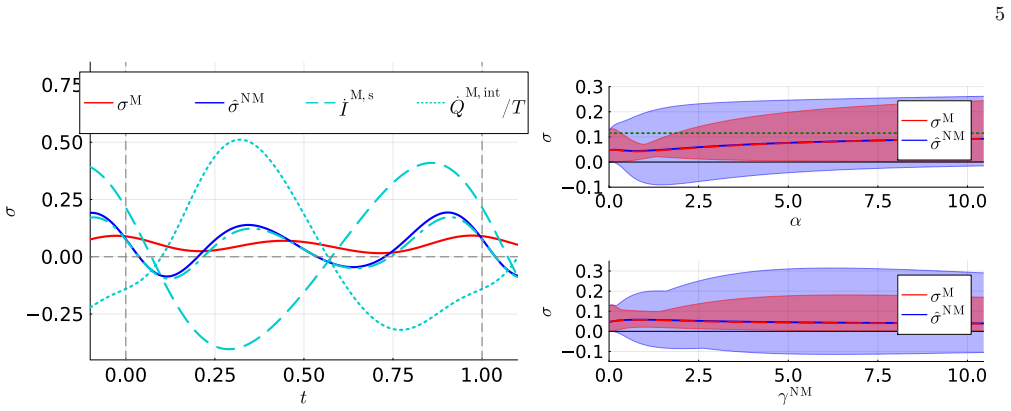
We develop the thermodynamics of non-Markovian generalized Langevin equations by embedding them in a high-dimensional Markovian representation involving auxiliary degrees of freedom. If the memory is linear and satisfies detailed balance with the noise, we provide an explicit construction of the embedding for non-Markovian dynamics with many degrees of freedom and hydrodynamic interactions. Moreover, while the embedding is generally not unique, we show that it results in unique values of thermodynamic quantities of the Markovian system. This allows us to define the Markovian entropy production of a non-Markovian system, which, in contrast to the definition based directly on the non-Markovian dynamics, is guaranteed to increase monotonically with time. Moreover, the Markovian representation allows us to identify the apparent decrease in the non-Markovian entropy with heat and information exchange between the system and the auxiliary degrees of freedom.
Editorial analysis
A structured set of objections, weighed in public.
Referee Report
Summary. The manuscript develops the thermodynamics of non-Markovian generalized Langevin equations by embedding them in a high-dimensional Markovian representation involving auxiliary degrees of freedom. Under the condition of linear memory that satisfies detailed balance with the noise, an explicit construction is provided for systems with many degrees of freedom and hydrodynamic interactions. The embedding is generally not unique, but the thermodynamic quantities of the Markovian system are shown to be unique. This allows defining the Markovian entropy production of a non-Markovian system that increases monotonically with time, and attributes the apparent decrease in non-Markovian entropy to heat and information exchange with the auxiliary degrees of freedom.
Significance. If the results hold, this work offers a valuable framework for assigning consistent thermodynamic properties, especially entropy production, to non-Markovian systems by reducing them to Markovian ones where standard results apply. The explicit construction for multi-degree-of-freedom systems including hydrodynamic interactions is a notable strength, as it applies to physically relevant cases like interacting particles in fluids. The demonstration of uniqueness of thermodynamic quantities across different embeddings is particularly useful, enabling unambiguous definitions. The paper is credited for providing the explicit construction and the uniqueness result under clearly stated conditions, which supports the central claims.
minor comments (2)
- The introduction would benefit from a short paragraph contrasting the present embedding with prior Markovian representations of non-Markovian dynamics to clarify the advance.
- Equation numbering for the memory kernel and its fluctuation-dissipation relation should be introduced early and used consistently in later sections.
Simulated Author's Rebuttal
We thank the referee for their careful reading of the manuscript and for the positive overall assessment. The referee summary accurately reflects the scope and main results of our work. We note that no specific major comments were provided in the report.
Circularity Check
No significant circularity; construction is self-contained
full rationale
The paper supplies an explicit embedding construction for non-Markovian generalized Langevin equations into a high-dimensional Markovian system, conditioned on linear memory that satisfies detailed balance with the noise. It then proves that thermodynamic quantities (including entropy production) remain invariant across the family of possible embeddings. The monotonicity of the resulting Markovian entropy production follows directly from standard Markovian thermodynamics once the embedding is established. No step reduces by definition to its inputs, no fitted parameter is relabeled as a prediction, and no load-bearing self-citation or uniqueness theorem imported from the authors' prior work is invoked. The derivation chain is therefore independent of the target result and rests on verifiable construction plus existing Markovian theory.
Axiom & Free-Parameter Ledger
axioms (1)
- domain assumption The memory is linear and satisfies detailed balance with the noise
invented entities (1)
-
auxiliary degrees of freedom
no independent evidence
Reference graph
Works this paper leans on
-
[1]
S. C. Weber, A. J. Spakowitz, and J. A. Theriot, Bac- terial Chromosomal Loci Move Subdiffusively through a Viscoelastic Cytoplasm, Physical Review Letters104, 238102 (2010)
2010
-
[2]
Weiss, Single-particle tracking data reveal anticorre- lated fractional Brownian motion in crowded fluids, Phys- ical Review E88, 010101 (2013)
M. Weiss, Single-particle tracking data reveal anticorre- lated fractional Brownian motion in crowded fluids, Phys- ical Review E88, 010101 (2013)
2013
-
[3]
Breuer, E.-M
H.-P. Breuer, E.-M. Laine, J. Piilo, and B. Vacchini, Colloquium: Non-Markovian dynamics in open quantum systems, Reviews of Modern Physics88, 021002 (2016)
2016
-
[4]
de Vega and D
I. de Vega and D. Alonso, Dynamics of non-Markovian open quantum systems, Reviews of Modern Physics89, 015001 (2017)
2017
-
[5]
Zwanzig, Memory Effects in Irreversible Thermody- namics, Physical Review124, 983 (1961)
R. Zwanzig, Memory Effects in Irreversible Thermody- namics, Physical Review124, 983 (1961)
1961
-
[6]
Mori, Transport, Collective Motion, and Brownian Motion*), Progress of Theoretical Physics33, 423 (1965)
H. Mori, Transport, Collective Motion, and Brownian Motion*), Progress of Theoretical Physics33, 423 (1965)
1965
-
[7]
Cockrell and I
C. Cockrell and I. J. Ford, Stochastic thermodynamics in a non-Markovian dynamical system, Physical Review E 105, 064124 (2022)
2022
-
[8]
Strasberg and M
P. Strasberg and M. Esposito, Non-Markovianity and negative entropy production rates, Physical Review E99, 012120 (2019)
2019
-
[9]
Siegle, I
P. Siegle, I. Goychuk, P. Talkner, and P. H¨ anggi, Marko- vian embedding of non-markovian superdiffusion, Physi- cal Review E81, 011136 (2010)
2010
-
[10]
Goychuk, Viscoelastic Subdiffusion: Generalized Langevin Equation Approach, inAdvances in Chemical Physics(John Wiley & Sons, Ltd, 2012) pp
I. Goychuk, Viscoelastic Subdiffusion: Generalized Langevin Equation Approach, inAdvances in Chemical Physics(John Wiley & Sons, Ltd, 2012) pp. 187–253
2012
-
[11]
L. Ma, X. Li, and C. Liu, From generalized Langevin equations to Brownian dynamics and embedded Brow- nian dynamics, The Journal of Chemical Physics145, 114102 (2016)
2016
-
[12]
Kanazawa and D
K. Kanazawa and D. Sornette, Nonuniversal power law distribution of intensities of the self-excited Hawkes pro- cess: a field-theoretical approach, Physical Review Let- ters125, 138301 (2020)
2020
-
[13]
Kanazawa and D
K. Kanazawa and D. Sornette, Standard form of mas- ter equations for general non-Markovian jump processes: The Laplace-space embedding framework and asymptotic solution, Physical Review Research6, 023270 (2024)
2024
-
[14]
Stochastic thermodynamics for classical non-Markov jump processes
K. Kanazawa and A. Dechant, Stochastic ther- modynamics for classical non-Markov jump pro- cesses, https://arxiv.org/abs/2506.04726 (2025), arXiv:2506.04726
work page internal anchor Pith review Pith/arXiv arXiv 2025
-
[15]
Zwanzig, Nonlinear generalized Langevin equations, Journal of Statistical Physics9, 215 (1973)
R. Zwanzig, Nonlinear generalized Langevin equations, Journal of Statistical Physics9, 215 (1973)
1973
-
[16]
R. F. Fox, The generalized Langevin equation with Gaus- sian fluctuations, Journal of Mathematical Physics18, 2331 (1977)
1977
-
[17]
Cort´ es, B
E. Cort´ es, B. J. West, and K. Lindenberg, On the general- ized Langevin equation: Classical and quantum mechan- ical, The Journal of Chemical Physics82, 2708 (1985)
1985
-
[18]
Di Terlizzi, F
I. Di Terlizzi, F. Ritort, and M. Baiesi, Explicit Solution of the Generalised Langevin Equation, Journal of Statis- tical Physics181, 1609 (2020)
2020
-
[19]
Kubo, The fluctuation-dissipation theorem, Reports on Progress in Physics29, 255 (1966)
R. Kubo, The fluctuation-dissipation theorem, Reports on Progress in Physics29, 255 (1966)
1966
-
[20]
Fodor, D
E. Fodor, D. S. Grebenkov, P. Visco, and F. van Wij- land, Generalized Langevin equation with hydrodynamic backflow: Equilibrium properties, Physica A: Statistical Mechanics and its Applications422, 107 (2015)
2015
-
[21]
Kanazawa and D
K. Kanazawa and D. Sornette, Field master equation the- ory of the self-excited Hawkes process, Physical Review Research2, 033442 (2020)
2020
-
[22]
Sekimoto,Stochastic Energetics, Lecture Notes in Physics (Springer Berlin Heidelberg, 2010)
K. Sekimoto,Stochastic Energetics, Lecture Notes in Physics (Springer Berlin Heidelberg, 2010)
2010
-
[23]
Seifert, Stochastic thermodynamics, fluctuation the- orems and molecular machines, Reports on Progress in Physics75, 126001 (2012)
U. Seifert, Stochastic thermodynamics, fluctuation the- orems and molecular machines, Reports on Progress in Physics75, 126001 (2012)
2012
-
[24]
Speck and U
T. Speck and U. Seifert, The Jarzynski relation, fluctu- ation theorems, and stochastic thermodynamics for non- Markovian processes, J. Stat. Mech. Theory E.2007, L09002 (2007)
2007
-
[25]
J. M. Horowitz and M. Esposito, Thermodynamics with continuous information flow, Physical Review X4, 031015 (2014). 7
2014
-
[26]
Sagawa and M
T. Sagawa and M. Ueda, Fluctuation theorem with in- formation exchange: Role of correlations in stochastic thermodynamics, Physical Review Letters109, 180602 (2012)
2012
-
[27]
Ito and T
S. Ito and T. Sagawa, Information thermodynamics on causal networks, Physical Review Letters111, 180603 (2013)
2013
-
[28]
Hartich, A
D. Hartich, A. C. Barato, and U. Seifert, Stochastic ther- modynamics of bipartite systems: transfer entropy in- equalities and a maxwell’s demon interpretation, Journal of Statistical Mechanics: Theory and Experiment2014, P02016 (2014)
2014
-
[29]
J. M. R. Parrondo, J. M. Horowitz, and T. Sagawa, Ther- modynamics of information, Nature Phys.11, 131 (2015)
2015
-
[30]
K. Funo, T. V. Vu, and K. Saito, Private communication, publication in preparation (2026)
2026
-
[31]
Lutz, Fractional Langevin equation, Physical Review E64, 051106 (2001)
E. Lutz, Fractional Langevin equation, Physical Review E64, 051106 (2001)
2001
-
[32]
Deng and E
W. Deng and E. Barkai, Ergodic properties of frac- tional Brownian-Langevin motion, Physical Review E79, 011112 (2009)
2009
-
[33]
Siegle, I
P. Siegle, I. Goychuk, and P. H¨ anggi, Markovian embed- ding of fractional superdiffusion, Europhysics Letters93, 20002 (2011)
2011
-
[34]
Brandner, Dynamics of Microscale and Nanoscale Sys- tems in the Weak-Memory Regime, Physical Review Let- ters134, 037101 (2025)
K. Brandner, Dynamics of Microscale and Nanoscale Sys- tems in the Weak-Memory Regime, Physical Review Let- ters134, 037101 (2025)
2025
-
[35]
B´ erut, A
A. B´ erut, A. Arakelyan, A. Petrosyan, S. Ciliberto, R. Dillenschneider, and E. Lutz, Experimental verifica- tion of Landauer’s principle linking information and ther- modynamics, Nature483, 187 (2012)
2012
-
[36]
Proesmans, J
K. Proesmans, J. Ehrich, and J. Bechhoefer, Finite-Time Landauer Principle, Physical Review Letters125, 100602 (2020)
2020
-
[37]
S. A. Loos, S. Monter, F. Ginot, and C. Bechinger, Uni- versal Symmetry of Optimal Control at the Microscale, Physical Review X14, 021032 (2024)
2024
-
[38]
Monter, S
S. Monter, S. A. M. Loos, and C. Bechinger, Opti- mal transitions between nonequilibrium steady states, Proceedings of the National Academy of Sciences122, e2510654122 (2025)
2025
- [39]
-
[40]
D.-K. Kim, Y. Bae, S. Lee, and H. Jeong, Learning En- tropy Production via Neural Networks, Physical Review Letters125, 140604 (2020)
2020
-
[41]
Otsubo, S
S. Otsubo, S. Ito, A. Dechant, and T. Sagawa, Esti- mating entropy production by machine learning of short- time fluctuating currents, Physical Review E101, 062106 (2020). 8 END MA TTER Appendix A: Derivation of the generalized Langevin equation.We note that the form of the memory ker- nel Eq. (25a) implies that the noises acting on the target and auxilia...
2020
discussion (0)
Sign in with ORCID, Apple, or X to comment. Anyone can read and Pith papers without signing in.