Recognition: unknown
Thermodynamic Phase Transitions in Einstein-Maxwell-Scalar-Gauss-Bonnet Gravity
Pith reviewed 2026-05-07 16:09 UTC · model grok-4.3
The pith
Curvature-induced scalarization of charged black holes creates up to three thermodynamic phase transitions in Einstein-Maxwell-Scalar-Gauss-Bonnet gravity.
A machine-rendered reading of the paper's core claim, the machinery that carries it, and where it could break.
Core claim
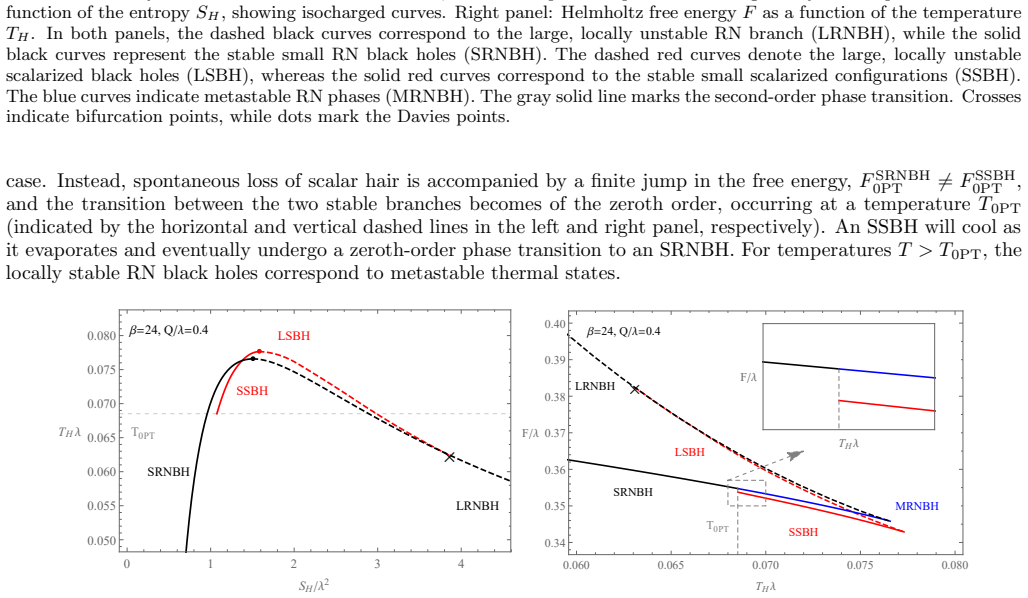
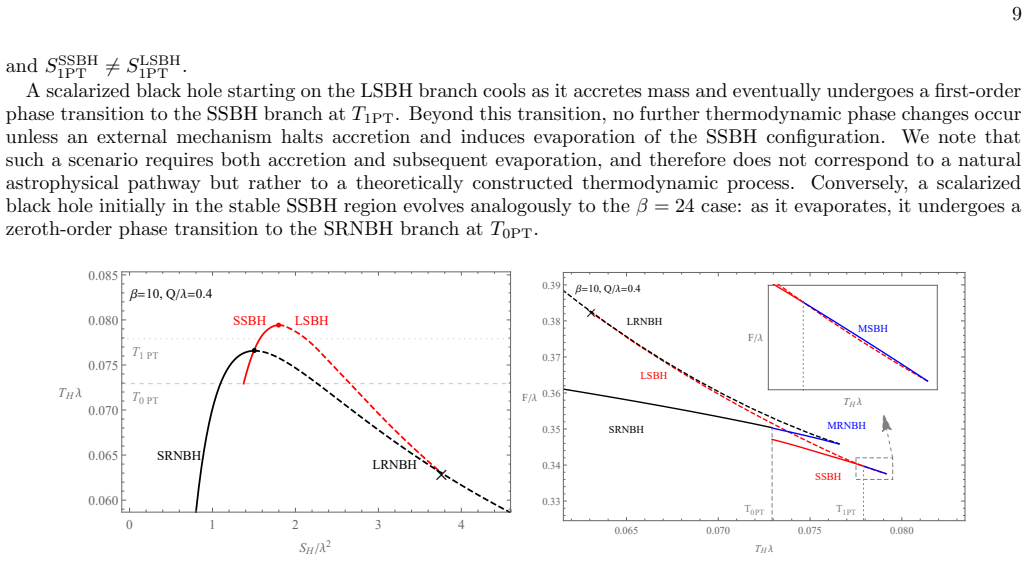
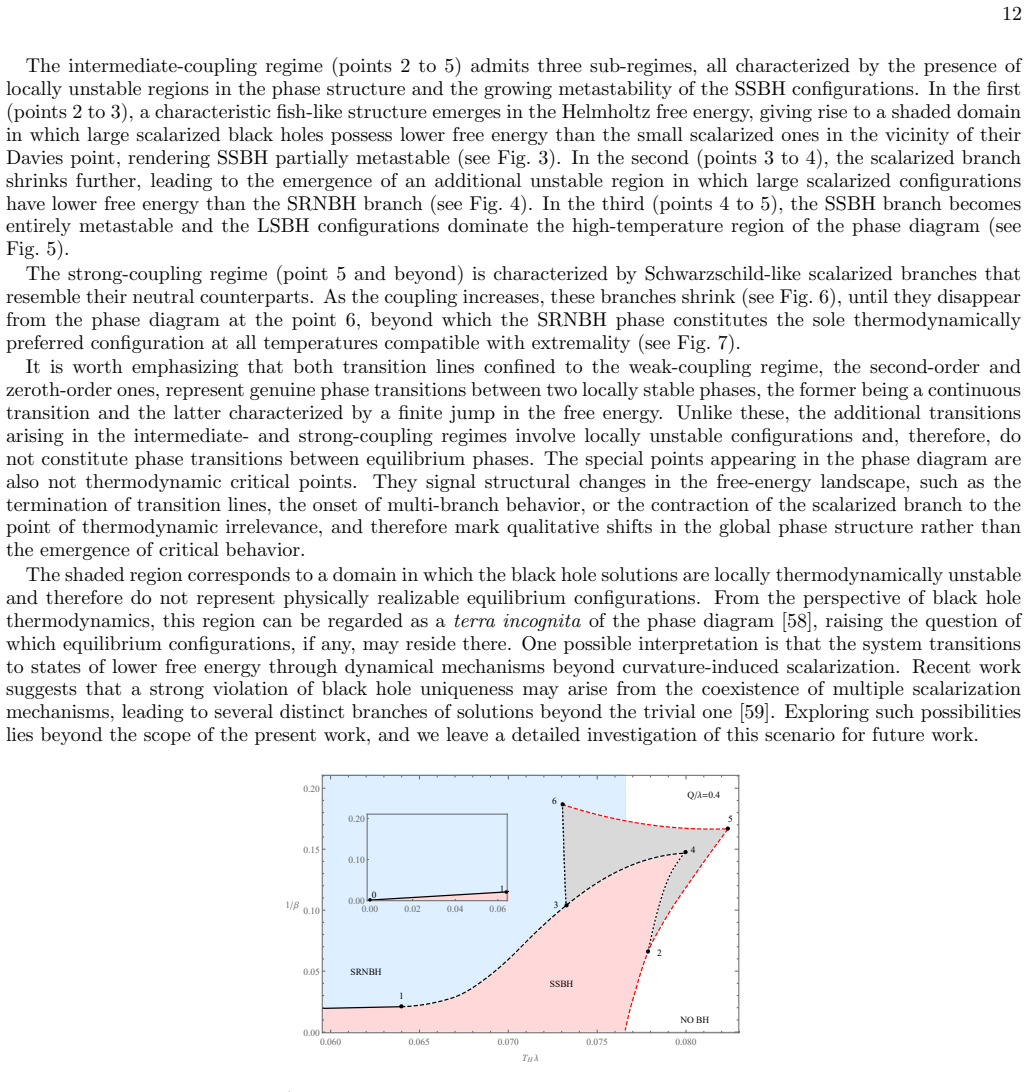
In the canonical ensemble the Euclidean action yields Helmholtz free energies whose crossings between locally stable scalarized and small Reissner-Nordström branches constitute genuine thermodynamic phase transitions. At weak coupling a second-order transition occurs exactly at the second bifurcation point; as the Gauss-Bonnet coupling increases the transition becomes zeroth-order, the scalarized branch develops a fish-like structure, and up to three transitions appear. In the strong-coupling limit the scalarized solutions reduce to Schwarzschild-like configurations and the Reissner-Nordström phase becomes the only thermodynamically preferred state.
What carries the argument
The Euclidean action evaluated on the on-shell solutions, which supplies the Helmholtz free energy whose level crossings mark equilibrium phase transitions between scalarized and Reissner-Nordström branches.
If this is right
- Locally stable scalarized black holes coexist with small Reissner-Nordström black holes over a range of temperatures and charges.
- A second-order phase transition occurs at the second bifurcation point for weak coupling, after which scalar hair is shed.
- Stronger coupling produces a zeroth-order transition, a fish-like free-energy structure, and up to three distinct phase transitions.
- In the strong-coupling limit the scalarized branch shrinks to a Schwarzschild-like solution and the Reissner-Nordström phase is thermodynamically preferred.
Where Pith is reading between the lines
- The same curvature-driven mechanism may generate phase transitions in other higher-curvature theories without added confining potentials.
- Metastable states visible in the fish-like free-energy diagram could be probed by dynamical simulations of scalar-field evolution on black-hole backgrounds.
- The reduction to a single preferred Reissner-Nordström phase at strong coupling suggests a universal endpoint for scalarized charged black holes in modified gravity.
Load-bearing premise
Free-energy crossings between locally stable branches correctly identify equilibrium thermodynamic phase transitions.
What would settle it
Explicit numerical evaluation of the on-shell Euclidean action for the scalarized solutions at intermediate coupling values that shows the free-energy curves never cross or that the scalarized branch is never locally stable.
Figures



read the original abstract
Although asymptotically flat black holes generically lack thermodynamic phase transitions, we show that curvature-induced scalarization of electrically charged black holes in Einstein-Maxwell- Scalar-Gauss-Bonnet theory provides a natural setting for nontrivial thermodynamic behavior, without invoking external confining mechanisms or an extended thermodynamic formalism. Working within the canonical ensemble and employing the Euclidean approach, we identify the coexistence of locally stable scalarized and small Reissner-Nordstr\"om thermal states, which promotes free-energy crossings to bona fide phase transitions between equilibrium phases. For weak coupling, a second-order phase transition coincides with the second bifurcation point, at which the scalarized branch reconnects with the Reissner-Nordstr\"om branch and scalar hair is spontaneously shed. As the coupling strength increases, this transition becomes zeroth order, the scalarized branch shrinks, and a fish-like structure develops in its Helmholtz free energy, rendering locally stable thermal states partially metastable, and yielding up to three phase transitions. In the strong-coupling limit, the scalarized branch reduces to a Schwarzschild-like solution, and the Reissner-Nordstr\"om phase ultimately emerges as the sole thermodynamically preferred configuration
Editorial analysis
A structured set of objections, weighed in public.
Referee Report
Summary. The paper claims that curvature-induced scalarization in asymptotically flat Einstein-Maxwell-Scalar-Gauss-Bonnet black holes enables genuine thermodynamic phase transitions in the canonical ensemble (via Euclidean action and Helmholtz free energy), without external confining mechanisms. For weak Gauss-Bonnet coupling, a second-order transition occurs at the second bifurcation point where scalar hair is shed; stronger coupling turns this zeroth-order, produces a fish-like free-energy structure with up to three transitions, and reduces the scalarized branch to a Schwarzschild-like solution, leaving RN as the preferred state.
Significance. If the local stability of both branches is rigorously confirmed, the result is significant: it supplies a natural, mechanism-free route to multiple thermodynamic phase transitions (including zeroth-order) for asymptotically flat charged black holes, which generically lack them. This enriches the phase structure of modified-gravity black holes and may inform studies of spontaneous scalarization and black-hole thermodynamics.
major comments (2)
- [Abstract and stability discussion] Abstract and stability analysis: the central claim that free-energy crossings constitute 'bona fide phase transitions between equilibrium phases' rests on the assertion that both the scalarized and small RN branches are locally stable. This requires explicit verification (positive specific heat at fixed charge or absence of negative modes in the quadratic perturbation action) rather than inference solely from bifurcation reconnection or free-energy shape; without these checks the promotion of crossings to equilibrium transitions is not load-bearing.
- [Numerical results] Results and numerical methods: the reported free-energy curves, bifurcation points, and the fish-like structure at intermediate coupling are presented without details on the numerical scheme (e.g., shooting or relaxation method, grid resolution, convergence criteria, or error estimates on the free-energy differences). These omissions undermine in the claimed number and order of transitions.
minor comments (2)
- [Abstract] The abstract is dense; a single sentence summarizing the numerical approach or the range of couplings explored would improve readability.
- [Introduction] Notation for the Gauss-Bonnet coupling and the scalar charge should be introduced once and used consistently; occasional redefinition risks confusion.
Simulated Author's Rebuttal
We thank the referee for the careful reading of our manuscript and the constructive comments. We appreciate the positive assessment of the potential significance of our results on thermodynamic phase transitions in Einstein-Maxwell-Scalar-Gauss-Bonnet gravity. Below we provide point-by-point responses to the major comments and indicate the revisions made to address them.
read point-by-point responses
-
Referee: [Abstract and stability discussion] Abstract and stability analysis: the central claim that free-energy crossings constitute 'bona fide phase transitions between equilibrium phases' rests on the assertion that both the scalarized and small RN branches are locally stable. This requires explicit verification (positive specific heat at fixed charge or absence of negative modes in the quadratic perturbation action) rather than inference solely from bifurcation reconnection or free-energy shape; without these checks the promotion of crossings to equilibrium transitions is not load-bearing.
Authors: We agree that explicit verification of local stability is required to rigorously support the identification of bona fide phase transitions. In the original manuscript, local stability was inferred from the reconnection of branches at the bifurcation points together with the shape of the Helmholtz free-energy curves (where the lower free-energy branch is taken as the globally stable state). To strengthen this, the revised manuscript now includes explicit calculations of the specific heat at fixed charge, C_Q = T (∂S/∂T)_Q, for both the scalarized and small Reissner-Nordström branches. We show that C_Q remains positive throughout the parameter ranges where we claim local stability, confirming the absence of thermodynamic instabilities. We also briefly discuss the absence of negative modes in the quadratic perturbation spectrum, consistent with the bifurcation analysis. These additions make the central claim load-bearing. revision: yes
-
Referee: [Numerical results] Results and numerical methods: the reported free-energy curves, bifurcation points, and the fish-like structure at intermediate coupling are presented without details on the numerical scheme (e.g., shooting or relaxation method, grid resolution, convergence criteria, or error estimates on the free-energy differences). These omissions undermine in the claimed number and order of transitions.
Authors: We concur that a detailed description of the numerical methods is essential for reproducibility and in the reported structures. The revised manuscript now contains a dedicated paragraph in the numerical results section specifying the scheme: a combination of the shooting method with relaxation to solve the coupled ODEs for the metric functions and scalar field, subject to the appropriate boundary conditions at the horizon and at infinity. We report the typical radial grid resolution (800–1200 points with adaptive refinement near the horizon), the convergence criterion (maximum residual < 10^{-9}), and error estimates on the free-energy differences obtained via grid-doubling tests (relative errors < 0.3 %). These details confirm the robustness of the fish-like free-energy structure and the number and order of the phase transitions. revision: yes
Circularity Check
No circularity: thermodynamic transitions derived from action and branches
full rationale
The paper computes the Euclidean action and Helmholtz free energy for the EMSGB solutions, locates bifurcation points where scalarized branches meet the RN branch, and interprets free-energy crossings as phase transitions. No equations reduce by construction to fitted inputs, no parameters are fit to a subset and relabeled as predictions, and no load-bearing uniqueness theorems or ansatze are imported solely via self-citation. The derivation chain (action → on-shell free energy → branch comparison) remains self-contained against external thermodynamic definitions and does not collapse to its own outputs.
Axiom & Free-Parameter Ledger
free parameters (1)
- Gauss-Bonnet coupling strength
axioms (2)
- domain assumption The Euclidean path-integral method yields the correct thermodynamic potential in the canonical ensemble for these asymptotically flat solutions.
- domain assumption Locally stable branches (positive specific heat or negative free-energy second derivative) correspond to equilibrium phases.
Reference graph
Works this paper leans on
-
[1]
S. Carlip, “Black Hole Thermodynamics,”Int. J. Mod. Phys. D23(2014) 1430023,arXiv:1410.1486 [gr-qc]
-
[2]
Black holes and entropy,
J. D. Bekenstein, “Black holes and entropy,”Phys. Rev. D7(1973) 2333–2346
1973
-
[3]
Particle Creation by Black Holes,
S. W. Hawking, “Particle Creation by Black Holes,”Commun. Math. Phys.43(1975) 199–220. [Erratum: Commun.Math.Phys. 46, 206 (1976)]
1975
-
[4]
The Four laws of black hole mechanics,
J. M. Bardeen, B. Carter, and S. W. Hawking, “The Four laws of black hole mechanics,”Commun. Math. Phys.31 (1973) 161–170
1973
-
[5]
Action Integrals and Partition Functions in Quantum Gravity,
G. W. Gibbons and S. W. Hawking, “Action Integrals and Partition Functions in Quantum Gravity,”Phys. Rev. D15 (1977) 2752–2756
1977
-
[6]
Black Holes and Thermodynamics,
S. W. Hawking, “Black Holes and Thermodynamics,”Phys. Rev. D13(1976) 191–197
1976
-
[7]
Introducing the black hole,
R. Ruffini and J. A. Wheeler, “Introducing the black hole,”Phys. Today24no. 1, (1971) 30
1971
-
[8]
Black hole explosions,
S. W. Hawking, “Black hole explosions,”Nature248(1974) 30–31
1974
-
[9]
Thermodynamics of black holes,
P. C. W. Davies, “Thermodynamics of black holes,”Rept. Prog. Phys.41(1978) 1313–1355
1978
-
[10]
Thermodynamics of Black Holes in anti-De Sitter Space,
S. W. Hawking and D. N. Page, “Thermodynamics of Black Holes in anti-De Sitter Space,”Commun. Math. Phys.87 (1983) 577
1983
-
[11]
Charged AdS Black Holes and Catastrophic Holography
A. Chamblin, R. Emparan, C. V. Johnson, and R. C. Myers, “Charged AdS black holes and catastrophic holography,” Phys. Rev. D60(1999) 064018,arXiv:hep-th/9902170
work page Pith review arXiv 1999
-
[12]
D. Kubiznak, R. B. Mann, and M. Teo, “Black hole chemistry: thermodynamics with Lambda,”Class. Quant. Grav.34 no. 6, (2017) 063001,arXiv:1608.06147 [hep-th]
-
[13]
N. Altamirano, D. Kubiznak, and R. B. Mann, “Reentrant phase transitions in rotating anti–de Sitter black holes,”Phys. Rev. D88no. 10, (2013) 101502,arXiv:1306.5756 [hep-th]
-
[14]
Kerr-AdS analogue of triple point and solid/liquid/gas phase transition,
N. Altamirano, D. Kubizˇ n´ ak, R. B. Mann, and Z. Sherkatghanad, “Kerr-AdS analogue of triple point and solid/liquid/gas phase transition,”Class. Quant. Grav.31(2014) 042001,arXiv:1308.2672 [hep-th]
-
[15]
S.-W. Wei and Y.-X. Liu, “Triple points and phase diagrams in the extended phase space of charged Gauss-Bonnet black holes in AdS space,”Phys. Rev. D90no. 4, (2014) 044057,arXiv:1402.2837 [hep-th]
-
[16]
Black hole chemistry: The first 15 years,
R. B. Mann, “Black hole chemistry: The first 15 years,”Int. J. Mod. Phys. D34no. 09, (2025) 2542001
2025
-
[17]
Black hole thermodynamics and the Euclidean Einstein action,
J. W. York, Jr., “Black hole thermodynamics and the Euclidean Einstein action,”Phys. Rev. D33(1986) 2092–2099
1986
-
[18]
Charged black hole in a canonical ensemble,
A. P. Lundgren, “Charged black hole in a canonical ensemble,”Phys. Rev. D77(2008) 044014,arXiv:gr-qc/0612119
-
[19]
D. Astefanesei, R. B. Mann, and R. Rojas, “Hairy Black Hole Chemistry,”JHEP11(2019) 043,arXiv:1907.08636 [hep-th]
-
[20]
A no-hair theorem for the galileon
L. Hui and A. Nicolis, “No-Hair Theorem for the Galileon,”Phys. Rev. Lett.110(2013) 241104,arXiv:1202.1296 [hep-th]
work page Pith review arXiv 2013
-
[21]
Asymptotically flat black holes with scalar hair: a review
C. A. R. Herdeiro and E. Radu, “Asymptotically flat black holes with scalar hair: a review,”Int. J. Mod. Phys. D24 no. 09, (2015) 1542014,arXiv:1504.08209 [gr-qc]
work page Pith review arXiv 2015
-
[22]
No-hair theorems in general relativity and scalar–tensor theories,
S. S. Yazadjiev and D. D. Doneva, “No-hair theorems in general relativity and scalar–tensor theories,”Int. J. Mod. Phys. D34no. 09, (2025) 2530004,arXiv:2505.01038 [gr-qc]
-
[23]
Introduction to Effective Field Theory,
C. P. Burgess, “Introduction to Effective Field Theory,”Ann. Rev. Nucl. Part. Sci.57(2007) 329–362, arXiv:hep-th/0701053
-
[24]
Flux compactifications in string theory: a comprehensive review
M. Grana, “Flux compactifications in string theory: A Comprehensive review,”Phys. Rept.423(2006) 91–158, arXiv:hep-th/0509003
work page Pith review arXiv 2006
-
[25]
Polchinski,String theory
J. Polchinski,String theory. Vol. 1: An introduction to the bosonic string. Cambridge Monographs on Mathematical Physics. Cambridge University Press, 12, 2007
2007
- [26]
-
[27]
Dynamically and thermodynamically stable black holes in Einstein-Maxwell-dilaton gravity,
D. Astefanesei, J. L. Bl´ azquez-Salcedo, C. Herdeiro, E. Radu, and N. Sanchis-Gual, “Dynamically and thermodynamically stable black holes in Einstein-Maxwell-dilaton gravity,”JHEP07(2020) 063,arXiv:1912.02192 [gr-qc]
-
[28]
Quasilocal formalism and thermodynamics of asymptotically flat black objects,
D. Astefanesei, R. B. Mann, M. J. Rodriguez, and C. Stelea, “Quasilocal formalism and thermodynamics of asymptotically flat black objects,”Class. Quant. Grav.27(2010) 165004,arXiv:0909.3852 [hep-th]
-
[29]
Thermodynamically stable asymptotically flat hairy black holes with a dilaton potential,
D. Astefanesei, D. Choque, F. G´ omez, and R. Rojas, “Thermodynamically stable asymptotically flat hairy black holes with a dilaton potential,”JHEP03(2019) 205,arXiv:1901.01269 [hep-th]
-
[30]
D. Astefanesei, J. Luis Bl´ azquez-Salcedo, F. G´ omez, and R. Rojas, “Thermodynamically stable asymptotically flat hairy black holes with a dilaton potential: the general case,”JHEP02(2021) 233,arXiv:2009.01854 [hep-th]
-
[31]
Existence of thermodynamically stable asymptotically flat black holes,
D. Astefanesei, R. Ballesteros, P. Cabrera, G. Casanova, and R. Rojas, “Existence of thermodynamically stable asymptotically flat black holes,”Phys. Rev. D110no. 2, (2024) 024045,arXiv:2404.15566 [hep-th]
-
[32]
C. Erices and M. Fathi, “Thermodynamic and observational constraints on black holes with primary hair in Beyond Horndeski gravity: Stability and shadows,”JCAP01(2025) 016,arXiv:2409.07312 [gr-qc]
-
[33]
A. Bakopoulos, N. Chatzifotis, and T. Karakasis, “Thermodynamics of black holes featuring primary scalar hair,”Phys. Rev. D110no. 10, (2024) L101502,arXiv:2404.07522 [hep-th]
-
[34]
Renormalization of Higher Derivative Quantum Gravity,
K. S. Stelle, “Renormalization of Higher Derivative Quantum Gravity,”Phys. Rev. D16(1977) 953–969. 15
1977
-
[35]
Charged black holes in effective string theory,
S. Mignemi and N. R. Stewart, “Charged black holes in effective string theory,”Phys. Rev. D47(1993) 5259–5269, arXiv:hep-th/9212146
- [36]
-
[37]
Dilatonic Black Holes with Gauss-Bonnet Term
T. Torii, H. Yajima, and K.-i. Maeda, “Dilatonic black holes with Gauss-Bonnet term,”Phys. Rev. D55(1997) 739–753, arXiv:gr-qc/9606034
work page Pith review arXiv 1997
-
[38]
D. Ayzenberg and N. Yunes, “Slowly rotating black holes in einstein-dilaton-gauss-bonnet gravity: Quadratic order in spin solutions,”Physical Review D90no. 4, (Aug, 2014) .http://dx.doi.org/10.1103/PhysRevD.90.044066
-
[39]
Rotating black holes in dilatonic einstein-gauss-bonnet theory,
B. Kleihaus, J. Kunz, and E. Radu, “Rotating black holes in dilatonic einstein-gauss-bonnet theory,”Physical Review Letters106no. 15, (Apr, 2011) .http://dx.doi.org/10.1103/PhysRevLett.106.151104
-
[40]
Rapidly rotating neutron stars in dilatonic einstein-gauss-bonnet theory,
B. Kleihaus, J. Kunz, S. Mojica, and M. Zagermann, “Rapidly rotating neutron stars in dilatonic einstein-gauss-bonnet theory,”Physical Review D93no. 6, (Mar, 2016) .http://dx.doi.org/10.1103/PhysRevD.93.064077
-
[41]
EFT approach to black hole scalarization and its compatibility with cosmic evolution,
C. Erices, S. Riquelme, and N. Zalaquett, “EFT approach to black hole scalarization and its compatibility with cosmic evolution,”Phys. Rev. D106no. 4, (2022) 044046,arXiv:2203.06030 [gr-qc]
-
[42]
T. Damour and G. Esposito-Far` ese, “Nonperturbative strong-field effects in tensor-scalar theories of gravitation,”Phys. Rev. Lett.70(Apr, 1993) 2220–2223.https://link.aps.org/doi/10.1103/PhysRevLett.70.2220
-
[43]
Tensor - scalar gravity and binary pulsar experiments,
T. Damour and G. Esposito-Farese, “Tensor - scalar gravity and binary pulsar experiments,”Phys. Rev. D54(1996) 1474–1491,arXiv:gr-qc/9602056
-
[44]
D. D. Doneva and S. S. Yazadjiev, “New Gauss-Bonnet Black Holes with Curvature-Induced Scalarization in Extended Scalar-Tensor Theories,”Phys. Rev. Lett.120no. 13, (2018) 131103,arXiv:1711.01187 [gr-qc]
work page Pith review arXiv 2018
-
[45]
Spontaneous scalarization of black holes and compact stars from a Gauss-Bonnet coupling
H. O. Silva, J. Sakstein, L. Gualtieri, T. P. Sotiriou, and E. Berti, “Spontaneous scalarization of black holes and compact stars from a Gauss-Bonnet coupling,”Phys. Rev. Lett.120no. 13, (2018) 131104,arXiv:1711.02080 [gr-qc]
work page Pith review arXiv 2018
-
[46]
Spontaneous scalarisation of charged black holes
C. A. R. Herdeiro, E. Radu, N. Sanchis-Gual, and J. A. Font, “Spontaneous Scalarization of Charged Black Holes,”Phys. Rev. Lett.121no. 10, (2018) 101102,arXiv:1806.05190 [gr-qc]
work page Pith review arXiv 2018
-
[47]
Charged gauss-bonnet black holes with curvature induced scalarization in the extended scalar-tensor theories,
D. D. Doneva, S. Kiorpelidi, P. G. Nedkova, E. Papantonopoulos, and S. S. Yazadjiev, “Charged gauss-bonnet black holes with curvature induced scalarization in the extended scalar-tensor theories,”Physical Review D98no. 10, (Nov,
-
[48]
http://dx.doi.org/10.1103/PhysRevD.98.104056
-
[49]
Spontaneous scalarisation of charged black holes: coupling dependence and dynamical features,
P. G. S. Fernandes, C. A. R. Herdeiro, A. M. Pombo, E. Radu, and N. Sanchis-Gual, “Spontaneous scalarisation of charged black holes: coupling dependence and dynamical features,”Classical and Quantum Gravity36no. 13, (Jun,
-
[50]
134002.http://dx.doi.org/10.1088/1361-6382/ab23a1
-
[51]
Spin-induced black hole spontaneous scalarization,
A. Dima, E. Barausse, N. Franchini, and T. P. Sotiriou, “Spin-induced black hole spontaneous scalarization,”Phys. Rev. Lett.125no. 23, (2020) 231101,arXiv:2006.03095 [gr-qc]
-
[52]
D. D. Doneva, F. M. Ramazano˘ glu, H. O. Silva, T. P. Sotiriou, and S. S. Yazadjiev, “Spontaneous scalarization,”Rev. Mod. Phys.96no. 1, (2024) 015004,arXiv:2211.01766 [gr-qc]
-
[53]
C. Herdeiro, H. Huang, J. Kunz, M.-Y. Lai, E. Radu, and D.-C. Zou, “Phase Structure of Scalarized Black Holes in Einstein-Scalar-Gauss-Bonnet Gravity,”arXiv:2603.24164 [gr-qc]
-
[54]
D. D. Doneva, S. Kiorpelidi, P. G. Nedkova, E. Papantonopoulos, and S. S. Yazadjiev, “Charged Gauss-Bonnet black holes with curvature induced scalarization in the extended scalar-tensor theories,”Phys. Rev. D98no. 10, (2018) 104056,arXiv:1809.00844 [gr-qc]
-
[55]
Radial perturbations of scalar-Gauss-Bonnet black holes beyond spontaneous scalarization,
J. L. Bl´ azquez-Salcedo, D. D. Doneva, J. Kunz, and S. S. Yazadjiev, “Radial perturbations of scalar-Gauss-Bonnet black holes beyond spontaneous scalarization,”Phys. Rev. D105no. 12, (2022) 124005,arXiv:2203.00709 [gr-qc]
-
[56]
Black Hole Entropy is Noether Charge
R. M. Wald, “Black hole entropy is the Noether charge,”Phys. Rev. D48no. 8, (1993) R3427–R3431, arXiv:gr-qc/9307038
work page Pith review arXiv 1993
-
[57]
The thermodynamics of black holes,
R. M. Wald, “The thermodynamics of black holes,”Living Rev. Rel.4(2001) 6,arXiv:gr-qc/9912119
-
[58]
Thermal stability of hairy black holes,
N. Chatzifotis, P. Dorlis, N. E. Mavromatos, and E. Papantonopoulos, “Thermal stability of hairy black holes,”Phys. Rev. D107no. 8, (2023) 084053,arXiv:2302.03980 [gr-qc]
-
[59]
L. D. Landau and E. M. Lifshitz,Statistical Physics, Part 1, vol. 5 ofCourse of Theoretical Physics. Butterworth-Heinemann, Oxford, 1980
1980
-
[60]
Holography, Thermodynamics and Fluctuations of Charged AdS Black Holes
A. Chamblin, R. Emparan, C. V. Johnson, and R. C. Myers, “Holography, thermodynamics and fluctuations of charged AdS black holes,”Phys. Rev. D60(1999) 104026,arXiv:hep-th/9904197
work page Pith review arXiv 1999
-
[61]
Strong breaking of black-hole uniqueness from coexisting scalarization mechanisms,
A. Eichhorn, P. G. S. Fernandes, and L. Marino, “Strong breaking of black-hole uniqueness from coexisting scalarization mechanisms,”arXiv:2603.05064 [gr-qc]
-
[62]
Thermodynamic stability of quasibald asymptotically flat black holes,
N. M. Santos, C. A. R. Herdeiro, and E. Radu, “Thermodynamic stability of quasibald asymptotically flat black holes,” Phys. Rev. D106no. 12, (2022) 124005,arXiv:2207.10089 [gr-qc]
-
[63]
New model of spontaneous scalarization of black holes induced by curvature and matter,
Z. Belkhadria and S. Mignemi, “New model of spontaneous scalarization of black holes induced by curvature and matter,”Phys. Rev. D112no. 4, (2025) 044015,arXiv:2506.12137 [gr-qc]
discussion (0)
Sign in with ORCID, Apple, or X to comment. Anyone can read and Pith papers without signing in.