Recognition: unknown
Quantum Dynamics via Score Matching on Bohmian Trajectories
Pith reviewed 2026-05-07 16:56 UTC · model grok-4.3
The pith
Minimizing a self-consistent score-matching loss on Bohmian trajectories recovers exact Schrödinger dynamics for nodeless wave functions.
A machine-rendered reading of the paper's core claim, the machinery that carries it, and where it could break.
Core claim
Parametrizing the score with a neural network and minimizing the self-consistent Fisher divergence between the network output and the score of the density evolved under the Bohmian velocity field derived from that score yields a zero-loss solution that satisfies both the continuity equation and the quantum Hamilton-Jacobi equation. Consequently the learned dynamics recover the full time-dependent Schrödinger equation for nodeless wave functions. The non-crossing nature of the trajectories guarantees that the mapping remains a valid continuous normalizing flow.
What carries the argument
Self-consistent Fisher divergence minimization between a neural-network score and the score of the probability density induced by the Bohmian flow whose velocity is itself determined by that score.
If this is right
- Wave-packet splitting in a double-well potential can be simulated by evolving only an ensemble of trajectories guided by the learned score.
- Anharmonic vibrations of a Morse chain can be computed without discretizing the full many-dimensional wave function.
- Zero loss guarantees exact recovery of Schrödinger evolution whenever the wave function remains nodeless.
- Time-dependent quantum problems are recast as training tasks in score-based generative modeling.
Where Pith is reading between the lines
- The same self-consistent objective could be paired with more advanced normalizing-flow architectures to improve sampling efficiency in higher-dimensional systems.
- Because the method is demonstrated on atomic vibrations, it suggests a route to computing vibrational spectra directly from trajectory ensembles rather than from grid-based wave functions.
Load-bearing premise
The minimization procedure is assumed to reach the true score globally without becoming trapped by approximation errors or instabilities, and the target wave functions must stay nodeless so that trajectories never cross.
What would settle it
Apply the trained network to the exactly solvable harmonic oscillator, extract the time-evolved density from the trajectories, and check whether it matches the known analytic Gaussian wave-packet solution to numerical precision at multiple times.
Figures


read the original abstract
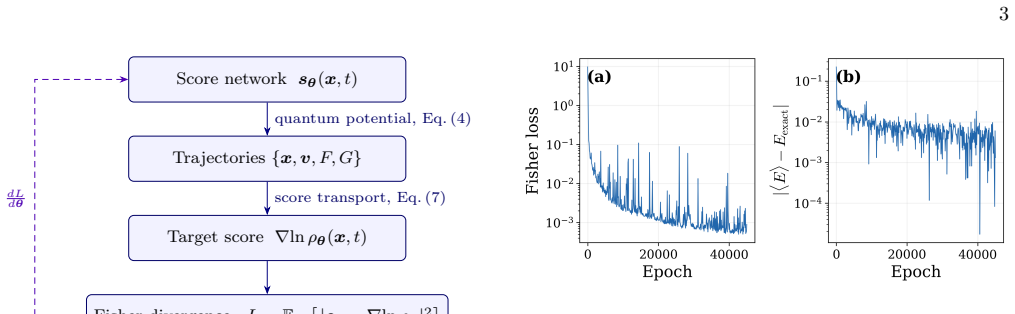
We solve the time-dependent Schr\"odinger equation by learning the score function, the gradient of the log-probability density, on Bohmian trajectories. In Bohm's formulation of quantum mechanics, particles follow deterministic paths under the classical potential supplemented by a quantum potential depending on the score function of the evolving density. These non-crossing Bohmian trajectories form a continuous normalizing flow governed by the score. We parametrize the score with a neural network and minimize a self-consistent Fisher divergence between the network and the score of the resulting density. We prove that the zero-loss minimizer of this self-consistent objective recovers Schr\"odinger dynamics for nodeless wave functions, a condition naturally met in quantum vibrations of atoms. We demonstrate the approach on wavepacket splitting in a double-well potential and anharmonic vibrations of a Morse chain. By recasting real-time quantum dynamics as a self-consistent score-driven normalizing flow, this framework opens the time-dependent Schr\"odinger equation to the rapidly advancing toolkit of modern generative modeling.
Editorial analysis
A structured set of objections, weighed in public.
Referee Report
Summary. The manuscript proposes solving the time-dependent Schrödinger equation by parametrizing the score function (gradient of log-density) with a neural network and minimizing a self-consistent Fisher divergence objective on Bohmian trajectories. These trajectories form a continuous normalizing flow whose velocity depends on the learned score. The central theoretical claim is a proof that any zero-loss minimizer of this objective recovers exact Schrödinger dynamics for nodeless wave functions. The approach is demonstrated numerically on wave-packet splitting in a double-well potential and anharmonic vibrations of a Morse chain.
Significance. If the zero-loss recovery result holds and the optimization reaches it in practice, the work would usefully recast real-time quantum dynamics as a score-based generative modeling task, potentially allowing the TDSE to benefit from advances in continuous normalizing flows and score matching. The explicit proof for the nodeless case (relevant to many vibrational problems) and the connection to Bohmian mechanics are concrete strengths that distinguish the contribution from purely heuristic ML-for-quantum-dynamics papers.
major comments (2)
- [theoretical derivation of zero-loss minimizer] Proof of zero-loss recovery (theoretical section): the argument correctly shows that an exact zero of the self-consistent Fisher divergence implies the TDSE under the nodeless assumption, but does not establish uniqueness of the fixed point or rule out other self-consistent solutions that satisfy the objective yet fail to reproduce Schrödinger evolution. Because trajectories are generated on-the-fly from the current network, this leaves open whether the optimization landscape contains non-physical attractors.
- [demonstrations on double-well and Morse potentials] Numerical experiments (double-well and Morse-chain sections): the demonstrations are qualitative only; no quantitative error metrics (e.g., L2 deviation from exact TDSE solutions, conservation of energy or norm, or convergence of the loss to machine zero) are reported, nor is there analysis of discretization artifacts or batch-size effects on the self-consistent loop. This makes it impossible to assess whether practical training reaches the regime where the proof applies.
minor comments (2)
- [methods] Notation for the self-consistent objective and the Fisher divergence should be introduced with an explicit equation number early in the methods section to improve readability.
- [discussion] The manuscript would benefit from a short discussion of how the nodeless condition is verified or enforced for the target systems, even if it holds for the chosen examples.
Simulated Author's Rebuttal
We thank the referee for the positive assessment of our work's significance and for the constructive comments. We address each major point below and describe the revisions we will undertake.
read point-by-point responses
-
Referee: Proof of zero-loss recovery (theoretical section): the argument correctly shows that an exact zero of the self-consistent Fisher divergence implies the TDSE under the nodeless assumption, but does not establish uniqueness of the fixed point or rule out other self-consistent solutions that satisfy the objective yet fail to reproduce Schrödinger evolution. Because trajectories are generated on-the-fly from the current network, this leaves open whether the optimization landscape contains non-physical attractors.
Authors: We appreciate the referee's precise reading. Our derivation shows that any exact zero of the self-consistent objective recovers the TDSE for nodeless wave functions, as stated. We agree that the proof does not establish uniqueness of this fixed point or exclude other self-consistent solutions, and that on-the-fly trajectory generation leaves open the possibility of non-physical attractors. In the revised manuscript we will add an explicit discussion of this limitation in the theoretical section, noting that the nodeless condition together with the continuity of the Bohmian flow strongly constrains the solution space while acknowledging that practical optimization may require suitable initialization to reach the physical attractor. We present this as an important open question rather than a fully settled claim. revision: partial
-
Referee: Numerical experiments (double-well and Morse-chain sections): the demonstrations are qualitative only; no quantitative error metrics (e.g., L2 deviation from exact TDSE solutions, conservation of energy or norm, or convergence of the loss to machine zero) are reported, nor is there analysis of discretization artifacts or batch-size effects on the self-consistent loop. This makes it impossible to assess whether practical training reaches the regime where the proof applies.
Authors: We agree that the current numerical demonstrations are qualitative. In the revised manuscript we will add quantitative metrics, including L2 deviations from reference TDSE solutions for the double-well example, time series of energy and norm conservation, and plots of loss convergence during self-consistent training. We will also include a brief analysis of discretization step size and batch-size effects on the stability of the self-consistent loop to demonstrate that the reported trajectories operate in the regime where the zero-loss guarantee is expected to hold. revision: yes
Circularity Check
No significant circularity in the derivation chain
full rationale
The paper defines a self-consistent Fisher divergence objective whose fixed point is the score matching the density induced by trajectories driven by that score. It then supplies an explicit proof that any zero-loss solution of this objective recovers the time-dependent Schrödinger equation for nodeless wave functions. Because the proof supplies an independent mathematical reduction from the fixed-point condition to the TDSE (rather than the equivalence being true by definition or by renaming), the central claim does not collapse to its inputs. No load-bearing self-citations, fitted parameters presented as predictions, or smuggled ansatzes appear in the derivation. The self-consistency is a deliberate fixed-point formulation whose correctness is verified externally by the proof, making the overall argument self-contained against external benchmarks.
Axiom & Free-Parameter Ledger
free parameters (1)
- Neural network weights
axioms (2)
- domain assumption Bohmian trajectories form a continuous normalizing flow governed by the score function
- domain assumption Zero loss of the self-consistent objective recovers exact Schrödinger dynamics for nodeless wave functions
Reference graph
Works this paper leans on
-
[1]
Meyer, U
H.-D. Meyer, U. Manthe, and L. S. Cederbaum, The multi-configurational time-dependent Hartree approach, Chem. Phys. Lett.165, 73 (1990)
1990
-
[2]
Carleo and M
G. Carleo and M. Troyer, Solving the quantum many- body problem with artificial neural networks, Science 355, 602 (2017)
2017
-
[3]
C. L. Lopreore and R. E. Wyatt, Quantum wave packet dynamics with trajectories, Physical Review Letters82, 5190 (1999)
1999
-
[4]
Sales Mayor, A
F. Sales Mayor, A. Askar, and H. A. Rabitz, Quantum fluid dynamics in the Lagrangian representation and ap- plications to photodissociation problems, The Journal of Chemical Physics111, 2423 (1999)
1999
-
[5]
R. E. Wyatt,Quantum Dynamics with Trajectories: In- troduction to Quantum Hydrodynamics, Interdisciplinary Applied Mathematics, Vol. 28 (Springer, 2005)
2005
-
[6]
Madelung, Quantentheorie in hydrodynamischer Form, Zeitschrift f¨ ur Physik40, 322 (1927)
E. Madelung, Quantentheorie in hydrodynamischer Form, Zeitschrift f¨ ur Physik40, 322 (1927)
1927
-
[7]
de Broglie, La m´ ecanique ondulatoire et la structure atomique de la mati` ere et du rayonnement, Journal de Physique et le Radium8, 225 (1927)
L. de Broglie, La m´ ecanique ondulatoire et la structure atomique de la mati` ere et du rayonnement, Journal de Physique et le Radium8, 225 (1927)
1927
-
[8]
Bohm, A suggested interpretation of the quantum the- ory in terms of “hidden” variables
D. Bohm, A suggested interpretation of the quantum the- ory in terms of “hidden” variables. I, Physical Review85, 166 (1952)
1952
-
[9]
Bohm, A suggested interpretation of the quantum the- ory in terms of “hidden” variables
D. Bohm, A suggested interpretation of the quantum the- ory in terms of “hidden” variables. II, Physical Review 85, 180 (1952)
1952
-
[10]
R. T. Q. Chen, Y. Rubanova, J. Bettencourt, and D. Du- venaud, Neural ordinary differential equations, Advances in Neural Information Processing Systems31(2018)
2018
- [11]
-
[12]
Song and S
Y. Song and S. Ermon, Generative modeling by estimat- ing gradients of the data distribution, inAdvances in Neural Information Processing Systems, Vol. 32 (2019)
2019
-
[13]
Y. Song, J. Sohl-Dickstein, D. P. Kingma, A. Kumar, S. Ermon, and B. Poole, Score-based generative mod- eling through stochastic differential equations, inInter- national Conference on Learning Representations(2021) arXiv:2011.13456
work page internal anchor Pith review arXiv 2021
-
[14]
P. R. Holland,The Quantum Theory of Motion: An Account of the de Broglie–Bohm Causal Interpretation of Quantum Mechanics(Cambridge University Press, 1993)
1993
-
[15]
Garashchuk and V
S. Garashchuk and V. A. Rassolov, Quantum dynamics with bohmian trajectories: energy conserving approxi- mation to the quantum potential, Chemical Physics Let- ters376, 358 (2003)
2003
-
[16]
Garashchuk and V
S. Garashchuk and V. A. Rassolov, Energy conserving ap- proximations to the quantum potential: Dynamics with linearized quantum force, Journal of Chemical Physics 120, 1181 (2004)
2004
-
[17]
Hyv¨ arinen, Estimation of non-normalized statistical models by score matching, Journal of Machine Learning Research6, 695 (2005)
A. Hyv¨ arinen, Estimation of non-normalized statistical models by score matching, Journal of Machine Learning Research6, 695 (2005)
2005
-
[18]
J. B. Maddox and E. R. Bittner, Estimating Bohm’s quantum force using Bayesian statistics, The Journal of Chemical Physics119, 6465 (2003)
2003
-
[19]
T. Chen, B. Xu, C. Zhang, and C. Guestrin, Training deep nets with sublinear memory cost, arXiv:1604.06174 (2016)
work page internal anchor Pith review arXiv 2016
-
[20]
Perez, F
E. Perez, F. Strub, H. de Vries, V. Dumoulin, and A. Courville, FiLM: Visual reasoning with a general con- ditioning layer, inProceedings of the AAAI Conference on Artificial Intelligence, Vol. 32 (2018)
2018
-
[21]
F´ enyes, Eine wahrscheinlichkeitstheoretische Begr¨ undung und Interpretation der Quantenmechanik, Zeitschrift f¨ ur Physik132, 81 (1952)
I. F´ enyes, Eine wahrscheinlichkeitstheoretische Begr¨ undung und Interpretation der Quantenmechanik, Zeitschrift f¨ ur Physik132, 81 (1952)
1952
-
[22]
Nelson, Derivation of the Schr¨ odinger equation from Newtonian mechanics, Physical Review150, 1079 (1966)
E. Nelson, Derivation of the Schr¨ odinger equation from Newtonian mechanics, Physical Review150, 1079 (1966)
1966
-
[23]
Maoutsa, S
D. Maoutsa, S. Reich, and M. Opper, Interacting particle solutions of Fokker–Planck equations through gradient– log–density estimation, Entropy22, 802 (2020)
2020
-
[24]
Z. Shen, Z. Wang, S. Kale, A. Ribeiro, A. Karbasi, and H. Hassani, Self-consistency of the Fokker–Planck equa- tion, inProceedings of the 35th Conference on Learning Theory, Proceedings of Machine Learning Research, Vol. 178 (2022) pp. 817–841
2022
-
[25]
N. M. Boffi and E. Vanden-Eijnden, Probability flow so- lution of the Fokker–Planck equation, Machine Learning: Science and Technology4, 035012 (2023)
2023
-
[26]
L. Li, S. Hurault, and J. Solomon, Self-consistent veloc- ity matching of probability flows, inAdvances in Neural Information Processing Systems, Vol. 36 (2023)
2023
- [27]
-
[28]
Flow Matching for Generative Modeling
Y. Lipman, R. T. Q. Chen, H. Ben-Hamu, M. Nickel, and M. Le, Flow matching for generative modeling, inInter- national Conference on Learning Representations(2023) arXiv:2210.02747
work page internal anchor Pith review arXiv 2023
-
[29]
X. Liu, C. Gong, and Q. Liu, Flow straight and fast: Learning to generate and transfer data with rectified flow, inInternational Conference on Learning Representations (2023) arXiv:2209.03003
work page internal anchor Pith review arXiv 2023
-
[30]
M. S. Albergo and E. Vanden-Eijnden, Building nor- malizing flows with stochastic interpolants, inInterna- tional Conference on Learning Representations(2023) arXiv:2209.15571
work page internal anchor Pith review arXiv 2023
-
[31]
Orlova, A
E. Orlova, A. Ustimenko, R. Jiang, P. Y. Lu, and R. Wil- lett, Deep stochastic mechanics, inProceedings of the 41st International Conference on Machine Learning, Proceed- ings of Machine Learning Research, Vol. 235 (PMLR,
- [32]
-
[33]
Carleo, F
G. Carleo, F. Becca, M. Schir´ o, and M. Fabrizio, Lo- calization and glassy dynamics of many-body quantum systems, Sci. Rep.2, 243 (2012)
2012
-
[34]
P. A. M. Dirac, Note on exchange phenomena in the Thomas atom, Math. Proc. Cambridge Philos. Soc.26, 376 (1930)
1930
-
[35]
A. D. McLachlan, A variational solution of the time- dependent Schr¨ odinger equation, Mol. Phys.8, 39 (1964)
1964
-
[36]
Raissi, P
M. Raissi, P. Perdikaris, and G. E. Karniadakis, Physics- informed neural networks: A deep learning framework for solving forward and inverse problems involving nonlinear partial differential equations, Journal of Computational Physics378, 686 (2019)
2019
- [37]
-
[38]
Sinibaldi, D
A. Sinibaldi, D. Hendry, F. Vicentini, and G. Carleo, 7 Time-dependent neural galerkin method for quantum dy- namics, Phys. Rev. Lett.136, 120402 (2026)
2026
- [39]
-
[40]
D. M. Ceperley, Fermion nodes, J. Stat. Phys.63, 1237 (1991)
1991
-
[41]
T. C. Wallstrom, Inequivalence between the Schr¨ odinger equation and the Madelung hydrodynamic equations, Physical Review A49, 1613 (1994)
1994
-
[42]
H. Xie, L. Zhang, and L. Wang, Ab-initio study of inter- acting fermions at finite temperature with neural canon- ical transformation, Journal of Machine Learning1, 38 (2022)
2022
-
[43]
H. Xie, L. Zhang, and L. Wang,m ∗ of two-dimensional electron gas: A neural canonical transformation study, SciPost Phys.14, 154 (2023)
2023
-
[44]
Z. Li, H. Xie, X. Dong, and L. Wang, Deep variational free energy calculation of hydrogen hugoniot, Phys. Rev. Lett.136, 076504 (2026)
2026
-
[45]
FFJORD: Free-form Continuous Dynamics for Scalable Reversible Generative Models
W. Grathwohl, R. T. Q. Chen, J. Bettencourt, I. Sutskever, and D. Duvenaud, FFJORD: Free-form con- tinuous dynamics for scalable reversible generative mod- els, inInternational Conference on Learning Representa- tions(2019) arXiv:1810.01367. 8 End Matter Proof of the exactness theorem We prove the Exactness Theorem by constructing the wave function Ψ = √ρ...
work page Pith review arXiv 2019
discussion (0)
Sign in with ORCID, Apple, or X to comment. Anyone can read and Pith papers without signing in.