Recognition: unknown
On the Role of Prompt Photons in the Anisotropic Emission of Direct Photons -- Direct Photons from Au+Au collisions at sqrt{s_{NN}}=200 GeV with IP-Glasma Initial Condition
Pith reviewed 2026-05-07 16:09 UTC · model grok-4.3
The pith
Accounting for prompt photons resolves apparent discrepancies in direct photon elliptic flow from Au+Au collisions.
A machine-rendered reading of the paper's core claim, the machinery that carries it, and where it could break.
Core claim
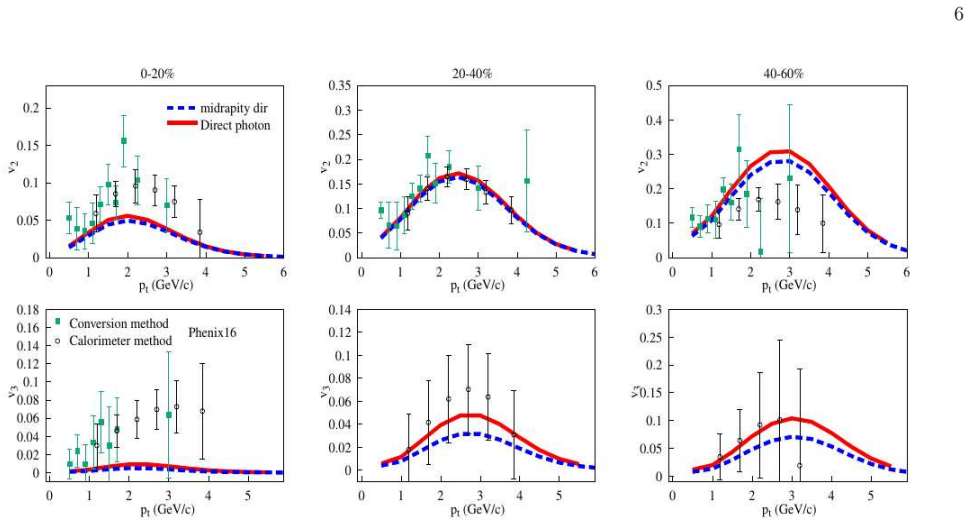
Using a (3+1)-dimensional viscous hydrodynamic model initialized with IP-Glasma conditions, the transverse momentum spectra of direct photons match RHIC data in three centrality classes. The elliptic and triangular flows are centrality dependent and agree best in mid-central collisions. Once the prompt photon component is properly subtracted, the remaining flow from thermal photons aligns with observations, and an overestimate of the prompt yield would suppress both v2 and v3 below the measured values.
What carries the argument
The (3+1)-dimensional viscous hydrodynamic evolution with IP-Glasma initial conditions, combined with pQCD estimates for prompt photons from initial hard scatterings.
If this is right
- Transverse momentum spectra of direct photons agree with data in 0-20%, 20-40%, and 40-60% centrality bins.
- Elliptic flow v2 agrees with data in the 20-40% bin but underpredicts in 0-20% collisions and overpredicts in 40-60% collisions.
- Triangular flow v3 exhibits similar centrality-dependent agreement with data.
- An overestimate of prompt photon yield suppresses both v2 and v3 below the observed experimental values.
Where Pith is reading between the lines
- Refinements to prompt photon calculations or nuclear modification factors could improve agreement in the most central and most peripheral bins.
- The same accounting for prompt photons may be required when comparing thermal photon flows at other collision energies or with different initial-state models.
- Better experimental separation of prompt and thermal photons would allow cleaner tests of hydrodynamic predictions for the quark-gluon plasma.
Load-bearing premise
The prompt photon yield estimated from perturbative QCD calculations scaled to nuclear collisions is accurate enough that it does not distort the extracted anisotropic flows.
What would settle it
An independent determination that the actual prompt photon yield in these collisions differs substantially from the pQCD value used in the calculation would change whether the hydrodynamic flows match the measured v2 and v3.
Figures


read the original abstract
The anisotropic emission of direct photons from Au+Au collisions at $\sqrt{s_{NN}}$=200 GeV was calculated using a (3+1)-dimensional viscous hydrodynamic model with the impact parameter Glasma initial condition. The transverse momentum spectra of direct photons in different centrality bins (0-20\%, 20-40\%, and 40-60\%) are in good agreement with experimental data measured at RHIC. For the elliptic flow $v_{2}$ and triangular flow $v_{3}$, the agreement is centrality dependent, showing good correspondence for the 20-40\% bin but underprediction for the 0-20\% bin and overprediction for the 40-60\% bin. After carefully accounting for the contribution from prompt photons, the measured $v_{2}$ of direct photons is no longer too large to explain. An overestimation of the prompt photon yield can suppress the $v_2$ and $v_3$ of direct photons to values lower than those observed in the experimental data.
Editorial analysis
A structured set of objections, weighed in public.
Referee Report
Summary. The manuscript calculates transverse momentum spectra and anisotropic flows (v2, v3) of direct photons in Au+Au collisions at √s_NN=200 GeV using a (3+1)D viscous hydrodynamic model with IP-Glasma initial conditions. Prompt photons are included from pQCD calculations scaled to nuclear collisions. Spectra agree with RHIC data across 0-20%, 20-40%, and 40-60% centrality bins. For v2 and v3, agreement is good in the 20-40% bin but underpredicted in 0-20% and overpredicted in 40-60%. The inclusion of prompt photons (with v2≈0) is argued to resolve the previously large direct photon v2, with the note that prompt overestimation suppresses flows below data.
Significance. If the prompt photon normalization is robust, the work addresses the direct photon flow puzzle by showing that yield-weighted averaging with prompt contributions can bring calculated v2 into agreement with data without requiring anomalously large thermal photon anisotropies. The IP-Glasma initial conditions represent a strength, offering a more dynamical and fluctuating initial state than Glauber-based models for photon production. The centrality-dependent results underscore the sensitivity of direct photon observables to prompt-thermal partitioning. Significance is reduced by the absence of quantified uncertainties on the prompt component and limited discussion of parameter tuning effects.
major comments (3)
- The central claim that 'the measured v2 of direct photons is no longer too large to explain' after including prompt photons depends on the prompt yield being accurately estimated. The manuscript explicitly states that overestimation of the prompt photon yield suppresses v2 and v3 below data, yet no uncertainty bands, alternative pQCD scale choices (renormalization/factorization scales), or nuclear PDF variations are shown for the prompt component. This is load-bearing because direct photon v2 is the yield-weighted average of thermal (nonzero v2) and prompt (v2≈0) contributions; a typical 20-30% shift in prompt normalization would move the 20-40% bin result outside reported agreement.
- No details are provided on error propagation, how the shear viscosity to entropy density ratio and IP-Glasma parameters were tuned (or their sensitivity for photons), or the precise pQCD computation and scaling procedure for prompt yields. This prevents independent verification of the reported data agreement for spectra and centrality-dependent flows, as noted in the abstract.
- While agreement is reported for the 20-40% centrality bin, the underprediction of v2/v3 in 0-20% and overprediction in 40-60% indicate incomplete resolution of the centrality dependence. This limits the strength of the conclusion that prompt photons fully address the anisotropic emission puzzle across the measured range.
minor comments (2)
- The notation distinguishing prompt, thermal, and direct photon contributions could be clarified, perhaps with an explicit equation for the weighted v2 in the methods or results section.
- Add references to the specific pQCD calculations and nuclear PDFs used for prompt photons, and consider including a table or figure showing the relative prompt vs. thermal yields in each centrality bin.
Simulated Author's Rebuttal
We thank the referee for the careful reading of our manuscript and the constructive comments. We believe the points raised will help improve the clarity and robustness of our results. We address each major comment below and indicate the revisions we plan to make.
read point-by-point responses
-
Referee: The central claim that 'the measured v2 of direct photons is no longer too large to explain' after including prompt photons depends on the prompt yield being accurately estimated. The manuscript explicitly states that overestimation of the prompt photon yield suppresses v2 and v3 below data, yet no uncertainty bands, alternative pQCD scale choices (renormalization/factorization scales), or nuclear PDF variations are shown for the prompt component. This is load-bearing because direct photon v2 is the yield-weighted average of thermal (nonzero v2) and prompt (v2≈0) contributions; a typical 20-30% shift in prompt normalization would move the 20-40% bin result outside reported agreement.
Authors: We acknowledge that the prompt photon normalization is critical to our conclusions, as the direct photon flow is indeed a yield-weighted average. In our calculation, we employed a fixed pQCD setup with standard scale choices (μ_R = μ_F = p_T) and EPS09 nuclear PDFs, as is common in the literature for such studies. While we did not present variations in the original submission, we agree this would strengthen the paper. In the revised manuscript, we will add uncertainty bands corresponding to scale variations by factors of 2 and alternative nPDF sets, showing that the agreement in the 20-40% centrality remains within uncertainties for reasonable variations. This supports that the inclusion of prompt photons resolves the anomalously large v2 issue without requiring fine-tuning. revision: yes
-
Referee: No details are provided on error propagation, how the shear viscosity to entropy density ratio and IP-Glasma parameters were tuned (or their sensitivity for photons), or the precise pQCD computation and scaling procedure for prompt yields. This prevents independent verification of the reported data agreement for spectra and centrality-dependent flows, as noted in the abstract.
Authors: We agree that additional methodological details are necessary for reproducibility. The IP-Glasma parameters were chosen to reproduce the charged hadron multiplicities and flow harmonics as in our previous works, with η/s = 0.12 fixed for the hydrodynamic evolution. For prompt photons, the pQCD cross sections were computed using the JETPHOX package with the specified scales and scaled by the number of binary collisions. In the revision, we will include a dedicated subsection detailing the parameter choices, tuning criteria, sensitivity of photon v2/v3 to variations in η/s and initial conditions, and the exact procedure for prompt photon calculation including any K-factors or scaling. Error propagation will be discussed qualitatively, noting that statistical uncertainties from hydro are small compared to systematic from initial conditions. revision: yes
-
Referee: While agreement is reported for the 20-40% centrality bin, the underprediction of v2/v3 in 0-20% and overprediction in 40-60% indicate incomplete resolution of the centrality dependence. This limits the strength of the conclusion that prompt photons fully address the anisotropic emission puzzle across the measured range.
Authors: The manuscript already emphasizes the centrality-dependent nature of the agreement, as reflected in both the abstract and the results. The remaining discrepancies can be attributed to the increasing importance of prompt photons in more peripheral collisions, where the thermal contribution is smaller, and potential limitations in the hydrodynamic description for very central or peripheral events. We do not claim perfect agreement in all bins but rather that prompt photons bring the calculated v2 into the ballpark of data, unlike pure thermal calculations which overpredict v2 significantly. In the revised version, we will expand the discussion section to better contextualize these discrepancies and their implications, without overstating the resolution of the puzzle. revision: partial
Circularity Check
No significant circularity; derivation uses external hydro constraints and pQCD prompt yields
full rationale
The paper computes thermal photon yields and v2/v3 from a (3+1)D viscous hydrodynamic model initialized with IP-Glasma conditions, then forms direct-photon observables as yield-weighted sums with prompt photons obtained from independent pQCD calculations. Hydrodynamic parameters and initial conditions are constrained by hadronic data (external benchmark), while prompt normalization follows standard pQCD scaling without evidence of refitting to the photon data under study. The reported agreement with direct-photon spectra and flows in selected centrality bins therefore constitutes an independent test rather than a reduction of the target quantities to the model's fitted inputs by construction. No self-definitional loops, fitted-input predictions, or load-bearing self-citations appear in the derivation chain.
Axiom & Free-Parameter Ledger
free parameters (2)
- shear viscosity to entropy density ratio
- IP-Glasma initial condition parameters
axioms (2)
- domain assumption Viscous hydrodynamics accurately describes the space-time evolution of the quark-gluon plasma
- domain assumption Prompt photon yield can be reliably estimated by scaling pQCD calculations from p+p to Au+Au
Reference graph
Works this paper leans on
-
[1]
A. Adare et al. [PHENIX Collaboration], Phys. Rev. Lett. 109, 122302 (2012) [arXiv:1105.4126 [nucl-ex]]
-
[2]
S. Afanasiev et al. [PHENIX Collaboration], Phys. Rev. Lett. 109, 152302 (2012) [arXiv:1205.5759[nucl-ex]]. 6 Figure 3: (Color Online) As in Fig. 2, except that the dashed l ines represent the results for direct photons within the rap idity window − 1 ≤ η ≤ 1 used for event plane determination
-
[3]
A. Adare et al. [PHENIX], Phys. Rev. C 94, no.6, 064901 (2016) [arXiv:1509.07758 [nucl-ex]]
- [4]
- [5]
- [6]
-
[7]
A Systematic study on direct photon production from central heavy ion collisions,
F. M. Liu and K. Werner, “A Systematic study on direct photon production from central heavy ion collisions,” J. Phys. G 36, 035101 (2009) [arXiv:0712.3619 [hep-ph]]
-
[8]
Centrality-dependent direct photon p(t) spectra in Au + Au collisions at RHIC,
F. -M. Liu, T. Hirano, K. Werner and Y. Zhu, “Centrality-dependent direct photon p(t) spectra in Au + Au collisions at RHIC,” Phys. Rev. C 79, 014905 (2009) [arXiv:0807.4771 [hep-ph]]
-
[9]
Ellip- tic flow of thermal photons in Au + Au collisions at s(NN)**(1/2) = 200-GeV,
F. -M. Liu, T. Hirano, K. Werner and Y. Zhu, “Ellip- tic flow of thermal photons in Au + Au collisions at s(NN)**(1/2) = 200-GeV,” Phys. Rev. C 80, 034905 (2009) [arXiv:0902.1303 [hep-ph]]
-
[10]
Direct photons at low transverse momentum: A QGP signal in pp colli- sions at LHC,
F. -M. Liu and K. Werner, “Direct photons at low transverse momentum: A QGP signal in pp colli- sions at LHC,” Phys. Rev. Lett. 106, 242301 (2011) [arXiv:1102.1052[hep-ph]]
-
[11]
Quark-gluon plasma formation time and direct photons from heavy ion collisions,
F. M. Liu and S. X. Liu, “Quark-gluon plasma formation time and direct photons from heavy ion collisions,” Phys. Rev. C 89, no.3, 034906 (2014) [arXiv:1212.6587 [nucl- th]]
- [12]
-
[13]
Fluctuating Glasma initial conditions and flow in heavy ion collisions
B. Schenke, P. Tribedy and R. Venugopalan, Phys. Rev. Lett. 108, 252301 (2012) [arXiv:1202.6646 [nucl-th]]
work page Pith review arXiv 2012
-
[14]
B. Schenke, P. Tribedy and R. Venugopalan, Phys. Rev. C 86, 034908 (2012) [[arXiv:1206.6805 [hep-ph]]
-
[15]
A. D. Martin, R. G. Roberts, W. J. Stirling, and R. S. Thorne, Eur. Phys. J. C 23, 73 (2002)
2002
-
[16]
Eskola, V.J
K.J. Eskola, V.J. Kolhinen and C.A. Salgado, Eur. Phys. J. C 9, 61 (1999); K.J. Eskola, V.J. Kolhinen and P.V. Ruuskanen, Nucl. Phys. B 535, 351 (1998)
1999
-
[17]
Owens, Rev
J.F. Owens, Rev. Mod. Phys. 59, 465 (1987)
1987
-
[18]
L. Adamczyk et al. [STAR], Phys. Lett. B 770, 451-458 (2017) [arXiv:1607.01447 [nucl-ex]]
discussion (0)
Sign in with ORCID, Apple, or X to comment. Anyone can read and Pith papers without signing in.