Recognition: unknown
Coulomb Effects and Wigner-SU(4) Symmetry in He-3 Charge and Magnetic Properties
Pith reviewed 2026-05-07 14:26 UTC · model grok-4.3
The pith
Non-perturbative Coulomb corrections modify He-3 radii by 4% in leading-order pionless EFT.
A machine-rendered reading of the paper's core claim, the machinery that carries it, and where it could break.
Core claim
At leading order in pionless effective field theory, adding the non-perturbative Coulomb interaction between the two protons in helium-3 produces a binding energy splitting of 0.85 MeV relative to tritium. The resulting corrections to the point charge radius and full magnetic radius are 0.043 fm and 0.036 fm, amounting to four percent of the leading-order predictions without Coulomb. The correction to the magnetic moment is much smaller, at -0.0041 nuclear magnetons or 0.2 percent. Wigner-SU(4) symmetry explains the observed hierarchy in the magnitude of Coulomb effects on different observables.
What carries the argument
The non-perturbative Coulomb potential added to the leading-order pionless EFT Lagrangian, analyzed with Wigner-SU(4) symmetry to interpret the hierarchy of corrections in binding energy, radii, and magnetic moment.
If this is right
- The 4% corrections to radii indicate that Coulomb must be included at N2LO and beyond to achieve consistent EFT accuracy.
- The much smaller 0.2% effect on the magnetic moment shows that not all observables are equally sensitive to isospin breaking.
- The calculated 0.85 MeV binding energy difference serves as a test for the validity of the LO approximation with Coulomb.
- Wigner-SU(4) symmetry remains useful for understanding patterns even when Coulomb explicitly breaks isospin symmetry.
Where Pith is reading between the lines
- Similar non-perturbative treatments could be applied to other light nuclei to refine predictions of charge radii for atomic physics applications.
- The hierarchy might guide which observables require full inclusion of electromagnetic effects in higher-order EFT calculations.
- If the LO wave functions hold, this could simplify computations by separating strong and electromagnetic contributions in few-body systems.
Load-bearing premise
The leading-order pionless EFT wave functions remain accurate enough after adding the non-perturbative Coulomb interaction without needing higher-order contact terms to capture short-distance physics.
What would settle it
Precise experimental measurements of the helium-3 charge radius or binding energy difference with tritium that differ by more than the quoted uncertainties from the predicted Coulomb-corrected values would falsify the necessity or magnitude of these corrections at this order.
Figures




read the original abstract
This work studies the non-perturbative Coulomb corrections to the He-3 binding energy, magnetic moment, and charge and magnetic radii in leading-order (LO) Pionless Effective Field Theory (Pionless EFT). The splitting between He-3 and H-3 binding energy is found to be 0.85(3) MeV. The Coulomb corrections to the He-3 point charge radius and full magnetic radius are found to be 0.043(2) fm and 0.036(2) fm, respectively. These corrections are 4% of the LO predictions without Coulomb and should be taken into account at next-to-next-to-leading order or beyond in Pionless EFT to achieve the desired EFT accuracy. The Coulomb correction to the He-3 magnetic moment is found to be -0.0041(1)$\mu_N$, only 0.2% of the LO prediction without Coulomb. The impact of Wigner-SU(4) symmetry in the presence of the non-perturbative Coulomb interaction is also discussed and used to help explain the hierarchy of Coulomb effects in He-3 observables.
Editorial analysis
A structured set of objections, weighed in public.
Referee Report
Summary. The manuscript computes non-perturbative Coulomb corrections to the He-3 binding energy, point charge radius, magnetic radius, and magnetic moment within leading-order pionless EFT. It reports a He-3/H-3 binding splitting of 0.85(3) MeV, Coulomb-induced shifts of 0.043(2) fm and 0.036(2) fm to the charge and magnetic radii (each ~4% of the no-Coulomb LO values), and a magnetic-moment shift of -0.0041(1) μ_N (~0.2%). Wigner-SU(4) symmetry is invoked to explain the hierarchy of these corrections, with the conclusion that the radius corrections must be promoted to N2LO or higher.
Significance. If the numerical results are robust, the work supplies concrete benchmarks for the size of electromagnetic corrections in few-body pionless EFT and illustrates how symmetry arguments can organize the relative importance of observables. The finding that radius corrections reach 4% while the moment correction remains 0.2% is useful for planning the order at which Coulomb must be treated in precision calculations of light nuclei.
major comments (2)
- [Results and Discussion sections] The central claim that the radius corrections are 4% of the LO result and therefore belong at N2LO rests on the accuracy of the LO wave functions once the Coulomb potential is treated non-perturbatively. In pionless EFT the three-nucleon system at LO requires a three-body force for renormalization; the manuscript should demonstrate that the existing two-body contacts (plus any three-body term) continue to absorb the short-distance physics after the long-range Coulomb interaction modifies the ultraviolet behavior of the wave function. No explicit cutoff-variation study or comparison with an explicit three-body force is referenced in support of the quoted 0.043(2) fm and 0.036(2) fm values.
- [Abstract and numerical results] The quoted uncertainties (0.85(3) MeV, 0.043(2) fm, 0.036(2) fm) are presented without a documented regularization scheme, cutoff range, or convergence checks against the three-body force strength. Because the 4% claim is load-bearing for the recommendation to include these corrections at N2LO, the absence of these technical controls weakens the quantitative conclusion.
minor comments (2)
- [Method] Clarify whether the LO calculation includes the standard three-body contact or relies solely on two-body contacts plus Coulomb; the distinction affects the interpretation of renormalization.
- [Results] The definition of the 'full magnetic radius' versus the point-proton radius should be stated explicitly when the 0.036(2) fm correction is introduced.
Simulated Author's Rebuttal
We thank the referee for the careful reading of our manuscript and the constructive comments on the renormalization and technical documentation of our LO pionless EFT results. We address each major comment below and will revise the manuscript to incorporate the requested details.
read point-by-point responses
-
Referee: [Results and Discussion sections] The central claim that the radius corrections are 4% of the LO result and therefore belong at N2LO rests on the accuracy of the LO wave functions once the Coulomb potential is treated non-perturbatively. In pionless EFT the three-nucleon system at LO requires a three-body force for renormalization; the manuscript should demonstrate that the existing two-body contacts (plus any three-body term) continue to absorb the short-distance physics after the long-range Coulomb interaction modifies the ultraviolet behavior of the wave function. No explicit cutoff-variation study or comparison with an explicit three-body force is referenced in support of the quoted 0.043(2) fm and 0.036(2) fm values.
Authors: We agree that an explicit demonstration of cutoff independence is needed to fully validate the LO wave functions under non-perturbative Coulomb. In the present calculation the three-body force is tuned to the triton binding energy, which is designed to absorb short-distance physics. To address the referee's concern directly, the revised manuscript will include a cutoff-variation study (Gaussian regulator, Lambda = 400-900 MeV) showing that the quoted binding splitting and radius shifts remain stable within the reported uncertainties. This will confirm that the two- and three-body contacts continue to renormalize the theory after the Coulomb interaction modifies the ultraviolet behavior of the wave function. revision: yes
-
Referee: [Abstract and numerical results] The quoted uncertainties (0.85(3) MeV, 0.043(2) fm, 0.036(2) fm) are presented without a documented regularization scheme, cutoff range, or convergence checks against the three-body force strength. Because the 4% claim is load-bearing for the recommendation to include these corrections at N2LO, the absence of these technical controls weakens the quantitative conclusion.
Authors: We appreciate the referee highlighting the need for explicit technical controls. The quoted uncertainties reflect numerical quadrature precision together with a limited variation of the three-body force strength around the value that reproduces the experimental triton binding energy. In the revised manuscript we will document the regularization scheme (Gaussian regulator), specify the cutoff range employed, and add convergence plots versus three-body force strength. These additions will substantiate the robustness of the 4% radius corrections and the associated N2LO recommendation. revision: yes
Circularity Check
No significant circularity in the derivation chain
full rationale
The paper computes the Coulomb corrections to He-3 observables by solving the three-nucleon Schrödinger equation at LO in pionless EFT, using two-body contact strengths fixed from external two-body data and adding the Coulomb potential non-perturbatively. The resulting corrections (0.043(2) fm charge radius, 0.036(2) fm magnetic radius) are direct numerical outputs of this model, compared to the separate no-Coulomb LO results to obtain the 4% figure. This comparison and the subsequent statement that the effects should be promoted to N2LO are standard EFT size estimates, not reductions of the claimed results to the inputs by construction. No self-citations, ansatzes, or renamings are invoked to force the central numbers; the Wigner-SU(4) discussion is used only for qualitative explanation of the observed hierarchy. The derivation is therefore self-contained as a model calculation with externally fixed parameters.
Axiom & Free-Parameter Ledger
axioms (1)
- domain assumption Leading-order pionless EFT contact interactions plus Coulomb potential suffice for the quoted observables at the reported precision.
Reference graph
Works this paper leans on
-
[1]
The kernel,K(E, p, q), contains four contributions [14], K(E, p, q) =Ks(E, p, q) +K (i) sc(E, p, q) +K (ii) sc (E, p, q) +K (iii) sc (E, p, q),(20) whereK s is the piece with pure strong interactions.K (i) sc , K(ii) sc , andK (iii) sc involve both the strong and Coulomb inter- action, corresponding to the labeled diagrams in Fig. 3. The explicit expressi...
-
[2]
4, T=T −1 = 1/2 3/4 1−1/2 .(32) S(q1, q2;q ′ 1, q′ 2)in Eq
= 1 2 Z 1 −1 d(ˆq1 · ˆq2) ˜Pℓ (ˆq1 · ˆq2) × ˜Pℓ′ \(T ⃗Q)1 · \(T ⃗Q)2 ×S |(T ⃗Q)1|,|(T ⃗Q)2|;q ′ 1, q′ 2 ,(30) where ⃗Q= ( ⃗q1, ⃗q2)⊺ and ˜Pℓ(⃗q1, ⃗q2) = (−1)ℓ√ 2ℓ+ 1P ℓ(⃗q1, ⃗q2).(31) Tis the transformation matrix that connects two sets of the three-body Jacobi momentum in adjacent partitions in Fig. 4, T=T −1 = 1/2 3/4 1−1/2 .(32) S(q1, q2;q ′ 1, q′ 2)in...
-
[3]
ijm” [“abc
=C(q1, q′ 1)C(q2, q′ 2), ∼δ(q ′ 1 −q 1)δ(q ′ 2 −q 2),(33) In this work,C(q 1, q′ 1)is chosen to be a cubic spline. More details regarding interpolation can be found in App. C. The last piece of the kernel,K (iii) sc (E, p, q), has exactly the same structure asK (ii) sc (E, p, q)up to a permutation of the two nucleons connected to the CoulombT-matrix. It c...
-
[4]
eψsc(⃗p, ⃗q)in Eq
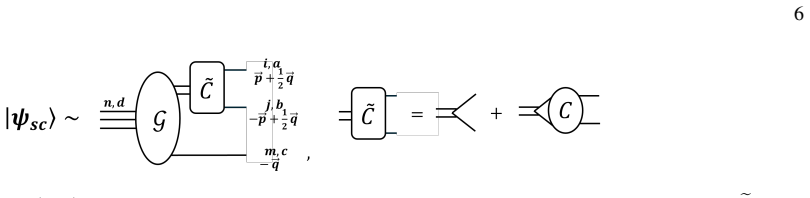
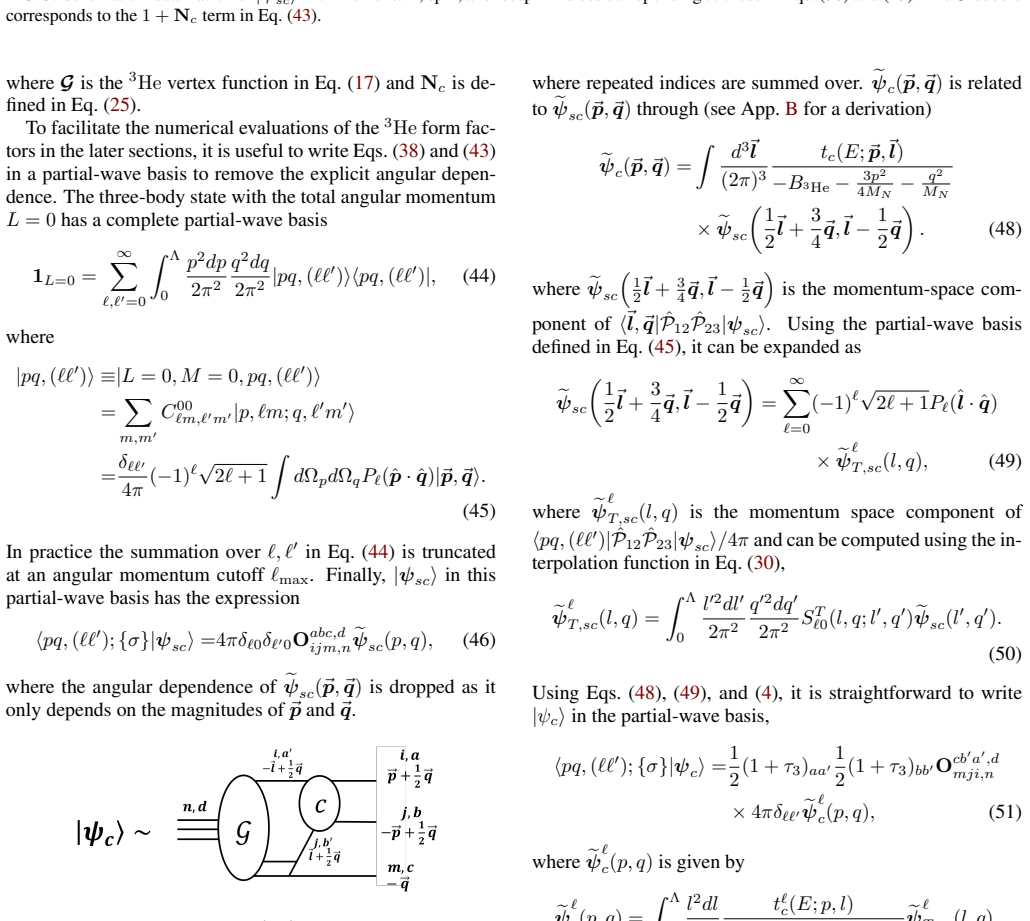
For 3He[ 3H], the isospin indexdtakes the upper [lower] component of the associated Pauli matrix or Kronecker delta in the isospin space, corre- sponding to an isospin of+1/2[−1/2]. eψsc(⃗p, ⃗q)in Eq. (38) is given by (see App. B for a derivation) eψsc(⃗p, ⃗q) = r 4π MN 1 +N c(E− 3q2 4MN , p) −B3He − 3p2 4MN − q2 MN ×D d E− q2 2MN , q G(−B 3He, q),(43) 6 ...
-
[5]
w. Coulomb
The results shown below are obtained using a three- body force fixed to the physical value ofB exp 3H = 8.48MeV; i.e., the three-body force does not change withδ. −30 −20 −10 0 10 20 30 40 50 δ[MeV] 5 6 7 8 9 10 11B3He [MeV] Wigner-SU(4) Physicalw. Coulomb w/o. Coulomb −30 −20 −10 0 10 20 30 40 50 δ[MeV] −1.900 −1.875 −1.850 −1.825 −1.800 −1.775 −1.750 µ3...
-
[6]
Three-nucleon kernel The CCS matrixXin Eq. (23) is obtained from X= X A,B σI√ 3 τAδA3 τAδA± (P ⊺ J )† ( ¯P ⊺ B)† ( ¯P ⊺ B)† PI ¯PA ¯PA σJ√ 3 τBδB3 τBδB∓ =− 1 8 −1 √ 3 √ 6√ 3 1− √ 2√ 6− √ 2 0 (A1) whereP A τAδA± = (τ 1 ±iτ 2)/ √
-
[7]
The3×3matrices on the first row are the projectorPin Eq
The spin and isospin indices of Pauli matrices are suppressed. The3×3matrices on the first row are the projectorPin Eq. (19) and selects the spin-doublet channel where three-nucleon bound states live. The inhomogeneous termBin Eq. (18) comes from σI −τAδA3 −τAδA± √ 2 = σI√ 3 τAδA3 τAδA± √ 3 −1 − √ 2 | {z } B (A2) where the left sid...
-
[8]
(66) through the type-(b) contraction in Fig
Type-(a) and Type-(b) Contractions For the one-nucleon isoscalar magnetic current, the CCS matrices are Ms a,1 =M s a,2 =diag 1 3 ,0,0 κ0,M s a,3 =diag −1 6 , 1 2 , 1 2 κ0,(A5) Ms b,1 = (Ms b,3)⊺ = 4XMs a,3κ0,M s b,2 =−2· 1 8 −5/3 1/ √ 3 p 2/3 1/ √ 3−1 √ 2p 2/3 √ 2 0 κ0,(A6) where all type-(b) matrices receive a factor of 2 because both permutatio...
-
[9]
Type-(c) Contraction For the one-nucleon magnetic isoscalar current, the CCS matrices are Ms c,1 =diag − 1 12 , 1 4 ,0 κ0,(A12) and Ms c,2 = 1/6 1/4 √ 3 0 1/4 √ 3 0 0 0 0 0 κ0,M s c,3 = 1/6−1/4 √ 3 0 −1/4 √ 3 0 0 0 0 0 κ0.(A13) The CCS matrices for the one-nucleon isovector magnetic current are related to those for the isoscalar one by Mv ...
-
[10]
The construction works the same for any of the currents considered in this work
Type-(d), (e), and (f) Contractions Mξ α,i forα=d, e, fcan be constructed using the matrices above along with the diagonal matrix, δ33 =diag(0,0,1),(A17) which is used to project out theppchannel for 3He. The construction works the same for any of the currents considered in this work. A superscriptO=s, v, C,#will thus be used below. For the type-(d)permut...
-
[11]
In principle one needs to permute ˆVs as the interaction can apply to any of the three pairs
With separable two-body interaction A separable two-body potential embedded in a three-body system can be written as ˆVs = (|ϕ⟩v2⟨ϕ|)⊗ ˆIp2 , ˆIp2 = X ⃗p2 |⃗p2⟩⟨⃗p2| (B1) where ⃗p1 and ⃗p2 are Jacobi momenta, with ⃗p1 being the relative momentum between two particles interacting through|ϕ⟩v2⟨ϕ|, and ⃗p2 being the relative momentum between the inter...
-
[12]
Denote the separable two-body interaction as ˆVs and the non-separable one, ˆVc
Including non-separable two-body interaction In the presence of both separable and non-separable two-body interactions, such as the strong plus the Coulomb interaction, the two-bodyT-matrix can be written as the sum of a separable part, denoted ˆtsc, and a non-separable piece, denoted ˆtc. Denote the separable two-body interaction as ˆVs and the non-separ...
-
[13]
Including separable three-body interaction Consider a momentum-independent separable three-body interaction ˆV3, ˆV3 =|ξ⟩v 3⟨ξ|,(B26) where|ξ⟩is given by |ξ⟩=|ϕ⟩ ⊗ |ϕ 3⟩= X ⃗p1,⃗p2 ϕ(p1)ϕ3(p2)|⃗p1⃗p2⟩.(B27) In the above equationϕ(p 1)andϕ 3(p2)are regulators for each Jacobi momentum, with the former being the same as the two-body one in Eq. (B2). The Fadd...
- [14]
- [15]
- [16]
-
[17]
J.-W. Chen and M. J. Savage, n p —>d gamma for big bang nucleosynthesis, Phys. Rev. C60, 065205 (1999), arXiv:nucl-th/9907042
-
[18]
Rupak, Precision calculation ofnp→dγcross-section for big bang nucleosynthesis, Nucl
G. Rupak, Precision calculation ofnp→dγcross-section for big bang nucleosynthesis, Nucl. Phys. A678, 405 (2000), arXiv:nucl- th/9911018
-
[19]
F. Gabbiani, P. F. Bedaque, and H. W. Griesshammer, Higher partial waves in an effective field theory approach to nd scattering, Nucl. Phys. A675, 601 (2000), arXiv:nucl-th/9911034
- [20]
- [21]
-
[22]
Vanasse, Fully Perturbative Calculation ofndScattering to Next-to-next-to-leading-order, Phys
J. Vanasse, Fully Perturbative Calculation ofndScattering to Next-to-next-to-leading-order, Phys. Rev. C88, 044001 (2013), arXiv:1305.0283 [nucl-th]
- [23]
- [24]
- [25]
-
[26]
G. Rupak and X.-w. Kong, Quartet S wave p d scattering in EFT, Nucl. Phys. A717, 73 (2003), arXiv:nucl-th/0108059
-
[27]
S.-i. Ando and M. C. Birse, Effective field theory of 3He, J. Phys. G37, 105108 (2010), arXiv:1003.4383 [nucl-th]
-
[28]
S. K ¨onig and H.-W. Hammer, Low-energy p-d scattering and He-3 in pionless EFT, Phys. Rev. C83, 064001 (2011), arXiv:1101.5939 [nucl-th]
-
[29]
J. Vanasse, D. A. Egolf, J. Kerin, S. K ¨onig, and R. P. Springer, 3HeandpdScattering to Next-to-Leading Order in Pionless Effective Field Theory, Phys. Rev. C89, 064003 (2014), arXiv:1402.5441 [nucl-th]
-
[30]
K ¨onig, Second-order perturbation theory for 3Heand pd scattering in pionless EFT, J
S. K ¨onig, Second-order perturbation theory for 3Heand pd scattering in pionless EFT, J. Phys. G44, 064007 (2017), arXiv:1609.03163 [nucl-th]
-
[31]
S. K ¨onig and H.-W. Hammer, Precision calculation of the quartet-channel p-d scattering length, Phys. Rev. C90, 034005 (2014), arXiv:1312.2573 [nucl-th]
-
[32]
S. K ¨onig, H. W. Grießhammer, and H.-W. Hammer, The proton-deuteron system in pionless EFT revisited, J. Phys. G42, 045101 (2015), arXiv:1405.7961 [nucl-th]
-
[33]
S. K ¨onig, H. W. Grießhammer, H. W. Hammer, and U. van Kolck, Effective theory of 3H and 3He, J. Phys. G43, 055106 (2016), arXiv:1508.05085 [nucl-th]
-
[34]
J. Vanasse, Triton charge radius to next-to-next-to-leading order in pionless effective field theory, Phys. Rev. C95, 024002 (2017), arXiv:1512.03805 [nucl-th]
-
[35]
J. Vanasse, Charge and Magnetic Properties of Three-Nucleon Systems in Pionless Effective Field Theory, Phys. Rev. C98, 034003 (2018), arXiv:1706.02665 [nucl-th]
-
[36]
L. Platter and H. W. Hammer, Universality in the triton charge form-factor, Nucl. Phys. A766, 132 (2006), arXiv:nucl-th/0509045
-
[37]
J. Kirscher, E. Pazy, J. Drachman, and N. Barnea, Electromagnetic characteristics ofA≤3physical and lattice nuclei, Phys. Rev. C96, 024001 (2017), arXiv:1702.07268 [nucl-th]
-
[38]
J. Kirscher, H. W. Griesshammer, D. Shukla, and H. M. Hofmann, Universal Correlations in Pion-less EFT with the Resonating Group Model: Three and Four Nucleons, Eur. Phys. J. A44, 239 (2010), arXiv:0903.5538 [nucl-th]
- [39]
- [40]
-
[41]
H. Sadeghi, S. Bayegan, and H. W. Griesshammer, Effective field theory calculation of thermal energies and radiative capture cross- section, Phys. Lett. B643, 263 (2006), arXiv:nucl-th/0610029
- [42]
-
[43]
X. Kong and F. Ravndal, Proton proton scattering lengths from effective field theory, Phys. Lett. B450, 320 (1999), [Erratum: Phys.Lett.B 458, 565–565 (1999)], arXiv:nucl-th/9811076
-
[44]
X. Kong and F. Ravndal, Coulomb effects in low-energy proton proton scattering, Nucl. Phys. A665, 137 (2000), arXiv:hep-ph/9903523
- [45]
-
[46]
Nguyen and J
H. Nguyen and J. Vanasse, Coulomb corrections to three nucleon moments (2026), manuscript in preparation
2026
-
[47]
Cavanna and P
F. Cavanna and P. Prati, Direct measurement of nuclear cross-section of astrophysical interest: Results and perspectives, Int. J. Mod. Phys. A33, 1843010 (2018)
2018
-
[48]
St ¨ockelet al., Novel approach to infer the H2(p,γ)He3 angular distribution: Experimental results and comparison with theoretical calculations, Phys
K. St ¨ockelet al., Novel approach to infer the H2(p,γ)He3 angular distribution: Experimental results and comparison with theoretical calculations, Phys. Rev. C110, L032801 (2024)
2024
-
[49]
Ti ˇsma, M
I. Ti ˇsma, M. Lipoglavˇsek, M. Mihoviloviˇc, S. Markelj, M. Vencelj, and J. Vesi´c, Experimental cross section and angular distribution of the 2H(p,γ)3He reaction at Big-Bang nucleosynthesis energies, European Physical Journal A55, 137 (2019)
2019
- [50]
-
[51]
Wigner, On the Consequences of the Symmetry of the Nuclear Hamiltonian on the Spectroscopy of Nuclei, Phys
E. Wigner, On the Consequences of the Symmetry of the Nuclear Hamiltonian on the Spectroscopy of Nuclei, Phys. Rev.51, 106 (1937)
1937
- [52]
- [53]
-
[54]
Leeet al., Hidden Spin-Isospin Exchange Symmetry, Phys
D. Leeet al., Hidden Spin-Isospin Exchange Symmetry, Phys. Rev. Lett.127, 062501 (2021), arXiv:2010.09420 [nucl-th]
-
[55]
J. Vanasse and D. R. Phillips, Three-nucleon bound states and the Wigner-SU(4) limit, Few Body Syst.58, 26 (2017), arXiv:1607.08585 [nucl-th]
-
[56]
D. B. Kaplan, M. J. Savage, and M. B. Wise, A New expansion for nucleon-nucleon interactions, Phys. Lett. B424, 390 (1998), arXiv:nucl-th/9801034. 22
work page Pith review arXiv 1998
-
[57]
K ¨onig, Energies and radii of light nuclei around unitarity, Eur
S. K ¨onig, Energies and radii of light nuclei around unitarity, Eur. Phys. J. A56, 113 (2020), arXiv:1910.12627 [nucl-th]
- [58]
-
[59]
Schmidt, ¨Uber die magnetischen momente der atomkerne, Zeitschrift f¨ur Physik106, 358 (1937)
T. Schmidt, ¨Uber die magnetischen momente der atomkerne, Zeitschrift f¨ur Physik106, 358 (1937)
1937
-
[60]
Sick, Elastic electron scattering from light nuclei, Prog
I. Sick, Elastic electron scattering from light nuclei, Prog. Part. Nucl. Phys.47, 245 (2001), arXiv:nucl-ex/0208009
- [61]
-
[62]
Navaset al.(Particle Data Group), Review of particle physics, Phys
S. Navaset al.(Particle Data Group), Review of particle physics, Phys. Rev. D110, 030001 (2024)
2024
- [63]
-
[64]
Z. Epstein, G. Paz, and J. Roy, Model independent extraction of the proton magnetic radius from electron scattering, Phys. Rev. D90, 074027 (2014), arXiv:1407.5683 [hep-ph]
-
[65]
Xionget al., A small proton charge radius from an electron–proton scattering experiment, Nature575, 147 (2019)
W. Xionget al., A small proton charge radius from an electron–proton scattering experiment, Nature575, 147 (2019)
2019
-
[66]
Bezginov, T
N. Bezginov, T. Valdez, M. Horbatsch, A. Marsman, A. C. Vutha, and E. A. Hessels, A measurement of the atomic hydrogen Lamb shift and the proton charge radius, Science365, 1007 (2019)
2019
-
[67]
Schuhmannet al.(CREMA), The helion charge radius from laser spectroscopy of muonic helium-3 ions, Science388, adj2610 (2025)
K. Schuhmannet al.(CREMA), The helion charge radius from laser spectroscopy of muonic helium-3 ions, Science388, adj2610 (2025)
2025
-
[68]
E. Braaten and H. W. Hammer, Universality in few-body systems with large scattering length, Phys. Rept.428, 259 (2006), arXiv:cond- mat/0410417
-
[69]
J. Kirscher and D. Gazit, The Coulomb interaction in Helium-3: Interplay of strong short-range and weak long-range potentials, Phys. Lett. B755, 253 (2016), arXiv:1510.00118 [nucl-th]
-
[70]
L. D. Faddeev, Scattering Theory for a Three-Particle System, Sov. Phys. JETP12, 1014 (1961)
1961
-
[71]
Stadler, W
A. Stadler, W. Gl ¨ockle, and P. U. Sauer, Faddeev equations with three-nucleon force in momentum space, Phys. Rev. C44, 2319 (1991)
1991
discussion (0)
Sign in with ORCID, Apple, or X to comment. Anyone can read and Pith papers without signing in.