Recognition: unknown
Hierarchy of entropy production and thermodynamic trade-off relations in non-Markovian systems
Pith reviewed 2026-05-07 14:47 UTC · model grok-4.3
The pith
The entropy production of a non-Markovian system upper-bounds that of its Markovian embedding, creating a hierarchy that extends thermodynamic trade-off relations.
A machine-rendered reading of the paper's core claim, the machinery that carries it, and where it could break.
Core claim
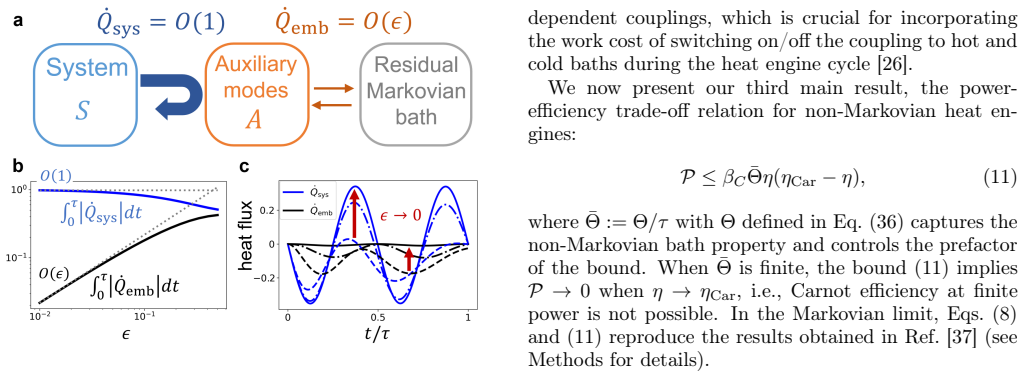
We employ a Markovian embedding of generalized Langevin dynamics in which bath memory is encoded in auxiliary modes and irreversible dissipation occurs only in a residual Markovian bath. We show that the entropy production defined for the original non-Markovian system upper bounds that of the embedded system. Leveraging this hierarchy we derive non-Markovian extensions of the thermodynamic uncertainty relation, speed limit, and power-efficiency trade-off. For underdamped generalized Langevin systems, sufficiently structured baths allow finite heat currents at vanishingly small entropy production, whereas Carnot efficiency at finite power remains unattainable for ordinary spectral densities.
What carries the argument
The Markovian embedding of generalized Langevin dynamics, with bath memory encoded in auxiliary modes and dissipation confined to a residual Markovian bath.
If this is right
- Non-Markovian extensions of the thermodynamic uncertainty relation, speed limits, and power-efficiency trade-offs follow directly from the hierarchy.
- In underdamped systems, sufficiently structured baths permit finite heat currents while entropy production approaches zero.
- Carnot efficiency at finite power remains impossible for ordinary spectral densities even with memory.
- In the overdamped regime, memory effects can reduce both entropy production and current fluctuations at the same time.
- The hierarchy extends in principle to generic bath models and to the quantum regime.
Where Pith is reading between the lines
- The same embedding technique could be applied to design protocols that deliberately shape bath memory to meet a target precision with minimal dissipation.
- Numerical checks on simple underdamped models with engineered spectral densities would test how close to zero entropy production can be achieved while keeping a nonzero current.
- The framework suggests exploring whether similar hierarchies appear in other non-Markovian settings such as active matter or biological transport.
Load-bearing premise
The Markovian embedding of the generalized Langevin dynamics reproduces the thermodynamics of the original non-Markovian system without adding extra irreversibility that would invalidate the upper bound on entropy production.
What would settle it
An explicit calculation or simulation of a generalized Langevin system in which the entropy production of the non-Markovian description falls below the entropy production of its Markovian embedding would falsify the hierarchy.
Figures


read the original abstract
Non-Markovian dynamics arise when a system is coupled to a bath with finite correlation time, giving rise to memory effects that allow the bath to temporarily store and return excitations. However, how memory modifies irreversibility and whether it can be exploited to improve thermodynamic performance is not well established. We address this question by employing a Markovian embedding of generalized Langevin dynamics, in which bath memory is encoded in auxiliary modes and irreversible dissipation in a residual Markovian bath. Here we show that the entropy production defined for the original non-Markovian system upper bounds that of the embedded system, thereby establishing a hierarchy of entropy production under Markovian embedding. Leveraging this hierarchy, we derive non-Markovian extensions of the thermodynamic uncertainty relation, speed limit, and power-efficiency trade-off. For underdamed generalized Langevin systems, sufficiently structured baths allow finite heat currents at vanishingly small entropy production, whereas Carnot efficiency at finite power remains unattainable for ordinary spectral densities. In the overdamped regime, memory effects can simultaneously reduce entropy production and current fluctuations, thereby enhancing the precision-to-dissipation ratio. We further discuss the extension of the hierarchy to generic bath models and the quantum regime. These results provide a quantitative framework for exploiting memory as a thermodynamic resource and for designing energy-efficient protocols in structured environments.
Editorial analysis
A structured set of objections, weighed in public.
Referee Report
Summary. The paper claims that Markovian embedding of generalized Langevin dynamics (encoding bath memory in auxiliary modes) yields a hierarchy in which the entropy production defined for the original non-Markovian system upper-bounds the entropy production of the embedded Markovian system. This hierarchy is leveraged to derive non-Markovian extensions of the thermodynamic uncertainty relation, speed limits, and power-efficiency trade-offs; the work further argues that structured baths can permit finite heat currents at arbitrarily small entropy production (underdamped case) while ordinary spectral densities still forbid Carnot efficiency at finite power, and that memory can improve the precision-to-dissipation ratio in the overdamped regime.
Significance. If the hierarchy is valid, the framework supplies a concrete route to treat memory as a thermodynamic resource and to obtain falsifiable extensions of standard stochastic-thermodynamic bounds to non-Markovian dynamics. The explicit discussion of underdamped vs. overdamped regimes and the quantum extension add breadth; reproducible derivations or parameter-free limits would strengthen the contribution.
major comments (3)
- [Abstract and main derivation] Abstract and central claim (hierarchy): the asserted inequality σ_non-Markovian ≥ σ_embedded contradicts the data-processing inequality for path KL divergences. The non-Markovian entropy production is the marginal KL D(P_sys || P_rev_sys) while the embedded quantity is the joint KL D(P_sys+aux || P_rev_sys+aux); DPI requires D(marginal) ≤ D(joint) for any consistent time reversal, implying the opposite direction. This reversal is load-bearing for the entire hierarchy and all derived trade-off relations; the manuscript must either adopt a non-standard EP definition (e.g., effective-force heat) or specify an asymmetric reversal protocol for the auxiliaries.
- [Embedding construction] § on embedding construction: the claim that the embedding “faithfully reproduces the original non-Markovian thermodynamics without introducing artifacts” is not accompanied by an explicit check that the marginal path measure of the embedded process recovers the original generalized Langevin statistics for arbitrary memory kernels; without this verification the upper-bound relation cannot be guaranteed to hold beyond the linear-response or specific-kernel cases.
- [Trade-off relations] Trade-off derivations (TUR, speed limit, power-efficiency): these extensions rest directly on the hierarchy; once the inequality direction is clarified, the proofs must be re-examined to confirm that the resulting bounds remain non-trivial and reduce to the known Markovian limits when memory vanishes.
minor comments (3)
- [Notation] Notation for entropy production: introduce distinct symbols (e.g., σ_NM vs. σ_emb) at first use and maintain them consistently through all equations and figures.
- [Figures] Figure clarity: ensure that plots comparing non-Markovian and embedded entropy production explicitly label the two quantities and include the Markovian limit as a reference curve.
- [References] References: add citations to prior Markovian-embedding works (e.g., on generalized Langevin thermodynamics) to situate the hierarchy result.
Simulated Author's Rebuttal
We thank the referee for the careful reading and constructive comments. We address each major point below, providing clarifications on the hierarchy and indicating revisions where appropriate to strengthen the manuscript.
read point-by-point responses
-
Referee: [Abstract and main derivation] Abstract and central claim (hierarchy): the asserted inequality σ_non-Markovian ≥ σ_embedded contradicts the data-processing inequality for path KL divergences. The non-Markovian entropy production is the marginal KL D(P_sys || P_rev_sys) while the embedded quantity is the joint KL D(P_sys+aux || P_rev_sys+aux); DPI requires D(marginal) ≤ D(joint) for any consistent time reversal, implying the opposite direction. This reversal is load-bearing for the entire hierarchy and all derived trade-off relations; the manuscript must either adopt a non-standard EP definition (e.g., effective-force heat) or specify an asymmetric reversal protocol for the auxiliaries.
Authors: We appreciate this observation on the data-processing inequality. The hierarchy relies on an asymmetric time-reversal protocol for the auxiliary modes, chosen to match the physical interpretation of the non-Markovian entropy production as the marginal over the original system variables. This protocol does not correspond to the standard symmetric joint reversal, so the usual DPI does not apply in its standard form. We will revise the manuscript to explicitly define and justify this reversal convention, including a discussion of why the inequality direction is consistent with our derivations and numerical verifications. This will also clarify the implications for the derived trade-off relations. revision: yes
-
Referee: [Embedding construction] § on embedding construction: the claim that the embedding “faithfully reproduces the original non-Markovian thermodynamics without introducing artifacts” is not accompanied by an explicit check that the marginal path measure of the embedded process recovers the original generalized Langevin statistics for arbitrary memory kernels; without this verification the upper-bound relation cannot be guaranteed to hold beyond the linear-response or specific-kernel cases.
Authors: We agree that an explicit verification is valuable for generality. In the revised manuscript we will add an appendix or section providing the argument that the marginal path measure of the embedded Markovian process recovers the original generalized Langevin statistics for arbitrary memory kernels, following directly from the linear embedding construction. This will confirm the absence of artifacts and support the hierarchy beyond the cases already checked. revision: yes
-
Referee: [Trade-off relations] Trade-off derivations (TUR, speed limit, power-efficiency): these extensions rest directly on the hierarchy; once the inequality direction is clarified, the proofs must be re-examined to confirm that the resulting bounds remain non-trivial and reduce to the known Markovian limits when memory vanishes.
Authors: With the hierarchy clarified via the asymmetric reversal (as addressed in the first response), the derivations of the non-Markovian TUR, speed limits, and power-efficiency trade-offs follow by the same bounding procedure. We will re-examine and expand the proofs in the revision to explicitly show reduction to the standard Markovian results when the memory kernel becomes delta-correlated, and to confirm that the bounds remain non-trivial for finite memory. Additional steps will be included in the main text or supplementary material. revision: partial
Circularity Check
No significant circularity; hierarchy follows directly from embedding construction and standard EP definitions
full rationale
The paper defines entropy production for the non-Markovian system and the embedded Markovian system using standard path-probability ratios and heat expressions. The claimed inequality σ_non-Markovian ≥ σ_embedded is presented as a theorem derived from the explicit construction of the auxiliary modes and residual bath; it does not reduce to a self-definition, a fitted parameter renamed as prediction, or a load-bearing self-citation. Subsequent TUR, speed-limit, and power-efficiency extensions are obtained by substituting the hierarchy into known inequalities, preserving independent mathematical content. No step equates the target result to its own inputs by construction.
Axiom & Free-Parameter Ledger
axioms (2)
- domain assumption The generalized Langevin equation with memory kernel accurately describes the target non-Markovian dynamics.
- domain assumption Entropy production remains well-defined and comparable between the original non-Markovian system and its Markovian embedding.
invented entities (1)
-
auxiliary modes
no independent evidence
Reference graph
Works this paper leans on
-
[1]
N. G. van Kampen,Stochastic Processes in Physics and Chemistry, 3rd ed., North-Holland Personal Library (El- sevier, 2007) imprint: North-Holland
2007
-
[2]
Klippenstein, M
V. Klippenstein, M. Tripathy, G. Jung, F. Schmid, and N. F. Van Der Vegt, Introducing memory in coarse- grained molecular simulations, The Journal of Physical Chemistry B125, 4931 (2021)
2021
-
[3]
B. A. Dalton, A. Klimek, H. Kiefer, F. N. Brünig, H. Co- linet, L. Tepper, A. Abbasi, and R. R. Netz, Memory and friction: From the nanoscale to the macroscale, Annual Review of Physical Chemistry76, 431 (2025)
2025
-
[4]
S. A. M. Loos, S. Monter, F. Ginot, and C. Bechinger, Universal symmetry of optimal control at the microscale, Phys. Rev. X14, 021032 (2024)
2024
-
[5]
F.GinotandC.Bechinger,Energyrecuperationofdriven colloids in non-markovian baths, Nature Communica- tions16, 10114 (2025)
2025
-
[6]
Breuer, E.-M
H.-P. Breuer, E.-M. Laine, J. Piilo, and B. Vacchini, Col- loquium: Non-markoviandynamicsinopenquantumsys- tems, Rev. Mod. Phys.88, 021002 (2016)
2016
-
[7]
de Vega and D
I. de Vega and D. Alonso, Dynamics of non-markovian open quantum systems, Rev. Mod. Phys.89, 015001 (2017)
2017
-
[8]
Seifert, Stochastic thermodynamics, fluctuation the- orems and molecular machines, Reports on progress in physics75, 126001 (2012)
U. Seifert, Stochastic thermodynamics, fluctuation the- orems and molecular machines, Reports on progress in physics75, 126001 (2012)
2012
-
[9]
Ohkuma and T
T. Ohkuma and T. Ohta, Fluctuation theorems for non- linear generalized langevin systems, Journal of Statisti- cal Mechanics: Theory and Experiment2007, P10010 (2007)
2007
-
[10]
Speck and U
T. Speck and U. Seifert, The jarzynski relation, fluctua- tion theorems, and stochastic thermodynamics for non- markovian processes, Journal of Statistical Mechanics: Theory and Experiment2007, L09002 (2007)
2007
-
[11]
Seifert, First and second law of thermodynamics at strong coupling, Phys
U. Seifert, First and second law of thermodynamics at strong coupling, Phys. Rev. Lett.116, 020601 (2016)
2016
-
[12]
Jarzynski, Stochastic and macroscopic thermodynam- ics of strongly coupled systems, Phys
C. Jarzynski, Stochastic and macroscopic thermodynam- ics of strongly coupled systems, Phys. Rev. X7, 011008 (2017)
2017
-
[13]
Talkner and P
P. Talkner and P. Hänggi, Colloquium: Statistical me- 8 chanics and thermodynamics at strong coupling: Quan- tum and classical, Rev. Mod. Phys.92, 041002 (2020)
2020
-
[14]
Stochastic thermodynamics for classical non-Markov jump processes
K. Kanazawa and A. Dechant, Stochastic thermody- namics for classical non-markov jump processes, arXiv preprint arXiv:2506.04726 (2025)
work page internal anchor Pith review Pith/arXiv arXiv 2025
-
[15]
Strasberg and M
P. Strasberg and M. Esposito, Non-markovianity and negative entropy production rates, Phys. Rev. E99, 012120 (2019)
2019
-
[16]
G.T.LandiandM.Paternostro,Irreversibleentropypro- duction: From classical to quantum, Rev. Mod. Phys.93, 035008 (2021)
2021
-
[17]
Caruso, V
F. Caruso, V. Giovannetti, C. Lupo, and S. Mancini, Quantum channels and memory effects, Rev. Mod. Phys. 86, 1203 (2014)
2014
-
[18]
X. Yang, X. Long, R. Liu, K. Tang, Y. Zhai, X. Nie, T. Xin, J. Li, and D. Lu, Control-enhanced non- markovian quantum metrology, Communications Physics 7, 282 (2024)
2024
-
[19]
Bylicka, M
B. Bylicka, M. Tukiainen, D. Chruściński, J. Piilo, and S. Maniscalco, Thermodynamic power of non- markovianity, Scientific reports6, 27989 (2016)
2016
-
[20]
Ptaszyński, Non-markovian thermal operations boost- ing the performance of quantum heat engines, Phys
K. Ptaszyński, Non-markovian thermal operations boost- ing the performance of quantum heat engines, Phys. Rev. E106, 014114 (2022)
2022
-
[21]
Krishnamurthy, R
S. Krishnamurthy, R. Ganapathy, and A. Sood, Over- coming power-efficiency tradeoff in a micro heat engine by engineered system-bath interactions, Nature Commu- nications14, 6842 (2023)
2023
-
[22]
K.KanazawaandD.Sornette,Fieldmasterequationthe- ory of the self-excited hawkes process, Phys. Rev. Res.2, 033442 (2020)
2020
-
[23]
Kanazawa and D
K. Kanazawa and D. Sornette, Standard form of mas- ter equations for general non-markovian jump processes: The laplace-space embedding framework and asymptotic solution, Phys. Rev. Res.6, 023270 (2024)
2024
-
[24]
B.M.Garraway,Nonperturbativedecayofanatomicsys- tem in a cavity, Phys. Rev. A55, 2290 (1997)
1997
-
[25]
Tamascelli, A
D. Tamascelli, A. Smirne, S. F. Huelga, and M. B. Plenio, Nonperturbative treatment of non-markovian dynamics of open quantum systems, Phys. Rev. Lett.120, 030402 (2018)
2018
-
[26]
Nazir and G
A. Nazir and G. Schaller, The reaction coordinate map- ping in quantum thermodynamics, inThermodynamics in the Quantum Regime: Fundamental Aspects and New Directions,editedbyF.Binder, L.A.Correa, C.Gogolin, J. Anders, and G. Adesso (Springer International Pub- lishing, Cham, 2018) pp. 551–577
2018
-
[27]
Strasberg, G
P. Strasberg, G. Schaller, N. Lambert, and T. Brandes, Nonequilibrium thermodynamics in the strong coupling and non-markovian regime based on a reaction coordi- nate mapping, New Journal of Physics18, 073007 (2016)
2016
-
[28]
Trivedi, D
R. Trivedi, D. Malz, and J. I. Cirac, Convergence guaran- tees for discrete mode approximations to non-markovian quantum baths, Phys. Rev. Lett.127, 250404 (2021)
2021
-
[29]
Seifert, From stochastic thermodynamics to thermo- dynamic inference, Annual Review of Condensed Matter Physics10, 171 (2019)
U. Seifert, From stochastic thermodynamics to thermo- dynamic inference, Annual Review of Condensed Matter Physics10, 171 (2019)
2019
-
[30]
J. M. Horowitz and T. R. Gingrich, Thermodynamic uncertainty relations constrain non-equilibrium fluctua- tions, Nature Physics16, 15–20 (2020)
2020
-
[31]
A. C. Barato and U. Seifert, Thermodynamic uncertainty relation for biomolecular processes, Phys. Rev. Lett.114, 158101 (2015)
2015
-
[32]
T. R. Gingrich, J. M. Horowitz, N. Perunov, and J. L. England, Dissipation bounds all steady-state current fluctuations, Phys. Rev. Lett.116, 120601 (2016)
2016
-
[33]
Aurell, K
E. Aurell, K. Gawędzki, C. Mejía-Monasterio, R. Mo- hayaee, and P. Muratore-Ginanneschi, Refined second law of thermodynamics for fast random processes, Jour- nal of statistical physics147, 487 (2012)
2012
-
[34]
Shiraishi, K
N. Shiraishi, K. Funo, and K. Saito, Speed limit for clas- sical stochastic processes, Phys. Rev. Lett.121, 070601 (2018)
2018
-
[35]
Van Vu and K
T. Van Vu and K. Saito, Thermodynamic unification of optimal transport: Thermodynamic uncertainty relation, minimum dissipation, and thermodynamic speed limits, Phys. Rev. X13, 011013 (2023)
2023
-
[36]
Dechant and S.-i
A. Dechant and S.-i. Sasa, Entropic bounds on currents in langevin systems, Phys. Rev. E97, 062101 (2018)
2018
-
[37]
Shiraishi, K
N. Shiraishi, K. Saito, and H. Tasaki, Universal trade-off relation between power and efficiency for heat engines, Phys. Rev. Lett.117, 190601 (2016)
2016
-
[38]
Pietzonka and U
P. Pietzonka and U. Seifert, Universal trade-off between power, efficiency, and constancy in steady-state heat en- gines, Phys. Rev. Lett.120, 190602 (2018)
2018
-
[39]
Zwanzig, Nonlinear generalized langevin equations, Journal of Statistical Physics9, 215 (1973)
R. Zwanzig, Nonlinear generalized langevin equations, Journal of Statistical Physics9, 215 (1973)
1973
-
[40]
Tajima and K
H. Tajima and K. Funo, Superconducting-like heat cur- rent: Effective cancellation of current-dissipation trade- off by quantum coherence, Phys. Rev. Lett.127, 190604 (2021)
2021
-
[41]
H.D.Nguyen,Thesmall-masslimitandwhite-noiselimit of an infinite dimensional generalized langevin equation, Journal of Statistical Physics173, 411 (2018)
2018
-
[42]
Villani,Optimal transport: old and new, Vol
C. Villani,Optimal transport: old and new, Vol. 338 (Springer, Berlin, 2009)
2009
-
[43]
Benamou and Y
J.-D. Benamou and Y. Brenier, A computational fluid mechanics solution to the monge-kantorovich mass trans- fer problem, Numerische Mathematik84, 375 (2000)
2000
-
[44]
Koyuk and U
T. Koyuk and U. Seifert, Thermodynamic uncertainty re- lation for time-dependent driving, Phys. Rev. Lett.125, 260604 (2020)
2020
-
[45]
M. Odeh, K. Godeneli, E. Li, R. Tangirala, H. Zhou, X. Zhang, Z.-H. Zhang, and A. Sipahigil, Non-markovian dynamics of a superconducting qubit in a phononic bandgap, Nature Physics21, 406 (2025)
2025
-
[46]
Lambert, Y.-N
N. Lambert, Y.-N. Chen, Y.-C. Cheng, C.-M. Li, G.-Y. Chen, and F. Nori, Quantum biology, Nature Physics9, 10 (2013)
2013
-
[47]
Tanimura, Numerically “exact” approach to open quantum dynamics: The hierarchical equations of motion (heom), The Journal of chemical physics153(2020)
Y. Tanimura, Numerically “exact” approach to open quantum dynamics: The hierarchical equations of motion (heom), The Journal of chemical physics153(2020)
2020
-
[48]
B.-H. Liu, L. Li, Y.-F. Huang, C.-F. Li, G.-C. Guo, E.-M. Laine, H.-P. Breuer, and J. Piilo, Experimental control of the transition from markovian to non-markovian dy- namics of open quantum systems, Nature Physics7, 931 (2011)
2011
-
[49]
Breuer and F
H.-P. Breuer and F. Petruccione,The Theory of Open Quantum Systems(Oxford University Press, 2002)
2002
-
[50]
J. M. Parrondo, J. M. Horowitz, and T. Sagawa, Thermo- dynamics of information, Nature physics11, 131 (2015)
2015
-
[51]
Dechant and K
A. Dechant and K. Kanazawa, Private communication, publication in preparation (2026)
2026
-
[52]
Colla and H.-P
A. Colla and H.-P. Breuer, Entropy production and the role of correlations in quantum brownian motion, Phys. Rev. A104, 052408 (2021)
2021
-
[53]
Ptaszyński and M
K. Ptaszyński and M. Esposito, Quantum and clas- sical contributions to entropy production in fermionic 9 and bosonic gaussian systems, PRX Quantum4, 020353 (2023)
2023
-
[54]
Petz, Sufficiency of channels over von neumann al- gebras, The Quarterly Journal of Mathematics39, 97 (1988)
D. Petz, Sufficiency of channels over von neumann al- gebras, The Quarterly Journal of Mathematics39, 97 (1988)
1988
-
[55]
A. M. Lacerda, M. J. Kewming, M. Brenes, C. Jackson, S. R. Clark, M. T. Mitchison, and J. Goold, Entropy pro- duction in the mesoscopic-leads formulation of quantum thermodynamics, Phys. Rev. E110, 014125 (2024)
2024
-
[56]
Aurell, On work and heat in time-dependent strong coupling, Entropy19(2017)
E. Aurell, On work and heat in time-dependent strong coupling, Entropy19(2017)
2017
-
[57]
Nakazato and S
M. Nakazato and S. Ito, Geometrical aspects of en- tropy production in stochastic thermodynamics based on wasserstein distance, Phys. Rev. Res.3, 043093 (2021)
2021
-
[58]
Kamijima, A
T. Kamijima, A. Takatsu, K. Funo, and T. Sagawa, Op- timal finite-time maxwell’s demons in langevin systems, Phys. Rev. Res.7, 023159 (2025)
2025
-
[59]
Esposito, K
M. Esposito, K. Lindenberg, and C. Van den Broeck, Entropy production as correlation between system and reservoir, New Journal of Physics12, 013013 (2010). 10 Appendix A: Special cases of the spectral density Here, we give several special cases of the spectral density (A1) and the memory kernel (A2): J(ω) =ω X k c2 k 2mkω2 k " Γk +δ k cos 2θk(1−ω/Ω k) Γ2 ...
2010
-
[60]
Derivation of the fluctuation-dissipation relation We now show Eq. (B24). First, the ensemble average of the initial values of the auxiliary modesδzk,a(0)with respect to the conditional thermal state (B8) readsE[δzk,a(0)] = 0and E δzk,a(0)δzl,b(0)T =δ abδkl Ck,a,(B25) where Ck,a = 1 βamk,aω2 k,a 0 0 mk,a βa .(B26) Now, let us first assume thatt≥...
-
[61]
The work rate is defined as the expectation value of the time-derivative of the total Hamiltonian as ˙W=⟨ ˙Htot SA⟩=⟨ ˙λt∂λt H λt S ⟩+ X a ⟨˙ga t ∂ga t H ga t int⟩.(C1) Using Eqs
Work and heat current We first give the expression of work in the case of time-dependent couplingsga t. The work rate is defined as the expectation value of the time-derivative of the total Hamiltonian as ˙W=⟨ ˙Htot SA⟩=⟨ ˙λt∂λt H λt S ⟩+ X a ⟨˙ga t ∂ga t H ga t int⟩.(C1) Using Eqs. (B9) and (B20), the term∂ga t H ga t int reads ∂ga t H ga t int(t) =−X(t)...
-
[62]
Hierarchy of the entropy production We now derive the hierarchy of the entropy production betweenΣemb andΣ. For the multi-bath setup, the entropy production is defined as Σ := ∆SS − X a βa Z τ 0 dt ˙Qa sys ≥0,(C8) whereas the Markovian entropy production for the embedded model reads Σemb := ∆SSA − X a βa Z τ 0 dt ˙Qa emb,(C9) and the heat from the residua...
-
[63]
Thermodynamic trade-off relation for multiple baths In this subsection, we derive the trade-off relation between the heat current and the entropy production presented in the main text: Z τ 0 dt X a | ˙Qa sys| 2 ≤ΘΣ.(C15) We first show that the entropy production rate˙Σemb satisfies the property ˙Σemb = ˙SSA − X a βa ˙Qa emb = X k,a βaγx k,amk,aω2 k,a Z dX...
-
[64]
Entropic bound Next, we derive an entropic bound presented in the main text: Z τ 0 dt X a J a t [O] !2 ≤Σ X a Sa βa Z τ 0 dt Z dX dP ∂P Ot(X, P) 2 f S t (X, P).(C24) Here, the bound is slightly generalized to the case of multiple baths. We start by writing the formal time-evolution equation of the system as ∂tf S t ={H λt S , f S t } −∂ P X a F NM,a t f S...
-
[65]
Bath heat current and trade-off relation We now discuss yet another definition of heat based on the energy change of the bath Hamiltonian: ˙Qa bath =− D ga t X(t) d dt h ηa(t)− Z t 0 dsKa(t−s) ga s P(s) M + ˙ga s X(s) +g a t X(t)K a(0) iE ,(C28) which differs by a change in the interaction Hamiltonian compared with˙Qa sys: ˙Qa sys = ˙Qa bath − d dt ⟨H ga ...
-
[66]
Derivation of power-efficiency trade-off relation Finally, we derive the power-efficiency trade-off relation presented in the main text: P ≤β C ¯Θη(ηCar −η).(C36) From Eq. (C15) and|Qa sys| ≤ R τ 0 dt| ˙Qa sys|, we obtain (QH sys)2 ≤(|Q H sys|+|Q C sys|)2 ≤ΘΣ.(C37) Combining with the relation Σ =−β H QH sys −β CQC sys =β CQH sys(ηCar −η),(C38) 20 multiply...
-
[67]
(A8) by assuming the overdamped Drude-Lorentz spectral density (A7)
Overdamped generalized Langevin equation In the following, we consider taking the small mass limit of the generalized Langevin equation and obtain the overdamped generalized Langevin equation 1 µ ˙X(t) =−∂ X V λt S − Z t 0 dsKod(t−s) ˙X(s) +η od(t) + 1 µ ξ(t),(D2) whereµis the mobility,ξ(t)andη od(t)are uncorrelated Gaussian white noise and Gaussian color...
-
[68]
The steady state of Eq
Fokker-Planck equation and entropy production for embedded system From the Langevin equation (D9) for the joint systemSA, the Fokker-Planck equation for the Markovian embedded model reads ∂tf SA t (X,x) =−∂ X(νX f SA t )− X k ∂xk(νxk f SA t ),(D16) where the mean local velocities are νX =µ(−∂ X Htot SA − 1 β ∂X lnf SA t ), ν xk =µ k(−∂xk Htot SA − 1 β ∂xk...
-
[69]
Hierarchy of entropy production a.Σ emb ≤Σ Now, we define the system heat flux as the change of the system energy (note that we take constant couplinggt = 1 for simplicity): ˙Qsys := Z dXdxV λt S (X)∂ tf SA t ,(D25) and define the non-Markovian entropy production as Σ = ∆SS −β Z τ 0 dt ˙Qsys.(D26) By comparing Eqs. (D21) and (D25), the relation between˙Qe...
-
[70]
Thermodynamic speed limit We now derive the thermodynamic speed limit for overdamped generalized Langevin systems described by Eq
Thermodynamic trade-off relations in the overdamped regime a. Thermodynamic speed limit We now derive the thermodynamic speed limit for overdamped generalized Langevin systems described by Eq. (D2): W(f S 0 , f S τ )2 τ ≤ µ β Σ.(D48) To show Eq. (D48), we use the continuity equation (D30) and note that the Wasserstein distance is bounded from above as W(f...
-
[71]
The state at timet=τis given byρ SB τ =U SB ρSB 0 U † SB, whereU SB =Texp(− i ℏ R τ 0 dtHtot SB)is the unitary time-evolution operator fromt= 0tot=τ
Unitary system-bath model The total Hamiltonian of the system-bath model reads Htot SB =H λt S +H gt int +H B,(F1) 29 and the time-evolution is described by the von Neumann equation: ∂tρSB t =− i ℏ[Htot SB , ρSB t ].(F2) We assume that the initial state is given by the product state of the form ρSB 0 =ρ S 0 ⊗π B,(F3) whereπ B := exp(−βH B)/ZB withZ B :=Tr...
-
[72]
Markovian embedded model The total Hamiltonian of the Markovian embedded model reads Htot SA =H λt S +H gt int +H A,(F6) and the initial state is given by ρSA 0 =ρ S 0 ⊗π A.(F7) The time-evolution equation is assumed to take the Gorini-Kossakowski-Sudarshan-Lindblad (GKSL) form ∂tρSA t =L t[ρSA t ] =− i ℏ[Htot SA, ρSA t ] +D t[ρSA t ],(F8) and we assume t...
-
[73]
1 and Fig
Figure 1 and 2 In Fig. 1 and Fig. 2, we chooseVλt =λX 2/2and use one auxiliary mode. The parameters areβ=M=m= λ=c=ω=g= 1,γ x = sinθ=ϵ,γ p =ϵ −1,τ= 2π/ √
-
[74]
The initial distribution of the system is assumed to be Gaussian, with⟨X⟩= 0,⟨P⟩= 1, Var[X] =Var[P] = 1, Cov(X, P) = 0
-
[75]
3, we use one auxiliary mode
Figure 3 In Fig. 3, we use one auxiliary mode. The parameters areβ=µ=κ= 1,τ= 2.5,v= 5,µ 1 = 5, andκ 1 = 3. The initial distribution of the system is assumed to be Gaussian, with⟨X⟩= 0and Var[X] = 0.3. 31
discussion (0)
Sign in with ORCID, Apple, or X to comment. Anyone can read and Pith papers without signing in.