Recognition: unknown
Dynamical analysis of the covariant f(Q) gravity models
Pith reviewed 2026-05-07 15:26 UTC · model grok-4.3
The pith
Covariant f(Q) gravity with Hubble-proportional coupling reproduces the full sequence of radiation, matter, and dark energy eras.
A machine-rendered reading of the paper's core claim, the machinery that carries it, and where it could break.
Core claim
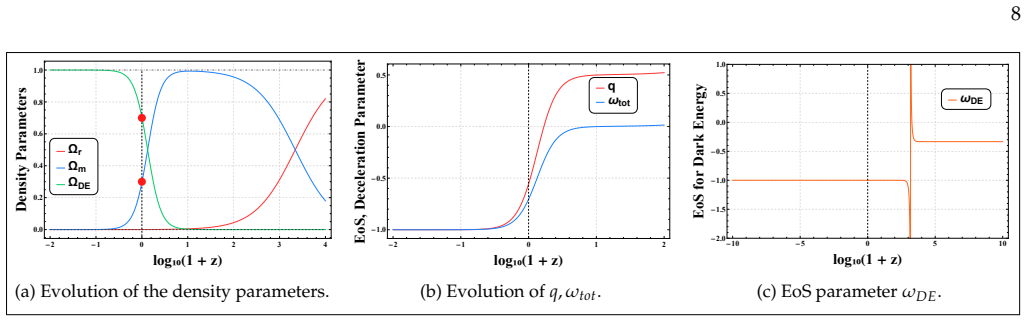
In the covariant formulation of f(Q) gravity, the power-law and logarithmic models with Hubble-proportional coupling admit a sequence of critical points whose stability properties allow the universe to evolve from a radiation-dominated era through a matter-dominated era into a dark-energy-dominated attractor, as verified by phase-space trajectories, density-parameter evolution, and the total equation-of-state parameter.
What carries the argument
The autonomous dynamical system constructed from the cosmological field equations, whose critical points are classified by stability and whose trajectories are shown to connect the successive eras.
If this is right
- Both models produce stable critical points that correspond to radiation, matter, and dark energy domination with the correct equation-of-state values.
- Phase-space trajectories connect these eras in the expected order for each functional form.
- The deceleration parameter changes sign at the appropriate transitions, confirming late-time acceleration.
- The total equation-of-state parameter approaches -1 in the final attractor for both models.
Where Pith is reading between the lines
- If the Hubble-proportional coupling holds, similar dynamical-system techniques could be applied to other covariant modified-gravity theories to check whether they also generate the observed era sequence.
- The results imply that late-time acceleration can arise from the geometric sector alone, potentially reducing reliance on separate dark-energy fields in model building.
- Extension of the analysis to include linear perturbations around the critical points would test whether the models remain viable when structure formation is considered.
- Comparison of the predicted density-parameter evolution curves with current supernova and CMB data could directly constrain the free parameters of the power-law and logarithmic forms.
Load-bearing premise
The coupling function is taken to evolve in direct proportion to the Hubble parameter, and the two chosen functional forms are assumed to be representative of the covariant f(Q) framework.
What would settle it
A set of cosmological observations that showed no stable radiation-dominated epoch or that lacked the predicted transitions in the density parameters between radiation, matter, and dark energy would falsify the models' ability to reproduce the cosmic sequence.
Figures



read the original abstract
In this study, we explore the cosmological evolution of the Universe in the framework of covariant $f(Q)$ gravity, with a coupling function that evolves dynamically in proportion to the Hubble parameter. Two specific forms of the function are examined: a power-law model and a logarithmic model. By rewriting the cosmological field equations as an autonomous dynamical system, we determine and classify the corresponding critical points and analyze their stability. Our results show that both models are able to reproduce the sequence of cosmic evolution, including radiation, matter, and dark energy-dominated eras, along with the transitions between them. The physical properties at each critical point are described using key cosmological quantities such as the total EoS parameter, density parameters, and the deceleration parameter. The stability of the non-hyperbolic critical point is analyzed through center manifold theory. In addition, we present phase space trajectories along with the stability behavior of each critical point. The evolution plots for the density parameters of radiation, matter, and dark energy, along with the EoS parameter for the total, are illustrated for further analysis. Overall, the analysis suggests that the $f(Q)$ models considered here, within the context of covariant formulation, provide a consistent description of cosmic evolution and offer a promising approach to explaining the late-time acceleration of the Universe.
Editorial analysis
A structured set of objections, weighed in public.
Referee Report
Summary. The manuscript performs a dynamical systems analysis of covariant f(Q) gravity with a Hubble-proportional coupling function, considering power-law and logarithmic forms. The cosmological field equations are rewritten as an autonomous system; critical points are identified, classified by stability (including eigenvalues and center-manifold reduction for a non-hyperbolic point), and their cosmological properties (EoS, density parameters, deceleration) are computed. Phase-space trajectories and evolution plots for density parameters and total EoS are presented. The authors conclude that both models reproduce the observed cosmic sequence (radiation → matter → dark-energy domination) and provide a consistent description of late-time acceleration.
Significance. If the global flow is shown to connect the fixed points in the required order, the results would strengthen the case for covariant f(Q) gravity as a viable alternative to ΛCDM that naturally produces the full cosmic history from a single modified-gravity action. The explicit use of center-manifold theory for the non-hyperbolic point is a technical strength that goes beyond standard linear stability analysis.
major comments (1)
- [Results / abstract] The central claim that both models reproduce the radiation-matter-dark-energy sequence rests only on local stability classifications and center-manifold analysis. No numerical integration of the autonomous system, explicit heteroclinic orbits, or phase-portrait trajectories starting near the radiation fixed point and passing through a matter-dominated saddle before reaching the accelerating attractor are provided (see abstract and results sections). Local stability alone does not establish the global evolutionary history asserted in the conclusions.
minor comments (2)
- The explicit autonomous equations and the concrete numerical values chosen for the power-law exponent and logarithmic coefficient are not stated in the provided text; these should be displayed prominently so that the stability results can be reproduced.
- Figure captions and labels should explicitly indicate which model (power-law or logarithmic) and which initial conditions correspond to each plotted trajectory and evolution curve.
Simulated Author's Rebuttal
We thank the referee for the careful reading of our manuscript and the constructive comment. We address the major point below.
read point-by-point responses
-
Referee: [Results / abstract] The central claim that both models reproduce the radiation-matter-dark-energy sequence rests only on local stability classifications and center-manifold analysis. No numerical integration of the autonomous system, explicit heteroclinic orbits, or phase-portrait trajectories starting near the radiation fixed point and passing through a matter-dominated saddle before reaching the accelerating attractor are provided (see abstract and results sections). Local stability alone does not establish the global evolutionary history asserted in the conclusions.
Authors: We agree that local stability classifications, even when supplemented by center-manifold analysis, do not by themselves establish the global flow connecting the fixed points in the observed cosmic sequence. The manuscript does contain phase-space trajectories and evolution plots of the density parameters and total equation-of-state parameter that are obtained by numerical integration of the autonomous system; these plots illustrate the overall behavior and the transitions between eras. However, the referee is correct that the existing figures do not explicitly display trajectories initiated near the radiation-dominated critical point that pass through the matter-dominated saddle before reaching the accelerating attractor. To strengthen the claim, we will add dedicated numerical integrations with initial conditions close to the radiation fixed point, together with the corresponding heteroclinic orbits and additional phase-portrait insets, in the revised version. revision: yes
Circularity Check
No circularity; derivation follows directly from modeling choices and standard dynamical systems methods
full rationale
The paper introduces the coupling function's proportionality to the Hubble parameter and selects power-law and logarithmic forms as explicit modeling assumptions. It then rewrites the covariant f(Q) field equations as an autonomous system, locates critical points, classifies them via eigenvalues, and applies center-manifold analysis to the non-hyperbolic point. These steps are standard and self-contained; no reported outcome is obtained by fitting a parameter to data and relabeling it a prediction, nor does any load-bearing step reduce to a self-citation whose content is itself unverified or tautological. The claimed reproduction of radiation-matter-dark-energy sequence is asserted from the stability classification of the fixed points, which is a direct consequence of the chosen equations rather than a circular redefinition of the inputs.
Axiom & Free-Parameter Ledger
free parameters (2)
- exponent or coefficient in power-law coupling
- coefficient in logarithmic coupling
axioms (1)
- domain assumption Covariant formulation of f(Q) gravity with matter coupling on an FLRW background
Reference graph
Works this paper leans on
-
[1]
The presence of a zero eigenvalue at this point suggests that it is non- hyperbolic, meaning its stability must be assessed by examining the signs of the remaining eigenvalues
It marks the moment when the dominance in the Universe shifts from dark matter to dark energy, characterized byΩ DE =1. The presence of a zero eigenvalue at this point suggests that it is non- hyperbolic, meaning its stability must be assessed by examining the signs of the remaining eigenvalues. Within the parameter range of 1<n<2, this critical point beh...
-
[2]
These findings illustrate how the model successfully describes all major phases of the development of the Universe. The eigenvalues corresponding to this critical point show both positive and negative signs, indicating that it behaves as a saddle point. This behavior has also been corroborated by the phase space analysis depicted in Fig. 1c. To gain a cle...
work page internal anchor Pith review arXiv 1998
-
[3]
Dark energy anisotropic stress and large scale structure formation,
T. Koivisto and D. F. Mota, “Dark energy anisotropic stress and large scale structure formation,”Phys. Rev. D73(2006) no. 8, 083502,arXiv:astro-ph/0512135 [astro-ph]
-
[4]
Large Scale Structure as a Probe of Gravitational Slip,
S. F. Daniel, R. R. Caldwell, A. Cooray, and A. Melchiorri, “Large Scale Structure as a Probe of Gravitational Slip,”Phys. Rev. D77(2008) 103513,arXiv:0802.1068 [astro-ph]
-
[5]
On the impact off(Q)gravity on the large scale structure,
O. Sokoliuket al., “On the impact off(Q)gravity on the large scale structure,”MNRAS522(2023) no. 1, 252–267, arXiv:2303.17341 [astro-ph]. [6]WMAPCollaboration, G. Hinshawet al., “First year Wilkinson Microwave Anisotropy Probe (WMAP) observations: The Angular power spectrum,”Astrophys. J. Suppl.148(2003) 135,arXiv:astro-ph/0302217 [astro-ph]. [7]WMAPColla...
-
[6]
D. J. Eisensteinet al., “Detection of the baryon acoustic peak in the large-scale correlation function of sdss luminous red galaxies,”Astrophys. J.633(2005) no. 2, 560–574,arXiv:astro-ph/0501171 [astro-ph]. [9]SDSSCollaboration, W. J. Percivalet al., “Baryon Acoustic Oscillations in the Sloan Digital Sky Survey Data Release 7 Galaxy Sample,”MNRAS401(2010)...
work page Pith review arXiv 2005
-
[7]
The Hubble Tension in Our Own Backyard: DESI and the Nearness of the Coma Cluster,
D. Scolnicet al., “The Hubble Tension in Our Own Backyard: DESI and the Nearness of the Coma Cluster,”Astrophys. J. Lett. 979(2025) no. 1, L9,arXiv:2409.14546 [astro-ph.CO]
-
[8]
Structure formation inf(T)gravity and a solution forH 0 tension,
R. C. Nunes, “Structure formation inf(T)gravity and a solution forH 0 tension,”JCAP05(2018) 052,arXiv:1802.02281 [gr-qc]
-
[9]
The Geometrical Trinity of Gravity
J. Beltr ´an Jim´enez, L. Heisenberg, and T. S. Koivisto, “The geometrical trinity of gravity,”Universe5(2019) no. 7, 173, arXiv:1903.06830 [hep-th]
work page Pith review arXiv 2019
-
[10]
J. B. Jim ´enez, L. Heisenberg, and T. Koivisto, “Coincident general relativity,”Phys. Rev. D98(2018) no. 4, 044048, arXiv:1710.03116 [gr-qc]. 13
work page Pith review arXiv 2018
-
[11]
Modified teleparallel gravity: Inflation without inflaton,
R. Ferraro and F. Fiorini, “Modified teleparallel gravity: Inflation without inflaton,”Phys. Rev. D75(2007) 084031, arXiv:gr-qc/0610067 [gr-qc]
-
[12]
f(T) teleparallel gravity and cosmology
Y.-F. Cai, S. Capozziello, M. De Laurentis, and E. N. Saridakis, “f(T)teleparallel gravity and cosmology,”Rept. Prog. Phys. 79(2016) no. 10, 106901,arXiv:1511.07586 [gr-qc]
work page Pith review arXiv 2016
-
[13]
Dark torsion as the cosmic speed-up,
G. R. Bengochea and R. Ferraro, “Dark torsion as the cosmic speed-up,”Phys. Rev. D79(2009) 124019,arXiv:0812.1205 [astro-ph]
-
[14]
Dynamical stability analysis of acceleratingf(T)gravity models,
L. K. Duchaniya, S. V . Lohakare, B. Mishra, and S. K. Tripathy, “Dynamical stability analysis of acceleratingf(T)gravity models,”Eur. Phys. J. C82(2022) no. 5, 448,arXiv:2202.08150 [gr-qc]
-
[15]
Teleparallel gravity: from theory to cosmology,
S. Bahamondeet al., “Teleparallel gravity: from theory to cosmology,”Rep. Prog. Phys.86(2023) ,arXiv:2106.13793 [gr-qc]
-
[16]
Disappearing cosmological constant inf(R)gravity,
A. A. Starobinsky, “Disappearing cosmological constant inf(R)gravity,”JETP Lett.86(2007) 157–163, arXiv:arXiv:0706.2041 [astro-ph]
-
[17]
T. P . Sotiriou and V . Faraoni, “f(R)Theories Of Gravity,”Rev. Mod. Phys.82(2010) 451–497,arXiv:0805.1726 [gr-qc]
work page Pith review arXiv 2010
-
[18]
Nonmetricity formulation of general relativity and its scalar-tensor extension,
L. J ¨arv, M. R¨unkla, M. Saal, and O. Vilson, “Nonmetricity formulation of general relativity and its scalar-tensor extension,” Phys. Rev. D97(2018) no. 12, 124025,arXiv:1802.00492 [gr-qc]
-
[19]
Stability analysis off(Q)gravity models using dynamical systems,
P . Vishwakarma and P . Shah, “Stability analysis off(Q)gravity models using dynamical systems,”Int. J. Mod. Phys. D32 (2023) no. 11, ,arXiv:2401.09004 [gr-qc]
-
[20]
Dynamical Systems Analysis off(Q)Gravity,
C. B ¨ohmer, E. Jensko, and R. Lazkoz, “Dynamical Systems Analysis off(Q)Gravity,”Universe9(2023) no. 4, 166, arXiv:2303.04463 [gr-qc]
-
[21]
Dynamical analysis off(Q)-cosmology,
A. Paliathanasis, “Dynamical analysis off(Q)-cosmology,”Phys. Dark Univ.41(2023) 101255,arXiv:2304.04219 [gr-qc]
-
[22]
Dynamical system analysis of LRS-BI Universe withf(Q)gravity theory,
P . Sarmah and U. D. Goswami, “Dynamical system analysis of LRS-BI Universe withf(Q)gravity theory,”Phys. Dark Univ. 46(2024) 101556,arXiv:2403.16118 [gr-qc]
-
[23]
Signatures off(Q)gravity in cosmology,
N. Frusciante, “Signatures off(Q)gravity in cosmology,”Phys. Rev. D103(2021) no. 4, ,arXiv:2101.09242 [astro-ph]
-
[24]
J. Dutta, W. Khyllep, S. Chakraborty, D. Gregoris, and K. Karwan, “A unified dynamical systems framework for cosmology inf(Q)gravity: generic features across the connection branches,”Eur. Phys. J. C85(2025) no. 12, ,arXiv:2508.09530 [gr-qc]
-
[26]
Phantom Cosmological Model with Observational Constraints inf(Q)Gravity,
S. A. Narawade and B. Mishra, “Phantom Cosmological Model with Observational Constraints inf(Q)Gravity,”Annalen der Physik535(2023) no. 5, 2200626,arXiv:2211.09701 [gr-qc]
-
[27]
Black holes inf(Q)gravity,
F. D. et al., “Black holes inf(Q)gravity,”Phys. Rev. D105(2022) no. 2, 024042
2022
-
[28]
On the viability off(Q)gravity models,
A. De and T.-H. Loo, “On the viability off(Q)gravity models,”Classical and Quantum Gravity40(2023) no. 11, 115007
2023
-
[29]
A designer approach tof(Q)gravity and cosmological implications,
I. S. Albuquerque and N. Frusciante, “A designer approach tof(Q)gravity and cosmological implications,”Phys. Dark Univ.35(2022) 100980,arXiv:2202.04637 [astro-ph.CO]
-
[30]
L. Heisenberg, “Review onf(Q)gravity,”Physics Reports1066(2024) 1–78,arXiv:2306.13324 [gr-qc]
-
[31]
Y. Xu, G. Li, T. Harko, and S.-D. Liang, “f(Q,T)gravity,”Eur. Phys. J. C79(2019) no. 8, 708,arXiv:1908.04760 [gr-qc]
-
[32]
Non-metricity with boundary terms:f(Q,C)gravity and cosmology,
A. De, T.-H. Loo, and E. N. Saridakis, “Non-metricity with boundary terms:f(Q,C)gravity and cosmology,”J. Cosmol. Astropart. Phys.2024(2024) no. 03, 050,arXiv:2308.00652 [gr-qc]
-
[33]
f (Q, Lm) gravity , and its cosmological implications,
A. Hazarikaet al., “f(Q,L m)gravity, and its cosmological implications,”Phys. Dark Univ.50(2025) 102092, arXiv:2407.00989 [gr-qc]
-
[34]
Dynamical system analysis for accelerating models in non-metricityf(Q) gravity,
S. Narawade, L. Pati, B. Mishra, and S. Tripathy, “Dynamical system analysis for accelerating models in non-metricityf(Q) gravity,”Phys. Dark Univ.36(2022) 101020,arXiv:2203.14121 [gr-qc]
-
[35]
Perko,Differential Equations and Dynamical Systems
L. Perko,Differential Equations and Dynamical Systems. Springer New York, 3 ed., 2000
2000
-
[36]
Geodesic deviation equation inf(Q)-gravity,
J.-T. Beh, T.-h. Loo, and A. De, “Geodesic deviation equation inf(Q)-gravity,”Chin. J. Phys.77(2022) 1551–1560, arXiv:2107.04513 [gr-qc]
-
[37]
Covariant formulation off(Q)theory,
D. Zhao, “Covariant formulation off(Q)theory,”Eur. Phys. J. C82(2022) no. 4, 303,arXiv:2104.02483 [gr-qc]
-
[38]
Stablef(Q)gravity model through non-trivial connection,
S. A. Narawade, S. V . Lohakare, and B. Mishra, “Stablef(Q)gravity model through non-trivial connection,”Ann. Phys.474 (2025) 169913,arXiv:2408.12846 [gr-qc]
-
[39]
Exploring the stability off(Q)cosmology near general relativity limit with different connections,
M.-J. Guzm ´an, L. J¨arv, and L. Pati, “Exploring the stability off(Q)cosmology near general relativity limit with different connections,”Phys. Rev. D110(2024) 124013,arXiv:2406.11621 [gr-qc]
-
[40]
Dynamical analysis onf(R,G) cosmology,
S. S. da Costa, F. V . Roig, J. S. Alcaniz, S. Capozziello, M. D. Laurentis, and M. Benetti, “Dynamical analysis onf(R,G) cosmology,”Class. Quan. Grav.35(2018) no. 7, 075013,arXiv:1802.02572 [gr-qc]
-
[41]
J. B. Jim ´enezet al., “Cosmology inf(Q)geometry,”Phys. Rev. D101(2020) 103507,arXiv:1906.10027 [gr-qc]
-
[42]
Observational constraints off(Q)gravity,
R. Lazkoz, F. S. N. Lobo, M. Ortiz-Ba ˜nos, and V . Salzano, “Observational constraints off(Q)gravity,”Phys. Rev. D100 (2019) no. 10, 104027,arXiv:1907.13219 [gr-qc]. 14
-
[43]
Observational constraints on cosmological solutions off(Q)theories,
I. Ayusoet al., “Observational constraints on cosmological solutions off(Q)theories,”Phys. Rev. D103(2021) 063505, arXiv:2012.00046 [astro-ph]
-
[44]
New models and big bang nucleosynthesis constraints inf(Q)gravity,
F. K. Anagnostopouloset al., “New models and big bang nucleosynthesis constraints inf(Q)gravity,”Eur. Phys. J. C83 (2023) 58,arXiv:2205.11445 [gr-qc]
-
[45]
Cosmology inf(Q)gravity: A unified dynamical systems analysis of the background and perturbations,
W. Khyllepet al., “Cosmology inf(Q)gravity: A unified dynamical systems analysis of the background and perturbations,”Phys. Rev. D107(2023) 044022,arXiv:2207.02610 [gr-qc]
-
[46]
Cosmological dynamics of dark energy in scalar-torsionf(T,ϕ)gravity,
M. Gonzalez-Espinoza and G. Otalora, “Cosmological dynamics of dark energy in scalar-torsionf(T,ϕ)gravity,”Eur. Phys. J. C81(2021) no. 5, 480,arXiv:2011.08377 [gr-qc]. [50]PlanckCollaboration, N. Aghanimet al., “Planck 2018 results. VI. Cosmological parameters,”Astron. Astrophys.641(2020) A6,arXiv:1807.06209 [astro-ph.CO]. [Erratum: Astron.Astrophys. 652,...
-
[47]
Cosmographic bounds on the cosmological deceleration–acceleration transition redshift inf(R)gravity,
S. Capozziello, O. Farooq, O. Luongo, and B. Ratra, “Cosmographic bounds on the cosmological deceleration–acceleration transition redshift inf(R)gravity,”Phys. Rev. D90(2014) no. 4, 044016,arXiv:1403.1421 [gr-qc]
-
[48]
First evidence that non-metricityf(Q)gravity could challenge ΛCDM,
F. K. Anagnostopoulos, S. Basilakos, and E. N. Saridakis, “First evidence that non-metricityf(Q)gravity could challenge ΛCDM,”Physics Letters B822(2021) 136634
2021
-
[49]
Continuous and discrete dynamics near manifolds of equilibria,
B. Aulbach, “Continuous and discrete dynamics near manifolds of equilibria,”Lecture notes in mathematics1058(1984)
1984
-
[50]
Dynamical systems in cosmology,
A. A. Coley, “Dynamical systems in cosmology,” inSpanish Relativity Meeting (ERE 99). 9, 1999.arXiv:gr-qc/9910074 [gr-qc]
work page internal anchor Pith review arXiv 1999
discussion (0)
Sign in with ORCID, Apple, or X to comment. Anyone can read and Pith papers without signing in.