Recognition: unknown
Deterministic Realization of Classical Dissipation on Quantum Computers
Pith reviewed 2026-05-07 13:58 UTC · model grok-4.3
The pith
A signed two-rail encoding implements classical MRT dissipation on quantum computers with success probability one.
A machine-rendered reading of the paper's core claim, the machinery that carries it, and where it could break.
Core claim
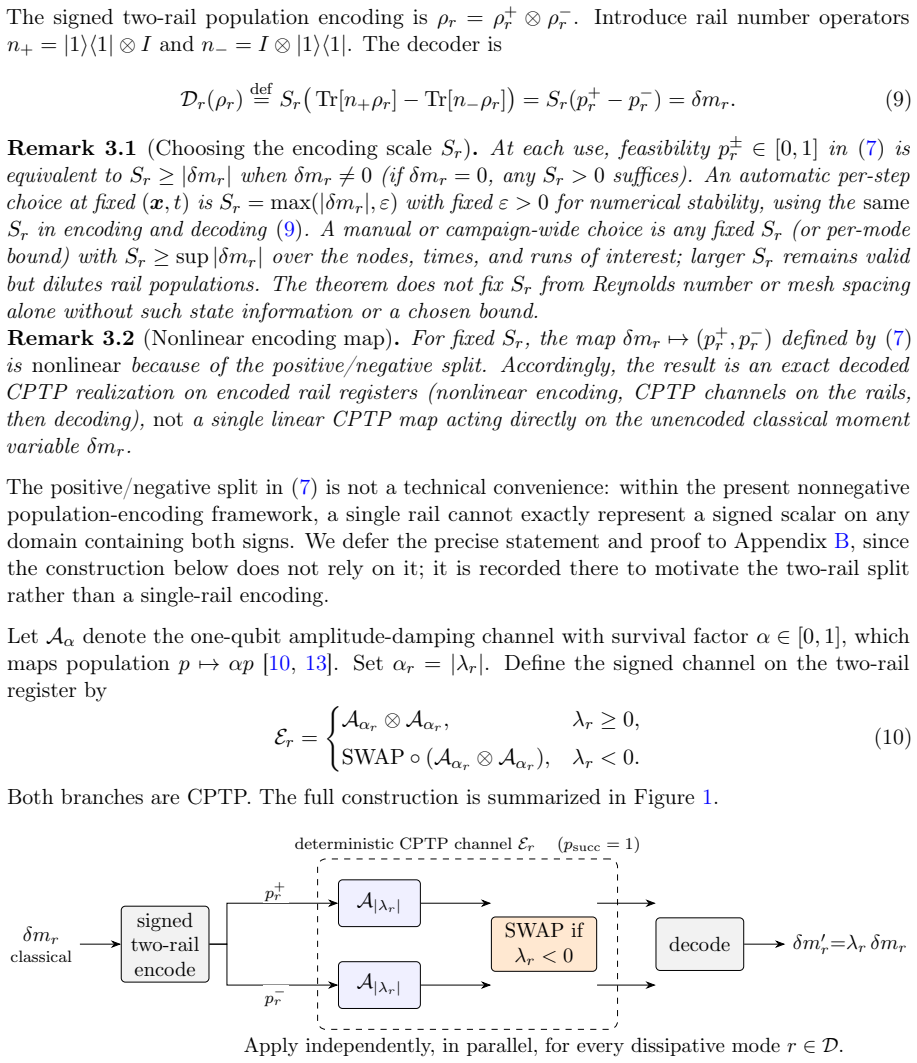
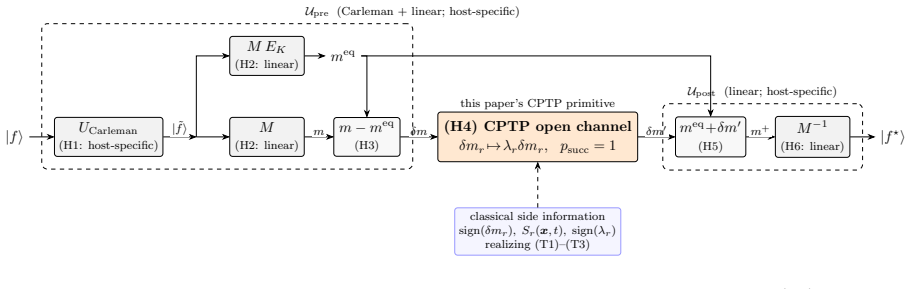
For the dissipative MRT block alone we give a block-encoding-free construction: a signed two-rail population encoding, then a CPTP map (per-rail amplitude damping with survival |λ_r| and, if λ_r<0, a rail SWAP) so that, after the decode, the map agrees with classical MRT relaxation exactly (expectations of the rail number operators, common encoding--decode scale). Trace preservation gives success probability 1 for that substage.
What carries the argument
Signed two-rail population encoding followed by per-rail amplitude damping and conditional rail SWAP for negative relaxation rates.
If this is right
- The dissipative substage contributes no multiplicative decay to overall success probability regardless of the number of modes or time steps.
- The block composes directly with standard moment transforms, streaming, and boundary conditions in the host LB pipeline.
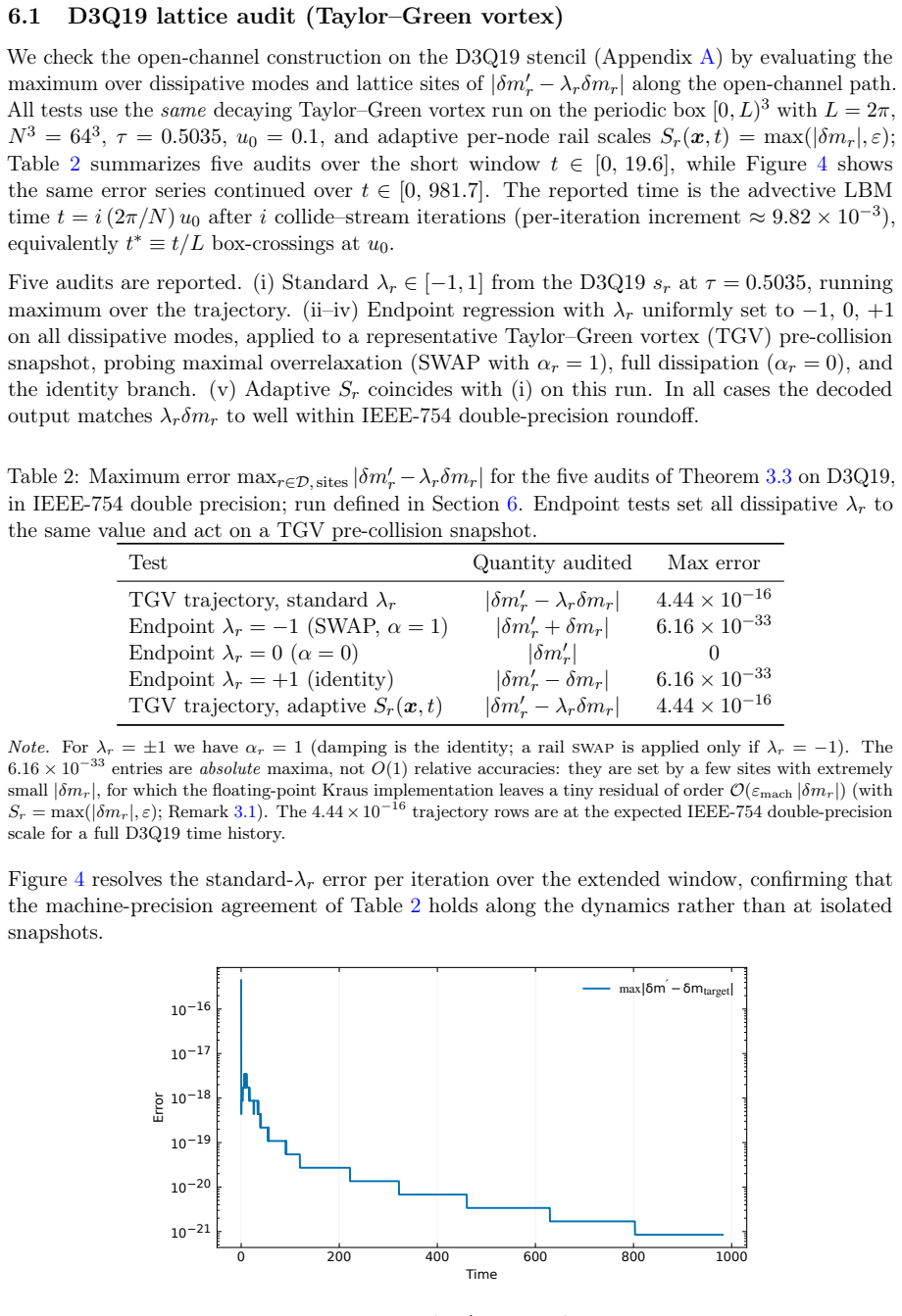
- Audits on long collide-stream runs and on stencil-free inputs recover the target classical values to machine precision.
- The same framework rules out a one-rail nonnegative encoding while allowing hybrid and fully coherent variants.
Where Pith is reading between the lines
- Combining this deterministic collision block with coherent streaming circuits could remove the dominant source of probabilistic overhead in full quantum LB simulations.
- The two-rail construction may extend to other classical dissipative operators that appear in reaction-diffusion or kinetic models on quantum devices.
- Near-term hardware tests could isolate the effect of gate noise on the exact classical match by comparing decoded rail expectations before and after the CPTP stage.
Load-bearing premise
The construction assumes that ideal error-free encoding and decoding operations exist for the signed two-rail populations and that the CPTP map can be realized exactly on quantum hardware without additional decoherence or gate errors.
What would settle it
Implementing the amplitude-damping-plus-conditional-SWAP circuit on quantum hardware for a small MRT system and finding that decoded expectations deviate from the classical λ_r δm_r relation by more than machine precision would falsify the exact match.
Figures

read the original abstract
Lattice Boltzmann (LB) on quantum devices must reconcile unitary gate evolution with the dissipative \emph{collision} step. In the multiple-relaxation-time (MRT) class, we work in the common setting of \emph{modewise diagonal} moment relaxation, $\delta m_r'=\lambda_r\,\delta m_r$ with $\lambda_r\in[-1,1]$ (overrelaxation if $\lambda_r<0$). Embedding that contraction in a unitary by block encoding or a linear combination of unitaries (LCU) typically yields subunitary success probability that decays multiplicatively across modes, sites, and time, a key bottleneck for quantum LB. \emph{For the dissipative MRT block alone} we give a \emph{block-encoding-free} construction: a signed \emph{two-rail} population encoding, then a completely positive trace-preserving (CPTP) map (per-rail amplitude damping with survival $|\lambda_r|$ and, if $\lambda_r<0$, a rail SWAP) so that, after the decode, the map agrees with classical MRT relaxation exactly (expectations of the rail number operators, common encoding--decode scale). Trace preservation gives success probability $1$ for that substage. The main result is the dissipative MRT block; construction of the equilibrium moment vector~$m^{\mathrm{eq}}=Mf^{\mathrm{eq}}$ (prescribed~$f^{\mathrm{eq}}$, host moment matrix~$M$; notation as in Section~\ref{subsec:generic-mrt}), moment transforms, streaming, and boundaries are composed with it as in a standard host pipeline and lie outside the scope of the formal theorem. Hybrid and fully coherent encodings, adaptive scales, Carleman-based context, and a one-rail no-go in the same nonnegative population framework are in the main text. Audits of the open-channel map on a long LBM collide-stream simulation and on stencil-free inputs both match the target to machine precision.
Editorial analysis
A structured set of objections, weighed in public.
Referee Report
Summary. The paper claims a block-encoding-free construction for the dissipative MRT collision step in quantum lattice Boltzmann methods. It encodes populations in a signed two-rail scheme, applies a per-rail CPTP map (amplitude damping by survival factor |λ_r| with a conditional rail SWAP when λ_r < 0), and decodes to recover exactly the classical relaxation δm_r' = λ_r δm_r in the expectations of the rail number operators. Trace preservation of the CPTP map guarantees success probability 1 for this sub-block. Numerical audits on full collide-stream LBM runs and stencil-free inputs match the target to machine precision. Equilibrium moments, streaming, and boundaries are treated as standard host-pipeline components outside the formal result.
Significance. If the central construction holds, it removes a key scalability barrier for quantum LB by eliminating the multiplicative success-probability decay that arises from block encodings or LCU when embedding dissipation. The deterministic (probability-1) realization for the MRT block, supported by machine-precision numerical verification, would enable more efficient hybrid quantum-classical fluid simulations and could extend to other dissipative operators that admit a diagonal relaxation structure.
major comments (2)
- [Derivation of the CPTP map for the signed two-rail encoding] The exact agreement after decoding is asserted for the expectations of the signed rail number operators. The manuscript should include an explicit algebraic verification (for both λ_r > 0 and λ_r < 0) showing that the post-CPT P state, when decoded with the common encoding-decoding scale, reproduces δm_r' = λ_r δm_r without residual terms from the damping or SWAP operations.
- [Discussion of hybrid and fully coherent encodings] The construction relies on the existence of ideal, error-free encoding and decoding unitaries for the signed two-rail populations. While the paper correctly scopes the main theorem to the dissipative block alone, a brief resource estimate or circuit-depth discussion for these encoding/decoding steps would clarify whether the overall pipeline remains advantageous compared with block-encoding approaches.
minor comments (2)
- [Numerical verification section] The abstract and main text refer to 'audits ... match the target to machine precision'; specifying the floating-point tolerance used and the length of the collide-stream runs (in lattice units) would strengthen reproducibility.
- [Introduction of MRT notation] Notation for the moment matrix M and equilibrium vector m^eq is introduced via reference to a prior subsection; a self-contained one-sentence reminder of the definitions would aid readers who encounter the MRT block in isolation.
Simulated Author's Rebuttal
We thank the referee for the careful reading and the positive recommendation for minor revision. We address each major comment below.
read point-by-point responses
-
Referee: [Derivation of the CPTP map for the signed two-rail encoding] The exact agreement after decoding is asserted for the expectations of the signed rail number operators. The manuscript should include an explicit algebraic verification (for both λ_r > 0 and λ_r < 0) showing that the post-CPT P state, when decoded with the common encoding-decoding scale, reproduces δm_r' = λ_r δm_r without residual terms from the damping or SWAP operations.
Authors: We agree that an explicit algebraic verification would strengthen the presentation. In the revised manuscript we will add a short derivation (new subsection or appendix) that applies the CPTP map to the signed two-rail basis states. For λ_r ≥ 0 the amplitude-damping channel scales the expectation of the signed number operator by exactly λ_r. For λ_r < 0 the combination of damping by |λ_r| followed by the conditional rail SWAP inverts the sign while preserving the magnitude; because the map is trace-preserving, the decoded expectation after the common encoding–decoding scale equals λ_r δm_r with no residual terms. revision: yes
-
Referee: [Discussion of hybrid and fully coherent encodings] The construction relies on the existence of ideal, error-free encoding and decoding unitaries for the signed two-rail populations. While the paper correctly scopes the main theorem to the dissipative block alone, a brief resource estimate or circuit-depth discussion for these encoding/decoding steps would clarify whether the overall pipeline remains advantageous compared with block-encoding approaches.
Authors: The manuscript already contains a discussion of hybrid and fully coherent encodings. To address the referee’s request we will add a concise paragraph supplying order-of-magnitude circuit-depth estimates for the encoding and decoding unitaries in the hybrid setting. These steps consist of local operations whose depth is independent of the number of relaxation modes and do not incur the multiplicative success-probability penalty of block encodings, thereby preserving the deterministic advantage of the MRT collision block. revision: yes
Circularity Check
No significant objection identified
full rationale
The paper presents an explicit construction for realizing classical MRT relaxation on quantum hardware via a signed two-rail encoding followed by a per-rail CPTP map (amplitude damping with survival factor |λ_r| and conditional SWAP for negative λ_r). After decoding, the expectations of the rail number operators are designed to match δm_r' = λ_r δm_r exactly, with trace preservation ensuring success probability 1. This is a direct engineering of the quantum map to reproduce the classical target on the relevant observables; the match is achieved by the definition of the map itself rather than by any reduction of the target to a fitted parameter, self-citation chain, or tautological redefinition. No load-bearing step relies on prior author work for uniqueness or ansatz smuggling, and the audits confirm agreement to machine precision on the stated inputs. The derivation chain is therefore self-contained against external benchmarks.
Axiom & Free-Parameter Ledger
axioms (2)
- standard math Amplitude damping is a valid completely positive trace-preserving map
- domain assumption Ideal encoding and decoding operations exist for the signed two-rail populations
invented entities (1)
-
Signed two-rail population encoding
no independent evidence
Reference graph
Works this paper leans on
-
[1]
Quantum algorithm for the lattice Boltzmann method with applications on real quantum devices,
A. Bastida-Zamoraet al., “Quantum algorithm for the lattice Boltzmann method with applications on real quantum devices,”arXiv preprintarXiv:2603.02127 (2026); https: //doi.org/10.48550/arXiv.2603.02127
-
[2]
Lindbladian Homotopy Analysis Method to Solve Nonlinear Partial Differential Equations
E. Choi, J. E. Kim, X. Lu, and Y. Wang, “Lindbladian Homotopy Analysis Method to Solve Nonlinear Partial Differential Equations,”arXiv preprintarXiv:2604.18924 (2026); https://doi.org/10.48550/arXiv.2604.18924
work page internal anchor Pith review Pith/arXiv arXiv doi:10.48550/arxiv.2604.18924 2026
-
[3]
Simulating the Flow Around a Circular Cylinder with a Lattice Boltzmann Equation,
F. J. Higuera and S. Succi, “Simulating the Flow Around a Circular Cylinder with a Lattice Boltzmann Equation,”Europhysics Letters8(6), 517 (1989);https://doi.org/10.1209/ 0295-5075/8/6/005
1989
-
[4]
Lattice Gas Dynamics with Enhanced Collisions,
F. J. Higuera, S. Succi, and R. Benzi, “Lattice Gas Dynamics with Enhanced Collisions,” Europhysics Letters9(4), 345 (1989);https://doi.org/10.1209/0295-5075/9/4/008
-
[5]
Boltzmann Approach to Lattice Gas Simulations,
F. J. Higuera and J. Jiménez, “Boltzmann Approach to Lattice Gas Simulations,”Europhysics Letters9(7), 663 (1989);https://doi.org/10.1209/0295-5075/9/7/009
-
[6]
The lattice Boltzmann equation: theory and applica- tions,
R. Benzi, S. Succi, and M. Vergassola, “The lattice Boltzmann equation: theory and applica- tions,”Physics Reports222(3), 145–197 (1992);https://doi.org/10.1016/0370-1573(92) 90090-M
-
[7]
C. Sanavio and S. Succi, “Lattice Boltzmann–Carleman quantum algorithm and circuit for fluid flows at moderate Reynolds number,”AVS Quantum Science6(2), 023802 (2024); https://doi.org/10.1116/5.0195549
-
[8]
Quantum computing for fluids: Where do we stand?
S. Succi, W. Itani, K. R. Sreenivasan, and R. Steijl, “Quantum computing for fluids: Where do we stand?”Europhysics Letters144(1), 10001 (2023); https://doi.org/10.1209/ 0295-5075/acfdc7
2023
-
[9]
Multiple-relaxation- time lattice Boltzmann models in three dimensions,
D. d’Humières, I. Ginzburg, M. Krafczyk, P. Lallemand, and L.-S. Luo, “Multiple-relaxation- time lattice Boltzmann models in three dimensions,”Philosophical Transactions of the Royal Society A360(2002), 437–451;https://doi.org/10.1098/rsta.2001.0955
-
[10]
M. A. Nielsen and I. L. Chuang,Quantum Computation and Quantum Information: 10th Anniversary Edition, Cambridge University Press, Cambridge, 2010; ISBN 978-1-139-49548-6; https://books.google.it/books?id=-s4DEy7o-a0C
2010
-
[11]
Quantum lattice Boltzmann method for simulating nonlinear fluid dynamics,
B. Wang, Z. Meng, Y. Zhao, and Y. Yang, “Quantum lattice Boltzmann method for simulating nonlinear fluid dynamics,”npj Quantum Information11(1), 196 (2025);https: //doi.org/10.1038/s41534-025-01142-6. 21
-
[12]
Theory of the lattice Boltzmann method: Acoustic and thermal properties in two and three dimensions,
P. Lallemand and L.-S. Luo, “Theory of the lattice Boltzmann method: Acoustic and thermal properties in two and three dimensions,”Phys. Rev. E68(3), 036706 (2003); https://doi.org/10.1103/PhysRevE.68.036706
-
[13]
Watrous,The Theory of Quantum Information, Cambridge University Press, Cambridge, 2018; ISBN 978-1-316-85312-2;https://books.google.it/books?id=jQFWDwAAQBAJ
J. Watrous,The Theory of Quantum Information, Cambridge University Press, Cambridge, 2018; ISBN 978-1-316-85312-2;https://books.google.it/books?id=jQFWDwAAQBAJ
2018
-
[14]
D. Manzano, “A short introduction to the Lindblad master equation,”AIP Advances10(2), 025106 (2020);https://doi.org/10.1063/1.5115323
-
[15]
Surrogate Quantum Circuit Design for the Lattice Boltzmann Collision Operator,
M. Lăcătuş and M. Möller, “Surrogate Quantum Circuit Design for the Lattice Boltzmann Collision Operator,”International Journal for Numerical Methods in Engineering127(4), e70286 (2026);https://doi.org/10.1002/nme.70286
-
[16]
Quantum Lattice Boltzmann Method based on linear equilibrium distribution functions,
Z. Liu, B. John, and D. R. Emerson, “Quantum Lattice Boltzmann Method based on linear equilibrium distribution functions,”Frontiers in Mechanical Engineering, Volume 11 (2025), Article 1717775 (2026);https://doi.org/10.3389/fmech.2025.1717775
-
[17]
D. Wawrzyniak, J. Winter, S. Schmidt, T. Indiniger, C. F. Janßen, U. Schramm, and N. A. Adams, “Linearized quantum lattice-Boltzmann method for the advection-diffusion equation using dynamic circuits,”Computer Physics Communications317, 109856 (2025); https://doi.org/10.1016/j.cpc.2025.109856
-
[18]
M. Lee, Z. Song, S. Kocherla, A. Adams, A. Alexeev, and S. H. Bryngelson, “A multiple- circuit approach to quantum resource reduction with application to the quantum lattice Boltzmann method,”Future Gener. Comput. Syst.174, 107975 (2026);https://doi.org/ 10.1016/j.future.2025.107975
-
[19]
Algorithmic Advances Towards a Realizable Quantum Lattice Boltzmann Method,
A. Tiwari, J. Iaconis, J. Jojo, S. Ray, M. Roetteler, C. Hill, and J. Pathak, “Algorithmic Advances Towards a Realizable Quantum Lattice Boltzmann Method,”arXiv preprint arXiv:2504.10870 (2025);https://arxiv.org/abs/2504.10870
-
[20]
L. Xu, M. Li, L. Zhang, H. Sun, and J. Yao, “Improved quantum lattice Boltzmann method for advection-diffusion equations with a linear collision model,”Phys. Rev. E111(4), 045305 (2025);https://doi.org/10.1103/PhysRevE.111.045305
-
[21]
K.-Y. Zeng, X.-D. Niu, A. Khan, D.-C. Li, and H. Yamaguchi, “A quantum computing- based lattice Boltzmann method with a linearized non-equilibrium collision operator and modular circuit for practical flow simulation,”Physics of Fluids37(8), 081701 (2025); https://doi.org/10.1063/5.0278054. 22
discussion (0)
Sign in with ORCID, Apple, or X to comment. Anyone can read and Pith papers without signing in.