Recognition: unknown
Microlensing of fast and slow compact objects
Pith reviewed 2026-05-07 14:51 UTC · model grok-4.3
The pith
Microlensing data from M31 and LMC surveys constrain densities of fast and slow compact objects at masses far outside standard dark matter windows.
A machine-rendered reading of the paper's core claim, the machinery that carries it, and where it could break.
Core claim
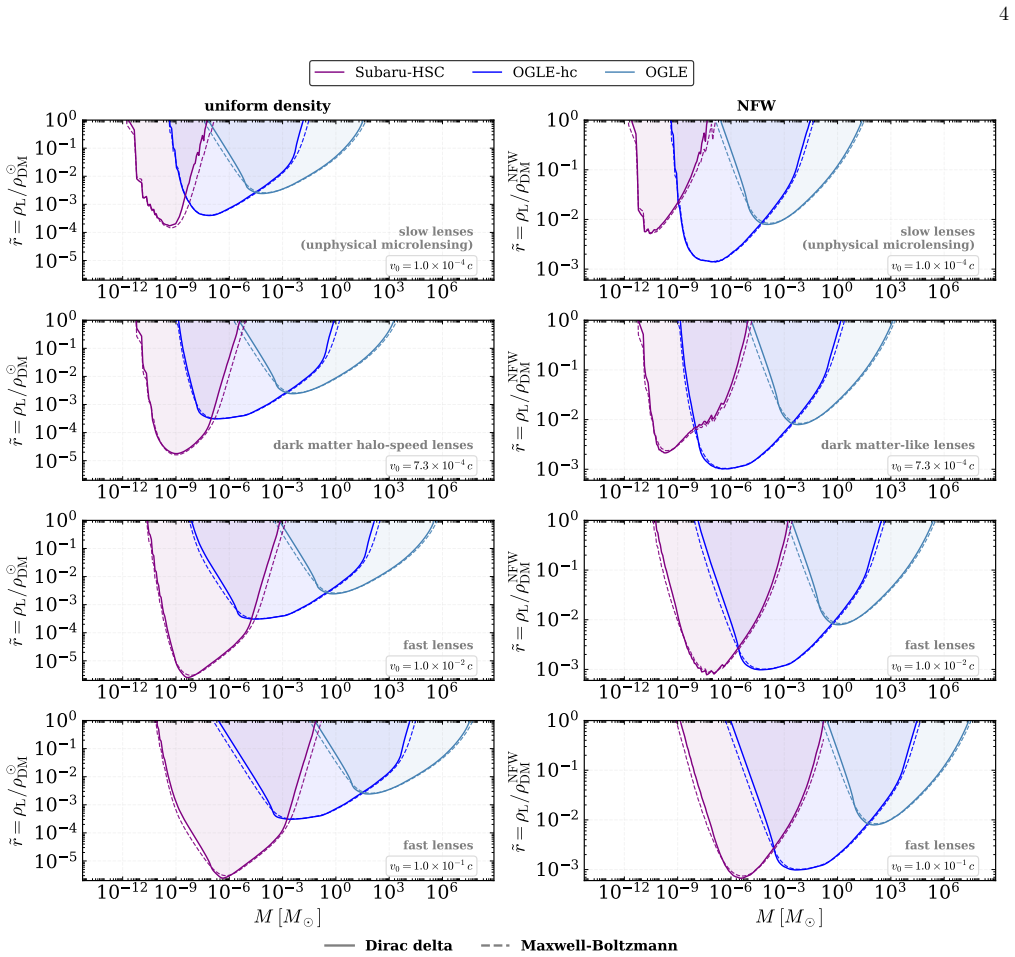
After deriving model-independent upper limits on the microlensing event rate, the authors obtain mass-dependent constraints on the density of lens populations with speeds spanning 10^{-4}c to 10^{-1}c from Subaru-HSC M31 and OGLE LMC surveys. These constraints are calculated for Maxwell-Boltzmann and Dirac delta velocity distributions as well as uniform and NFW spatial distributions. The work demonstrates that these limits exclude lens densities and masses differing from dark matter constraints by orders of magnitude, with additional considerations for source-observer transverse motion in slow cases and cadence effects in fast cases.
What carries the argument
The inherent speed-mass degeneracy in the Einstein crossing time of microlensing events, which shifts the mass range probed by a given observed duration depending on the lens speed.
If this is right
- Upper limits on event rates are independent of specific lens models.
- Density constraints apply across a broad range of speeds for two velocity and two spatial distributions.
- Slow lenses require accounting for transverse motions of sources and observers.
- Fast lenses benefit from higher cadence observations to reach smaller masses without additional suppressions.
Where Pith is reading between the lines
- Specific theoretical models predicting fast or slow compact objects, such as those from cosmic strings or gravitational kicks, can now be tested with existing data.
- This framework could be extended to other surveys or future observations with varying cadences to further map out allowed parameter space.
- The results suggest that searches for compact objects should routinely consider velocity distributions different from virialized halos.
Load-bearing premise
The derived constraints depend on the compact objects following one of the two benchmark velocity distributions and one of the two spatial distributions considered.
What would settle it
Detection of microlensing events at rates above the model-independent upper limits in the relevant time scales for the M31 or LMC fields would invalidate the density bounds for the corresponding speeds and masses.
Figures

read the original abstract
Gravitational microlensing constraints on non-standard compact objects are conventionally derived assuming lenses trace the dark matter halo with velocities following a Maxwell-Boltzmann distribution centered around $10^{-3}c$. However, a variety of theoretical scenarios predict populations of compact objects whose velocities deviate dramatically from those of virialized halo dark matter -- ultrarelativistic primordial black holes from cosmic string collapse, mirror neutron stars, gravitationally kicked black hole merger remnants, dark matter nuggets, free floaters ejected from gravitationally bound systems, disk-formed compact objects, and so on. For a given Einstein crossing time, the speed-mass degeneracy inherent in it means that fast (slow) lenses produce events at larger (smaller) masses than spanned by standard windows, opening qualitatively new regions of parameter space. After deriving model-independent upper limits on the microlensing event rate, we obtain mass-dependent constraints on the density of lens populations with speeds spanning $10^{-4}c-10^{-1}c$ from surveys of M31 by Subaru-HSC and the LMC by OGLE with different observing cadences. We do this for two benchmark velocity distributions -- Maxwell-Boltzmann and Dirac delta -- and two spatial distributions -- uniform and NFW, and exclude lens densities and masses that differ from dark matter constraints by orders of magnitude. We examine the effect of the transverse motion of the source and observer relative to the lensing tube, which becomes significant for our slow lenses. We also show that, unlike in dark matter searches, for our fast lenses an increase in the cadence of observations would probe smaller masses without suppression of event rates from the finite source and wave optics effects.
Editorial analysis
A structured set of objections, weighed in public.
Referee Report
Summary. The paper claims to derive model-independent upper limits on microlensing event rates using public data from Subaru-HSC observations of M31 and OGLE observations of the LMC. These limits are then used to place mass-dependent constraints on the density of compact object populations with velocities between 10^{-4}c and 10^{-1}c, employing benchmark Maxwell-Boltzmann and Dirac delta velocity distributions along with uniform and NFW spatial distributions. The resulting exclusions on lens densities and masses are stated to differ from standard dark matter constraints by orders of magnitude. Additional considerations include the transverse motion of sources and observers for slow lenses and the impact of observation cadence on detecting fast lenses without finite-source or wave-optics suppression.
Significance. If substantiated, this work is significant for opening new regions of parameter space in microlensing searches for non-standard compact objects. By focusing on extreme velocities, it provides a way to constrain theoretical scenarios such as ultrarelativistic primordial black holes, mirror neutron stars, and ejected compact objects using existing survey data. The model-independent approach to event rate limits and the use of public datasets are strengths that enhance reproducibility and applicability. The analysis of cadence effects for fast lenses and motion effects for slow lenses adds practical value for future observations.
major comments (3)
- The manuscript describes deriving model-independent upper limits on the microlensing event rate but does not include the detailed calculation, such as the formula relating observed events to the rate upper limit or the treatment of survey efficiencies and backgrounds. This is central to supporting the quantitative density constraints claimed.
- The statement that an increase in cadence for fast lenses probes smaller masses without suppression from finite source and wave optics effects lacks a quantitative backing, including specific calculations of the relevant scales for velocities up to 10^{-1}c; this affects the interpretation of how new mass ranges are accessed.
- The examination of transverse motion of source and observer for slow lenses (10^{-4}c) is mentioned, but the resulting modification to the constraints, including any updated error budgets, should be explicitly shown to confirm the order-of-magnitude exclusions.
minor comments (2)
- The abstract refers to 'different observing cadences' without specifying the values used for Subaru-HSC and OGLE; including these numbers would improve clarity.
- Ensure all equations for the rate-to-density conversion are numbered and referenced consistently in the text.
Simulated Author's Rebuttal
We thank the referee for their careful reading of the manuscript, their positive assessment of its significance, and their constructive major comments. We address each point below and will revise the manuscript accordingly to improve clarity and completeness.
read point-by-point responses
-
Referee: The manuscript describes deriving model-independent upper limits on the microlensing event rate but does not include the detailed calculation, such as the formula relating observed events to the rate upper limit or the treatment of survey efficiencies and backgrounds. This is central to supporting the quantitative density constraints claimed.
Authors: We agree that the derivation of the model-independent upper limits requires more explicit detail to support the claimed density constraints. The manuscript currently references the use of public Subaru-HSC and OGLE data and states that upper limits are derived from the absence of detected events, but the statistical formula (e.g., Poisson-based upper limit on event rate given zero observed events) and the precise incorporation of published survey efficiencies and background treatments are not laid out step by step. In the revised version we will add a dedicated methods subsection that presents the exact relation between observed events and the rate upper limit, specifies how efficiencies from the original survey papers are folded in, and clarifies the background assumptions. This will make the quantitative link to the mass-dependent density exclusions fully transparent. revision: yes
-
Referee: The statement that an increase in cadence for fast lenses probes smaller masses without suppression from finite source and wave optics effects lacks a quantitative backing, including specific calculations of the relevant scales for velocities up to 10^{-1}c; this affects the interpretation of how new mass ranges are accessed.
Authors: We accept that the claim would benefit from explicit quantitative support. The abstract notes that higher cadence allows access to shorter Einstein crossing times and thus lower masses for fast lenses before finite-source or wave-optics suppression sets in, but no numerical scales are provided for v up to 0.1c. In the revision we will insert a short calculation section that derives the mass thresholds at which finite-source effects (source angular size versus Einstein radius) and wave-optics suppression become important for velocities in the stated range, and shows that sub-minute cadence can reach these masses while remaining above the suppression regime. This will substantiate the statement that new mass ranges are accessed without loss of sensitivity. revision: yes
-
Referee: The examination of transverse motion of source and observer for slow lenses (10^{-4}c) is mentioned, but the resulting modification to the constraints, including any updated error budgets, should be explicitly shown to confirm the order-of-magnitude exclusions.
Authors: We thank the referee for highlighting this point. The manuscript discusses that transverse motions of the source and observer become non-negligible relative to the lens velocity for the slowest objects and therefore modify the effective relative velocity, but the quantitative impact on the derived density limits and any associated error-budget adjustments are not displayed. In the revised manuscript we will add explicit calculations of the modified event rates that incorporate these transverse velocities, present the resulting updated constraints for the 10^{-4}c population, and include a brief discussion of how uncertainties in the transverse-velocity components propagate into the final error budget. This will confirm that the order-of-magnitude separation from standard dark-matter constraints remains intact. revision: yes
Circularity Check
No significant circularity detected
full rationale
The paper derives model-independent upper limits on microlensing event rates directly from Subaru-HSC and OGLE survey data, then translates these to density constraints for specified speed ranges using two explicitly chosen benchmark velocity distributions (Maxwell-Boltzmann and Dirac delta) and two spatial distributions (uniform and NFW). These benchmarks are stated as assumptions rather than derived or fitted quantities presented as predictions. No steps reduce by construction to self-defined inputs, fitted parameters renamed as outputs, or load-bearing self-citations whose validity depends on the present work. Additional analyses of transverse motion effects and cadence impacts are independent examinations. The central claims remain conditional on the benchmarks and grounded in external observational data, rendering the derivation chain self-contained.
Axiom & Free-Parameter Ledger
axioms (2)
- standard math Einstein crossing time depends on lens mass and transverse velocity via the standard microlensing relation t_E proportional to sqrt(M)/v
- domain assumption Microlensing event rate upper limits can be derived model-independently from observed light-curve statistics
Reference graph
Works this paper leans on
-
[1]
Lectures on Gravitational Lensing
A. Einstein, Science84, 506 (1936). [2] R. Narayan and M. Bartelmann, in13th Jerusalem Win- ter School in Theoretical Physics: Formation of Structure 8 in the Universe(1996) arXiv:astro-ph/9606001
work page Pith review arXiv 1936
-
[2]
A. M. Green and B. J. Kavanagh, J. Phys. G48, 043001 (2021), arXiv:2007.10722 [astro-ph.CO]
work page internal anchor Pith review arXiv 2021
- [3]
- [4]
-
[5]
M. Fairbairn, D. J. E. Marsh, and J. Quevillon, Phys. Rev. Lett.119, 021101 (2017), arXiv:1701.04787 [astro- ph.CO]
-
[6]
N. Blinov, M. J. Dolan, and P. Draper, Physical Review D101(2020), 10.1103/physrevd.101.035002
- [7]
-
[8]
Croon, D
D. Croon, D. McKeen, and N. Raj, Phys. Rev. D101, 083013 (2020)
2020
- [9]
- [10]
-
[11]
Sajadian, Monthly Notices of the Royal Astronomical Society506, 3615–3628 (2021)
S. Sajadian, Monthly Notices of the Royal Astronomical Society506, 3615–3628 (2021)
2021
-
[12]
Bachelet, D
E. Bachelet, D. Specht, M. Penny, M. Hundertmark, S. Awiphan, J.-P. Beaulieu, M. Dominik, E. Kerins, D. Maoz, E. Meade, A. A. Nucita, R. Poleski, C. Ranc, J. Rhodes, and A. C. Robin, Astronomy & Astrophysics 664, A136 (2022)
2022
-
[13]
Microlensing constraints on primordial black holes with the Subaru/HSC Andromeda observation
H. Niikuraet al., Nature Astron.3, 524 (2019), arXiv:1701.02151 [astro-ph.CO]
work page Pith review arXiv 2019
-
[14]
P. Mr´ ozet al., Astrophys. J. Lett.976, L19 (2024), arXiv:2410.06251 [astro-ph.CO]
-
[15]
P. Mr´ ozet al., Astrophys. J. Suppl.273, 4 (2024), arXiv:2403.02398 [astro-ph.GA]
-
[16]
Limits on the Macho Content of the Galactic Halo from the EROS-2 Survey of the Magellanic Clouds
P. Tisserandet al.(EROS-2), Astron. Astrophys.469, 387 (2007), arXiv:astro-ph/0607207 [astro-ph]
work page Pith review arXiv 2007
-
[17]
The MACHO Project: Microlensing Results from 5.7 Years of LMC Observations
C. Alcocket al.(MACHO), Astrophys. J.542, 281 (2000), arXiv:astro-ph/0001272
work page Pith review arXiv 2000
- [18]
-
[19]
M. Hippert, J. Setford, H. Tan, D. Curtin, J. Noronha- Hostler, and N. Yunes, Phys. Rev. D106, 035025 (2022), arXiv:2103.01965 [astro-ph.HE]
-
[20]
P. Disberg and I. Mandel, Astrophys. J. Lett.989, L8 (2025), arXiv:2505.22102 [astro-ph.HE]
-
[21]
D. Gerosa and C. J. Moore, Phys. Rev. Lett.117, 011101 (2016), arXiv:1606.04226 [gr-qc]
- [22]
- [23]
-
[24]
P. van Dokkum, C. Jennings, I. Pasha, C. Conroy, I. Kaul, R. Abraham, S. Danieli, A. J. Romanowsky, and G. Tremblay, Astrophys. J. Lett.998, L27 (2026), arXiv:2512.04166 [astro-ph.GA]
- [25]
-
[26]
Dong, et al., Science391, 96 (2026), arXiv:2601.00057 [astro-ph.EP]
S. Dong, et al., Science391, 96 (2026), arXiv:2601.00057 [astro-ph.EP]
-
[27]
Bottema, AAP275, 16 (1993)
R. Bottema, AAP275, 16 (1993)
1993
- [28]
- [29]
- [30]
-
[31]
G. D’Amico, P. Panci, A. Lupi, S. Bovino, and J. Silk, Mon. Not. Roy. Astron. Soc.473, 328 (2018), arXiv:1707.03419 [astro-ph.CO]
- [32]
- [33]
- [34]
-
[35]
J. Bramante, M. Diamond, and J. L. Kim, JCAP02, 002 (2024), arXiv:2309.13148 [hep-ph]
- [36]
-
[37]
Gould, APJ392, 442 (1992)
A. Gould, APJ392, 442 (1992)
1992
-
[38]
C. Alcock, R. A. Allsman, D. Alves, T. S. Axelrod, D. P. Bennett, K. H. Cook, K. C. Freeman, K. Griest, J. Guern, M. J. Lehner, S. L. Marshall, B. A. Peterson, M. R. Pratt, P. J. Quinn, A. W. Rodgers, C. W. Stubbs, and W. Sutherland, APJL454, L125 (1995), arXiv:astro- ph/9506114 [astro-ph]
-
[39]
E. Hog, I. D. Novikov, and A. G. Polnarev, aap294, 287 (1995)
1995
- [40]
-
[41]
Lee, Universe3, 53 (2017), arXiv:1711.05298 [astro-ph.IM]
C.-H. Lee, Universe3, 53 (2017), arXiv:1711.05298 [astro-ph.IM]
- [42]
- [43]
-
[44]
Griest, APJ366, 412 (1991)
K. Griest, APJ366, 412 (1991)
1991
-
[45]
R. P. van der Marel, M. Fardal, G. Besla, R. L. Beaton, S. T. Sohn, J. Anderson, T. Brown, and P. Guhathakurta, The Astrophysical Journal753, 8 (2012)
2012
-
[46]
Constraints on Earth-mass primordial black holes from OGLE 5-year microlensing events
H. Niikura, M. Takada, S. Yokoyama, T. Sumi, and S. Masaki, Phys. Rev. D99, 083503 (2019), arXiv:1901.07120 [astro-ph.CO]
work page Pith review arXiv 2019
-
[47]
A. M. Green, (2026), arXiv:2602.15974 [astro-ph.GA]
work page internal anchor Pith review Pith/arXiv arXiv 2026
-
[48]
H. J. Witt and S. Mao, APJ430, 505 (1994)
1994
- [49]
- [50]
-
[51]
S. Sugiyama, M. Takada, N. Yasuda, and N. Tominaga, (2026), arXiv:2602.05840 [astro-ph.CO]
-
[52]
Eppur non si trovano Vol. 2: No Planetary-mass Primordial Black Holes toward the Andromeda Galaxy
P. Mr´ oz and A. Udalski, (2026), arXiv:2604.00111 [astro- ph.CO]
work page internal anchor Pith review Pith/arXiv arXiv 2026
-
[53]
Verma, M
H. Verma, M. Tamta, N. Raj. In preparation
-
[54]
A. Katz, J. Kopp, S. Sibiryakov, and W. Xue, Journal of Cosmology and Astroparticle Physics2018, 005 (2018), arXiv:1807.11495
work page Pith review arXiv 2018
-
[55]
Gamma-ray burst lensing parallax: Closing the primordial black hole dark matter mass window,
S. Jung and T. Kim, Physical Review Research2, 013113 (2020), arXiv:1908.00078. 9
-
[56]
On the feasibility of primordial black hole abundance constraints using lensing parallax of GRBs,
P. Gawade, S. More, and V. Bhalerao, Mon. Not. Roy. Astron. Soc.527, 3306 (2023), arXiv:2308.01775 [astro- ph.CO]
- [57]
-
[58]
Drlica-Wagneret al.(LSST Dark Matter Group), (2019), arXiv:1902.01055 [astro-ph.CO]
A. Drlica-Wagneret al.(LSST Dark Matter Group), (2019), arXiv:1902.01055 [astro-ph.CO]
-
[59]
M. Crispim Romao, D. Croon, B. Crossey, and D. Godines, JCAP10, 066 (2025), arXiv:2506.20709 [astro-ph.CO]
-
[60]
W. DeRocco, E. Frangipane, N. Hamer, S. Profumo, and N. Smyth, Phys. Rev. D109, 023013 (2024), arXiv:2311.00751 [astro-ph.CO]
-
[61]
As- trometric microlensing by primordial black holes with the roman space telescope,
J. Fardeen, P. McGill, S. E. Perkins, W. A. Dawson, N. S. Abrams, J. R. Lu, M.-F. Ho, and S. Bird, “As- trometric microlensing by primordial black holes with the roman space telescope,” (2024), arXiv:2312.13249 [astro-ph.GA]
-
[62]
L. Hamolli, M. Hafizi, F. De Paolis, and A. A. Nucita, Astrophysics and Space Science366(2021), 10.1007/s10509-021-03980-0
- [63]
- [64]
- [65]
-
[66]
Y. Inoue and A. Kusenko, JCAP10, 034 (2017), arXiv:1705.00791 [astro-ph.CO]
-
[67]
J. Manshanden, D. Gaggero, G. Bertone, R. M. T. Connors, and M. Ricotti, JCAP06, 026 (2019), arXiv:1812.07967 [astro-ph.HE]
-
[68]
D. Croon and S. Sevillano Mu˜ noz, JCAP07, 060 (2024), arXiv:2403.13072 [astro-ph.CO]
discussion (0)
Sign in with ORCID, Apple, or X to comment. Anyone can read and Pith papers without signing in.