Recognition: unknown
Sector-dominant graph-local drivers for path-window barrier Hamiltonians on the Boolean hypercube
Pith reviewed 2026-05-07 16:42 UTC · model grok-4.3
The pith
Hybrid sector and path-window drivers improve ground-state fidelity for aligned non-diagonal barrier Hamiltonians on Boolean hypercubes.
A machine-rendered reading of the paper's core claim, the machinery that carries it, and where it could break.
Core claim
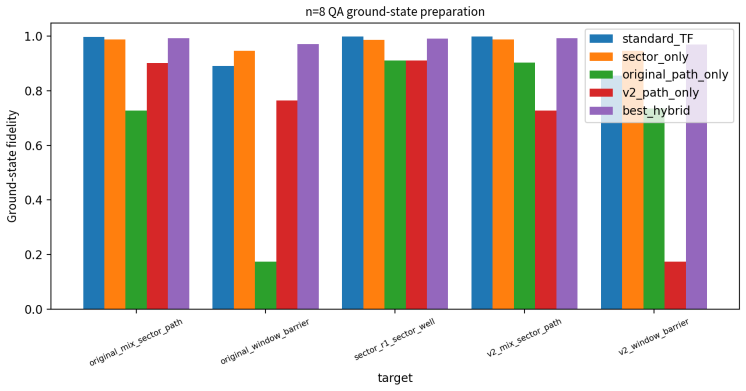
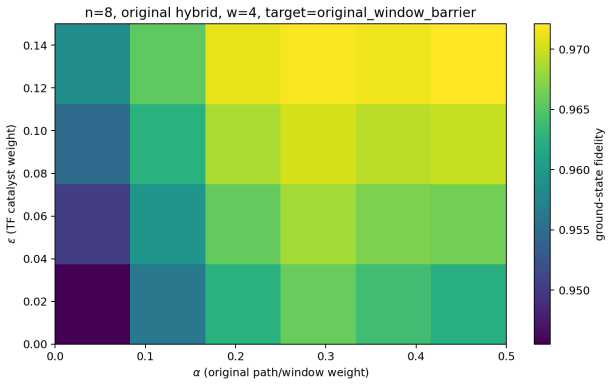
For non-diagonal target Hamiltonians whose geometry is expressed in the same sector/path coordinates, hybrid drivers combining sector, path-window, and small transverse-field components can substantially improve the final ground-state fidelity in centered barrier instances. Reproduction runs confirm a representative centered original-window barrier value of approximately 0.9799 for the fixed-control hybrid parameters (w,α,ε)=(8,0.50,0.15), while also showing that the improvement is target-class dependent. The dominant contribution is the sector-preserving skeleton, with strict one-bit completion acting as a secondary refinement.
What carries the argument
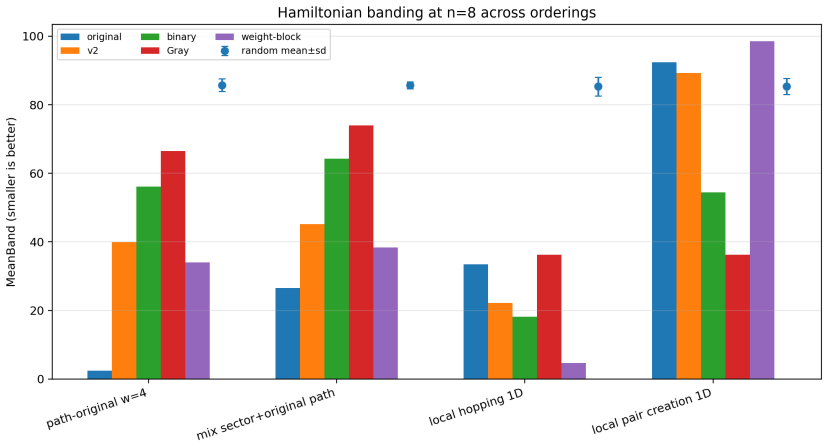
Sector/path coordinates related to monotone Gray-code representatives, used to construct graph-local hybrid drivers that preserve sector dominance while adding path-window and transverse-field refinements.
If this is right
- Ordinary diagonal-cost transverse-field annealing gains no robust advantage from the sector/path ordering.
- The fidelity improvement depends on the target class and requires coordinate alignment between driver and Hamiltonian.
- Ablation controls identify the sector-preserving skeleton as the primary source of the gain and one-bit completion as a secondary refinement.
- The construction supplies finite representatives and code that make the reported fidelity values directly traceable and reproducible.
Where Pith is reading between the lines
- If coordinate alignment can be maintained or approximated at larger sizes, the hybrid approach may remain useful for barrier-like problems.
- The negative result for diagonal cases indicates that driver ordering must be matched to problem geometry rather than applied universally.
- The supplied reproduction scripts allow direct checks on other barrier widths or target classes to map the range of effectiveness.
Load-bearing premise
The target Hamiltonians must have geometry that can be expressed in the same sector/path coordinates as the drivers.
What would settle it
A test in which the fidelity gain disappears when the target Hamiltonian geometry is deliberately chosen to lie outside the sector/path coordinates used by the driver.
Figures




read the original abstract
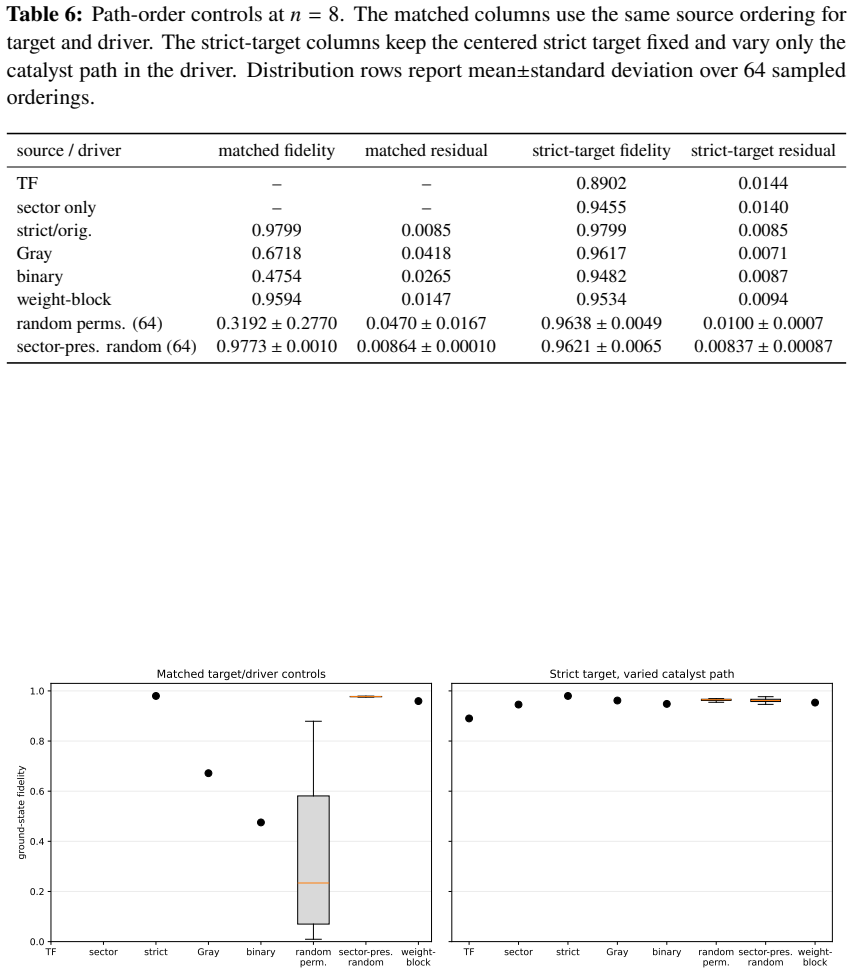
We study finite-size adiabatic state preparation on Boolean hypercubes using graph-local drivers built from sector/path coordinates related to monotone Gray-code representatives. The construction is not presented as a new all-$n$ Gray-code existence theorem; rather, it provides finite representatives, explicitly checked through the cases used in the numerical experiments, for testing problem-dependent graph-local drivers. For ordinary diagonal-cost transverse-field annealing, the ordering does not yield a robust advantage, and we include this negative result as a baseline. For non-diagonal target Hamiltonians whose geometry is expressed in the same sector/path coordinates, hybrid drivers combining sector, path-window, and small transverse-field components can substantially improve the final ground-state fidelity in centered barrier instances. Reproduction runs from the accompanying code confirm a representative centered original-window barrier value of approximately \(0.9799\) for the fixed-control hybrid parameters \((w,\alpha,\epsilon)=(8,0.50,0.15)\), while also showing that the improvement is target-class dependent. Randomized and ablation controls indicate that the dominant contribution is the sector-preserving skeleton, with strict one-bit completion acting as a secondary refinement. We provide code, finite certificates, CSV files, validation logs, and reproduction scripts to make the finite-size claims traceable.
Editorial analysis
A structured set of objections, weighed in public.
Referee Report
Summary. The paper studies finite-size adiabatic state preparation on Boolean hypercubes using graph-local drivers constructed from sector/path coordinates tied to monotone Gray-code representatives. It supplies finite representatives explicitly verified in the numerical experiments rather than a general all-n construction. For standard diagonal-cost transverse-field annealing the ordering yields no robust advantage (included as a negative baseline). For non-diagonal target Hamiltonians whose geometry is expressed in the same sector/path coordinates, hybrid drivers that combine a sector-dominant skeleton, path-window terms, and a small transverse-field component substantially improve final ground-state fidelity on centered barrier instances; reproduction runs give a representative value of approximately 0.9799 for the fixed parameters (w, α, ε) = (8, 0.50, 0.15). The improvement is shown to be target-class dependent, with the sector-preserving component dominant and one-bit completion secondary. The manuscript supplies code, finite certificates, CSV files, validation logs, and reproduction scripts.
Significance. If the reported fidelity gains hold under the stated alignment precondition, the work supplies a concrete, reproducible template for designing problem-dependent graph-local drivers that exploit geometric structure in the target Hamiltonian. The explicit negative baseline for ordinary transverse-field annealing and the provision of machine-readable artifacts (code, certificates, logs) are clear strengths that allow independent verification of the finite-size claims.
major comments (2)
- [Abstract and numerical-experiments description] The central positive claim is restricted to 'non-diagonal target Hamiltonians whose geometry is expressed in the same sector/path coordinates.' No section or appendix supplies a general procedure for expressing an arbitrary target in these coordinates or for verifying the alignment condition. Because the hybrid construction loses its intended action without this alignment (reducing to a non-advantageous baseline), the absence of such a method is load-bearing for any claim of practical utility beyond the explicitly checked finite instances.
- [Numerical experiments and reproduction runs] The reported fidelity of ~0.9799 is given for the specific parameter set (w, α, ε) = (8, 0.50, 0.15) on centered original-window barriers. The manuscript does not present a systematic scan of these parameters, error bars from multiple random seeds, or an ablation table that isolates the contribution of each hybrid component across all tested barrier instances. Without this, the quantitative assertion that the hybrid 'substantially improve[s]' fidelity rests on a single-point reproduction rather than a statistically characterized improvement.
minor comments (1)
- [Abstract] The abstract states that 'the improvement is target-class dependent' but does not cross-reference the specific table or figure that quantifies the dependence; adding an explicit pointer would improve readability.
Simulated Author's Rebuttal
We thank the referee for the positive evaluation and constructive comments on our finite-size study of graph-local drivers. We address each major comment below, clarifying the manuscript's scope and outlining targeted revisions to strengthen the presentation of results and limitations.
read point-by-point responses
-
Referee: [Abstract and numerical-experiments description] The central positive claim is restricted to 'non-diagonal target Hamiltonians whose geometry is expressed in the same sector/path coordinates.' No section or appendix supplies a general procedure for expressing an arbitrary target in these coordinates or for verifying the alignment condition. Because the hybrid construction loses its intended action without this alignment (reducing to a non-advantageous baseline), the absence of such a method is load-bearing for any claim of practical utility beyond the explicitly checked finite instances.
Authors: The manuscript explicitly frames its contribution around finite-size instances and finite representatives of monotone Gray-code orderings, with all numerical claims restricted to cases where the target Hamiltonian geometry is already expressed in the sector/path coordinates (as verified by the supplied certificates and code). We do not assert a general mapping procedure for arbitrary targets, nor do we claim robustness outside the alignment precondition; the negative baseline for standard transverse-field annealing is included precisely to illustrate the loss of advantage without alignment. To address the concern about scope, we will revise the abstract and the opening of Section 1 to state the alignment requirement more prominently and to reiterate that the reported fidelity gains apply only to the explicitly aligned, finite instances studied. revision: yes
-
Referee: [Numerical experiments and reproduction runs] The reported fidelity of ~0.9799 is given for the specific parameter set (w, α, ε) = (8, 0.50, 0.15) on centered original-window barriers. The manuscript does not present a systematic scan of these parameters, error bars from multiple random seeds, or an ablation table that isolates the contribution of each hybrid component across all tested barrier instances. Without this, the quantitative assertion that the hybrid 'substantially improve[s]' fidelity rests on a single-point reproduction rather than a statistically characterized improvement.
Authors: The current text reports the representative value 0.9799 from the fixed-parameter reproduction runs and notes that randomized and ablation controls were performed, with the sector-preserving component identified as dominant. However, we acknowledge that a dedicated ablation table, multi-seed error bars, and a systematic parameter scan are not presented. In the revision we will add an ablation table that quantifies the fidelity contribution of each hybrid component (sector skeleton, path-window terms, and transverse-field) across the tested centered-barrier instances, include standard deviations from multiple random seeds for the key runs, and provide a limited sensitivity check over nearby (w, α, ε) values to better support the quantitative improvement claim. revision: yes
Circularity Check
No significant circularity; claims rest on finite numerical simulations with code, controls, and explicit scope limits.
full rationale
The paper's central results are empirical fidelity measurements from adiabatic evolution on finite Boolean hypercube instances. It explicitly disclaims a general Gray-code theorem and instead supplies checked finite representatives plus reproduction code. Negative baselines for transverse-field annealing are included, and improvements are stated as target-class dependent (requiring sector/path coordinate alignment). No equation or claim reduces by construction to a fitted parameter, self-definition, or unverified self-citation chain; ablation and randomized controls are reported. This is the most common honest non-finding for simulation-driven work.
Axiom & Free-Parameter Ledger
free parameters (1)
- hybrid parameters (w, α, ε) =
(8, 0.50, 0.15)
axioms (1)
- domain assumption Adiabatic theorem applies for slow enough evolution in finite systems
Reference graph
Works this paper leans on
-
[1]
Quantum computation by adiabatic evolution, 2000
Edward Farhi, Jeffrey Goldstone, Sam Gutmann, and Michael Sipser. Quantum computation by adiabatic evolution, 2000
2000
-
[2]
Quantum annealing in the transverse Ising model.Physical Review E, 58:5355–5363, 1998
Tadashi Kadowaki and Hidetoshi Nishimori. Quantum annealing in the transverse Ising model.Physical Review E, 58:5355–5363, 1998. doi: 10.1103/PhysRevE.58. 5355. 26
-
[3]
Adiabatic quantum computation is equivalent to standard quantum computation.SIAM Journal on Computing, 37(1):166–194, 2007
Dorit Aharonov, Wim van Dam, Julia Kempe, Zeph Landau, Seth Lloyd, and Oded Regev. Adiabatic quantum computation is equivalent to standard quantum computation.SIAM Journal on Computing, 37(1):166–194, 2007. doi: 10.1137/ S0097539705447323
2007
-
[4]
Quantum annealing with antiferromagnetic fluctuations.Physical Review E, 85:051112, 2012
Yuya Seki and Hidetoshi Nishimori. Quantum annealing with antiferromagnetic fluctuations.Physical Review E, 85:051112, 2012. doi: 10.1103/PhysRevE.85. 051112
-
[5]
Nonstoquastic hamiltonians and quantum annealing of an ising spin glass,
Layla Hormozi, Ethan W. Brown, Giuseppe Carleo, and Matthias Troyer. Nonsto- quastic hamiltonians and quantum annealing of an Ising spin glass.Physical Review B, 95:184416, 2017. doi: 10.1103/PhysRevB.95.184416
-
[6]
Carla D. Savage and Peter Winkler. Monotone Gray codes and the middle levels problem.Journal of Combinatorial Theory, Series A, 70(2):230–248, 1995. doi: 10.1016/0097-3165(95)90091-8
-
[7]
Frank Ruskey, Joe Sawada, and Aaron Williams. The coolest way to generate combinations.Discrete Mathematics, 309(17):5305–5320, 2009. doi: 10.1016/j. disc.2007.11.048
work page doi:10.1016/j 2009
-
[8]
Combinatorial Gray codes—an updated survey.The Electronic Journal of Combinatorics, DS26, 2023
Torsten M¨ utze. Combinatorial Gray codes—an updated survey.The Electronic Journal of Combinatorics, DS26, 2023. doi: 10.37236/11023
-
[9]
Carla D. Savage. A survey of combinatorial Gray codes.SIAM Review, 39(4): 605–629, 1997. doi: 10.1137/S0036144595295272
-
[10]
Nicholas Streib and William T. Trotter. Hamiltonian cycles and symmetric chains in Boolean lattices.Graphs and Combinatorics, 30:327–335, 2014. doi: 10.1007/ s00373-013-1350-8
2014
-
[11]
Gray codes and symmetric chains
Petr Gregor, Sven J¨ager, Torsten M¨ utze, Joe Sawada, and Kaja Wille. Gray codes and symmetric chains. In45th International Colloquium on Automata, Languages, and Programming (ICALP 2018), volume 107 ofLeibniz International Proceedings in Informatics, pages 66:1–66:14, 2018. doi: 10.4230/LIPIcs.ICALP.2018.66
-
[12]
Fan R. K. Chung.Spectral Graph Theory, volume 92 ofCBMS Regional Con- ference Series in Mathematics. American Mathematical Society, 1997. ISBN 9780821803158
1997
-
[13]
Ising formulations of many NP problems.Frontiers in Physics, 2:5,
Andrew Lucas. Ising formulations of many NP problems.Frontiers in Physics, 2:5,
-
[14]
doi: 10.3389/fphy.2014.00005
-
[15]
Reducing the bandwidth of sparse symmetric matrices
Elizabeth Cuthill and James McKee. Reducing the bandwidth of sparse symmetric matrices. InProceedings of the 1969 24th National Conference, pages 157–172,
1969
-
[16]
doi: 10.1145/800195.805928
-
[17]
Ryan Babbush, Peter J. Love, and Al´an Aspuru-Guzik. Adiabatic quantum simulation of quantum chemistry.Scientific Reports, 4:6603, 2014. doi: 10.1038/srep06603. 27
-
[18]
Peter G. Wolynes. Folding funnels and energy landscapes of larger proteins within the capillarity approximation.Proceedings of the National Academy of Sciences USA, 94(12):6170–6175, 1997. doi: 10.1073/pnas.94.12.6170
-
[19]
Finding low-energy conformations of lattice protein models by quantum annealing
Alejandro Perdomo-Ortiz, Neil Dickson, Marshall Drew-Brook, Geordie Rose, and Al´an Aspuru-Guzik. Finding low-energy conformations of lattice protein models by quantum annealing.Scientific Reports, 2:571, 2012. doi: 10.1038/srep00571. 28
discussion (0)
Sign in with ORCID, Apple, or X to comment. Anyone can read and Pith papers without signing in.