Recognition: unknown
Criticality of ISCOs and AdS/CFT
Pith reviewed 2026-05-07 15:42 UTC · model grok-4.3
The pith
The coalescence of fixed points at the limiting ISCO produces universal mean-field scaling in conserved quantities for particle motion around black holes.
A machine-rendered reading of the paper's core claim, the machinery that carries it, and where it could break.
Core claim
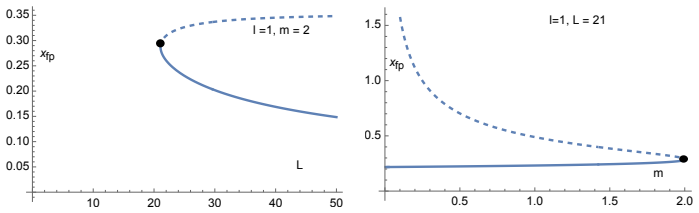
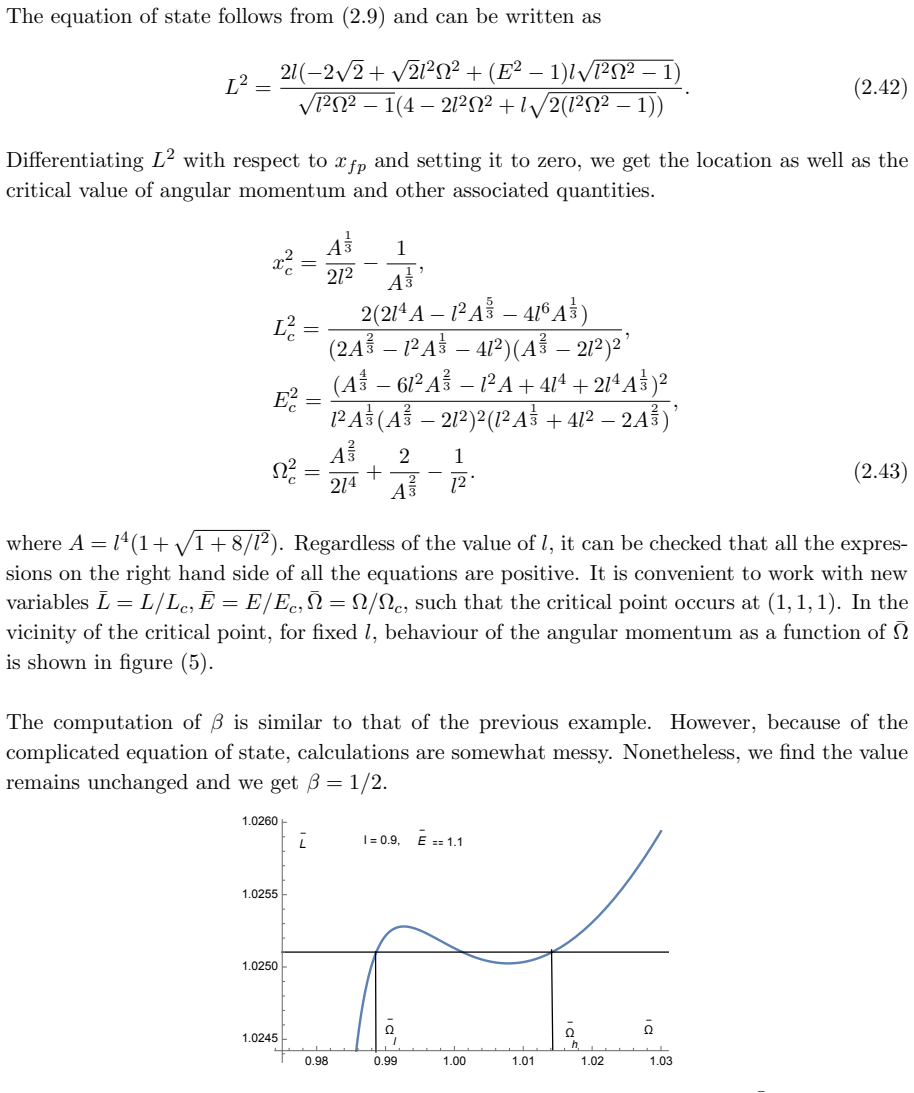
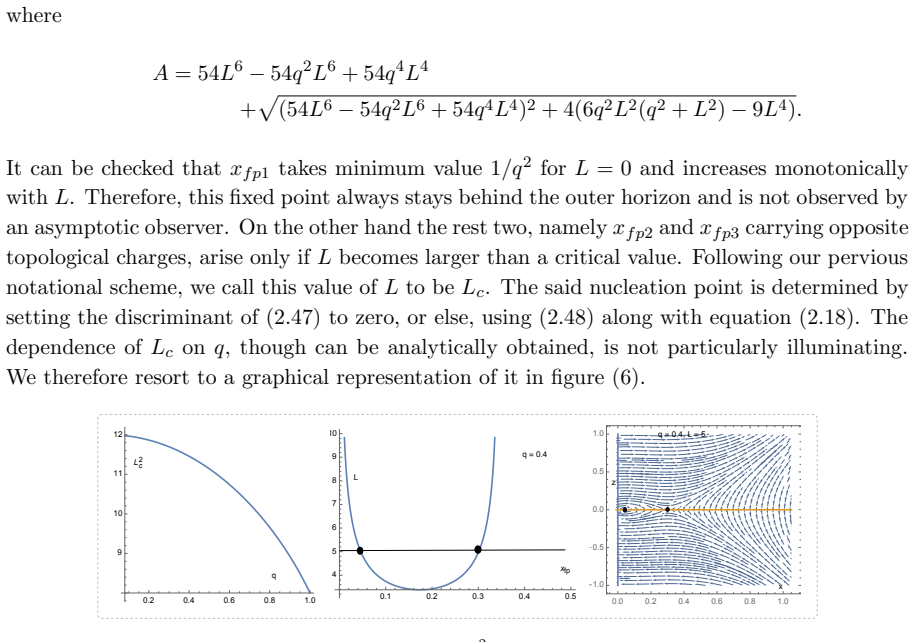
At the critical point where the center and the saddle coalesce in the radial effective potential, defining the limiting ISCO, the conserved quantities show universal, van der Waals-like mean-field scaling typical of a second-order phase transition. This holds for arbitrary spherically symmetric black holes. The anomalous dimensions γ of the double-twist operators in the CFT are negative for the center and positive for the saddle, with certain non-analytic behaviour emerging at the ISCO. Subleading corrections in 1/Δ_H to γ are also found for the center.
What carries the argument
Topological classification of fixed points as centers and saddles in the radial effective potential for massive particle trajectories, with their coalescence at the limiting ISCO enforcing the mean-field scaling and the AdS/CFT map to CFT operator dimensions.
If this is right
- The scaling behavior at the critical point is universal and independent of the specific form of the black hole metric.
- The signs of the anomalous dimensions γ distinguish the center (negative) from the saddle (positive) in the dual CFT.
- Non-analytic terms appear in the anomalous dimensions precisely at the ISCO.
- Subleading corrections to γ in powers of 1/Δ_H can be computed explicitly for the center using both gravity and CFT methods.
Where Pith is reading between the lines
- This suggests that orbital stability transitions in gravity can be holographically dual to phase transitions in CFT operator spectra.
- Similar topological arguments might apply to particle motion in non-spherically symmetric or rotating black hole spacetimes.
- The results provide a new way to compute or constrain anomalous dimensions of double-twist operators using gravitational critical points.
Load-bearing premise
The topological classification of fixed points applies to arbitrary spherically symmetric black holes and the coalescence of center and saddle exactly identifies the limiting ISCO whose conserved quantities map directly to CFT anomalous dimensions under AdS/CFT.
What would settle it
An explicit computation for a particular black hole where the scaling exponents of energy or angular momentum near the critical angular momentum fail to match the mean-field values, or where the CFT four-point function yields an anomalous dimension of the wrong sign for the center.
Figures




read the original abstract
We study the trajectories of massive particles in spherically symmetric black holes in arbitrary dimensions, and find certain universal features based on the topological classification of the fixed points. If the system admits a center, we find two possible outcomes: regardless of the value of the angular momentum, the center always survives, which is realized in global AdS spacetimes or, the center disappears below a critical value of angular momentum, which happens for various spherically symmetric black holes. For the latter case, we find that irrespective of the details of the black hole, there must always be a saddle point. Topological arguments show that there exists a certain critical value of energy, angular momentum and the angular velocity, where the center and the saddle coalesce. This happens at a special point in the parameter space where the trajectories are the limiting innermost stable circular orbits (ISCOs). At the critical point, conserved quantities show universal, van der Waals-like mean-field scaling typical of a second-order phase transition. The anomalous dimensions $\gamma$ of the double-twist operators in the CFT are found, both using AdS/CFT and through the the heavy-heavy-light-light four point correlators, giving negative and positive values for the center and saddle, respectively, including the emergence of certain non-analytic behaviour at the ISCO. For the center, we also find subleading corrections in $\frac{1}{\Delta_H}$ to $\gamma$ in the dual CFT, and dsicuss the implications of our results.
Editorial analysis
A structured set of objections, weighed in public.
Referee Report
Summary. The paper studies trajectories of massive particles in spherically symmetric black holes in arbitrary dimensions. It uses topological classification of fixed points in the radial effective potential to show that when a center disappears below a critical angular momentum, a saddle always exists; these coalesce at a critical point identified with the limiting ISCO. At this coalescence, conserved quantities exhibit universal van der Waals-like mean-field scaling characteristic of a second-order phase transition. Anomalous dimensions γ of double-twist operators in the dual CFT are extracted both via AdS/CFT geodesics and heavy-heavy-light-light correlators, with negative values for the center, positive for the saddle, non-analytic behavior at the ISCO, and subleading 1/Δ_H corrections for the center.
Significance. If the central claims hold, the work would establish a direct link between the topology of geodesic effective potentials, critical phenomena at ISCOs, and the spectrum of double-twist operators in the dual CFT. The combination of bulk geodesic methods with explicit CFT correlator computations provides a useful cross-check, and the topological approach plus subleading corrections represent concrete strengths. The asserted universality across arbitrary metrics and dimensions would be a notable result if the non-degeneracy of the bifurcation is confirmed.
major comments (1)
- [Abstract and critical-point analysis] Abstract and analysis of critical coalescence: The assertion that conserved quantities show universal mean-field scaling 'irrespective of the details of the black hole' in arbitrary dimensions assumes a non-degenerate saddle-node bifurcation in the effective potential (i.e., the cubic term is non-vanishing after the first two derivatives vanish at the critical point). No general proof or explicit check for arbitrary metrics is provided to rule out degenerate cases (V'''=0) that would produce different exponents. This assumption is load-bearing for the universality and phase-transition claims.
minor comments (2)
- The abstract contains typographical errors ('dsicuss' for 'discuss'; duplicated 'the' in 'through the the heavy-heavy-light-light').
- Notation for the effective potential, conserved quantities, and the precise dictionary between bulk geodesics and CFT anomalous dimensions should be introduced with explicit equations at the outset for clarity.
Simulated Author's Rebuttal
We thank the referee for their careful reading of the manuscript and for identifying this important subtlety in our critical-point analysis. We address the comment in detail below and outline the revisions we will make.
read point-by-point responses
-
Referee: [Abstract and critical-point analysis] Abstract and analysis of critical coalescence: The assertion that conserved quantities show universal mean-field scaling 'irrespective of the details of the black hole' in arbitrary dimensions assumes a non-degenerate saddle-node bifurcation in the effective potential (i.e., the cubic term is non-vanishing after the first two derivatives vanish at the critical point). No general proof or explicit check for arbitrary metrics is provided to rule out degenerate cases (V'''=0) that would produce different exponents. This assumption is load-bearing for the universality and phase-transition claims.
Authors: We agree that the universality of the mean-field scaling relies on the coalescence being a non-degenerate saddle-node bifurcation, i.e., that V'''(r_c) remains nonzero once V'(r_c)=V''(r_c)=0. Our topological classification of fixed points in the effective potential guarantees the existence of a saddle whenever a center disappears, and the critical point is defined by the simultaneous vanishing of the first two derivatives. However, we did not supply either a general proof that V''' cannot vanish for arbitrary spherically symmetric metrics or explicit checks across a broad class of solutions. In the revised manuscript we will (i) state explicitly that the mean-field exponents hold under the assumption of a non-degenerate bifurcation, (ii) add a short appendix computing V''' at the critical point for representative metrics (Schwarzschild, RN, Kerr-Newman, and several higher-dimensional generalizations) in D=4,5,6, confirming that the cubic term is nonzero, and (iii) note that degenerate bifurcations would require additional fine-tuning of the metric functions and therefore lie outside the generic class of black-hole solutions considered in the paper. These changes will qualify the universality claim appropriately while preserving the central results. revision: partial
Circularity Check
No significant circularity; derivation is self-contained.
full rationale
The claimed universal van der Waals-like mean-field scaling at ISCO coalescence is derived from the topological classification of fixed points (centers and saddles) in the radial effective potential for arbitrary spherically symmetric metrics, followed by a standard saddle-node bifurcation analysis whose exponents follow from a generic Taylor expansion (V' = V'' = 0 with V''' ≠ 0). This is a direct mathematical consequence of the 1D potential structure rather than a redefinition or fit of the inputs. The anomalous dimensions γ are obtained via two independent routes—the AdS/CFT geodesic dictionary applied to the bulk trajectories and direct computation from heavy-heavy-light-light four-point correlators in the dual CFT—providing cross-validation that does not reduce to self-reference or prior self-citations. No self-definitional loops, fitted parameters presented as predictions, or load-bearing uniqueness theorems imported from the authors' own prior work are present. The derivation stands on external topological and holographic principles.
Axiom & Free-Parameter Ledger
axioms (2)
- domain assumption Spherically symmetric black hole metrics in arbitrary dimensions admit an effective radial potential whose fixed points can be classified topologically as centers or saddles.
- domain assumption The AdS/CFT correspondence maps bulk geodesic motion to boundary operator dimensions, allowing extraction of anomalous dimensions γ from both bulk critical points and boundary four-point functions.
Reference graph
Works this paper leans on
-
[1]
Phys.7 199 [arXiv:gr-qc/0506078]
R. Narayan, New J. Phys.7, 199 (2005), arXiv:gr-qc/0506078
-
[2]
Dean, Am
B. Dean, Am. J. Phys.67, 78 (1999)
1999
-
[3]
Bose and S
I. Bose and S. Ghosh, Journal of Statistical Mechanics: Theory and Experiment2019, 043403 (2019)
2019
-
[4]
A Bohr-Sommerfeld quantization formula for quasinormal frequencies of AdS black holes
G. Festuccia and H. Liu, Adv. Sci. Lett.2, 221 (2009), arXiv:0811.1033 [gr-qc]
work page Pith review arXiv 2009
-
[5]
D. Berenstein, Z. Li, and J. Simon, Class. Quant. Grav.38, 045009 (2021), arXiv:2009.04500 [hep-th]
-
[6]
V. Balasubramanian, A. Bernamonti, J. de Boer, N. Copland, B. Craps, E. Keski-Vakkuri, B. Muller, A. Schafer, M. Shigemori, and W. Staessens, Phys. Rev. D84, 026010 (2011), arXiv:1103.2683 [hep-th]
work page Pith review arXiv 2011
-
[7]
R. Karlsson, A. Parnachev, and P. Tadi´ c, JHEP09, 205 (2021), arXiv:2102.04953 [hep-th]
-
[8]
M. Dodelson and A. Zhiboedov, JHEP12, 163 (2022), arXiv:2204.09749 [hep-th]
-
[9]
A. L. Fitzpatrick, J. Kaplan, and M. T. Walters, JHEP08, 145 (2014), arXiv:1403.6829 [hep-th]
work page Pith review arXiv 2014
-
[10]
Black Holes, Heavy States, Phase Shift and Anomalous Dimensions
M. Kulaxizi, G. S. Ng, and A. Parnachev, SciPost Phys.6, 065 (2019), arXiv:1812.03120 [hep-th] . 28
work page Pith review arXiv 2019
-
[11]
Srednicki, Journal of Physics A: Mathematical and General32, 1163–1175 (1999)
M. Srednicki, Journal of Physics A: Mathematical and General32, 1163–1175 (1999)
1999
-
[12]
D’Alessio, Y
L. D’Alessio, Y. Kafri, A. Polkovnikov, and M. Rigol, Advances in Physics65, 239–362 (2016)
2016
-
[13]
Eigenstate Thermalization Hypothesis in Conformal Field Theory
N. Lashkari, A. Dymarsky, and H. Liu, “Eigenstate thermalization hypothesis in conformal field theory,” (2016), arXiv:1610.00302 [hep-th]
work page Pith review arXiv 2016
-
[14]
L. V. Delacretaz, SciPost Phys.9, 034 (2020)
2020
- [15]
- [16]
-
[17]
H.-M. Cui and Z.-Y. Fan, JHEP09, 130 (2025), arXiv:2506.20959 [gr-qc]
- [18]
-
[19]
D. Pugliese, H. Quevedo, and R. Ruffini, Phys. Rev. D83, 024021 (2011), arXiv:1012.5411 [astro-ph.HE]
-
[20]
Fidkowski, V
L. Fidkowski, V. Hubeny, M. Kleban, and S. Shenker, Journal of High Energy Physics 2004, 014–014 (2004)
2004
-
[21]
Cardoso, A
V. Cardoso, A. S. Miranda, E. Berti, H. Witek, and V. T. Zanchin, Phys. Rev. D79, 064016 (2009)
2009
-
[22]
S. Kinoshita, K. Murata, and D. Takeda, JHEP10, 074 (2023), arXiv:2304.01936 [hep-th]
-
[23]
N. ˇCeplak, H. Liu, A. Parnachev, and S. Valach, JHEP10, 105 (2024), arXiv:2404.17286 [hep-th]
-
[24]
K. Hashimoto, K. Sugiura, K. Sugiyama, and T. Yoda, JHEP10, 149 (2023), arXiv:2307.00237 [hep-th]
-
[25]
Cardoso and J
V. Cardoso and J. P. S. Lemos, Phys. Rev. D64, 084017 (2001)
2001
-
[26]
Y. Sekino and L. Susskind, JHEP10, 065 (2008), arXiv:0808.2096 [hep-th]
work page Pith review arXiv 2008
-
[27]
J. Abajo-Arrastia, J. Aparicio, and E. Lopez, JHEP11, 149 (2010), arXiv:1006.4090 [hep-th]
- [28]
-
[29]
S. H. Shenker and D. Stanford, JHEP03, 067 (2014), arXiv:1306.0622 [hep-th] . 29
work page Pith review arXiv 2014
-
[30]
ISCOs and the weak gravity conjecture bound in higher derivative theories of gravity
A. Paul and C. Bhamidipati, Phys. Lett. B868, 139702 (2025), arXiv:2404.07980 [hep-th]
work page internal anchor Pith review Pith/arXiv arXiv 2025
-
[31]
D. Jafferis, B. Mukhametzhanov, and A. Zhiboedov, JHEP05, 043 (2018), arXiv:1710.11161 [hep-th]
-
[32]
M. Dodelson, A. Grassi, C. Iossa, D. P. Lichtig, and A. Zhiboedov, SciPost Physics14 (2023), 10.21468/scipostphys.14.5.116
-
[33]
Caron-Huot, Journal of High Energy Physics2017(2017), 10.1007/jhep09(2017)078
S. Caron-Huot, Journal of High Energy Physics2017(2017), 10.1007/jhep09(2017)078
-
[34]
S. Caron-Huot, D. Maz´ aˇ c, L. Rastelli, and D. Simmons-Duffin, Journal of High Energy Physics2021(2021), 10.1007/jhep05(2021)243
-
[35]
Z. Komargodski and A. Zhiboedov, JHEP11, 140 (2013), arXiv:1212.4103 [hep-th]
-
[36]
L. Barack and O. Long, Phys. Rev. D106, 104031 (2022), arXiv:2209.03740 [gr-qc]
-
[37]
A. L. Fitzpatrick and J. Kaplan, “Scattering states in ads/cft,” (2011), arXiv:1104.2597 [hep-th]
work page Pith review arXiv 2011
-
[38]
D. Berenstein and J. Sim´ on, Phys. Rev. D101, 046026 (2020), arXiv:1910.10227 [hep-th]
-
[39]
Y.-Z. Li and H.-Y. Zhang, JHEP10, 055 (2020), arXiv:2004.04758 [hep-th]
-
[40]
J. Qiao and S. Rychkov, Journal of High Energy Physics2017(2017), 10.1007/jhep12(2017)119
-
[41]
B. Mukhametzhanov and A. Zhiboedov, Journal of High Energy Physics2019(2019), 10.1007/jhep10(2019)270
- [42]
-
[43]
Bulk Phase Shift, CFT Regge Limit and Einstein Gravity
M. Kulaxizi, A. Parnachev, and A. Zhiboedov, JHEP06, 121 (2018), arXiv:1705.02934 [hep-th]
work page Pith review arXiv 2018
-
[44]
M. F. Paulos, J. Penedones, J. Toledo, B. C. van Rees, and P. Vieira, Journal of High Energy Physics2017(2017), 10.1007/jhep11(2017)133
-
[45]
S. Komatsu, M. F. Paulos, B. C. van Rees, and X. Zhao, Journal of High Energy Physics 2020(2020), 10.1007/jhep11(2020)046
-
[46]
Hijano, Journal of High Energy Physics2019(2019), 10.1007/jhep07(2019)132
E. Hijano, Journal of High Energy Physics2019(2019), 10.1007/jhep07(2019)132
-
[47]
Li,Notes on flat-space limit of AdS/CFT,JHEP 09 (2021) 027, arXiv:2106.04606 [hep-th]
Y.-Z. Li, JHEP09, 027 (2021), arXiv:2106.04606 [hep-th] . 30
discussion (0)
Sign in with ORCID, Apple, or X to comment. Anyone can read and Pith papers without signing in.