Recognition: unknown
Quantum annealing inspired algorithms for the NISQ Era
Pith reviewed 2026-05-07 16:34 UTC · model grok-4.3
The pith
Approximate quantum annealing parameters warm-start QAOA to improve performance on hard 2-SAT instances in simulations.
A machine-rendered reading of the paper's core claim, the machinery that carries it, and where it could break.
Core claim
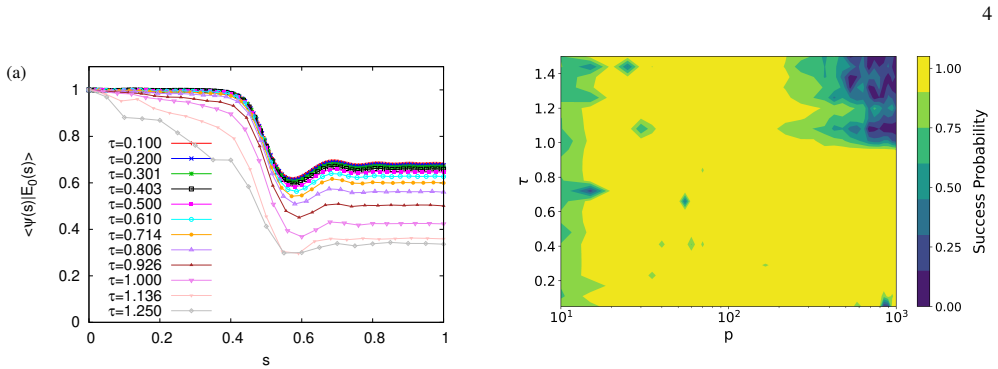
Approximate quantum annealing employs a discretized ansatz in which the time step and number of layers are permitted to deviate from a faithful quantum annealing schedule. Parameter scans locate regimes that retain annealing-like behavior yet require reduced resources compatible with NISQ constraints. The resulting parameters serve as warm starts that enhance QAOA performance relative to random initialization. Evolving Hamiltonian quantum optimization adds a multistep variational procedure that incorporates successive intermediate Hamiltonians derived from the standard annealing Hamiltonian. Numerical tests on hard 2-SAT instances indicate these annealing-inspired strategies supply practical
What carries the argument
Approximate quantum annealing (AQA) with adjustable discretization parameters that generate warm-start states for QAOA, together with evolving Hamiltonian quantum optimization (EHQO) as a multistep variational scheme using intermediate annealing Hamiltonians.
If this is right
- AQA identifies parameter regimes that reproduce annealing-like dynamics with fewer layers and steps than exact quantum annealing.
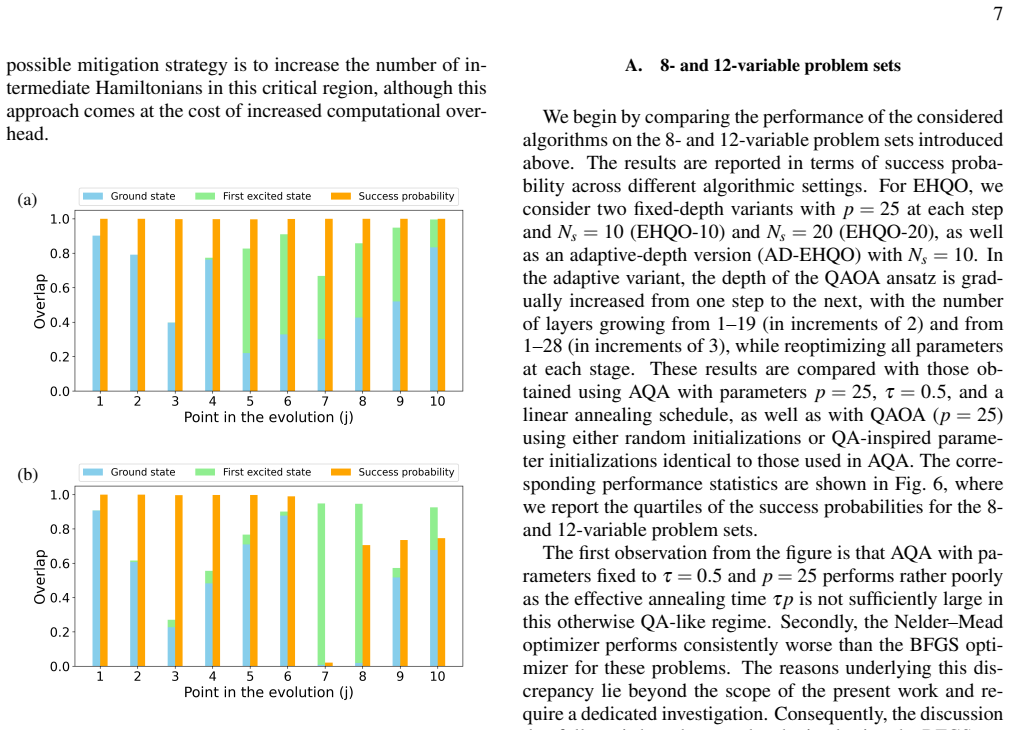
- AQA-derived warm starts improve QAOA solution quality over random initialization on hard 2-SAT instances.
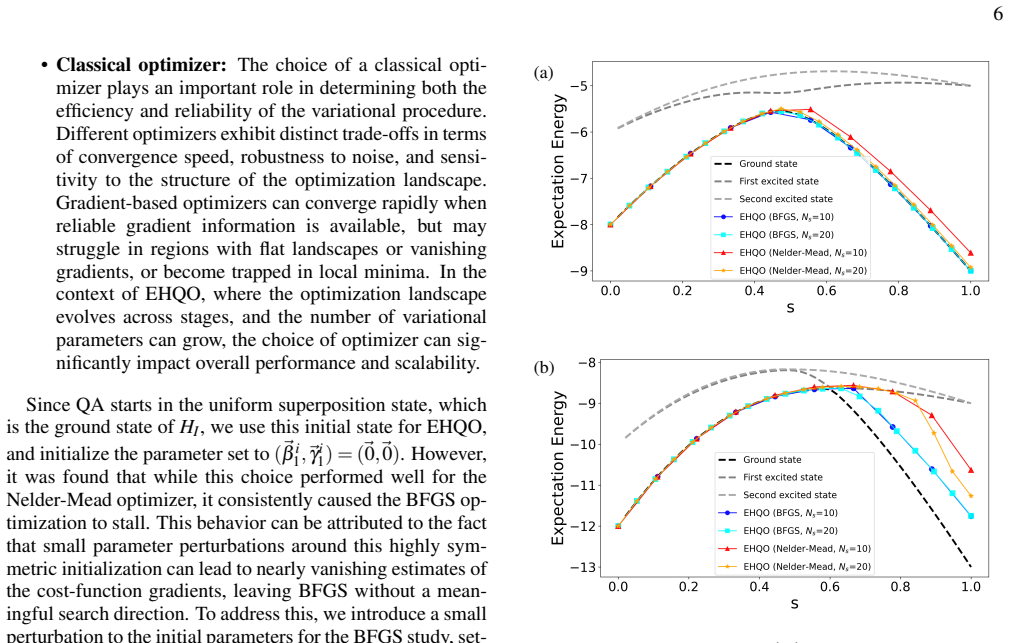
- EHQO guides variational optimization through a sequence of intermediate Hamiltonians taken from the annealing schedule.
- These methods demonstrate concrete, resource-efficient ways to strengthen variational quantum optimization for the NISQ era.
Where Pith is reading between the lines
- The AQA warm-start technique could lower the number of variational iterations needed to reach good solutions in QAOA.
- EHQO might combine with other variational ansatzes or extend to optimization problems beyond 2-SAT.
- These approaches illustrate how classical annealing trajectories can inform the design of more effective NISQ variational algorithms.
- Hardware experiments that include device noise and connectivity graphs would test whether the simulated gains survive real conditions.
Load-bearing premise
That the performance gains from AQA warm-starts and EHQO seen in classical simulations of small 2-SAT instances will persist when run on actual NISQ hardware subject to noise and limited connectivity.
What would settle it
Running AQA-warm-started QAOA and EHQO on a real NISQ processor for the same hard 2-SAT instances and observing no consistent improvement over standard QAOA with random initialization would show the claimed practical enhancement does not hold.
Figures




read the original abstract
We study algorithms inspired by quantum annealing that are suited for the NISQ era. First, we analyze approximate quantum annealing (AQA), which employs a discretized annealing ansatz in which the time step and the number of layers are allowed to deviate from a faithful implementation of quantum annealing. Parameter scans identify regimes that reproduce annealing-like behavior with reduced resources, making them more suitable for NISQ devices. The resulting parameters can then be used as an effective warm start for the quantum approximate optimization algorithm (QAOA), improving its performance compared to random initializations. We also introduce evolving Hamiltonian quantum optimization (EHQO), a multistep variational scheme that guides the optimization process through intermediate Hamiltonians derived from the standard annealing Hamiltonian. Numerical simulations on sets of hard 2-SAT instances suggest that quantum annealing-inspired algorithms provide practical strategies for enhancing variational quantum optimization.
Editorial analysis
A structured set of objections, weighed in public.
Referee Report
Summary. The manuscript proposes two algorithms inspired by quantum annealing for use in the NISQ era. Approximate Quantum Annealing (AQA) discretizes the annealing schedule with tunable time steps and number of layers, which can serve as a warm-start for QAOA. Evolving Hamiltonian Quantum Optimization (EHQO) uses a multistep variational approach with intermediate Hamiltonians from the annealing path. Parameter scans and numerical simulations on hard 2-SAT instances are presented to suggest that these methods enhance variational quantum optimization compared to standard approaches.
Significance. If the observed improvements in the noiseless simulations translate to actual NISQ devices, this work would provide useful strategies for initializing and guiding variational quantum algorithms using ideas from quantum annealing. It highlights potential synergies between annealing and variational methods, which could be valuable for near-term quantum computing applications in optimization. The parameter scans identifying resource-efficient regimes are a positive aspect.
major comments (2)
- The claim that the algorithms provide practical strategies for enhancing variational quantum optimization on NISQ devices is not supported by the reported evidence, as the numerical simulations are classical and noiseless, without incorporating noise models or limited connectivity typical of NISQ hardware. This leaves the practicality for the NISQ era unaddressed.
- The abstract reports parameter scans and numerical simulations on 2-SAT but provides no details on the number of instances, error bars, or statistical tests. Without these, it is difficult to determine if the performance gains are statistically significant or generalizable.
minor comments (2)
- Clarify the exact definition of the intermediate Hamiltonians in EHQO and how they are chosen.
- Include more details on the 2-SAT instance generation and hardness criteria used in the benchmarks.
Simulated Author's Rebuttal
We thank the referee for the constructive comments and positive assessment of the potential value of annealing-inspired approaches for variational algorithms. We address each major comment below and will revise the manuscript to clarify the scope of our claims while preserving the core contributions.
read point-by-point responses
-
Referee: The claim that the algorithms provide practical strategies for enhancing variational quantum optimization on NISQ devices is not supported by the reported evidence, as the numerical simulations are classical and noiseless, without incorporating noise models or limited connectivity typical of NISQ hardware. This leaves the practicality for the NISQ era unaddressed.
Authors: We agree that the simulations are performed in the ideal, noiseless setting and do not incorporate hardware-specific noise or connectivity constraints. The manuscript's emphasis on NISQ suitability stems from the algorithmic design: AQA allows tunable discretization with reduced layer counts and time steps relative to full annealing, while EHQO provides a multistep variational path using intermediate Hamiltonians that can lower optimization difficulty. These features are intended to align with NISQ resource limits. The observed improvements over random QAOA initialization in the ideal case provide supporting numerical evidence for the utility of these warm-start and guidance strategies. To address the referee's concern, we will revise the abstract, introduction, and conclusion to explicitly note that the NISQ relevance is based on resource efficiency and that experimental validation including noise models remains future work. A short discussion of potential noise resilience will also be added. revision: partial
-
Referee: The abstract reports parameter scans and numerical simulations on 2-SAT but provides no details on the number of instances, error bars, or statistical tests. Without these, it is difficult to determine if the performance gains are statistically significant or generalizable.
Authors: The detailed information on the number of hard 2-SAT instances, the generation of error bars via repeated optimizations with different random seeds, and the consistency of performance gains across the instance set is provided in the numerical results section of the manuscript. We acknowledge that the abstract is concise and omits these specifics, which can make it harder for readers to immediately assess robustness. We will revise the abstract to include a brief indication of the simulation scale and the observed consistent improvements, while remaining within length constraints. revision: yes
Circularity Check
No significant circularity; methods and simulations are independent of target metrics.
full rationale
The paper defines approximate quantum annealing (AQA) as a discretized annealing ansatz with tunable time steps and layers, and evolving Hamiltonian quantum optimization (EHQO) as a multistep variational scheme through intermediate Hamiltonians; both are specified independently of the final performance metric. Parameter scans identify regimes, after which the parameters are applied as warm-starts in separate numerical simulations on external hard 2-SAT instances. No equation or claim reduces a reported improvement or prediction to a fitted input by construction, no uniqueness theorem is imported from the authors' prior work, and no ansatz is smuggled via self-citation. The results are presented as empirical suggestions from classical simulations rather than forced equivalences.
Axiom & Free-Parameter Ledger
free parameters (2)
- time step and number of layers in AQA ansatz
- intermediate Hamiltonians in EHQO
axioms (2)
- domain assumption A discretized annealing ansatz with variable time step and layers can still exhibit annealing-like behavior.
- domain assumption Intermediate Hamiltonians derived from the annealing schedule provide useful guidance for variational optimization.
Reference graph
Works this paper leans on
-
[1]
However, it was found that while this choice performed well for the Nelder-Mead optimizer, it consistently caused the BFGS op- timization to stall
= (⃗0,⃗0). However, it was found that while this choice performed well for the Nelder-Mead optimizer, it consistently caused the BFGS op- timization to stall. This behavior can be attributed to the fact that small parameter perturbations around this highly sym- metric initialization can lead to nearly vanishing estimates of the cost-function gradients, le...
-
[2]
L. Wang, S. K. Kowk, and W. H. Ip, J. Intell. Manuf.23, 2227 (2012)
2012
-
[3]
T. Tran, M. Do, E. Rieffel, J. Frank, Z. Wang, B. O’Gorman, D. Venturelli, and J. Beck, inProceedings of the International Symposium on Combinatorial Search, V ol. 7 (2016) pp. 98– 106
2016
-
[4]
Solenov, J
D. Solenov, J. Brieler, and J. F. Scherrer, Mo. Med.115, 463 (2018)
2018
-
[5]
Or ´us, S
R. Or ´us, S. Mugel, and E. Lizaso, Reviews in Physics4, 100028 (2019)
2019
-
[6]
Woerner and D
S. Woerner and D. J. Egger, npj Quantum Inf.5, 15 (2019)
2019
-
[7]
Venturelli and A
D. Venturelli and A. Kondratyev, Quantum Mach. Intell.1, 17 (2019)
2019
-
[8]
S. Feld, C. Roch, T. Gabor, C. Seidel, F. Neukart, I. Gal- ter, W. Mauerer, and C. Linnhoff-Popien, Frontiers in ICT6, 10.3389/fict.2019.00013 (2019)
-
[9]
Sakuma, arXiv preprint arXiv:2011.07319 10.48550/arXiv.2011.07319 (2020)
T. Sakuma, arXiv preprint arXiv:2011.07319 10.48550/arXiv.2011.07319 (2020)
-
[10]
H. Mohammadbagherpoor, P. Dreher, M. Ibrahim, Y . Oh, J. Hall, R. E. Stone, and M. Stojkovic, arXiv preprint arXiv:2111.09472 10.48550/arXiv.2111.09472 (2021)
-
[11]
Inoue, A
D. Inoue, A. Okada, T. Matsumori, K. Aihara, and H. Yoshida, Sci. Rep.11, 1 (2021)
2021
-
[12]
Micheletti, P
C. Micheletti, P. Hauke, and P. Faccioli, Phys. Rev. Lett.127, 080501 (2021)
2021
-
[13]
F. Bova, A. Goldfarb, and R. G. Melko, EPJ Quantum Tech- nol.8, 2 (2021)
2021
-
[14]
B. A. Cordier, N. P. D. Sawaya, G. G. Guerreschi, and S. K. McWeeney, J. R. Soc. Interface19, 20220541 (2022)
2022
-
[15]
Apolloni, C
B. Apolloni, C. Carvalho, and D. de Falco, Stochastic Pro- cesses and their Applications33, 233 (1989)
1989
-
[16]
A. B. Finnila, M. A. Gomez, C. Sebenik, C. Stenson, and J. D. Doll, Chemical Physics Letters219, 343 (1994)
1994
-
[17]
Kadowaki and H
T. Kadowaki and H. Nishimori, Physical Review E58, 5355 (1998), publisher: American Physical Society
1998
- [18]
-
[19]
Farhi, J
E. Farhi, J. Goldstone, S. Gutmann, J. Lapan, A. Lundgren, and D. Preda, Science (New York, N.Y .)292, 472 (2001)
2001
-
[20]
Kirkpatrick, C
S. Kirkpatrick, C. D. Gelatt, and M. P. Vecchi, Science (New York, N.Y .)220, 671 (1983)
1983
-
[21]
Aarts and J
E. Aarts and J. Korst,Simulated Annealing and Boltzmann Machines: A Stochastic Approach to Combinatorial Opti- mization and Neural Computing(Wiley, 1988)
1988
-
[22]
Suzuki, Communications in Mathematical Physics51, 183 (1976)
M. Suzuki, Communications in Mathematical Physics51, 183 (1976)
1976
-
[23]
Suzuki, Journal of Mathematical Physics26, 601 (1985)
M. Suzuki, Journal of Mathematical Physics26, 601 (1985)
1985
-
[24]
De Raedt, Computer Physics Reports7, 1 (1987)
H. De Raedt, Computer Physics Reports7, 1 (1987)
1987
-
[25]
Huyghebaert and H
J. Huyghebaert and H. De Raedt, J. Phys. A: Math. Gen.23, 5777 (1990)
1990
-
[26]
Suzuki, Proc
M. Suzuki, Proc. Japan Acad., Ser. B69, 161 (1993)
1993
-
[27]
M. A. Nielsen and I. L. Chuang,Quantum Computation and Quantum Information(Cambridge University Press, 2000)
2000
-
[28]
D. Willsch, M. Willsch, F. Jin, K. Michielsen, and H. D. Raedt, GPU-accelerated simulations of quantum annealing and the quantum approximate optimization algorithm (2022), arXiv:2104.03293
-
[29]
A Quantum Approximate Optimization Algorithm
E. Farhi, J. Goldstone, and S. Gutmann, A Quantum Ap- proximate Optimization Algorithm (2014), arXiv:1411.4028 [quant-ph]
work page internal anchor Pith review arXiv 2014
-
[30]
J. R. McClean, J. Romero, R. Babbush, and A. Aspuru-Guzik, New Journal of Physics18, 023023 (2016), publisher: IOP Publishing
2016
-
[31]
D. Wecker, Physical Review A92, 10.1103/Phys- RevA.92.042303 (2015)
-
[32]
A. Garcia-Saez and J. I. Latorre, Addressing hard classical problems with Adiabatically Assisted Variational Quantum Eigensolvers (2018), arXiv:1806.02287. 10
-
[33]
M. Willsch, D. Willsch, F. Jin, H. D. Raedt, and K. Michielsen, Benchmarking the Quantum Approximate Optimization Algo- rithm (2020), arXiv:1907.02359
-
[34]
M. S. Jattana, F. Jin, H. De Raedt, and K. Michielsen, Phys. Rev. Appl.19, 024047 (2023)
2023
-
[35]
Thomas, Quantum Searches in a Hard 2SAT Ensemble (2014), arXiv:1412.5460
N. Thomas, Quantum Searches in a Hard 2SAT Ensemble (2014), arXiv:1412.5460
-
[36]
Zhou, S.-T
L. Zhou, S.-T. Wang, S. Choi, H. Pichler, and M. D. Lukin, Physical Review X10, 021067 (2020), publisher: American Physical Society
2020
-
[37]
Streif and M
M. Streif and M. Leib, Quantum Science & Technology5, 034008 (2020)
2020
-
[38]
S. H. Sack and M. Serbyn, quantum5, 491 (2021)
2021
-
[39]
Montanez-Barrera and K
J. Montanez-Barrera and K. Michielsen, npj Quantum Infor- mation11, 131 (2025)
2025
-
[40]
A. Javadi-Abhari, M. Treinish, K. Krsulich, C. J. Wood, J. Lishman, J. Gacon, S. Martiel, P. D. Nation, L. S. Bishop, A. W. Cross, B. R. Johnson, and J. M. Gambetta, Quantum computing with Qiskit (2024), arXiv:2405.08810 [quant-ph]
work page internal anchor Pith review arXiv 2024
-
[41]
De Raedt, K
K. De Raedt, K. Michielsen, H. De Raedt, B. Trieu, G. Arnold, M. Richter, T. Lippert, H. Watanabe, and N. Ito, Computer Physics Communications176, 121 (2007)
2007
-
[42]
De Raedt, F
H. De Raedt, F. Jin, D. Willsch, M. Willsch, N. Yoshioka, N. Ito, S. Yuan, and K. Michielsen, Computer Physics Com- munications237, 47 (2019)
2019
-
[43]
J ¨ulich Supercomputing Centre, Journal of large-scale research facilities5(2019)
2019
discussion (0)
Sign in with ORCID, Apple, or X to comment. Anyone can read and Pith papers without signing in.