Recognition: unknown
Accelerated Surface Hopping via Scaling the Spin--Orbit Coupling: Opportunities for Machine Learning
Pith reviewed 2026-05-07 14:14 UTC · model grok-4.3
The pith
Machine learning surrogates for potentials and couplings make accelerated surface hopping simulations statistically reliable for intersystem crossing.
A machine-rendered reading of the paper's core claim, the machinery that carries it, and where it could break.
Core claim
Scaling the spin-orbit coupling in surface hopping accelerates intersystem crossing dynamics, and machine learning models for the potential energy surfaces, nonadiabatic couplings, and spin-orbit couplings can be used to generate populations that lie within the confidence intervals of high-level reference calculations from MR-CISD/SA-CASSCF(2,2). However, the extrapolation to the unscaled time constant is highly sensitive to the method used to fit the time constants from the population decay curves.
What carries the argument
Accelerated surface hopping scheme that scales spin-orbit couplings combined with machine learning models trained via a rotate-predict-rotate approach for fitting the couplings.
If this is right
- Machine learning models yield populations within the confidence interval of reference data.
- The extrapolation of time constants shows discrepancies due to sensitivity to fitting methods.
- ML models can enhance the reliability by allowing more trajectories in the ensembles.
Where Pith is reading between the lines
- Larger systems could become accessible if ML reduces the cost enough to support more scaling factors or longer simulations.
- Improved fitting techniques for population decays might reduce the sensitivity and make the method more robust.
- The rotate-predict-rotate approach for SOCs could be generalized to other coupling types.
Load-bearing premise
Scaling spin-orbit couplings in surface hopping and extrapolating the resulting time constants from multiple scaling factors will accurately recover the physical intersystem crossing rate, despite variations in how population decay curves are fitted.
What would settle it
Running a direct surface hopping simulation with unscaled spin-orbit couplings for a sufficiently long time on silaethylene and comparing the resulting intersystem crossing time constant to the extrapolated value from the scaled ensembles.
Figures


read the original abstract
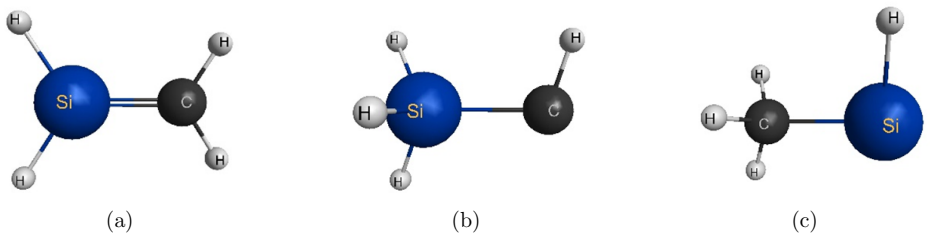
Surface hopping (SH) methods are typically employed to simulate ultrafast nonadiabatic processes, but long timescales often remain beyond their reach. To address this, accelerated SH scheme mitigate this limitation by scaling the driving forces of such process, either nonadiabatic couplings (NACs) in case of internal conversion or spin-orbit couplings (SOCs) for intersystem crossing. However, obtaining the actual time constant requires extrapolation from several ensembles of trajectories with different scaling factors. This introduces a significant computational demand, often restricting the number of trajectories per ensemble and, therefore, reducing the statistical confidence in the resulting time constant. In this work, we investigate the accelerated scheme using silaethylene (CH$_2$SiH$_2$) as a case study, evaluating various population fitting methods and extrapolation techniques. We trained machine learning models for potential energy surfaces (PESs) and NACs, and extended our rotate-predict-rotate approach to fit SOCs. These models demonstrate high performance, yielding populations within the confidence interval of the reference MR-CISD/SA-CASSCF(2,2) data; however, the extrapolation itself is highly sensitive to the fitted time constants, leading to discrepancies in the final time constant. Finally, we showcase and discuss how ML models can enhance the reliability of an accelerated SH scheme.
Editorial analysis
A structured set of objections, weighed in public.
Referee Report
Summary. The manuscript investigates an accelerated surface hopping (SH) scheme for intersystem crossing (ISC) by scaling spin-orbit couplings (SOCs) and extrapolating ISC time constants from multiple trajectory ensembles, using silaethylene as a case study. Machine learning (ML) models are developed for potential energy surfaces (PESs), nonadiabatic couplings (NACs), and SOCs via an extended rotate-predict-rotate approach. The work evaluates population fitting methods and extrapolation techniques, reports that ML-generated populations lie within the confidence intervals of reference MR-CISD/SA-CASSCF(2,2) data, notes high sensitivity of the extrapolated physical time constant to the choice of fitted time constants from decay curves, and discusses how ML can improve the reliability of the accelerated scheme despite this sensitivity.
Significance. If the ML models can demonstrably reduce the sensitivity of extrapolated ISC time constants to fitting choices and improve statistical reliability with fewer trajectories, the approach would offer a practical route to simulating longer-timescale spin-forbidden processes in photochemistry. The combination of SOC scaling with ML surrogates addresses a genuine computational bottleneck, and the explicit acknowledgment of extrapolation discrepancies provides a useful cautionary analysis for the field.
major comments (2)
- [Abstract] Abstract: the claim that ML models enhance the reliability of the accelerated SH scheme is not yet load-bearing because the extrapolation of the physical time constant remains highly sensitive to the fitted time constants obtained from population decay curves, producing discrepancies. This dependence on fitting procedure (even when populations match reference data within confidence intervals) directly affects the central output and requires explicit quantification of how ML reduces variance across fitting methods relative to direct ab initio ensembles.
- [Results on fitting and extrapolation] The section on population fitting and extrapolation: the weakest assumption—that scaling SOCs and extrapolating from ensembles at different factors reliably recovers the physical ISC time constant—is undermined when the input time constants are themselves sensitive to fitting method choice. With fewer trajectories per ensemble (due to cost), additional cross-validation or comparison against an independent unscaled reference calculation at physical SOC strength is needed to confirm robustness.
minor comments (1)
- [Methods] The rotate-predict-rotate extension for SOCs is introduced without a clear equation for the rotation step or how it preserves the scaling; adding this would improve reproducibility.
Simulated Author's Rebuttal
We thank the referee for their thorough and constructive review of our manuscript. We agree that the sensitivity of the extrapolated ISC time constant to fitting choices is a central issue that requires explicit attention, and we have revised the work to provide the requested quantification while acknowledging the inherent limitations of the accelerated scheme.
read point-by-point responses
-
Referee: [Abstract] Abstract: the claim that ML models enhance the reliability of the accelerated SH scheme is not yet load-bearing because the extrapolation of the physical time constant remains highly sensitive to the fitted time constants obtained from population decay curves, producing discrepancies. This dependence on fitting procedure (even when populations match reference data within confidence intervals) directly affects the central output and requires explicit quantification of how ML reduces variance across fitting methods relative to direct ab initio ensembles.
Authors: We acknowledge that matching populations within confidence intervals does not automatically ensure robustness of the extrapolated time constant, which is the key physical observable. In the revised manuscript we have added a dedicated analysis that quantifies the variance in both the fitted decay constants and the final extrapolated ISC time constants across multiple fitting procedures (single-exponential, bi-exponential, and log-linear fits) for the ab initio and ML ensembles. This shows that the substantially larger trajectory counts made possible by the ML models reduce the statistical scatter in the input time constants, thereby narrowing the spread of extrapolated values relative to the smaller ab initio ensembles. We have updated the abstract to state more precisely that the ML models improve both population accuracy and the statistical reliability of the extrapolation step. revision: yes
-
Referee: [Results on fitting and extrapolation] The section on population fitting and extrapolation: the weakest assumption—that scaling SOCs and extrapolating from ensembles at different factors reliably recovers the physical ISC time constant—is undermined when the input time constants are themselves sensitive to fitting method choice. With fewer trajectories per ensemble (due to cost), additional cross-validation or comparison against an independent unscaled reference calculation at physical SOC strength is needed to confirm robustness.
Authors: We agree that the extrapolation procedure rests on an assumption whose validity is limited by the precision of the fitted time constants. We have expanded the relevant section with additional cross-validation by systematically varying the fitting time windows and comparing results from different functional forms; the ML ensembles exhibit greater consistency across these choices because of reduced statistical noise. A full independent unscaled reference calculation at physical SOC strength, however, remains computationally prohibitive for the timescales of interest, which is precisely why the accelerated scheme was developed. We have added explicit discussion of this limitation and of the reliance on consistency with the scaled ab initio reference data. revision: partial
- Comparison against a complete independent unscaled reference simulation at physical SOC strength, which is computationally infeasible
Circularity Check
No significant circularity in derivation or claims
full rationale
The paper presents a computational workflow for accelerated surface hopping via SOC scaling, population fitting, and linear extrapolation to recover the physical ISC time constant, with ML models trained on reference data to generate PES/NAC/SOC for more trajectories. This workflow is a standard approximation technique whose output (extrapolated time constant) is not equivalent to its inputs by construction, nor does any step rename a fit as an independent prediction. No self-citations are invoked as load-bearing uniqueness theorems, no ansatzes are smuggled, and no self-definitional loops appear. The abstract's own acknowledgment of sensitivity to fitting choices is a reported limitation of the method, not evidence that the result reduces tautologically to the scaled inputs. The derivation chain remains self-contained against external MR-CISD benchmarks.
Axiom & Free-Parameter Ledger
free parameters (2)
- SOC scaling factors
- population fitting parameters
Reference graph
Works this paper leans on
-
[1]
E.; Fukumura, D.; Jain, R
(1) Dolmans, D. E.; Fukumura, D.; Jain, R. K. Photodynamic therapy for cancer.Nat. Rev. Cancer2003,3, 380–387. (2) Agostinis, P. et al. Photodynamic therapy of cancer: An update.CA. Cancer J. Clin. 2011,61, 250–281. (3) Wang, Z.; H¨ olzel, H.; Moth-Poulsen, K. Status and challenges for molecular solar ther- mal energy storage system based devices.Chem. So...
2011
-
[2]
Generalized Neural-Network Representation of High- Dimensional Potential-Energy Surfaces.Phys
(38) Behler, J.; Parrinello, M. Generalized Neural-Network Representation of High- Dimensional Potential-Energy Surfaces.Phys. Rev. Lett.2007,98, 146401. (39) Behler, J. Atom-centered symmetry functions for constructing high-dimensional neural network potentials.J. Chem. Phys.2011,134, 074106. (40) Unke, O. T.; Meuwly, M. PhysNet: A Neural Network for Pre...
2007
-
[3]
T.; Sauceda, H
(41) Sch¨ utt, K. T.; Sauceda, H. E.; Kindermans, P.-J.; Tkatchenko, A.; M¨ uller, K.-R. SchNet – A deep learning architecture for molecules and materials.J. Chem. Phys.2018,148, 241722. (42) Bart´ ok, A. P.; Payne, M. C.; Kondor, R.; Cs´ anyi, G. Gaussian Approximation Poten- tials: The Accuracy of Quantum Mechanics, without the Electrons.Phys. Rev. Lett...
2018
-
[4]
(66) Dral, P. O. Quantum Chemistry in the Age of Machine Learning.J. Phys. Chem. Lett. 2020,11, 2336–2347. (67) No´ e, F.; Tkatchenko, A.; M¨ uller, K.-R.; Clementi, C. Machine Learning for Molecular Simulation.Annu. Rev. Phys. Chem.2020,71, 361–390. (68) Westermayr, J.; Marquetand, P. Machine Learning for Electronically Excited States of Molecules.Chem. ...
2020
-
[5]
(72) Bispo, M. d. O.; Souza Mattos, R.; Pinheiro, M.; Garain, B. C.; Dral, P. O.; Barbatti, M. MELTS: Fully Automated Active Learning for Fewest-Switches Surface Hopping Dy- namics.J. Chem. Theory Comput.2025,21, 11390–11400. (73) Sch¨ utt, K. T.; Unke, O. T.; Gastegger, M. Equivariant message passing for the predic- tion of tensorial properties and molec...
2025
-
[6]
28 (80) Lischka, H. et al. The Generality of the GUGA MRCI Approach in COLUMBUS for Treating Complex Quantum Chemistry.J. Chem. Phys.2020,152, 134110. (81) Barbatti, M.; Aquino, A. J. A.; Lischka, H. The UV absorption of nucleobases: semi- classical ab initio spectra simulations.Phys. Chem. Chem. Phys.2010,12,
2020
-
[7]
Newton-X: a surface-hopping program for nonadiabatic molecular dynamics
(82) Barbatti, M.; Ruckenbauer, M.; Plasser, F.; Pittner, J.; Granucci, G.; Persico, M.; Lischka, H. Newton-X: a surface-hopping program for nonadiabatic molecular dynamics. WIREs Comput. Mol. Sci.2014,4, 26–33. (83) Barbatti, M. et al. The Newton-X Platform for Mixed Quantum–Classical Dynamics. ChemRxiv2026,2026. (84) Nijamudheen, A.; Akimov, A. V. Excit...
2014
discussion (0)
Sign in with ORCID, Apple, or X to comment. Anyone can read and Pith papers without signing in.