Recognition: unknown
Search for electroweakinos in compressed-spectrum scenarios with low-momentum isolated tracks in proton-proton collisions at sqrt{s} = 13 TeV
Pith reviewed 2026-05-07 14:13 UTC · model grok-4.3
The pith
CMS excludes higgsino charginos up to 185 GeV when mass splitting to the neutralino lies between 0.28 and 1.15 GeV.
A machine-rendered reading of the paper's core claim, the machinery that carries it, and where it could break.
Core claim
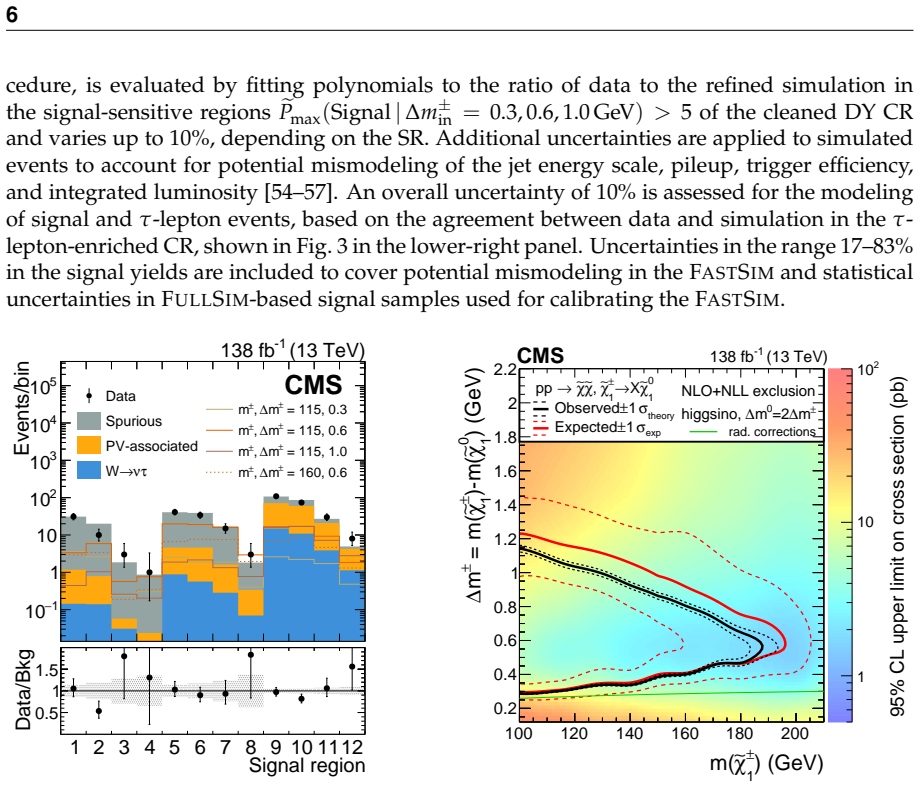
No significant excess above the standard model expectation is observed. The search uses a parameterized neural network that combines kinematic information and track impact parameters to discriminate signal events containing a soft, possibly displaced pion track from background. At 95% confidence level the considered higgsino model is excluded for mass splittings between 0.28 and 1.15 GeV and for chargino masses up to 185 GeV.
What carries the argument
Parameterized neural network that classifies events using kinematic variables together with the impact parameter of low-momentum isolated tracks.
If this is right
- The lightest chargino in the higgsino model must exceed 185 GeV if the mass splitting to the neutralino is between 0.28 and 1.15 GeV.
- Natural supersymmetry parameter space with small electroweakino mass differences is reduced.
- Future LHC runs at higher luminosity can target the remaining allowed region at larger chargino masses or smaller splittings using the same soft-track signature.
Where Pith is reading between the lines
- The result can be reinterpreted in other supersymmetric models that produce similar soft-track plus missing-momentum signatures.
- Improved modeling of low-momentum track efficiencies in simulation would directly tighten or loosen the present limits.
- Complementary searches at future colliders or with different final states would be needed to close the remaining gaps in compressed electroweakino scenarios.
Load-bearing premise
The neural-network discrimination and background modeling in the low-momentum, high-impact-parameter region accurately reflect real data.
What would settle it
A statistically significant excess of events with soft isolated tracks and large missing transverse momentum in the signal regions, beyond the predicted background, would invalidate the no-excess conclusion and the resulting exclusion limits.
Figures


read the original abstract
A search for supersymmetric electroweakinos is performed using events with a low-momentum (soft) isolated track and large missing transverse momentum, targeting nearly mass-degenerate higgsino-like charginos and neutralinos. For mass splittings of 0.3$-$1 GeV, the chargino decays to the lightest neutralino and a low-momentum pion, which can produce a soft, potentially displaced track. A parameterized neural network separates signal from background using kinematic and impact parameter information. The analysis uses 138 fb$^{-1}$ of proton$-$proton collision data at a center-of-mass energy of 13 TeV recorded with the CMS detector. No significant excess above the standard model expectation is observed. At 95% confidence level, the considered higgsino model is excluded for mass splittings in the range 0.28$-$1.15 GeV and for chargino masses up to 185 GeV, setting stringent constraints on natural supersymmetry scenarios.
Editorial analysis
A structured set of objections, weighed in public.
Referee Report
Summary. The manuscript presents a search for supersymmetric electroweakinos in compressed mass spectra using proton-proton collisions at 13 TeV with the CMS detector and an integrated luminosity of 138 fb^{-1}. The analysis focuses on events with a low-momentum isolated track and large missing transverse momentum, targeting the decay of nearly degenerate charginos to neutralinos and soft pions. A parameterized neural network is used to separate potential signal from standard model backgrounds based on kinematic and impact parameter information. No significant excess above the expected background is observed, leading to 95% confidence level exclusions on higgsino-like models for mass splittings between 0.28 and 1.15 GeV and chargino masses up to 185 GeV.
Significance. If the background modeling and neural network discrimination hold, this result would be significant for constraining natural supersymmetry scenarios, particularly the compressed higgsino region that is motivated by electroweak naturalness but difficult to probe due to soft decay products. The approach extends sensitivity to small mass splittings using soft tracks and machine learning techniques. The analysis follows standard CMS practices for limit setting and reports no excess, providing direct data-driven constraints.
major comments (1)
- The central exclusion limits depend on the parameterized neural network's ability to accurately model the background in the low-momentum, high-impact-parameter tail. The manuscript should provide explicit validation of the NN output distribution and background prediction using data in control regions that closely match the signal region's kinematics and pile-up conditions, as mismatches in soft-track reconstruction efficiency or impact-parameter resolution could shift the expected background and alter the exclusion contours.
Simulated Author's Rebuttal
We thank the referee for their thorough review and constructive feedback on our manuscript. We address the major comment below and have revised the manuscript accordingly.
read point-by-point responses
-
Referee: The central exclusion limits depend on the parameterized neural network's ability to accurately model the background in the low-momentum, high-impact-parameter tail. The manuscript should provide explicit validation of the NN output distribution and background prediction using data in control regions that closely match the signal region's kinematics and pile-up conditions, as mismatches in soft-track reconstruction efficiency or impact-parameter resolution could shift the expected background and alter the exclusion contours.
Authors: We agree that detailed validation of the neural network performance in relevant control regions is crucial for the robustness of the background modeling. In the revised version of the manuscript, we have added explicit comparisons of the NN output distributions in data and simulation for control regions that closely mimic the signal region kinematics, including variations in pile-up conditions. These control regions are defined using events with lower missing transverse momentum or by inverting certain selection criteria while maintaining similar track properties. We also discuss the systematic uncertainties associated with soft-track reconstruction efficiency and impact parameter resolution, demonstrating that any potential mismatches are covered by the assigned uncertainties and do not significantly alter the exclusion limits. The new validation plots and corresponding text have been incorporated into Section 7 and the supplementary material. revision: yes
Circularity Check
No circularity: experimental limit derived directly from data with independent background estimation
full rationale
The analysis uses 138 fb^{-1} of recorded CMS data to search for soft displaced tracks from electroweakino decays, applying a parameterized neural network trained on simulation to discriminate signal from SM backgrounds in kinematic and impact-parameter variables. No excess is observed relative to the standard-model expectation, yielding 95% CL exclusions on higgsino mass splittings and chargino masses. The background modeling and NN output rely on simulation validated in control regions outside the signal region; no parameter is fitted to the signal-region data and then presented as a prediction, no self-citation supplies a uniqueness theorem or ansatz, and the final limit is not equivalent to any input by construction. The derivation chain is therefore self-contained against external data.
Axiom & Free-Parameter Ledger
free parameters (2)
- neural-network hyperparameters
- signal-strength scaling factor
axioms (2)
- domain assumption Standard Model background processes and their cross sections are correctly modeled by simulation in the soft-track region.
- domain assumption Detector simulation accurately reproduces tracking efficiency and impact-parameter resolution for pions below 1 GeV.
Reference graph
Works this paper leans on
-
[1]
P . Ramond, “Dual theory for free fermions”,Phys. Rev. D3(1971) 2415, doi:10.1103/PhysRevD.3.2415
-
[2]
Extension of the algebra of Poincare group generators and violation ofPinvariance
Y. A. Gol’fand and E. P . Likhtman, “Extension of the algebra of Poincare group generators and violation ofPinvariance”,JETP Lett.13(1971) 323, doi:10.1142/9789814542340_0001
-
[3]
Factorizable dual model of pions
A. Neveu and J. H. Schwarz, “Factorizable dual model of pions”,Nucl. Phys. B31(1971) 86,doi:10.1016/0550-3213(71)90448-2
-
[4]
Possible universal neutrino interaction
D. V . Volkov and V . P . Akulov, “Possible universal neutrino interaction”,JETP Lett.16 (1972) 438,doi:10.1007/BFb0105270
-
[5]
A Lagrangian model invariant under supergauge transformations
J. Wess and B. Zumino, “A Lagrangian model invariant under supergauge transformations”,Phys. Lett. B49(1974) 52,doi:10.1016/0370-2693(74)90578-4
-
[6]
Supergauge transformations in four dimensions
J. Wess and B. Zumino, “Supergauge transformations in four dimensions”,Nucl. Phys. B 70(1974) 39,doi:10.1016/0550-3213(74)90355-1
-
[7]
Supergauge invariant extension of the Higgs mechanism and a model for the electron and its neutrino
P . Fayet, “Supergauge invariant extension of the Higgs mechanism and a model for the electron and its neutrino”,Nucl. Phys. B90(1975) 104, doi:10.1016/0550-3213(75)90636-7
-
[8]
P . Fayet and S. Ferrara, “Supersymmetry”,Phys. Rept.32(1977) 249, doi:10.1016/0370-1573(77)90066-7
-
[9]
Supersymmetry, supergravity and particle physics
H. Nilles, “Supersymmetry, supergravity and particle physics”,Phys. Rept.110(1984) 1, doi:10.1016/0370-1573(84)90008-5
-
[10]
, year = 1937, month = oct, volume =
F. Zwicky, “On the masses of nebulae and of clusters of nebulae”,Astrophys. J.86(1937) 217,doi:10.1086/143864
-
[11]
Rotation of the Andromeda Nebula from a Spectroscopic Survey of Emission Regions
V . C. Rubin and W. K. Ford, Jr., “Rotation of the Andromeda Nebula from a spectroscopic survey of emission regions”,Astrophys. J.159(1970) 379,doi:10.1086/150317
-
[12]
R. Barbieri and G. F. Giudice, “Upper bounds on supersymmetric particle masses”,Nucl. Phys. B306(1988) 63,doi:10.1016/0550-3213(88)90171-X
-
[13]
S. P . Martin, “A supersymmetry primer”,Adv. Ser. Direct. High Energy Phys.21(2010) 1, doi:10.1142/9789814307505_0001,arXiv:hep-ph/9709356
-
[14]
Higgsino dark matter in high-scale supersymmetry
N. Nagata and S. Shirai, “Higgsino dark matter in high-scale supersymmetry”,JHEP01 (2015) 029,doi:10.1007/JHEP01(2015)029,arXiv:1410.4549
-
[15]
ATLAS Collaboration, “Searches for electroweak production of supersymmetric particles with compressed mass spectra in √s=13 TeV pp collisions with the ATLAS detector”, Phys. Rev. D101(2020) 052005,doi:10.1103/PhysRevD.101.052005, arXiv:1911.12606
-
[16]
CMS Collaboration, “Search for supersymmetry in final states with two or three soft leptons and missing transverse momentum in proton-proton collisions at √s=13 TeV”, JHEP04(2022) 091,doi:10.1007/JHEP04(2022)091,arXiv:2111.06296. References 9
-
[17]
Search for disappearing tracks in proton-proton collisions at√s=13 TeV
CMS Collaboration, “Search for disappearing tracks in proton-proton collisions at√s=13 TeV”,Phys. Lett. B806(2020) 135502, doi:10.1016/j.physletb.2020.135502,arXiv:2004.05153
-
[18]
ATLAS Collaboration, “Search for long-lived charginos based on a disappearing-track signature using 136 fb−1 of pp collisions at √s=13 TeV with the ATLAS detector”,Eur. Phys. J. C82(2022) 606,doi:10.1140/epjc/s10052-022-10489-5, arXiv:2201.02472
-
[19]
CMS Collaboration, “Search for supersymmetry in final states with disappearing tracks in proton-proton collisions at √s=13 TeV”,Phys. Rev. D109(2024) 072007, doi:10.1103/PhysRevD.109.072007,arXiv:2309.16823
-
[20]
Description and performance of track and primary-vertex reconstruction with the CMS tracker
CMS Collaboration, “Description and performance of track and primary-vertex reconstruction with the CMS tracker”,JINST9(2014) P10009, doi:10.1088/1748-0221/9/10/P10009,arXiv:1405.6569
-
[21]
Closing the window for compressed dark sectors with disappearing charged tracks
R. Mahbubani, P . Schwaller, and J. Zurita, “Closing the window for compressed dark sectors with disappearing charged tracks”,JHEP06(2017) 119, doi:10.1007/JHEP06(2017)119,arXiv:1703.05327. [Erratum doi:10.1007/JHEP10(2017)061]
-
[22]
ATLAS Collaboration, “Search for nearly mass-degenerate Higgsinos using low-momentum mildly displaced tracks in pp collisions at √s=13 TeV with the ATLAS detector”,Phys. Rev. Lett.132(2024) 221801, doi:10.1103/PhysRevLett.132.221801,arXiv:2401.14046
-
[23]
ATLAS Collaboration, “Search for higgsinos in compressed mass spectra using low-momentum tracks in pp collisions at √s=13 TeV with the ATLAS detector”, 2025. arXiv:2511.20042. Submitted toJHEP
-
[24]
The CMS experiment at the CERN LHC
CMS Collaboration, “The CMS experiment at the CERN LHC”,JINST3(2008) S08004, doi:10.1088/1748-0221/3/08/S08004
-
[25]
Development of the CMS detector for the CERN LHC Run 3
CMS Collaboration, “Development of the CMS detector for the CERN LHC Run 3”, JINST19(2024) P05064,doi:10.1088/1748-0221/19/05/P05064, arXiv:2309.05466
-
[26]
Performance of the CMS Level-1 trigger in proton-proton collisions at √s=13 TeV
CMS Collaboration, “Performance of the CMS Level-1 trigger in proton-proton collisions at √s=13 TeV”,JINST15(2020) P10017,doi:10.1088/1748-0221/15/10/P10017, arXiv:2006.10165
-
[27]
CMS Collaboration, “The CMS trigger system”,JINST12(2017) P01020, doi:10.1088/1748-0221/12/01/P01020,arXiv:1609.02366
-
[28]
Performance of the CMS high-level trigger during LHC Run 2
CMS Collaboration, “Performance of the CMS high-level trigger during LHC Run 2”, JINST19(2024) P11021,doi:10.1088/1748-0221/19/11/P11021, arXiv:2410.17038
-
[29]
Electron and photon reconstruction and identification with the CMS experiment at the CERN LHC
CMS Collaboration, “Electron and photon reconstruction and identification with the CMS experiment at the CERN LHC”,JINST16(2021) P05014, doi:10.1088/1748-0221/16/05/P05014,arXiv:2012.06888. 10
-
[30]
CMS Collaboration, “Performance of the CMS muon detector and muon reconstruction with proton-proton collisions at √s=13 TeV”,JINST13(2018) P06015, doi:10.1088/1748-0221/13/06/P06015,arXiv:1804.04528
work page internal anchor Pith review doi:10.1088/1748-0221/13/06/p06015 2018
-
[31]
Particle-flow reconstruction and global event description with the CMS detector
CMS Collaboration, “Particle-flow reconstruction and global event description with the CMS detector”,JINST12(2017) P10003,doi:10.1088/1748-0221/12/10/P10003, arXiv:1706.04965
work page internal anchor Pith review doi:10.1088/1748-0221/12/10/p10003 2017
-
[32]
CMS Collaboration, “Performance of reconstruction and identification ofτleptons decaying to hadrons andν τ in pp collisions at √s=13 TeV”,JINST13(2018) P10005, doi:10.1088/1748-0221/13/10/P10005,arXiv:1809.02816
-
[33]
Jet energy scale and resolution in the CMS experiment in pp collisions at 8 TeV
CMS Collaboration, “Jet energy scale and resolution in the CMS experiment in pp collisions at 8 TeV”,JINST12(2017) P02014, doi:10.1088/1748-0221/12/02/P02014,arXiv:1607.03663
-
[34]
CMS Collaboration, “Performance of missing transverse momentum reconstruction in proton-proton collisions at √s=13 TeV using the CMS detector”,JINST14(2019) P07004,doi:10.1088/1748-0221/14/07/P07004,arXiv:1903.06078
-
[35]
M. Cacciari, G. P . Salam, and G. Soyez, “The anti-kT jet clustering algorithm”,JHEP04 (2008) 063,doi:10.1088/1126-6708/2008/04/063,arXiv:0802.1189
-
[36]
M. Cacciari, G. P . Salam, and G. Soyez, “FASTJETuser manual”,Eur. Phys. J. C72(2012) 1896,doi:10.1140/epjc/s10052-012-1896-2,arXiv:1111.6097
-
[37]
J. Alwall et al., “The automated computation of tree-level and next-to-leading order differential cross sections, and their matching to parton shower simulations”,JHEP07 (2014) 079,doi:10.1007/JHEP07(2014)079,arXiv:1405.0301
-
[38]
J. Alwall et al., “Comparative study of various algorithms for the merging of parton showers and matrix elements in hadronic collisions”,Eur. Phys. J. C53(2008) 473, doi:10.1140/epjc/s10052-007-0490-5,arXiv:0706.2569
-
[39]
T. Sj ¨ostrand et al., “An introduction toPYTHIA8.2”,Comput. Phys. Commun.191(2015) 159,doi:10.1016/j.cpc.2015.01.024,arXiv:1410.3012
-
[40]
Event generator tunes obtained from underlying event and multiparton scattering measurements
CMS Collaboration, “Event generator tunes obtained from underlying event and multiparton scattering measurements”,Eur. Phys. J. C76(2016) 155, doi:10.1140/epjc/s10052-016-3988-x,arXiv:1512.00815
-
[41]
Extraction and validation of a new set of CMS PYTHIA8 tunes from underlying-event measurements
CMS Collaboration, “Extraction and validation of a new set of CMSPYTHIA8 tunes from underlying-event measurements”,Eur. Phys. J. C80(2020) 4, doi:10.1140/epjc/s10052-019-7499-4,arXiv:1903.12179
-
[42]
Parton distributions with QED corrections
NNPDF Collaboration, “Parton distributions with QED corrections”,Nucl. Phys. B877 (2013) 290,doi:10.1016/j.nuclphysb.2013.10.010,arXiv:1308.0598
-
[43]
Parton distributions from high-precision collider data
NNPDF Collaboration, “Parton distributions from high-precision collider data”,Eur. Phys. J. C77(2017) 663,doi:10.1140/epjc/s10052-017-5199-5, arXiv:1706.00428
work page Pith review doi:10.1140/epjc/s10052-017-5199-5 2017
-
[44]
GEANT4 Collaboration, “GEANT4—a simulation toolkit”,Nucl. Instrum. Meth. A506 (2003) 250,doi:10.1016/S0168-9002(03)01368-8. References 11
-
[45]
The fast simulation of the CMS detector at LHC
CMS Collaboration, S. Abdullin et al., “The fast simulation of the CMS detector at LHC”, inProc. 18th International Conference on Computing in High Energy and Nuclear Physics (CHEP 2010): T aipei, T aiwan, October 18–22, 2010. 2011. [J. Phys. Conf. Ser. 331 (2011) 032049].doi:10.1088/1742-6596/331/3/032049
-
[46]
The fast simulation of the CMS experiment
A. Giammanco, “The fast simulation of the CMS experiment”, inProc. 20th International Conference on Computing in High Energy and Nuclear Physics (CHEP 2013): Amsterdam, The Netherlands, October 14–18, 2013. 2014. [J. Phys. Conf. Ser. 513 (2014) 022012]. doi:10.1088/1742-6596/513/2/022012
-
[47]
CMS tracking performance in Run 2 and early Run 3
CMS Collaboration, “CMS tracking performance in Run 2 and early Run 3”, inProc. 32nd International Workshop on Vertex Detectors (VERTEX 2023): Genova, Italy, October 16–20,
2023
-
[48]
2024.arXiv:2312.08017. [PoS (VERTEX2023) 074]. doi:10.22323/1.448.0074
-
[49]
Identification of hadronic tau lepton decays using a deep neural network
CMS Collaboration, “Identification of hadronic tau lepton decays using a deep neural network”,JINST17(2022) P07023,doi:10.1088/1748-0221/17/07/P07023, arXiv:2201.08458
-
[50]
Identification of heavy-flavour jets with the CMS detector in pp collisions at 13 TeV
CMS Collaboration, “Identification of heavy-flavour jets with the CMS detector in pp collisions at 13 TeV”,JINST13(2018) P05011, doi:10.1088/1748-0221/13/05/P05011,arXiv:1712.07158
work page Pith review doi:10.1088/1748-0221/13/05/p05011 2018
-
[51]
Jet flavour classification using DeepJet
E. Bols et al., “Jet flavour classification using DeepJet”,JINST15(2020) P12012, doi:10.1088/1748-0221/15/12/P12012,arXiv:2008.10519
-
[52]
Rectifier nonlinearities improve neural network acoustic models
A. L. Maas, A. Y. Hannun, and A. Y. Ng, “Rectifier nonlinearities improve neural network acoustic models”, inProc. 30th International Conference on Machine Learning (ICML 2013): Atlanta GA, USA, June 17–19, 2013. 2013
2013
-
[53]
Fast Perfekt: Regression-based refinement of fast simulation
M. Wolf et al., “Fast Perfekt: Regression-based refinement of fast simulation”,SciPost Phys. Core8(2025) 021,doi:10.21468/SciPostPhysCore.8.1.021, arXiv:2410.15992
-
[54]
A kernel two-sample test
A. Gretton et al., “A kernel two-sample test”,J. Mach. Learn. Res.13(2012) 723
2012
-
[55]
Precision luminosity measurement in proton-proton collisions at√s=13 TeV in 2015 and 2016 at CMS
CMS Collaboration, “Precision luminosity measurement in proton-proton collisions at√s=13 TeV in 2015 and 2016 at CMS”,Eur. Phys. J. C81(2021) 800, doi:10.1140/epjc/s10052-021-09538-2,arXiv:2104.01927
-
[56]
CMS luminosity measurement for the 2017 data-taking period at√s=13 TeV
CMS Collaboration, “CMS luminosity measurement for the 2017 data-taking period at√s=13 TeV”, CMS Physics Analysis Summary CMS-PAS-LUM-17-004, 2018
2017
-
[57]
CMS luminosity measurement for the 2018 data-taking period at√s=13 TeV
CMS Collaboration, “CMS luminosity measurement for the 2018 data-taking period at√s=13 TeV”, CMS Physics Analysis Summary CMS-PAS-LUM-18-002, 2019
2018
-
[58]
Precision luminosity measurement in proton-proton collisions at√s=13 TeV with the CMS detector
CMS Collaboration, “Precision luminosity measurement in proton-proton collisions at√s=13 TeV with the CMS detector”, CMS Physics Analysis Summary CMS-PAS-LUM-20-001, 2025
2025
-
[59]
Gaugino production in proton-proton collisions at a center-of-mass energy of 8 TeV
B. Fuks, M. Klasen, D. R. Lamprea, and M. Rothering, “Gaugino production in proton-proton collisions at a center-of-mass energy of 8 TeV”,JHEP10(2012) 081, doi:10.1007/JHEP10(2012)081,arXiv:1207.2159. 12
-
[60]
Precision predictions for electroweak superpartner production at hadron colliders withRESUMMINO
B. Fuks, M. Klasen, D. R. Lamprea, and M. Rothering, “Precision predictions for electroweak superpartner production at hadron colliders withRESUMMINO”,Eur. Phys. J. C73(2013) 2480,doi:10.1140/epjc/s10052-013-2480-0,arXiv:1304.0790
-
[61]
Precise estimate of charged higgsino/wino decay rate
M. Ibe, Y. Nakayama, and S. Shirai, “Precise estimate of charged higgsino/wino decay rate”,JHEP03(2024) 012,doi:10.1007/JHEP03(2024)012,arXiv:2312.08087
-
[62]
Confidence Level Computation for Combining Searches with Small Statistics
T. Junk, “Confidence level computation for combining searches with small statistics”, Nucl. Instrum. Meth. A434(1999) 435,doi:10.1016/S0168-9002(99)00498-2, arXiv:hep-ex/9902006
work page Pith review doi:10.1016/s0168-9002(99)00498-2 1999
-
[63]
Presentation of search results: the CL s technique
A. L. Read, “Presentation of search results: The CL s technique”,J. Phys. G28(2002) 2693, doi:10.1088/0954-3899/28/10/313
-
[64]
HEPData record for this analysis
CMS Collaboration, “HEPData record for this analysis”, 2026. doi:10.17182/hepdata.166436. 13 A The CMS Collaboration Yerevan Physics Institute, Yerevan, Armenia A. Hayrapetyan, V . Makarenko , A. Tumasyan1 Institut f ¨ ur Hochenergiephysik, Vienna, Austria W. Adam , J.W. Andrejkovic, L. Benato , T. Bergauer , M. Dragicevic , C. Giordano , P .S. Hussain , ...
discussion (0)
Sign in with ORCID, Apple, or X to comment. Anyone can read and Pith papers without signing in.