Recognition: unknown
Basic linear algebra methods for quantum problems
Pith reviewed 2026-05-07 13:47 UTC · model grok-4.3
The pith
Basic linear algebra routines enable computers to solve quantum eigenvalue problems too complex for hand calculation.
A machine-rendered reading of the paper's core claim, the machinery that carries it, and where it could break.
Core claim
The paper establishes that reviewing elementary linear algebra solutions, computational complexity, and common decompositions supplies the practical knowledge needed to perform operations on quantum systems that cannot be completed with pen and paper alone. It shows that focusing on eigenvalue problems for quantum systems still yields broadly applicable guidance because the same matrix factorizations serve many other numerical tasks.
What carries the argument
Matrix decompositions (eigenvalue, Schur, QR, LU, LDL, Cholesky, and singular-value) that reduce quantum linear systems and eigenvalue problems to efficient numerical steps available in standard libraries.
If this is right
- Quantum systems expressed as common matrix forms become solvable by selecting the matching decomposition strategy from available libraries.
- Users avoid spending time re-implementing basic routines and instead use the most efficient existing functions for eigenvalue and related problems.
- Awareness of computational complexity guides choices among decompositions when scaling to larger quantum models.
Where Pith is reading between the lines
- The same foundation could help researchers quickly prototype numerical checks for new quantum models before investing in specialized code.
- Readers might combine these basic tools with domain-specific quantum symmetries to reduce matrix size before decomposition.
- The review suggests that teaching these routines early lowers the barrier for students entering computational quantum work.
Load-bearing premise
Readers need a review of these standard methods to access and apply computational linear algebra effectively to quantum problems.
What would settle it
A demonstration that typical quantum eigenvalue problems can be solved to the same accuracy and speed using only analytic pen-and-paper techniques, without any numerical matrix decompositions, would remove the need for the computational foundation the paper provides.
Figures

read the original abstract
Making new methods for quantum problems often relies on using basic operations in linear algebra. Often these routines are hidden behind well-known libraries that have been optimized over decades. Attempting to improve on those basic routines would be highly time-consuming. We aim in this article to review those basic routines and provide a knowledge foundation for how to perform basic operations on a computer that would be inaccessible with pen and paper. Elementary details on the solutions to linear algebra problems and computational complexity are reviewed. The focus is on solving eigenvalue problems for quantum systems, but the discussion is generic to many other applications. Common matrix forms relevant to quantum systems and their solution strategies are covered. The discussion extends to computational numerical methods for which the most efficient functions exist in freely available libraries. These include eigenvalue, Schur, QR, LU, LDL, Cholesky, and singular value decompositions. The algorithms for obtaining some of these decompositions are discussed, with focus being placed on those used in modern libraries.
Editorial analysis
A structured set of objections, weighed in public.
Referee Report
Summary. The manuscript reviews standard dense linear algebra routines (eigenvalue, Schur, QR, LU, LDL, Cholesky, and SVD decompositions) and their algorithms, with emphasis on computational complexity and applicability to eigenvalue problems in quantum systems. It positions these methods as a computer-based foundation for operations inaccessible by hand calculation, while noting that the discussion is generic across applications.
Significance. If the coverage is accurate and complete, the paper could function as a concise educational reference for students and researchers entering computational quantum mechanics who need to understand the numerical linear algebra underlying common libraries. It explicitly credits the decades of optimization in existing packages and avoids reinventing core algorithms.
major comments (1)
- [Abstract, §1] Abstract and §1: the central claim that these dense decompositions provide a usable foundation for quantum eigenvalue problems is undercut by the absence of any treatment of sparsity, iterative eigensolvers (Lanczos/Arnoldi), or scaling limits. Quantum Hamiltonians are almost always sparse with dimension exponential in particle number; O(n³) dense methods become unusable beyond modest sizes, yet no explicit discussion of sparse formats or when dense routines cease to apply appears.
minor comments (2)
- [Abstract] The abstract states that 'common matrix forms relevant to quantum systems' are covered, but without section numbers or examples (e.g., Hermitian, positive-definite, or block-structured cases) it is unclear how much domain-specific adaptation is actually provided.
- Computational complexity statements should be accompanied by explicit big-O notation and references to standard texts (e.g., Golub & Van Loan) for each decomposition.
Simulated Author's Rebuttal
We thank the referee for their constructive comments. We address the major comment below.
read point-by-point responses
-
Referee: [Abstract, §1] Abstract and §1: the central claim that these dense decompositions provide a usable foundation for quantum eigenvalue problems is undercut by the absence of any treatment of sparsity, iterative eigensolvers (Lanczos/Arnoldi), or scaling limits. Quantum Hamiltonians are almost always sparse with dimension exponential in particle number; O(n³) dense methods become unusable beyond modest sizes, yet no explicit discussion of sparse formats or when dense routines cease to apply appears.
Authors: We thank the referee for highlighting this point. The manuscript is intentionally scoped to review foundational dense linear algebra routines (eigenvalue, Schur, QR, LU, LDL, Cholesky, and SVD decompositions) and their algorithms, which remain directly applicable to quantum problems of modest Hilbert-space dimension and serve as the computational primitives underlying many libraries. We agree that the absence of any mention of sparsity, iterative solvers such as Lanczos/Arnoldi, or explicit scaling limits weakens the framing of these methods as a “usable foundation” for the broader class of quantum eigenvalue problems. To correct this, we will revise the abstract and §1 to state the intended scope, note the O(n³) complexity, and briefly indicate when dense methods cease to apply, thereby directing readers to sparse-matrix and iterative techniques for larger systems. revision: partial
Circularity Check
No circularity: review of standard linear algebra methods
full rationale
The paper is a review of known linear algebra routines (eigenvalue, Schur, QR, LU, Cholesky, SVD decompositions) and their computational complexity, aimed at providing a foundation for quantum eigenvalue problems. No new derivations, predictions, or first-principles results are claimed that could reduce to inputs by construction. The text explicitly positions itself as reviewing existing library methods without introducing fitted parameters, self-definitional claims, or load-bearing self-citations. The discussion is generic and explanatory, remaining self-contained against external benchmarks of standard numerical linear algebra.
Axiom & Free-Parameter Ledger
Reference graph
Works this paper leans on
-
[1]
There are a few gen- eral properties of any Hamiltonian in quantum mechan- ics
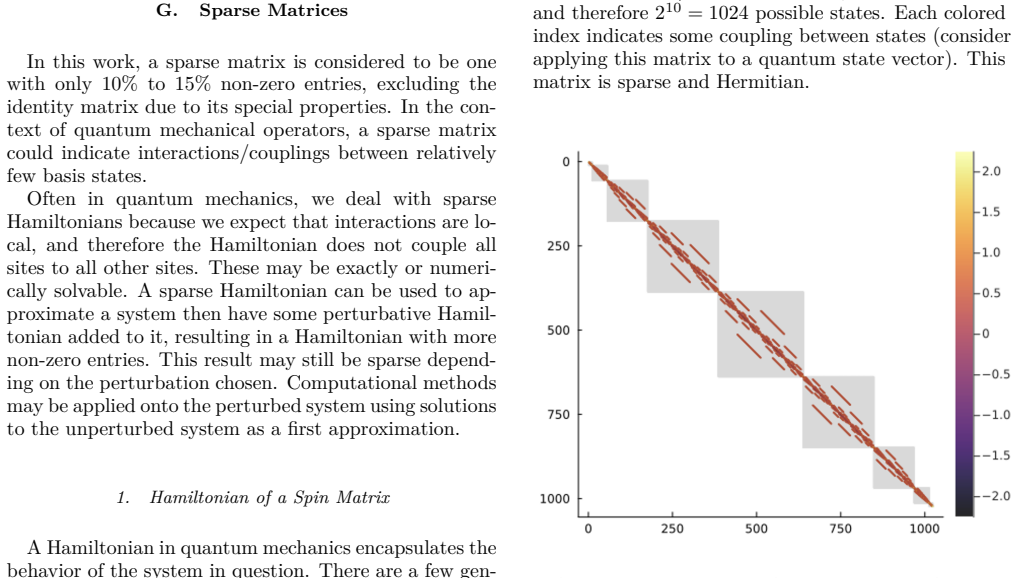
Hamiltonian of a Spin Matrix A Hamiltonian in quantum mechanics encapsulates the behavior of the system in question. There are a few gen- eral properties of any Hamiltonian in quantum mechan- ics. For what we consider, the Hamiltonian is Hermitian. The Hamiltonian describing a 10-site spin-1/2 XXZ Heisenberg model in the absence of an external magnetic fi...
-
[2]
Matrix partition- ing plays a key role in some algorithms, often towards improving efficiency
Block Matrices Square and rectangular matrices can be partitioned into block matrices arbitrarily [25]. Matrix partition- ing plays a key role in some algorithms, often towards improving efficiency. Fig. 3 exhibits block structure. Be- low is an example of how some3×3matrix might be partitioned. ˆH= a b c d e f g h i j k l m n o p (33) ˆH= (...
-
[3]
A banded matrix has upper and lower bandwidths according to aij = 0∀(j >i+q)∨(i>j+p)(35) whereqis the upper bandwidth andpis the lower band- width [21]
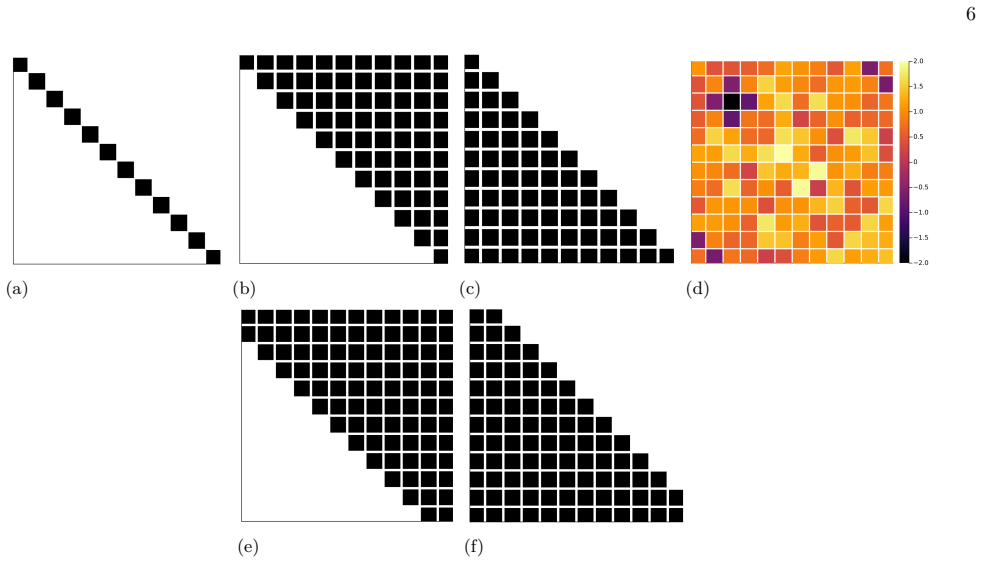
Banded Matrices A banded matrix is a sparse matrix with non-zero en- tries only near the main diagonal. A banded matrix has upper and lower bandwidths according to aij = 0∀(j >i+q)∨(i>j+p)(35) whereqis the upper bandwidth andpis the lower band- width [21]. Banded matrix structure can be leveraged in computational linear algebra problems for efficient com-...
-
[4]
Any alternative storage method requires modifications to linear algebra programs such that the benefits may be reaped
Storage Formats Sparsity can be leveraged such that less memory is con- sumed through clever storage methods. Any alternative storage method requires modifications to linear algebra programs such that the benefits may be reaped. If done well, these methods will often cost fewer operations. Themostobviousformatistostoreelementsasalistof 3-tuples where each...
-
[5]
Notice that all unitary matrices, which have unit de- terminant and a unitary inverse, must then have a con- dition number of 1. Forlargeconditionnumbers, smallperturbations(from rounding, numerical errors, problem formulation approx- imations, etc.) in the input vector which the matrix is applied to can result in relatively large deviations in the result...
-
[6]
Unshifted QR Algorithm The basic unshifted QR algorithm is best encapsulated by Ref. 29 in the following steps: Algorithm 2Unshifted QR method 1:Initialize ˆA1 = ˆA 2:whileA k is not in (approximate) upper triangular form do 3:Perform the decomposition ˆAk = ˆQk ˆRk 4:Take ˆAk+1 = ˆRk ˆQk 5:end while 6:return the final ˆAk The essential idea of this algor...
-
[7]
It can be shown that finding the QR decomposition of a Hessenberg ma- trix can be done inO(N2)rather thanO(N 3)[29]
Utilizing Hessenberg Form This brings us to why so much attention has been fo- cussed on Hessenberg form matrices. It can be shown that finding the QR decomposition of a Hessenberg ma- trix can be done inO(N2)rather thanO(N 3)[29]. Addi- tionally, inHessenbergformfeweriterationsoftheQRal- gorithm are required. This makes intuitive sense as Hes- senberg ma...
-
[8]
Shifted QR Algorithm The rate of convergence for the QR algorithm when applied to a Hessenberg matrix may be improved by in- corporating a shift at each step. Given matrixˆAin Hes- 15 senberg form, the steps of the shifted QR algorithm are as follows [21]: Algorithm 3Shifted QR method 1:Initialize ˆA1 = ˆA 2:whileA k is not in (approximate) upper triangul...
-
[9]
It is therefore necessary to define an extended algorithm capable of handling complex values
Double Shifted QR Algorithm In the case of complex numbers along the diagonal of the Hessenberg form matrix, the single shift algorithm will not converge. It is therefore necessary to define an extended algorithm capable of handling complex values. This can be done by introducing a second shift byσkIat each step. The double shifted QR algorithm takes a He...
2021
-
[10]
Edward Anderson, Zhaojun Bai, Christian Bischof, L Su- san Blackford, James Demmel, Jack Dongarra, Jeremy Du Croz, Anne Greenbaum, Sven Hammarling, Alan McKenney,et al., LAPACK users’ guide(SIAM, 1999)
1999
-
[11]
Cosmological baryon and lepto n number in the presence of electroweak fermion number violation,
Richard Cleve, Robin Kothari, Dominic W. Berry, Andrew M. Childs and Rolando D. Somma, “Simu- lating hamiltonian dynamics with a truncated Taylor Series,” Phys. Rev. Lett. 114 (2015), 10.1103/Phys- RevLett.114.090502
-
[12]
John S Townsend,A modern approach to quantum me- chanics(University Science Books, 2000)
2000
-
[13]
Diprima William E
Richard C. Diprima William E. Boyce and Douglas B. 19 Meade, Elementary Differential Equations and Boundary ValueProblems-11thEdition(JohnWiley&Sons, 2017) p. 303
2017
-
[14]
Méthodes de calcul avec réseaux de tenseurs en physique,
Thomas E Baker, Samuel Desrosiers, Maxime Trem- blay, and Martin P Thompson, “Méthodes de calcul avec réseaux de tenseurs en physique,” Canadian Journal of Physics99, 4 (2021); “Basic tensor network computa- tions in physics,” arXiv:1911.11566, p. 20 (2019)
-
[15]
Goodrich and Roberto TamassiaAlgorithm Design - Foundations, Analysis, and Internet Examples - First Edition(John Wiley & Sons, 2002) pp
Michael T. Goodrich and Roberto TamassiaAlgorithm Design - Foundations, Analysis, and Internet Examples - First Edition(John Wiley & Sons, 2002) pp. 13-20
2002
-
[16]
Chapra and Raymond P
Steven C. Chapra and Raymond P. Canale,Numerical Methods for Engineers - Eighth Edition(McGraw Hill,
-
[17]
180–183, 249–274
pp. 180–183, 249–274
-
[18]
Trefethen and David Bau III,Numerical Linear Algebra(Society for Industrial and Applied Mathematics,
Lloyd N. Trefethen and David Bau III,Numerical Linear Algebra(Society for Industrial and Applied Mathematics,
-
[19]
34, 94–95, 172–177, 187–188
pp. 34, 94–95, 172–177, 187–188
-
[20]
Shafarevich and Alexey O
Igor R. Shafarevich and Alexey O. RemizovLinear Alge- bra and Geometry(Springer Science & Business Media,
-
[21]
Application of the Q-Less QR Factorization to Resolve Sparse Linear Over-Constraints
Cho, Jeong-Rae and Cho, Keunhee and Yoon, Hyejin and Rhee, Dong Sop and Lee, Jin Ho, "Application of the Q-Less QR Factorization to Resolve Sparse Linear Over-Constraints" Applied Sciences,15, 13059 (2025)
2025
-
[22]
A high-performance ma- trix–matrix multiplication methodology for cpu and gpu architectures,
Iosif Mporas Vasilios Kelefouras, Angeliki Kritikakou, and Vasilios Kolonias, “A high-performance ma- trix–matrix multiplication methodology for cpu and gpu architectures,” The Journal of Supercomputing72, 804–844 (2016)
2016
-
[23]
An overview of cache optimization techniques and cache-aware numeri- cal algorithms,
Markus Kowarschik and Christian Weiß, “An overview of cache optimization techniques and cache-aware numeri- cal algorithms,” Algorithms for memory hierarchies: ad- vanced lectures, 213–232 (2003)
2003
-
[24]
Minimizing devel- opment and maintenance costs in supporting persistently optimized blas,
R Clint Whaley and Antoine Petitet, “Minimizing devel- opment and maintenance costs in supporting persistently optimized blas,” Software: Practice and Experience 35, 101–121 (2005)
2005
-
[25]
GEMM- based level 3 BLAS: High-performance model implemen- tations and performance evaluation benchmark,
Bo Kågström, Per Ling, and Charles van Loan, “GEMM- based level 3 BLAS: High-performance model implemen- tations and performance evaluation benchmark,” ACM Trans. Math. Softw. 24, 268–302 (1998)
1998
-
[26]
Robert van de Geijn and Kazushige Goto, BLAS (Basic Linear Algebra Subprograms), edited by David Padua (Springer US, 2011) pp. 157–164
2011
-
[27]
Ascher and Chen Greif,A First Course on Numerical Methods(Society for Industrial and Applied Mathematics, 2011) pp
Uri M. Ascher and Chen Greif,A First Course on Numerical Methods(Society for Industrial and Applied Mathematics, 2011) pp. 117–121
2011
-
[28]
Conjugate gradient methods for Toeplitz systems
Chan, Raymond H.; Ng, Michael K. Conjugate gradient methods for Toeplitz systems. SIAM Rev. 38 (1996), no. 3, 427–482
1996
-
[29]
Iterative methods for Toeplitz sys- tems.Numerical Mathematics and Scientific Computa- tion.(Oxford University Press, New York, 2004)
Ng, Michael K. Iterative methods for Toeplitz sys- tems.Numerical Mathematics and Scientific Computa- tion.(Oxford University Press, New York, 2004)
2004
-
[30]
Garoni, Carlo; Serra-Capizzano, Stefano.Generalized lo- cally Toeplitz sequences: theory and applications. Vol. I. (Springer, Cham, 2017)
2017
-
[31]
Garoni, Carlo; Serra-Capizzano, Stefano.Generalized lo- cally Toeplitz sequences: theory and applications. Vol. II. (Springer, Cham, 2018)
2018
-
[32]
Golub and Charles F
Gene H. Golub and Charles F. van Loan, Matrix Com- putations - Third Edition (The Johns Hopkins Univer- sity Press, 1996) pp. 16, 80–82, 89–98, 135–143, 223–233, 352–361, 442–449, 470–488
1996
-
[33]
LeslieHogben,Elementary Linear Algebra - First Edition (West Publishing Company, 1987) p. 130
1987
-
[34]
Horn,Matrix Mathematics - A Second Course in Linear Algebra(Cam- bridge University Press, 2017)
Stephan Ramon Garcia and Roger A. Horn,Matrix Mathematics - A Second Course in Linear Algebra(Cam- bridge University Press, 2017)
2017
-
[35]
Hall,Lie Groups, Lie Algebras, and Represen- tations - An Elementary Introduction - Second Edition (Springer US, 2015) p
Brian C. Hall,Lie Groups, Lie Algebras, and Represen- tations - An Elementary Introduction - Second Edition (Springer US, 2015) p. 27
2015
-
[36]
30–31, 237–238
Howard Anton and Chris Rorres,Elementary Linear Al- gebra - Applications version - 11th Edition(John Wiley & Sons, 2014) pp. 30–31, 237–238
2014
-
[37]
Strassen’s algorithm reloaded,
Greg Henry Jianyu Huang, Tyler Smith and Robert van de Geijn, “Strassen’s algorithm reloaded,” (IEEE Press,
-
[38]
Yousef Saad,Iterative Methods for Sparse Linear Sys- tems - Second Edition(Society for Industrial and Applied Mathematics, 2003) pp. 92–95
2003
-
[39]
Watkins,Fundamentals of Matrix Computations- Second Edition(John Wiley & Sons,
David S. Watkins,Fundamentals of Matrix Computations- Second Edition(John Wiley & Sons,
-
[40]
14, 17, 18
William Ford,Numerical Linear Algebra with Applica- tions - Using MATLAB(Academic Press, 2015) Chap. 14, 17, 18
2015
-
[41]
Research and imple- mentation of SVD in machine learning,
Yongchang Wang and Ligu Zhu, “Research and imple- mentation of SVD in machine learning,” (IEEE Press,
-
[42]
Mary L Boas,Mathematical methods in the physical sci- ences(Wiley, 2006)
2006
-
[43]
On the fast reduction of a quasi-separable matrix to Hes- senberg and tridiagonal forms,
Israel Gohberg Yuli Eidelman and Luca Gemignani, “On the fast reduction of a quasi-separable matrix to Hes- senberg and tridiagonal forms,”Linear Algebra and its Applications420, 86–101 (2007)
2007
-
[44]
The mul- tishift QR algorithm. part i: Maintaining well-focused shifts and level 3 performance,
Ralph Byers Karen Braman and Roy Mathias, “The mul- tishift QR algorithm. part i: Maintaining well-focused shifts and level 3 performance,” SIAM Journal on Ma- trix Analysis and Applications23, 929–947 (2002)
2002
-
[45]
The mul- tishift QR algorithm. part ii: Aggressive early deflation,
Ralph Byers Karen Braman and Roy Mathias, “The mul- tishift QR algorithm. part ii: Aggressive early deflation,” SIAM Journal on Matrix Analysis and Applications23, 948–973 (2002)
2002
-
[46]
Matrix Anal
Bogoya, Manuel; Grudsky, Sergei M.; Serra-Capizzano, StefanoFast non-Hermitian Toeplitz eigenvalue compu- tations, joining matrixless algorithms and FDE approxi- mation matrices.SIAM J. Matrix Anal. Appl.45(2024), no. 1, 284–305
2024
-
[47]
Matrix Anal
Serra-Capizzano, Stefano.Jordan canonical form of the Google matrix: a potential contribution to the PageRank computation.SIAM J. Matrix Anal. Appl.27(2005), no. 2, 305–312
2005
-
[48]
The PageR- ank vector: properties, computation, approximation, and acceleration
Brezinski, Claude; Redivo-Zaglia, Michela "The PageR- ank vector: properties, computation, approximation, and acceleration". SIAMJ.MatrixAnal.Appl.28(2006), no. 2, 551–575
2006
-
[49]
TENPACK,
Thomas E. Baker, “TENPACK,” https://github.com/bakerte/TensorPACK.jl (2020)
2020
discussion (0)
Sign in with ORCID, Apple, or X to comment. Anyone can read and Pith papers without signing in.