Recognition: unknown
Measurement of the Z to μ^+μ^- angular coefficients in pp collisions at sqrt{s} = 13 TeV as functions of transverse momentum and rapidity
Pith reviewed 2026-05-07 14:07 UTC · model grok-4.3
The pith
The eight angular polarization coefficients A0 to A7 are measured double-differentially in the Drell-Yan production of muon pairs.
A machine-rendered reading of the paper's core claim, the machinery that carries it, and where it could break.
Core claim
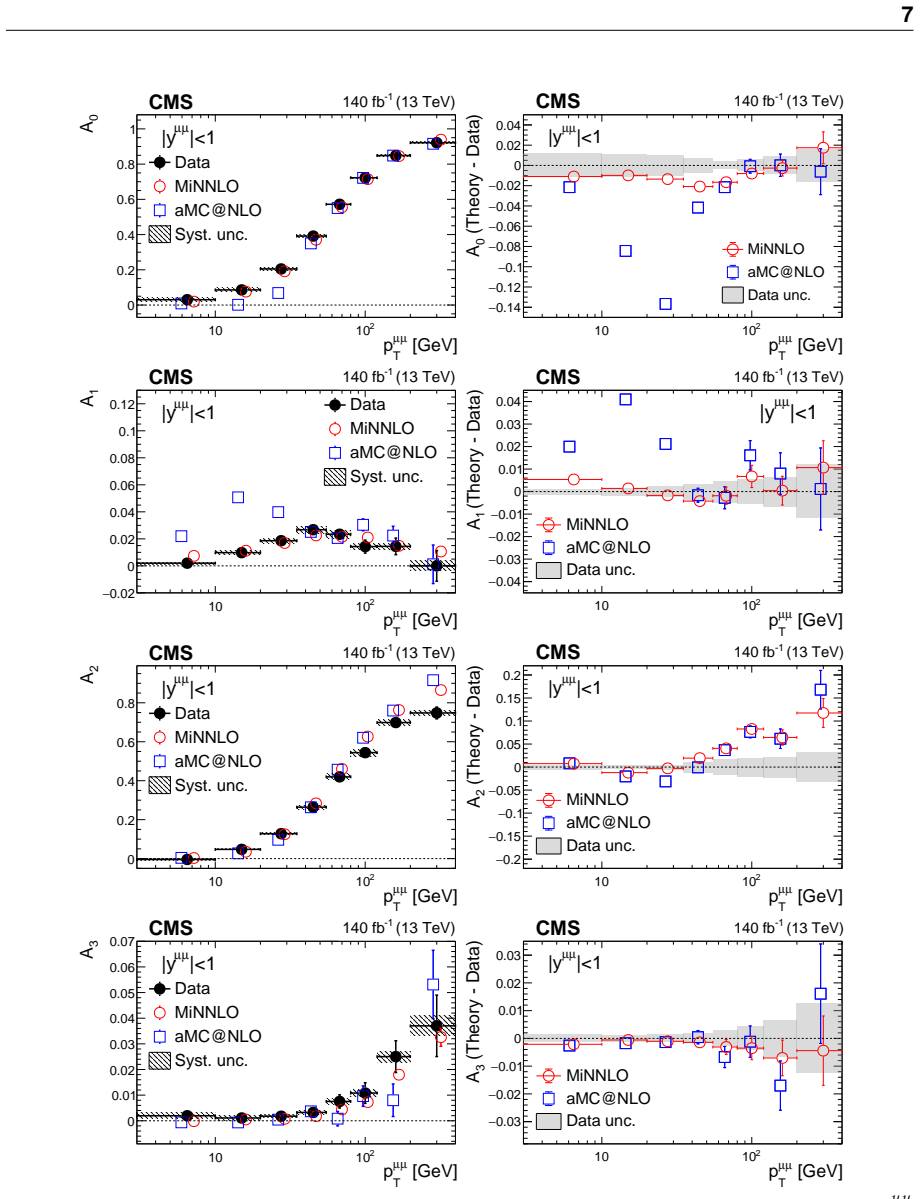
The measurement determines the eight angular coefficients A0 through A7 that appear in the differential cross section for Drell-Yan muon-pair production. The coefficients are extracted as functions of the transverse momentum and rapidity of the muon pair in the mass range 81-101 GeV and are compared with theoretical predictions calculated at next-to-next-to-leading order in perturbative quantum chromodynamics, thereby supplying information on the underlying partonic dynamics and Z production mechanisms.
What carries the argument
The eight angular polarization coefficients A0 to A7 that parameterize the full angular dependence of the muon pair in the Collins-Soper frame of the Drell-Yan process.
If this is right
- The results supply a direct test of the accuracy of perturbative QCD calculations for vector-boson production at this collider energy.
- Any region of kinematic space where the measured coefficients depart from the predictions would indicate the need for additional higher-order corrections or resummation.
- The double-differential data set constrains the parton-level dynamics that enter Z-boson production.
Where Pith is reading between the lines
- When these coefficients are included in global parton-distribution fits, they can tighten constraints on the gluon and quark densities at moderate momentum fractions.
- A future measurement extending to higher transverse momentum or lower invariant mass could expose the onset of electroweak corrections or possible new-physics contributions.
- The same angular framework can be applied to other vector-boson processes to test the universality of the extracted coefficients.
Load-bearing premise
Detector acceptance, efficiency, and background contributions can be modeled and corrected without introducing significant bias inside the chosen double-differential bins.
What would settle it
A statistically significant deviation between the measured coefficients and the next-to-next-to-leading-order QCD predictions that persists after all experimental uncertainties are accounted for, particularly in the highest transverse-momentum interval.
Figures



read the original abstract
A measurement of the eight angular polarization coefficients, $A_0$ to $A_7$, in the cross section for the Drell$-$Yan production of two muons is presented. The analysis is based on proton-proton (pp) collision data recorded with the CMS detector at the LHC at a center-of-mass energy of $\sqrt{s}$ = 13 TeV, corresponding to an integrated luminosity of 140 fb$^{-1}$. The coefficients are determined double differentially in eight intervals of transverse momentum and two intervals of rapidity of the muon pair $\mu^+\mu^-$. The results are presented for the $\mu^+\mu^-$ invariant mass range 81$-$101 GeV and are compared with theoretical predictions calculated at next-to-next-to-leading order in perturbative quantum chromodynamics. The measurement provides relevant information about the underlying partonic dynamics and the Z boson production mechanisms.
Editorial analysis
A structured set of objections, weighed in public.
Referee Report
Summary. The manuscript presents a measurement of the eight angular polarization coefficients A0 to A7 in the Drell-Yan process Z → μ⁺μ⁻ using 140 fb⁻¹ of 13 TeV pp collision data recorded with the CMS detector. The coefficients are extracted double-differentially in eight intervals of dimuon transverse momentum and two intervals of rapidity, restricted to the 81-101 GeV invariant-mass window, and compared to next-to-next-to-leading-order perturbative QCD predictions.
Significance. If the experimental corrections hold, the result supplies high-statistics, double-differential data on Z-boson polarization that can constrain partonic dynamics and test the accuracy of NNLO calculations in a kinematic regime where higher-order effects and parton distributions are relevant. The large integrated luminosity and fine binning constitute a clear experimental strength.
major comments (2)
- [analysis and coefficient extraction] The extraction of A0–A7 from the observed cosθ* and φ* distributions (described in the analysis section) relies on simulation-based corrections for detector acceptance, reconstruction efficiency, trigger, and backgrounds in each of the 8 pT × 2 y bins. No explicit validation is shown that residual data-MC differences in the angular variables inside these bins are negligible, especially at low pT where acceptance varies rapidly; any such mismatch directly biases the extracted coefficients and undermines the theory comparison.
- [results and systematic uncertainties] Table or figure presenting the final A_i values with uncertainties must include a breakdown of the systematic component arising from the acceptance/efficiency modeling; without it, it is impossible to judge whether the quoted precision is realistic or whether the double-differential binning has amplified modeling uncertainties.
minor comments (1)
- [abstract] The abstract states the mass window and binning but does not quote the total number of selected events or the typical statistical precision per bin; adding these numbers would help readers assess the measurement's reach.
Simulated Author's Rebuttal
We thank the referee for the careful review and constructive comments on our manuscript. We address each major comment below and outline the revisions we will make to strengthen the presentation of the analysis and results.
read point-by-point responses
-
Referee: The extraction of A0–A7 from the observed cosθ* and φ* distributions (described in the analysis section) relies on simulation-based corrections for detector acceptance, reconstruction efficiency, trigger, and backgrounds in each of the 8 pT × 2 y bins. No explicit validation is shown that residual data-MC differences in the angular variables inside these bins are negligible, especially at low pT where acceptance varies rapidly; any such mismatch directly biases the extracted coefficients and undermines the theory comparison.
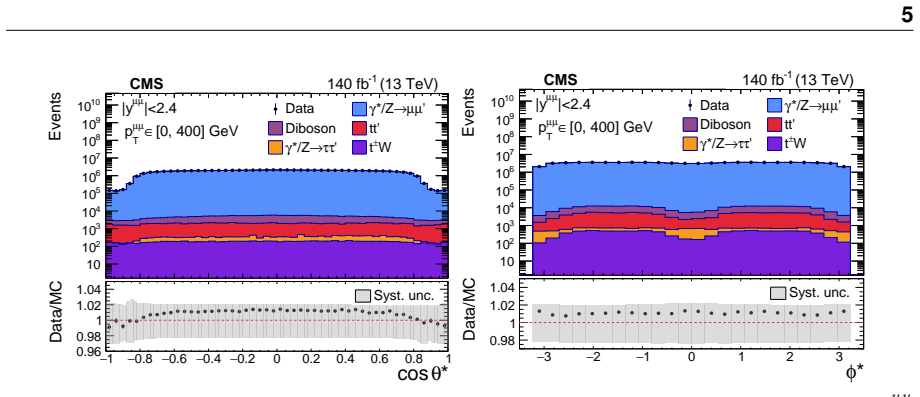
Authors: We agree that explicit validation of residual data-MC differences in the angular variables is essential, particularly at low pT. The manuscript describes the correction procedure and includes some data-MC comparisons in the supplementary material, but we will add a dedicated subsection and representative figures in the main text showing post-correction cosθ* and φ* distributions in data versus simulation across the pT and y bins. These will quantify any residuals and confirm they are covered by the assigned systematics, thereby reinforcing the reliability of the coefficient extraction. revision: yes
-
Referee: Table or figure presenting the final A_i values with uncertainties must include a breakdown of the systematic component arising from the acceptance/efficiency modeling; without it, it is impossible to judge whether the quoted precision is realistic or whether the double-differential binning has amplified modeling uncertainties.
Authors: We acknowledge the value of a detailed systematic breakdown for assessing the quoted precision. The current manuscript quotes the total systematic uncertainty; we will add a new table (or expanded panel in the results figure) that explicitly decomposes the systematic contributions, with a dedicated column or row for acceptance/efficiency modeling uncertainties, for each A_i in every pT and y bin. This will allow direct evaluation of modeling effects in the double-differential measurement. revision: yes
Circularity Check
Experimental measurement of angular coefficients is data-driven with no circular reduction
full rationale
The paper reports a direct experimental extraction of A0–A7 coefficients from observed muon angular distributions in pp collisions, after standard detector corrections and background subtraction, then compares the results to independent NNLO pQCD calculations. No equation or step defines the target coefficients in terms of themselves, renames a fit as a prediction, or relies on a self-citation chain for the central claim. The derivation chain from raw data to double-differential coefficients is externally benchmarked and does not reduce to its inputs by construction.
Axiom & Free-Parameter Ledger
axioms (1)
- domain assumption The angular distribution of muon pairs from Z decay can be fully described by eight coefficients A0 to A7 in a chosen reference frame.
Reference graph
Works this paper leans on
-
[1]
Massive lepton pair production in hadron-hadron collisions at high-energies
S. D. Drell and T.-M. Yan, “Massive lepton pair production in hadron-hadron collisions at high-energies”,Phys. Rev. Lett.25(1970) 316,doi:10.1103/PhysRevLett.25.316
-
[2]
W and Z polarization effects in hadronic collisions
E. Mirkes and J. Ohnemus, “W and Z polarization effects in hadronic collisions”,Phys. Rev. D50(1994) 5692,doi:10.1103/PhysRevD.50.5692,arXiv:hep-ph/9406381
-
[3]
Angular decay distribution of leptons from W-bosons at NLO in hadronic collisions
E. Mirkes, “Angular decay distribution of leptons from W-bosons at NLO in hadronic collisions”,Nucl. Phys. B387(1992) 3,doi:10.1016/0550-3213(92)90046-E
-
[4]
A. Bodek, J. Han, A. Khukhunaishvili, and W. Sakumoto, “Using Drell–Yan forward–backward asymmetry to reduce PDF uncertainties in the measurement of electroweak parameters”,Eur. Phys. J. C76(2016) 115, doi:10.1140/epjc/s10052-016-3958-3,arXiv:1507.02470
-
[5]
Extracting Boer–Mulders functions from p+D Drell–Yan processes
B. Zhang, Z. Lu, B.-Q. Ma, and I. Schmidt, “Extracting Boer–Mulders functions from p+D Drell–Yan processes”,Phys. Rev. D77(2008) 054011, doi:10.1103/PhysRevD.77.054011,arXiv:0803.1692
-
[6]
Angular distributions of Drell–Yan leptons in the TMD factorization approach
S. Piloneta and A. Vladimirov, “Angular distributions of Drell–Yan leptons in the TMD factorization approach”,JHEP12(2024) 059,doi:10.1007/JHEP12(2024)059, arXiv:2407.06277
-
[7]
Angular distribution of dileptons in high-energy hadron collisions
J. C. Collins and D. E. Soper, “Angular distribution of dileptons in high-energy hadron collisions”,Phys. Rev. D16(1977) 2219,doi:10.1103/PhysRevD.16.2219
-
[8]
CMS Collaboration, “Angular coefficients of Z bosons produced in pp collisions at√s=8 TeV and decaying toµ +µ− as a function of transverse momentum and rapidity”, Phys. Lett. B750(2015) 154,doi:10.1016/j.physletb.2015.08.061, arXiv:1504.03512
-
[9]
ATLAS Collaboration, “Measurement of the angular coefficients inZ-boson events using electron and muon pairs from data taken at √s=8 TeV with the ATLAS detector”,JHEP 08(2016) 159,doi:10.1007/JHEP08(2016)159,arXiv:1606.00689
-
[10]
Precise predictions for the angular coefficients in Z-boson production at the LHC
R. Gauld et al., “Precise predictions for the angular coefficients in Z-boson production at the LHC”,JHEP11(2017) 003,doi:10.1007/JHEP11(2017)003, arXiv:1708.00008
-
[11]
Systematic approach to inclusive lepton pair production in hadronic collisions
C. S. Lam and W.-K. Tung, “Systematic approach to inclusive lepton pair production in hadronic collisions”,Phys. Rev. D18(1978) 2447,doi:10.1103/PhysRevD.18.2447
-
[12]
Rotation-invariant relations in vector meson decays into fermion pairs
P . Faccioli, C. Lourenc ¸o, and J. Seixas, “Rotation-invariant relations in vector meson decays into fermion pairs”,Phys. Rev. Lett.105(2010) 061601, doi:10.1103/PhysRevLett.105.061601,arXiv:1005.2601
-
[13]
P . Faccioli and C. Lourenc ¸o, “Particle polarization in high energy physics: an introduction and case studies on vector particle production at the LHC”. Lecture Notes in Physics. Springer, 2022.doi:10.1007/978-3-031-08876-6. References 15
-
[14]
Interpretation of angular distributions of Z-boson production at colliders
J.-C. Peng, W.-C. Chang, R. E. McClellan, and O. Teryaev, “Interpretation of angular distributions of Z-boson production at colliders”,Phys. Lett. B758(2016) 384, doi:10.1016/j.physletb.2016.05.035,arXiv:1511.08932
-
[15]
Intrinsic transverse momentum and transverse spin asymmetries
D. Boer, “Intrinsic transverse momentum and transverse spin asymmetries”,Nucl. Phys. B Proc. Suppl.79(1999) 638,doi:10.1016/S0920-5632(99)00807-5, arXiv:hep-ph/9905336
-
[16]
CDF Collaboration, “Indirect measurement of sin 2 θW(MW)using e +e− pairs in the Z-boson region with pp collisions at a center-of-momentum energy of 1.96 TeV”,Phys. Rev. D88(2013) 072002,doi:10.1103/PhysRevD.88.072002,arXiv:1307.0770
-
[17]
CDF Collaboration, “First measurement of the angular coefficients of Drell–Yan e +e− pairs in the Z mass region from pp collisions at √s= 1.96 TeV”,Phys. Rev. Lett.106 (2011) 241801,doi:10.1103/PhysRevLett.106.241801,arXiv:1103.5699
-
[18]
CMS Collaboration, “Measurement of the Drell–Yan forward-backward asymmetry and of the effective leptonic weak mixing angle in proton-proton collisions at √s=13 TeV”, Phys. Lett. B866(2025) 139526,doi:10.1016/j.physletb.2025.139526, arXiv:2408.07622
-
[19]
Time-reversal-odd asymmetry in semi-inclusive lepton production in Quantum Chromodynamics
K. Hagiwara, K.-i. Hikasa, and N. Kai, “Time-reversal-odd asymmetry in semi-inclusive lepton production in Quantum Chromodynamics”,Phys. Rev. D27(1983) 84, doi:10.1103/PhysRevD.27.84
-
[20]
Probing the one-loop Zgg vertex at hadron colliders
K. Hagiwara, T. Kuruma, and Y. Yamada, “Probing the one-loop Zgg vertex at hadron colliders”,Nucl. Phys. B369(1992) 171,doi:10.1016/0550-3213(92)90382-L
-
[21]
LHCb Collaboration, “First measurement of the Z→µ +µ− angular coefficients in the forward region of pp collisions at √s=13 TeV”,Phys. Rev. Lett.129(2022) 091801, doi:10.1103/PhysRevLett.129.091801,arXiv:2203.01602
-
[22]
HEPData record for this analysis, 2026.doi:10.17182/hepdata.172103
-
[23]
The CMS experiment at the CERN LHC
CMS Collaboration, “The CMS experiment at the CERN LHC”,JINST3(2008) S08004, doi:10.1088/1748-0221/3/08/S08004
-
[24]
Performance of the CMS Level-1 trigger in proton-proton collisions at √s=13 TeV
CMS Collaboration, “Performance of the CMS Level-1 trigger in proton-proton collisions at √s=13 TeV”,JINST15(2020) P10017, doi:10.1088/1748-0221/15/10/P10017,arXiv:2006.10165
-
[25]
CMS Collaboration, “The CMS trigger system”,JINST12(2017) P01020, doi:10.1088/1748-0221/12/01/P01020,arXiv:1609.02366
-
[26]
Electron and photon reconstruction and identification with the CMS experiment at the CERN LHC
CMS Collaboration, “Electron and photon reconstruction and identification with the CMS experiment at the CERN LHC”,JINST16(2021) P05014, doi:10.1088/1748-0221/16/05/P05014,arXiv:2012.06888
-
[27]
CMS Collaboration, “Performance of the CMS muon detector and muon reconstruction with proton-proton collisions at √s=13 TeV”,JINST13(2018) P06015, doi:10.1088/1748-0221/13/06/P06015,arXiv:1804.04528
work page internal anchor Pith review doi:10.1088/1748-0221/13/06/p06015 2018
-
[28]
Description and performance of track and primary-vertex reconstruction with the CMS tracker
CMS Collaboration, “Description and performance of track and primary-vertex reconstruction with the CMS tracker”,JINST9(2014) P10009, doi:10.1088/1748-0221/9/10/P10009,arXiv:1405.6569. 16
-
[29]
Particle-flow reconstruction and global event description with the CMS detector
CMS Collaboration, “Particle-flow reconstruction and global event description with the CMS detector”,JINST12(2017) P10003,doi:10.1088/1748-0221/12/10/P10003, arXiv:1706.04965
work page internal anchor Pith review doi:10.1088/1748-0221/12/10/p10003 2017
-
[30]
Performance of the CMS high-level trigger during LHC Run 2
CMS Collaboration, “Performance of the CMS high-level trigger during LHC Run 2”, JINST19(2024) P11021,doi:10.1088/1748-0221/19/11/P11021, arXiv:2410.17038
-
[31]
MiNNLOPS: a new method to match NNLO QCD to parton showers
P . F. Monni et al., “MiNNLOPS: a new method to match NNLO QCD to parton showers”, JHEP05(2020) 143,doi:10.1007/JHEP05(2020)143,arXiv:1908.06987
-
[32]
Matching NLO QCD computations with Parton Shower simulations: the POWHEG method
S. Frixione, P . Nason, and C. Oleari, “Matching NLO QCD computations with Parton Shower simulations: the POWHEG method”,JHEP11(2007) 070, doi:10.1088/1126-6708/2007/11/070,arXiv:0709.2092
work page internal anchor Pith review doi:10.1088/1126-6708/2007/11/070 2007
-
[33]
T. Sj ¨ostrand et al., “An introduction to PYTHIA 8.2”,Comput. Phys. Commun.191(2015) 159,doi:10.1016/j.cpc.2015.01.024,arXiv:1410.3012
-
[34]
PHOTOS interface in C++: technical and physics documentation
N. Davidson, T. Przedzinski, and Z. Was, “PHOTOS interface in C++: technical and physics documentation”,Comput. Phys. Commun.199(2016) 86, doi:10.1016/j.cpc.2015.09.013,arXiv:1011.0937
-
[35]
Parton distributions from high-precision collider data
NNPDF Collaboration, “Parton distributions from high-precision collider data”,Eur. Phys. J. C77(2017) 663,doi:10.1140/epjc/s10052-017-5199-5, arXiv:1706.00428
work page Pith review doi:10.1140/epjc/s10052-017-5199-5 2017
-
[36]
J. Alwall et al., “The automated computation of tree-level and next-to-leading order differential cross sections, and their matching to parton shower simulations”,JHEP07 (2014) 079,doi:10.1007/JHEP07(2014)079,arXiv:1405.0301
-
[37]
R. Frederix and S. Frixione, “Merging meets matching in MC@NLO”,JHEP12(2012) 061,doi:10.1007/JHEP12(2012)061,arXiv:1209.6215
-
[38]
Extraction and validation of a new set of CMS PYTHIA8 tunes from underlying-event measurements
CMS Collaboration, “Extraction and validation of a new set of CMS PYTHIA8 tunes from underlying-event measurements”,Eur. Phys. J. C80(2020) 4, doi:10.1140/epjc/s10052-019-7499-4,arXiv:1903.12179
-
[39]
CMS Collaboration, “Measurements of differential Z boson production cross sections in proton-proton collisions at √s=13 TeV”,JHEP12(2019) 061, doi:10.1007/JHEP12(2019)061,arXiv:1909.04133
-
[40]
S. Agostinelli et al., “GEANT4–A simulation toolkit”,Nucl. Instrum. Meth. A506(2003) 250,doi:10.1016/S0168-9002(03)01368-8
-
[41]
Extracting muon momentum scale corrections for hadron collider experiments
A. Bodek et al., “Extracting muon momentum scale corrections for hadron collider experiments”,Eur. Phys. J. C72(2012) 2194, doi:10.1140/epjc/s10052-012-2194-8,arXiv:1208.3710
-
[42]
Performance of the CMS muon trigger system in proton-proton collisions at √s=13 TeV
CMS Collaboration, “Performance of the CMS muon trigger system in proton-proton collisions at √s=13 TeV”,JINST16(2021) P07001, doi:10.1088/1748-0221/16/07/P07001,arXiv:2102.04790
-
[43]
MINUIT function minimization and error analysis: reference manual version 94.1
F. James, “MINUIT function minimization and error analysis: reference manual version 94.1”, technical report, CERN, 1994. 17
1994
-
[44]
Precision luminosity measurement in proton-proton collisions at√s=13 TeV in 2015 and 2016 at CMS
CMS Collaboration, “Precision luminosity measurement in proton-proton collisions at√s=13 TeV in 2015 and 2016 at CMS”,Eur. Phys. J. C81(2021) 800, doi:10.1140/epjc/s10052-021-09538-2,arXiv:2104.01927
-
[45]
Precision luminosity measurement in proton-proton collisions at√s=13 TeV with the CMS detector
CMS Collaboration, “Precision luminosity measurement in proton-proton collisions at√s=13 TeV with the CMS detector”, Technical Report CMS-PAS-LUM-20-001, CERN, 2025
2025
-
[46]
J. Butterworth et al., “PDF4LHC recommendations for LHC Run II”,J. Phys. G43(2016) 023001,doi:10.1088/0954-3899/43/2/023001,arXiv:1510.03865. A Tables of angular polarization coefficients This appendix collects tables listing the angular polarization coefficientsA 0–A7, as well as the A0 −A 2 difference, measured in the CS frame, as a function ofp µµ T an...
discussion (0)
Sign in with ORCID, Apple, or X to comment. Anyone can read and Pith papers without signing in.