Recognition: unknown
Magnetic quantum phases of spin-orbit-coupled anisotropic dipolar bosons in square lattices
Pith reviewed 2026-05-07 14:11 UTC · model grok-4.3
The pith
Dipolar bosons with spin-orbit coupling switch from checkerboard to striped phases at a magic tilt angle.
A machine-rendered reading of the paper's core claim, the machinery that carries it, and where it could break.
Core claim
The checkerboard finite-momentum phase-twisted and phase-stripe states transform into their stripe counterparts at a magic tilt angle at which the off-site interaction along one direction becomes zero. At smaller tilt angles a checkerboard charge-density-wave phase is separated by two compressible finite-momentum phases; strong spin-orbit coupling produces phase-twisted supersolid and superfluid phases. At larger tilt angles the striped orders of the phase-twisted and phase-stripe states compete. Off-site inter-component correlations further stabilize density-correlated phases, lattice-induced supersolids, and ferromagnetic quantum phases.
What carries the argument
The magic tilt angle of the magnetic dipoles, which sets the anisotropic dipolar interaction to zero along one lattice axis while spin-orbit coupling generates finite-momentum condensation.
If this is right
- At small tilt angles a checkerboard charge-density-wave order appears, separated by compressible finite-momentum phases.
- Strong spin-orbit coupling stabilizes phase-twisted supersolid and superfluid phases.
- Larger tilt angles produce a direct transition between striped phase-twisted and phase-stripe orders.
- Off-site inter-component correlations generate additional density-correlated and ferromagnetic phases.
Where Pith is reading between the lines
- Tilting the dipoles offers an experimental knob to switch between checkerboard and striped supersolids while keeping density and lattice depth fixed.
- The finite-momentum character of the phases may produce distinctive Bragg scattering or transport signatures that could be measured in current atom-chip setups.
- The same tilt-tuning mechanism might be tested in other lattice geometries or with longer-range interactions to check whether additional crystal orders appear.
Load-bearing premise
The site-decoupled Gutzwiller ansatz and mean-field decoupling are sufficient to capture the essential phase structure without large corrections from fluctuations.
What would settle it
In a quantum-gas microscope or time-of-flight image, the sudden replacement of checkerboard density modulation by stripe modulation exactly when the dipole tilt makes the nearest-neighbor interaction zero along one axis.
Figures



read the original abstract
We examine the two-dimensional spin-orbit-coupled bosons in the presence of an anisotropic dipolar interaction in square lattices. The spin-orbit coupling leads to finite-momentum superfluid and supersolid states, while the nearest-neighbour interaction induces crystalline characteristics in the quantum phases of soft-core bosons. We employ site-decoupled Gutzwiller ansatz and mean-field decoupling theory to obtain the phase diagrams and investigate the effects of the tilt of magnetic dipoles with respect to the polarization axis. Our study reveals the intriguing quantum phase transition of checkerboard finite-momentum phase-twisted and phase-stripe states into their stripe counterparts at a magic tilt angle, at which the off-site interaction along one of the directions becomes zero. At smaller tilt angles, the checkerboard charge-density-wave phase intervened by two compressible finite-momentum phases, and at strong spin-orbit coupling strengths, the phase-twisted supersolid and superfluid phases emerge. At larger tilt angles, a transition between the striped order of phase-twisted states and phase-stripe states occurs. The inclusion of off-site inter-component correlation leads to density-correlated phases, lattice-induced supersolid, and ferromagnetic quantum phases. Our study highlights novel finite-momentum crystal phases of spin-orbit-coupled dipolar bosons and provides a parameter space to observe them in quantum gas experiments.
Editorial analysis
A structured set of objections, weighed in public.
Referee Report
Summary. The manuscript examines spin-orbit-coupled bosons with anisotropic dipolar interactions on square lattices. Employing a site-decoupled Gutzwiller ansatz combined with mean-field decoupling of the dipolar terms, it constructs phase diagrams in the plane of dipole tilt angle and spin-orbit coupling strength. The central claim is a quantum phase transition at a 'magic' tilt angle (where the off-site dipolar interaction vanishes along one lattice direction) from checkerboard finite-momentum phase-twisted and phase-stripe states to their purely striped counterparts; additional phases include compressible finite-momentum states, supersolids, superfluids, density-correlated phases, and ferromagnetic states when off-site inter-component correlations are included.
Significance. If the mean-field phase boundaries prove robust, the work identifies a tunable magic-angle transition and a family of finite-momentum crystalline phases that could be realized in dipolar quantum-gas experiments with synthetic spin-orbit coupling. The parameter space mapped is experimentally accessible and highlights how anisotropy and finite-momentum condensation interplay.
major comments (2)
- [Sec. III and abstract] The phase diagrams and the magic-angle transition are obtained exclusively from numerical minimization within the site-decoupled Gutzwiller ansatz (abstract and Sec. III). When the tilt reaches the magic angle the effective model reduces to a strongly anisotropic 2D system with one interaction channel exactly zero; in this regime the mean-field decoupling neglects quantum fluctuations that become relatively stronger, yet no error estimates, comparison with DMRG/QMC, or fluctuation-corrected calculations are provided to confirm that the reported first-order transition survives beyond the approximation.
- [abstract and results section] The claim that 'the checkerboard charge-density-wave phase intervened by two compressible finite-momentum phases' occurs at smaller tilt angles rests on the same variational ansatz without an explicit check that the site-factorized wave function captures the density-wave instabilities that may be enhanced when one dipolar coupling vanishes (abstract).
minor comments (3)
- [Introduction] Notation for the dipolar interaction tensor and the definition of the magic tilt angle should be stated explicitly in the main text rather than only in the abstract.
- [figure captions] Figure captions for the phase diagrams should include the precise variational parameters minimized and the convergence criteria used.
- [Methods] A brief discussion of the range of validity of the Gutzwiller ansatz for the soft-core dipolar bosons would improve clarity.
Simulated Author's Rebuttal
We thank the referee for the careful reading of our manuscript and the constructive comments. We address the major points below, providing clarifications on the scope and limitations of our mean-field approach while revising the text where appropriate to improve transparency.
read point-by-point responses
-
Referee: [Sec. III and abstract] The phase diagrams and the magic-angle transition are obtained exclusively from numerical minimization within the site-decoupled Gutzwiller ansatz (abstract and Sec. III). When the tilt reaches the magic angle the effective model reduces to a strongly anisotropic 2D system with one interaction channel exactly zero; in this regime the mean-field decoupling neglects quantum fluctuations that become relatively stronger, yet no error estimates, comparison with DMRG/QMC, or fluctuation-corrected calculations are provided to confirm that the reported first-order transition survives beyond the approximation.
Authors: We agree that the phase diagrams, including the magic-angle transition, are obtained from numerical minimization of the site-decoupled Gutzwiller ansatz with mean-field treatment of the dipolar interactions. This variational method is standard for lattice bosons with long-range interactions and has been validated in related dipolar and spin-orbit systems for capturing qualitative phase boundaries and first-order transitions via discontinuities in order parameters. At the magic angle the anisotropy increases, but the transition remains first-order in our calculations. We have added a paragraph in the revised Sec. III discussing the mean-field limitations, the expected role of fluctuations, and why the qualitative features are expected to be robust. Quantitative error estimates or direct DMRG/QMC benchmarks for the full model lie beyond the present scope due to computational cost. revision: partial
-
Referee: [abstract and results section] The claim that 'the checkerboard charge-density-wave phase intervened by two compressible finite-momentum phases' occurs at smaller tilt angles rests on the same variational ansatz without an explicit check that the site-factorized wave function captures the density-wave instabilities that may be enhanced when one dipolar coupling vanishes (abstract).
Authors: The site-decoupled Gutzwiller ansatz permits independent complex amplitudes and number occupations on each lattice site, which directly encodes checkerboard density modulations and finite-momentum order. We have confirmed the stability of the reported checkerboard and intervening compressible phases by seeding the variational minimization from multiple initial configurations (uniform, striped, and checkerboard) and observing consistent convergence. The density-wave character is further supported by the computed structure factor peaks. We have clarified this capability in the revised results section without altering the central claims. revision: no
- Direct quantitative comparisons with DMRG or QMC to assess fluctuation corrections beyond the Gutzwiller ansatz at the magic angle.
Circularity Check
No circularity: phase diagrams obtained via standard variational minimization
full rationale
The paper computes phase diagrams by direct numerical energy minimization within the site-decoupled Gutzwiller ansatz plus mean-field decoupling of the Hamiltonian. No parameter is fitted to a subset of results and then relabeled as a prediction; no quantity is defined in terms of itself; the magic-angle transition follows from the explicit dipolar interaction formula becoming zero in one direction, which is an input geometry rather than a derived output. No self-citations are invoked as load-bearing uniqueness theorems. The derivation chain is therefore self-contained and non-circular.
Axiom & Free-Parameter Ledger
free parameters (3)
- dipole tilt angle
- spin-orbit coupling strength
- interaction strengths
axioms (2)
- domain assumption The Gutzwiller ansatz provides a good variational description of the ground state
- domain assumption Mean-field decoupling is appropriate for the lattice model
Reference graph
Works this paper leans on
-
[1]
025 (d) -π 0 π (e) -π 0 π (f) FIG. 3. Real-space phaseθ σ variations across lattice and the asso- ciated spin-resolved momentum distributions for different supersolid states. Upper panel (a,b,c) depicts the phase configurations of the PT, PS, and ZM supersolid, while lower panel (d,e,f) displays the corresponding momentum-space distributions. Here,ais the...
-
[2]
02 CBDW(1,0) PT-DCSS PS- DCSS PS-SF + ZM-SF 0
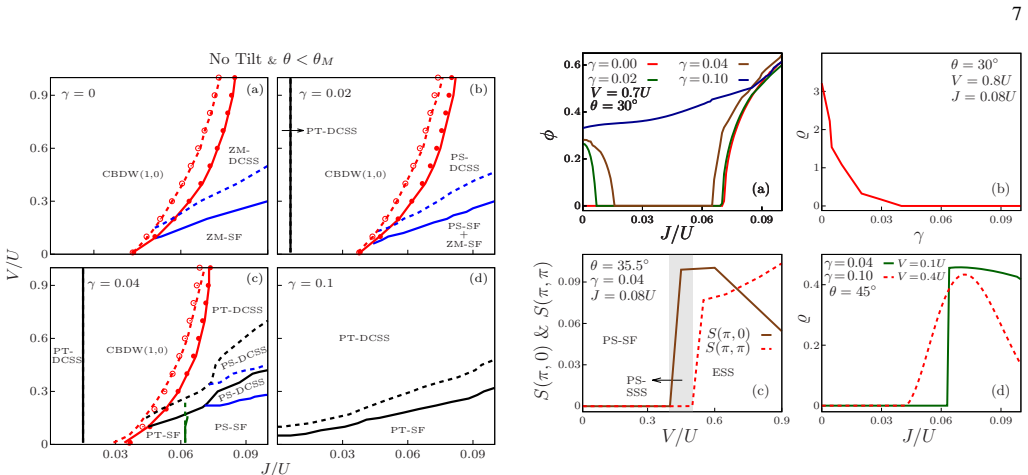
9 No Tilt & θ < θM γ = 0 CBDW(1,0) ZM- DCSS ZM-SF γ = 0 . 02 CBDW(1,0) PT-DCSS PS- DCSS PS-SF + ZM-SF 0
-
[3]
03 0 . 06 0 . 09 γ = 0 . 04 CBDW(1,0)PT- DCSS PT-DCSS PS-DCSS PT-SF PS-SF PS-DCSS
-
[4]
03 0 . 06 0 . 09 γ = 0 . 1 PT-SF PT-DCSS (a) (b) V /U (c) J/U (d) FIG. 4. Ground-state phase diagrams for SOC strengths (a)γ= 0, (b)γ= 0.02, (c)γ= 0.04andγ= 0.1withζ= 0. The solid (dashed) lines are the phase boundaries for the tilt angleθ= 0 ◦ (30 ◦ ) in the hopping amplitude and dipolar interaction strength plane. The red filled (open) circles are the p...
-
[5]
02 EDW ESS SDW PS-SSS PS PT-DCSS PS-SF + -SSS ZM-SF 0
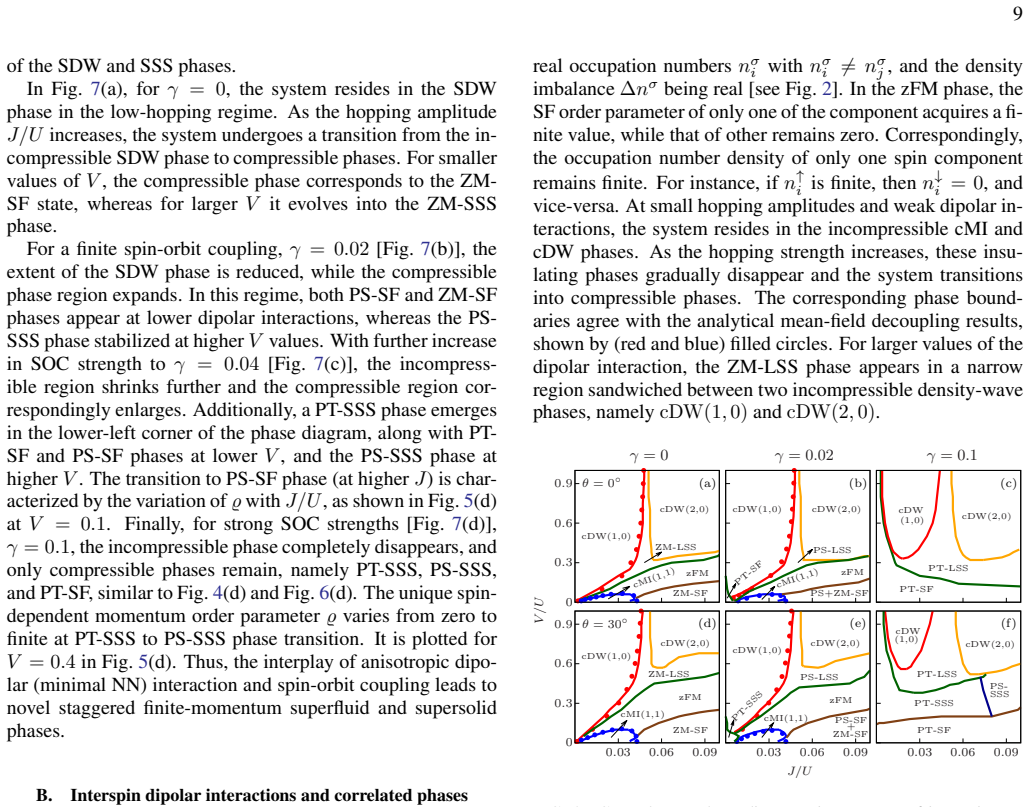
9 θ ≈ θM γ = 0 SDW EDW ZM-SSS ZM-SF ESS γ = 0 . 02 EDW ESS SDW PS-SSS PS PT-DCSS PS-SF + -SSS ZM-SF 0
-
[6]
03 0 . 06 0 . 09 γ = 0 . 04 PT- DCSS ESS PS- SSS SDW ESS PT-SF PS-SSS EDW PS-SF
-
[7]
03 0 . 06 0 . 09 γ = 0 . 1 PT- ESS PT-SF DCSS PS-SSS (a) J/U (b) V /U (c) (d) FIG. 6. Ground-state phase diagrams forU ↑↓/U= 0.5andµ/J= 10with SOC strengths (a)γ= 0, (b)0.02, (c)0.04, and (d)0.1. The tilt angle of polarized dipolar bosons isθ= 35.5 ◦ withζ= 0. Phase boundaries marked by red filled circles are obtained from analytical mean-field decoupling...
-
[8]
02 SDW PS-SSS PS-SF + ZM-SF 0
9 θ > θM γ = 0 SDW ZM-SSS ZM-SF γ = 0 . 02 SDW PS-SSS PS-SF + ZM-SF 0
-
[9]
03 0 . 06 0 . 09 γ = 0 . 04 SDW PT-SSS PS-SSS PT-SF PS-SF
-
[10]
03 0 . 06 0 . 09 γ = 0 . 1 PT-SSS PS-SSS PT-SF (a) J/U (b) V /U (c) (d) FIG. 7. Ground-state phase diagrams forU ↑↓/U= 0.5andµ/J= 10with SOC strengths (a)γ= 0, (b)0.02, (c)0.04and (d)0.1. The tilt angle isθ= 45 ◦ andζ= 0. Phase boundaries marked by red filled circles are obtained from analytical theory [Eq. (15)]. lating states. In the low-hopping regime,...
-
[11]
02 cDW(1,0) cDW(2,0) PS+ZM-SF PT-SF cMI(1,1) zFM PS-LSS (1,0) γ = 0
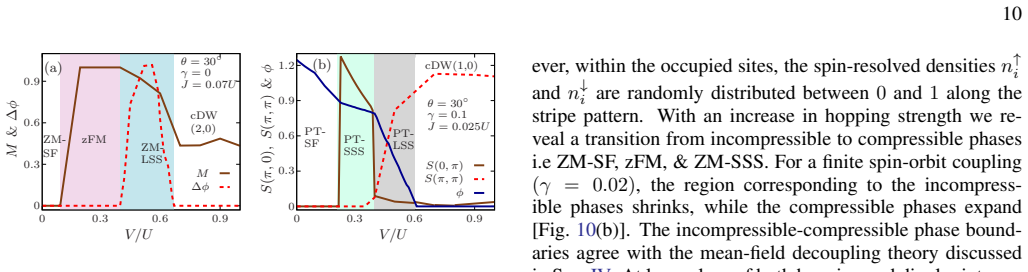
9 γ = 0 θ = 0 ◦ cDW(1,0) cDW(2,0) ZM-SF ZM-LSS cMI(1,1) zFM γ = 0. 02 cDW(1,0) cDW(2,0) PS+ZM-SF PT-SF cMI(1,1) zFM PS-LSS (1,0) γ = 0. 1 cDW cDW(2,0) PT-SF PT-LSS 0
-
[12]
03 0 . 06 0 . 09 θ = 30 ◦ cDW(1,0) cDW(2,0) ZM-LSS ZM-SF cMI(1,1) zFM
-
[13]
03 0 . 06 0 . 09 cDW(1,0) PS-LSS PT-SSS zFM cDW(2,0) cMI(1,1) PS-SF+ ZM-SF
-
[14]
03 0 . 06 0 . 09 cDW (1,0) cDW(2,0) PT-LSS PT-SSS PS- SSS PT-SF (a) (b) (c) V /U (d) J/U (e) (f) FIG. 8. Ground-state phase diagrams in presence of interspin NN interactionsV ↑↓ =ζVwhereζ= 1forU ↑↓/U= 0.5andµ/J= 10with SOC strengthsγ= 0,0.02, and0.1in (a,d), (b,e), and (c,f). The tilt angle isθ= 0 ◦ for upper panel (a,b,c) and30 ◦ for lower panel (d,e,f)....
-
[15]
9 0 0 . 3 0 . 6 0 . 9 0
-
[16]
2 0 0 . 3 0 . 6 0 . 9 M ∆ φ M & ∆ φ V /U (a) ZM- SF zFM ZM- LSS cDW (2,0) θ = 30 ◦ γ = 0 J = 0 . 07U S(0, π ) S(π, π ) φ S(π, 0), S (π, π ) & φ V /U (b) PT- SF PT- SSS PT- LSS cDW(1,0) θ = 30 ◦ γ = 0 . 1 J = 0 . 025U FIG. 9. (a) Variation of the magnetizationMand SF-order param- eter imbalance∆ϕas a function of the dipolar interactionV /Ufor θ= 30 ◦,γ= 0,...
-
[17]
5◦ cSDW (1,0) ZM-SSS ZM-SFSDW zFM γ = 0
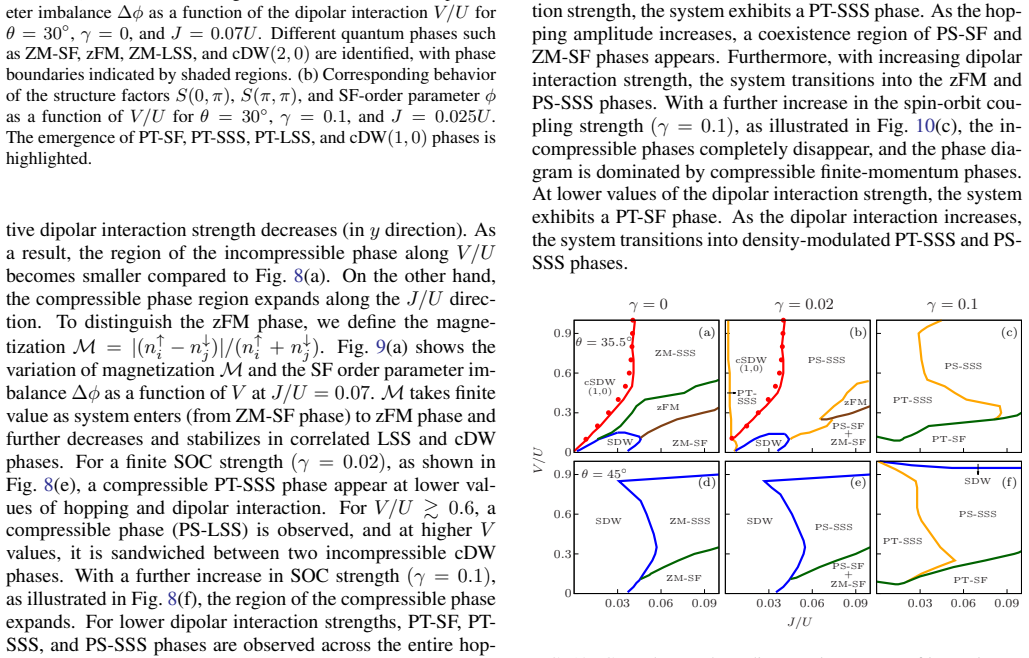
9 γ = 0 θ = 35 . 5◦ cSDW (1,0) ZM-SSS ZM-SFSDW zFM γ = 0. 02 cSDW PS-SSS PT- SDW zFM PS-SF+ ZM-SF (1,0) SSS γ = 0. 1 PS-SSS PT-SF PT-SSS 0
-
[18]
03 0 . 06 0 . 09 θ = 45 ◦ SDW ZM-SSS ZM-SF
-
[19]
03 0 . 06 0 . 09 SDW PS-SSS PS-SF + ZM-SF
-
[20]
03 0 . 06 0 . 09 SDW PT-SSS PS-SSS PT-SF (a) (b) (c) V /U (d) J/U (e) (f) FIG. 10. Ground-state phase diagrams in presence of interspin NN interactionsV ↑↓ =ζVwhereζ= 1forU 12/U= 0.5and µ/J= 10with SOC strengthsγ= 0,0.02and0.1in (a) & (d), (b) & (e) and (c) & (f). The angle isθ= 35.5 ◦ from (a)-(c) and 45 ◦ from (d)-(f). The cSDW phase possesses the strip...
2023
-
[21]
We further define the superfluid order parameter vector Φ† = (ϕ ↑† i , ϕ↓† i , ϕ↑† j , ϕ↓† j ), the perturbed ground-state energy is expressed in the matrix form asE (2) = Φ†MΦ. Explicitly, E(2) = Φ† A↑↓ j 0zJ γ 0A ↓↑ j −γ zJ zJ−γA ↑↓ i 0 γ zJ0A ↓↑ i Φ =K 1|ϕ↑ i |2 +K 2|ϕ↓ i |2 +K 3|ϕ↑ j |2 +K 4|ϕ↓ j |2, (A2) where the diagonal elements are ...
-
[22]
Žuti ´c, J
I. Žuti ´c, J. Fabian, and S. Das Sarma, Rev. Mod. Phys.76, 323 (2004)
2004
-
[23]
AU Lin, K
Y .-J. AU Lin, K. Jiménez-García, and I. B. Spielman, Nature 471, 83 (2011)
2011
-
[24]
Galitski and I
V . Galitski and I. B. Spielman, Nature494, 49 (2013)
2013
-
[25]
Zhai, Rep
H. Zhai, Rep. Prog. Phys.78, 026001 (2015)
2015
-
[26]
M. Z. Hasan and C. L. Kane, Rev. Mod. Phys.82, 3045 (2010)
2010
-
[27]
Qi and S.-C
X.-L. Qi and S.-C. Zhang, Rev. Mod. Phys.83, 1057 (2011)
2011
-
[28]
Manchon, H
A. Manchon, H. C. Koo, J. Nitta, S. M. Frolov, and R. A. Duine, Nat. Mater.14, 871 (2015)
2015
-
[29]
Z. Wu, L. Zhang, W. Sun, X.-T. Xu, B.-Z. Wang, S.-C. Ji, Y . Deng, S. Chen, X.-J. Liu, and J.-W. Pan, Science354, 83 (2016)
2016
-
[30]
Huang, Z
L. Huang, Z. Meng, P. Wang, P. Peng, S.-L. Zhang, L. Chen, D. Li, Q. Zhou, and J. Zhang, Nat. Phys.12, 540 (2016)
2016
-
[31]
Sun, B.-Z
W. Sun, B.-Z. Wang, X.-T. Xu, C.-R. Yi, L. Zhang, Z. Wu, Y . Deng, X.-J. Liu, S. Chen, and J.-W. Pan, Phys. Rev. Lett. 121, 150401 (2018)
2018
-
[32]
C.-H. Li, C. Qu, R. J. Niffenegger, S.-J. Wang, M. He, D. B. Blasing, A. J. Olson, C. H. Greene, Y . Lyanda-Geller, Q. Zhou, C. Zhang, and Y . P. Chen, Nat. Commun.10, 375 (2019)
2019
-
[33]
Valdés-Curiel, D
A. Valdés-Curiel, D. Trypogeorgos, Q.-Y . Liang, R. P. Ander- son, and I. B. Spielman, Nat. Commun.12, 593 (2021)
2021
-
[34]
Wang, X.-C
Z.-Y . Wang, X.-C. Cheng, B.-Z. Wang, J.-Y . Zhang, Y .-H. Lu, C.-R. Yi, S. Niu, Y . Deng, X.-J. Liu, S. Chen, and J.-W. Pan, Science372, 271 (2021)
2021
-
[35]
Z. Ren, D. Liu, E. Zhao, C. He, K. K. Pak, J. Li, and G.-B. Jo, Nat. Phys.18, 385 (2022)
2022
-
[36]
Liang, Z
Q. Liang, Z. Dong, J.-S. Pan, H. Wang, H. Li, Z. Yang, W. Yi, and B. Yan, Nat. Phys.20, 1738 (2024)
2024
-
[37]
Lewenstein, A
M. Lewenstein, A. Sanpera, V . Ahufinger, B. Damski, A. Sen(De), and U. Sen, Adv. Phys.56, 243 (2007)
2007
-
[38]
Boninsegni and N
M. Boninsegni and N. V . Prokof’ev, Rev. Mod. Phys.84, 759 (2012)
2012
-
[39]
Chomaz, I
L. Chomaz, I. Ferrier-Barbut, F. Ferlaino, B. Laburthe-Tolra, B. L. Lev, and T. Pfau, Rep. Prog. Phys.86, 026401 (2022)
2022
-
[40]
Y . Deng, J. Cheng, H. Jing, C.-P. Sun, and S. Yi, Phys. Rev. Lett.108, 125301 (2012)
2012
-
[41]
Gopalakrishnan, I
S. Gopalakrishnan, I. Martin, and E. A. Demler, Phys. Rev. Lett. 111, 185304 (2013)
2013
-
[42]
R. M. Wilson, B. M. Anderson, and C. W. Clark, Phys. Rev. Lett.111, 185303 (2013). 14
2013
-
[43]
Han, X.-F
W. Han, X.-F. Zhang, D.-S. Wang, H.-F. Jiang, W. Zhang, and S.-G. Zhang, Phys. Rev. Lett.121, 030404 (2018)
2018
-
[44]
van Otterlo, K.-H
A. van Otterlo, K.-H. Wagenblast, R. Baltin, C. Bruder, R. Fazio, and G. Schön, Phys. Rev. B52, 16176 (1995)
1995
-
[45]
G. G. Batrouni and R. T. Scalettar, Phys. Rev. Lett.84, 1599 (2000)
2000
-
[46]
Sengupta, L
P. Sengupta, L. P. Pryadko, F. Alet, M. Troyer, and G. Schmid, Phys. Rev. Lett.94, 207202 (2005)
2005
-
[47]
Capogrosso-Sansone, C
B. Capogrosso-Sansone, C. Trefzger, M. Lewenstein, P. Zoller, and G. Pupillo, Phys. Rev. Lett.104, 125301 (2010)
2010
-
[48]
Ohgoe, T
T. Ohgoe, T. Suzuki, and N. Kawashima, Phys. Rev. B86, 054520 (2012)
2012
-
[49]
Zhang, A
C. Zhang, A. Safavi-Naini, A. M. Rey, and B. Capogrosso- Sansone, New J. Phys.17, 123014 (2015)
2015
-
[50]
Bandyopadhyay, R
S. Bandyopadhyay, R. Bai, S. Pal, K. Suthar, R. Nath, and D. Angom, Phys. Rev. A100, 053623 (2019)
2019
-
[51]
Wu and W.-L
H.-K. Wu and W.-L. Tu, Phys. Rev. A102, 053306 (2020)
2020
-
[52]
Zhang, J
C. Zhang, J. Zhang, J. Yang, and B. Capogrosso-Sansone, Phys. Rev. A103, 043333 (2021)
2021
-
[53]
Zhang, C
J. Zhang, C. Zhang, J. Yang, and B. Capogrosso-Sansone, Phys. Rev. A105, 063302 (2022)
2022
-
[54]
P. H. Nguyen and M. Boninsegni, J. Low Temp. Phys.209, 34 (2022)
2022
-
[55]
Léonard, A
J. Léonard, A. Morales, P. Zupancic, T. Esslinger, and T. Don- ner, Nature543, 87 (2017)
2017
-
[56]
J.-R. Li, J. Lee, W. Huang, S. Burchesky, B. Shteynas, F. C. Top, A. O. Jamison, and W. Ketterle, Nature543, 91 (2017)
2017
-
[57]
M. Guo, F. Böttcher, J. Hertkorn, J.-N. Schmidt, M. Wenzel, H. P. Büchler, T. Langen, and T. Pfau, Nature574, 386 (2019)
2019
-
[58]
Tanzi, S
L. Tanzi, S. M. Roccuzzo, E. Lucioni, F. Famà, A. Fioretti, C. Gabbanini, G. Modugno, A. Recati, and S. Stringari, Nature 574, 382 (2019)
2019
-
[59]
Natale, R
G. Natale, R. M. W. van Bijnen, A. Patscheider, D. Petter, M. J. Mark, L. Chomaz, and F. Ferlaino, Phys. Rev. Lett.123, 050402 (2019)
2019
-
[60]
M. A. Norcia, C. Politi, L. Klaus, E. Poli, M. Sohmen, M. J. Mark, R. N. Bisset, L. Santos, and F. Ferlaino, Nature596, 357 (2021)
2021
-
[61]
Bland, E
T. Bland, E. Poli, C. Politi, L. Klaus, M. A. Norcia, F. Fer- laino, L. Santos, and R. N. Bisset, Phys. Rev. Lett.128, 195302 (2022)
2022
-
[62]
Kirkby, A.-C
W. Kirkby, A.-C. Lee, D. Baillie, T. Bland, F. Ferlaino, P. B. Blakie, and R. N. Bisset, Phys. Rev. Lett.133, 103401 (2024)
2024
-
[63]
Lagoin, U
C. Lagoin, U. Bhattacharya, T. Grass, R. W. Chhajlany, T. Sala- mon, K. Baldwin, L. Pfeiffer, M. Lewenstein, M. Holzmann, and F. Dubin, Nature609, 485 (2022)
2022
-
[64]
Baier, M
S. Baier, M. J. Mark, D. Petter, K. Aikawa, L. Chomaz, Z. Cai, M. Baranov, P. Zoller, and F. Ferlaino, Science352, 201 (2016)
2016
-
[65]
R. M. Wilson, W. E. Shirley, and S. S. Natu, Phys. Rev. A93, 011605 (2016)
2016
-
[66]
X. Guan, J. Fan, X. Zhou, G. Chen, and S. Jia, Phys. Rev. A 100, 013617 (2019)
2019
-
[67]
R. Bai, D. Gaur, H. Sable, S. Bandyopadhyay, K. Suthar, and D. Angom, Phys. Rev. A102, 043309 (2020)
2020
-
[68]
Ji, J.-Y
S.-C. Ji, J.-Y . Zhang, L. Zhang, Z.-D. Du, W. Zheng, Y .-J. Deng, H. Zhai, S. Chen, and J.-W. Pan, Nat. Phys.10, 314 (2014)
2014
-
[69]
N. Q. Burdick, Y . Tang, and B. L. Lev, Phys. Rev. X6, 031022 (2016)
2016
-
[70]
M. A. Norcia and F. Ferlaino, Nat. Phys.17, 1349 (2021)
2021
-
[71]
M. Gong, Y . Qian, M. Yan, V . W. Scarola, and C. Zhang, Sci. Rep.5, 10050 (2015)
2015
-
[72]
Z. Cai, X. Zhou, and C. Wu, Phys. Rev. A85, 061605 (2012)
2012
-
[73]
Zhang, Y
L. Zhang, Y . Ke, and C. Lee, Phys. Rev. B100, 224420 (2019)
2019
-
[74]
W. S. Cole, S. Zhang, A. Paramekanti, and N. Trivedi, Phys. Rev. Lett.109, 085302 (2012)
2012
-
[75]
S. a. d. A. Sousa-Júnior and R. Mondaini, Phys. Rev. B111, 075166 (2025)
2025
-
[76]
T. M. Bersano, J. Hou, S. Mossman, V . Gokhroo, X.-W. Luo, K. Sun, C. Zhang, and P. Engels, Phys. Rev. A99, 051602 (2019)
2019
-
[77]
T. Graß, K. Saha, K. Sengupta, and M. Lewenstein, Phys. Rev. A84, 053632 (2011)
2011
-
[78]
Mandal, K
S. Mandal, K. Saha, and K. Sengupta, Phys. Rev. B86, 155101 (2012)
2012
-
[79]
Hickey and A
C. Hickey and A. Paramekanti, Phys. Rev. Lett.113, 265302 (2014)
2014
-
[80]
Dutta, A
A. Dutta, A. Joshi, K. Sengupta, and P. Majumdar, Phys. Rev. B99, 195126 (2019)
2019
discussion (0)
Sign in with ORCID, Apple, or X to comment. Anyone can read and Pith papers without signing in.