Recognition: unknown
Ground-state energies of Ising models calculated using the samples from a quantum computer that simulates short-time evolution
Pith reviewed 2026-05-07 16:35 UTC · model grok-4.3
The pith
Ising model ground-state energies are approximated from short-time evolution samples on a quantum computer with up to 63 qubits.
A machine-rendered reading of the paper's core claim, the machinery that carries it, and where it could break.
Core claim
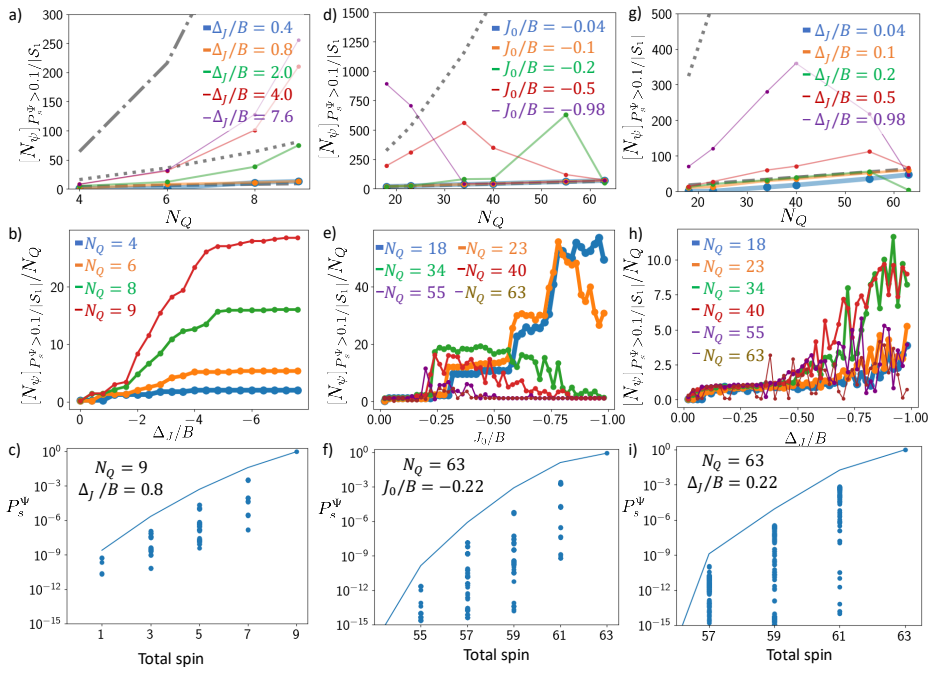
We find the ground-state energy of the Ising model using the Cascaded Variational Quantum Eigensolver (CVQE) algorithm with the Guided-Sampling Ansatz (GSA) using up to 63 qubits on a quantum computer. We study a heavy-hex lattice to match the qubit architecture, allowing us to perform calculations in the quantum utility regime. We study both a homogeneous and random-coupling model. We locate the boundary of acceptable quantum errors as a function of the number of qubits and coupling strength. An entropic analysis is performed giving insights into the quantum computing performance. A subspace analysis is performed that suggests that the Ising model is especially suited for near-term quantum
What carries the argument
The Cascaded Variational Quantum Eigensolver (CVQE) with Guided-Sampling Ansatz (GSA) applied to short-time evolution samples from the quantum computer.
Load-bearing premise
The short-time evolution samples from the quantum processor, after CVQE and GSA post-processing, provide a reliable approximation to the true ground-state energy even in the presence of hardware noise.
What would settle it
Comparing the method's energy estimates against exact diagonalization results for small instances (under 10 qubits) with varying noise levels to check if the acceptable error boundary holds as predicted.
Figures


read the original abstract
We find the ground-state energy of the Ising model using the Cascaded Variational Quantum Eigensolver (CVQE) algorithm with the Guided-Sampling Ansatz (GSA) using up to 63 qubits on a quantum computer. We study a heavy-hex lattice to match the qubit architecture, allowing us to perform calculations in the quantum utility regime. We study both a homogeneous and random-coupling model. We locate the boundary of acceptable quantum errors as a function of the number of qubits and coupling strength. An entropic analysis is performed giving insights into the quantum computing performance. A subspace analysis is performed that suggests that the Ising model is especially suited for near-term quantum computing.
Editorial analysis
A structured set of objections, weighed in public.
Referee Report
Summary. The paper reports ground-state energy calculations for homogeneous and random-coupling Ising models on heavy-hex lattices (up to 63 qubits) performed on a quantum processor. Short-time evolution samples are post-processed via the Cascaded Variational Quantum Eigensolver (CVQE) combined with the Guided-Sampling Ansatz (GSA). The authors locate an acceptable error boundary as a function of qubit number and coupling strength, conduct an entropic analysis of performance, and perform a subspace analysis that concludes the Ising model is especially well-suited to near-term quantum devices.
Significance. If the extracted energies are shown to be reliable proxies for the true ground states once the reported error boundary is respected, the work would supply concrete evidence that near-term hardware can address Ising problems at utility scale and would strengthen the case for subspace-based arguments favoring certain Hamiltonians. The 63-qubit scale and lattice matching to hardware architecture are notable strengths.
major comments (1)
- [Abstract] Abstract and methods description: The headline subspace-analysis claim that the Ising model is 'especially suited for near-term quantum computing' is load-bearing and rests on the assertion that CVQE+GSA post-processing of short-time samples recovers (or sufficiently approximates) the true ground-state energy up to the located error boundary. No quantitative validation against exact diagonalization, classical solvers, or high-accuracy references is described for the 63-qubit instances, nor is an error-bar methodology or protocol for avoiding post-hoc data selection supplied. Without these, the suitability conclusion cannot be assessed.
Simulated Author's Rebuttal
We thank the referee for the constructive feedback on the validation of our subspace analysis and error-boundary claims. We clarify our approach for smaller systems and commit to revisions that add explicit benchmarks and protocol details while acknowledging the inherent limits at 63 qubits.
read point-by-point responses
-
Referee: [Abstract] Abstract and methods description: The headline subspace-analysis claim that the Ising model is 'especially suited for near-term quantum computing' is load-bearing and rests on the assertion that CVQE+GSA post-processing of short-time samples recovers (or sufficiently approximates) the true ground-state energy up to the located error boundary. No quantitative validation against exact diagonalization, classical solvers, or high-accuracy references is described for the 63-qubit instances, nor is an error-bar methodology or protocol for avoiding post-hoc data selection supplied. Without these, the suitability conclusion cannot be assessed.
Authors: We agree that quantitative validation strengthens the load-bearing claim. In the revised manuscript we will add a new subsection with direct comparisons to exact diagonalization for homogeneous and random-coupling instances up to 16 qubits, confirming that CVQE+GSA energies lie within the reported error boundary. The error-boundary protocol itself is defined a priori from the variance across independent short-time evolution runs and the measured subspace overlap; we will expand the methods section to describe this procedure explicitly, including the pre-defined acceptance criteria used to avoid post-hoc selection. For the 63-qubit cases, exact classical references remain unavailable, but the boundary is extrapolated from the validated smaller-system regime and is further supported by the entropic analysis of sample distributions already present in the paper. revision: partial
- Exact diagonalization or high-accuracy classical solvers cannot be performed for the 63-qubit instances due to exponential classical scaling.
Circularity Check
No load-bearing circularity; energies and analyses are direct hardware outputs with independent validation steps.
full rationale
The derivation chain consists of running CVQE+GSA on short-time evolution samples from the quantum processor to obtain ground-state energies for Ising models, followed by locating an error boundary as a function of qubit number and coupling, plus entropic and subspace analyses. These steps do not reduce by construction to fitted parameters from the same dataset, self-definitions, or unverified self-citations; the outputs are presented as hardware-derived quantities whose reliability is assessed against the located boundary rather than assumed by definition. The subspace claim that the Ising model is especially suited follows from the observed performance metrics within that boundary and does not collapse to renaming or tautological input-output equivalence. This is the normal case of a self-contained empirical computation.
Axiom & Free-Parameter Ledger
Reference graph
Works this paper leans on
-
[1]
For fast evolution, we may not haveE n̸=0(t)−E 0 ≫ | ˙H(t)|, however, we may still have En>m(t)−E 0 >| ˙H(t)|for somem
=⇒(c n̸=0(t) = 0). For fast evolution, we may not haveE n̸=0(t)−E 0 ≫ | ˙H(t)|, however, we may still have En>m(t)−E 0 >| ˙H(t)|for somem. Due to the form of Eq. A8 the amplitude for states|Ψn>m(t)⟩will expo- nentially decay away fromm. Thus,|c 0(t)|is inversely proportional to the number of states|Ψn<m(t)⟩with en- ergiesE n(t)< E m(t). In this way, highl...
-
[2]
Simulating physics with comput- ers,
Richard P. Feynman, “Simulating physics with comput- ers,” International Journal of Theoretical Physics21, 467–488 (1982)
1982
-
[3]
Quantum measurements and the Abelian Stabilizer Problem
A. Yu. Kitaev, “Quantum measurements and the abelian stabilizer problem,” (1995), arXiv:quant-ph/9511026 [quant-ph]
work page internal anchor Pith review arXiv 1995
-
[4]
A quan- tum adiabatic evolution algorithm applied to random instances of an np-complete problem,
Edward Farhi, Jeffrey Goldstone, Sam Gutmann, Joshua Lapan, Andrew Lundgren, and Daniel Preda, “A quan- tum adiabatic evolution algorithm applied to random instances of an np-complete problem,” Science292, 472–475 (2001)
2001
-
[5]
Simulations of the adiabatic quantum optimization for the set partition problem,
V. N. Smelyanskiy, U. V. Toussaint, and D. A. Timucin, “Simulations of the adiabatic quantum optimization for the set partition problem,” (2002), arXiv:quant- ph/0112143 [quant-ph]
-
[6]
The quantum adiabatic optimiza- tion algorithm and local minima,
Ben W. Reichardt, “The quantum adiabatic optimiza- tion algorithm and local minima,” inProceedings of the Thirty-Sixth Annual ACM Symposium on Theory of Computing, STOC ’04 (Association for Computing Ma- chinery, New York, NY, USA, 2004) p. 502–510
2004
-
[7]
A varia- tional eigenvalue solver on a photonic quantum proces- sor,
Alberto Peruzzo, Jarrod R. McClean, Peter Shadbolt, Man-Hong Hong Yung, Xiao-Qi Qi Zhou, Peter J. Love, Alán Aspuru-Guzik, and Jeremy L. O’Brien, “A varia- tional eigenvalue solver on a photonic quantum proces- sor,” Nature Communications5, 4213 (2014)
2014
-
[8]
Scalable quan- tum simulation of molecular energies,
P. J. J. O’Malley, R. Babbush, I. D. Kivlichan, J. Romero, J. R. McClean, R. Barends, J. Kelly, P. Roushan, A. Tranter, N. Ding, B. Campbell, Y. Chen, Z. Chen, B. Chiaro, A. Dunsworth, A. G. Fowler, E. Jef- frey, E. Lucero, A. Megrant, J. Y. Mutus, M. Neeley, C. Neill, C. Quintana, D. Sank, A. Vainsencher, J. Wen- ner, T. C. White, P. V. Coveney, P. J. Lo...
2016
-
[9]
Quantum computational chemistry,
Sam McArdle, Suguru Endo, Alá n Aspuru-Guzik, Si- mon C. Benjamin, and Xiao Yuan, “Quantum computa- tional chemistry,” Reviews of Modern Physics92(2020), 10.1103/revmodphys.92.015003
-
[10]
Krylov vari- ational quantum algorithm for first principles materials simulations,
Francois Jamet, Abhishek Agarwal, Carla Lupo, Dan E. Browne, Cedric Weber, and Ivan Rungger, “Krylov vari- ational quantum algorithm for first principles materials simulations,” (2021), arXiv:2105.13298 [quant-ph]
-
[11]
Block lanczos method for excited states on a quantum computer,
Thomas E. Baker, “Block lanczos method for excited states on a quantum computer,” Phys. Rev. A110, 012420 (2024)
2024
-
[12]
The theory of variational hybrid quantum-classical algorithms,
Jarrod R McClean, Jonathan Romero, Ryan Babbush, and Alá n Aspuru-Guzik, “The theory of variational hybrid quantum-classical algorithms,” New Journal of Physics18, 023023 (2016)
2016
-
[13]
Hardware-efficient variational quan- tum eigensolver for small molecules and quantum mag- nets,
Abhinav Kandala, Antonio Mezzacapo, Kristan Temme, Maika Takita, Markus Brink, Jerry M. Chow, and Jay M. Gambetta, “Hardware-efficient variational quan- tum eigensolver for small molecules and quantum mag- nets,” Nature549, 242–246 (2017)
2017
-
[15]
Hartree- fock on a superconducting qubit quantum computer,
Frank Arute, Kunal Arya, Ryan Babbush, Dave Ba- con, Joseph C. Bardin, Rami Barends, Sergio Boixo, Michael Broughton, Bob B. Buckley, David A. Buell, Brian Burkett, Nicholas Bushnell, Yu Chen, Zijun Chen, Benjamin Chiaro, Roberto Collins, William Courtney, SeanDemura, AndrewDunsworth, EdwardFarhi, Austin Fowler, Brooks Foxen, Craig Gidney, Marissa Giustin...
2020
-
[16]
Jérôme F. Gonthier, Maxwell D. Radin, Corneliu Buda, Eric J. Doskocil, Clena M. Abuan, and Jhonathan Romero, “Measurements as a roadblock to near-term practical quantum advantage in chemistry: Resource analysis,” Physical Review Research4(2022), 10.1103/physrevresearch.4.033154
-
[17]
Quantum information and algorithmsforcorrelatedquantummatter,
Kade Head-Marsden, Johannes Flick, Christopher J. Cic- carino, and Prineha Narang, “Quantum information and algorithmsforcorrelatedquantummatter,” ChemicalRe- views121, 3061–3120 (2021)
2021
-
[18]
Variational quantum algorithms,
M. Cerezo, Andrew Arrasmith, Ryan Babbush, Simon C. Benjamin, Suguru Endo, Keisuke Fujii, Jarrod R. Mc- Clean, Kosuke Mitarai, Xiao Yuan, Lukasz Cincio, and Patrick J. Coles, “Variational quantum algorithms,” Na- ture Reviews Physics3, 625–644 (2021)
2021
-
[19]
Cascaded variational quantum eigensolver al- gorithm,
Daniel Gunlycke, C. Stephen Hellberg, and John P. T. Stenger, “Cascaded variational quantum eigensolver al- gorithm,” Phys. Rev. Res.6, 013238 (2024)
2024
-
[20]
Demonstration of the effectiveness of the cas- caded variational quantum eigensolver using the jastrow ansatz for molecular calculations,
John P. T. Stenger, C. Stephen Hellberg, and Daniel Gunlycke, “Demonstration of the effectiveness of the cas- caded variational quantum eigensolver using the jastrow ansatz for molecular calculations,” ACS Omega9, 21353– 21364 (2024)
2024
-
[21]
Guided sampling ansätzes for variational quantum computing,
Daniel Gunlycke, John P. T. Stenger, Andrii Maksymov, AnanthKaushik, MartinRoetteler, andC.StephenHell- berg, “Guided sampling ansätzes for variational quantum computing,” (2025), arXiv:2508.13926 [quant-ph]
-
[22]
Robert M. Parrish and Peter L. McMahon, “Quan- tum filter diagonalization: Quantum eigendecomposi- tion without full quantum phase estimation,” (2019), arXiv:1909.08925 [quant-ph]
-
[23]
A multireference quantum krylov algorithm for strongly correlated electrons,
Nicholas H. Stair, Renke Huang, and Francesco A. Evan- gelista, “A multireference quantum krylov algorithm for strongly correlated electrons,” Journal of Chemical The- ory and Computation16, 2236–2245 (2020)
2020
-
[24]
Lanczos recursion on a quantum com- puter for the green’s function and ground state,
Thomas E. Baker, “Lanczos recursion on a quantum com- puter for the green’s function and ground state,” Phys. Rev. A103, 032404 (2021)
2021
-
[25]
Iterative quantum- assisted eigensolver,
Kishor Bharti and Tobias Haug, “Iterative quantum- assisted eigensolver,” Phys. Rev. A104, L050401 (2021)
2021
-
[26]
Quantum filter diagonalization with compressed double- factorized hamiltonians,
Jeffrey Cohn, Mario Motta, and Robert M. Parrish, “Quantum filter diagonalization with compressed double- factorized hamiltonians,” PRX Quantum2, 040352 (2021)
2021
- [27]
-
[28]
Krylov diagonalization of large many-body hamiltonians on a quantum processor,
Nobuyuki Yoshioka, Mirko Amico, William Kirby, Petar Jurcevic, Arkopal Dutt, Bryce Fuller, Shelly Garion, Hol- ger Haas, Ikko Hamamura, Alexander Ivrii, Ritajit Ma- jumdar, Zlatko Minev, Mario Motta, Bibek Pokharel, Pedro Rivero, Kunal Sharma, Christopher J. Wood, Ali Javadi-Abhari, and Antonio Mezzacapo, “Krylov diagonalization of large many-body hamilto...
2025
-
[29]
Hybrid quantum-classicalhierarchyformitigationofdecoherence and determination of excited states,
Jarrod R. McClean, Mollie E. Kimchi-Schwartz, Jonathan Carter, and Wibe A. de Jong, “Hybrid quantum-classicalhierarchyformitigationofdecoherence and determination of excited states,” Phys. Rev. A95, 042308 (2017)
2017
-
[30]
Computation of molecular spec- tra on a quantum processor with an error-resilient algo- rithm,
J. I. Colless, V. V. Ramasesh, D. Dahlen, M. S. Blok, M. E. Kimchi-Schwartz, J. R. McClean, J. Carter, W. A. de Jong, and I. Siddiqi, “Computation of molecular spec- tra on a quantum processor with an error-resilient algo- rithm,” Phys. Rev. X8, 011021 (2018)
2018
-
[31]
Chemistry on quantum com- puters with virtual quantum subspace expansion,
Miroslav Urbanek, Daan Camps, Roel Van Beeumen, and Wibe A. de Jong, “Chemistry on quantum com- puters with virtual quantum subspace expansion,” Jour- nal of Chemical Theory and Computation16, 5425–5431 (2020)
2020
-
[32]
Hybrid quantum-classical algorithms and quan- tum error mitigation,
SuguruEndo, ZhenyuCai, SimonC.Benjamin, andXiao Yuan, “Hybrid quantum-classical algorithms and quan- tum error mitigation,” Journal of the Physical Society of Japan90, 032001 (2021)
2021
-
[33]
Mario Motta, Erika Ye, Jarrod R. McClean, Zhendong Li, Austin J. Minnich, Ryan Babbush, and Garnet Kin- Lic Chan, “Low rank representations for quantum simu- lation of electronic structure,” npj Quantum Information 7(2021), 10.1038/s41534-021-00416-z
-
[34]
A theory of quantum subspace diagonalization,
Ethan N. Epperly, Lin Lin, and Yuji Nakatsukasa, “A theory of quantum subspace diagonalization,” SIAM Journal on Matrix Analysis and Applications43, 1263– 1290 (2022)
2022
-
[35]
Subspace methods for electronic structure simu- lations on quantum computers,
Mario Motta, William Kirby, Ieva Liepuoniute, Kevin J Sung, Jeffrey Cohn, Antonio Mezzacapo, Katherine Klymko, Nam Nguyen, Nobuyuki Yoshioka, and Julia E Rice, “Subspace methods for electronic structure simu- lations on quantum computers,” Electronic Structure6, 013001 (2024)
2024
-
[36]
Quan- tum subspace expansion approach for simulating dynam- ical response functions of kitaev spin liquids,
Chukwudubem Umeano, Fran çois Jamet, Lachlan P. Lindoy, Ivan Rungger, and Oleksandr Kyriienko, “Quan- tum subspace expansion approach for simulating dynam- ical response functions of kitaev spin liquids,” Phys. Rev. Mater.9, 034401 (2025)
2025
-
[37]
Quantum computa- tion of electronic transitions using a variational quantum eigensolver,
Robert M. Parrish, Edward G. Hohenstein, Peter L. McMahon, and Todd J. Martínez, “Quantum computa- tion of electronic transitions using a variational quantum eigensolver,” Phys. Rev. Lett.122, 230401 (2019)
2019
-
[38]
A non-orthogonal variationalquantumeigensolver,
William J Huggins, Joonho Lee, Unpil Baek, Bryan O’Gorman, and K Birgitta Whaley, “A non-orthogonal variationalquantumeigensolver,” NewJournalofPhysics 22, 073009 (2020)
2020
-
[39]
Shi-Xin Zhang, Zhou-Quan Wan, Chee-Kong Lee, Chang-Yu Hsieh, Shengyu Zhang, and Hong Yao, “Variational quantum-neural hybrid eigensolver,” Physical Review Letters128(2022), 10.1103/phys- revlett.128.120502
-
[40]
Chemistry beyond the scale of exact diagonalization on a quantum-centric supercom- puter,
Javier Robledo-Moreno, Mario Motta, Holger Haas, Ali Javadi-Abhari, Petar Jurcevic, William Kirby, Simon Martiel, Kunal Sharma, Sandeep Sharma, Tomonori Shi- rakawa, Iskandar Sitdikov, Rong-Yang Sun, Kevin J. Sung, Maika Takita, Minh C. Tran, Seiji Yunoki, and Antonio Mezzacapo, “Chemistry beyond the scale of exact diagonalization on a quantum-centric sup...
2025
-
[41]
Quantum supremacy using a programmable superconducting processor,
Frank Arute, Kunal Arya, Ryan Babbush, Dave Bacon, Joseph C. Bardin, Rami Barends, Rupak Biswas, Sergio Boixo, Fernando G. S. L. Brandao, David A. Buell, Brian Burkett, Yu Chen, Zijun Chen, Ben Chiaro, Roberto Collins, William Courtney, Andrew Dunsworth, Ed- ward Farhi, Brooks Foxen, Austin Fowler, Craig Gidney, MarissaGiustina, RobGraff, KeithGuerin, Ste...
2019
-
[42]
Classical benchmarking of zero noise extrapolation beyond the exactly-verifiable regime,
Sajant Anand, Kristan Temme, Abhinav Kandala, and Michael Zaletel, “Classical benchmarking of zero noise extrapolation beyond the exactly-verifiable regime,” (2023), arXiv:2306.17839 [quant-ph]
-
[43]
Talal Ahmed Chowdhury, Kwangmin Yu, Mah- mud Ashraf Shamim, M. L. Kabir, and Raza Sabbir Sufian, “Enhancing quantum utility: Simulating large- scale quantum spin chains on superconducting quan- tum computers,” Physical Review Research6(2024), 10.1103/physrevresearch.6.033107
-
[44]
Evidence for the util- ity of quantum computing before fault tolerance,
Youngseok Kim, Andrew Eddins, Sajant Anand, Ken Xuan Wei, Ewout van den Berg, Sami Rosenblatt, Hasan Nayfeh, Yantao Wu, Michael Zaletel, Kristan Temme, and Abhinav Kandala, “Evidence for the util- ity of quantum computing before fault tolerance,” Nature 618, 500–505 (2023)
2023
-
[45]
What is quantum utility?
Robert Davis, “What is quantum utility?” https://www.ibm.com (2023)
2023
-
[46]
Hybrid vqe-cvqe algorithm using diabatic state preparation,
John P. T. Stenger, C. Stephen Hellberg, and Daniel Gunlycke, “Hybrid vqe-cvqe algorithm using diabatic state preparation,” (2025), arXiv:2512.04801 [quant-ph]
-
[47]
The quan- tum transition of the two-dimensional ising spin glass,
Massimo Bernaschi, Isidoro González-Adalid Pemartín, Víctor Martín-Mayor, and Giorgio Parisi, “The quan- tum transition of the two-dimensional ising spin glass,” Nature631, 749–754 (2024)
2024
-
[48]
Spin glass experiments,
Eric Vincent, “Spin glass experiments,” inEncyclopedia of Condensed Matter Physics(Elsevier, 2024) p.371–387
2024
-
[49]
Quantum adiabatic theorem revisited,
Runyao Duan, “Quantum adiabatic theorem revisited,” (2020), arXiv:2003.03063 [quant-ph]
-
[50]
On the product of semi-groups of opera- tors,
H. F. Trotter, “On the product of semi-groups of opera- tors,” Proceedings of the American Mathematical Society 10, 545–551 (1959)
1959
-
[51]
Generalized trotter’s formula and sys- tematic approximants of exponential operators and inner derivations with applications to many-body problems,
Masuo Suzuki, “Generalized trotter’s formula and sys- tematic approximants of exponential operators and inner derivations with applications to many-body problems,” Communications in Mathematical Physics51, 183–190 (1976)
1976
-
[52]
quantum.cloud.ibm.com,
ibm torino, “quantum.cloud.ibm.com,” (2023)
2023
discussion (0)
Sign in with ORCID, Apple, or X to comment. Anyone can read and Pith papers without signing in.