Recognition: unknown
NTL-amplified cryogenic light detectors with optically transparent electrodes
Pith reviewed 2026-05-07 13:55 UTC · model grok-4.3
The pith
Silicon cryogenic light detectors achieve NTL amplification at millikelvin temperatures using transparent ITO electrodes that also serve as anti-reflective coatings.
A machine-rendered reading of the paper's core claim, the machinery that carries it, and where it could break.
Core claim
Transparent ITO electrodes on silicon wafers enable NTL amplification in cryogenic light detectors by generating a perpendicular electric field that mitigates surface charge recombination while transmitting photons due to their optical transparency and anti-reflective properties. This dual function simplifies fabrication. Room-temperature verification confirmed electrode structure and optics, millikelvin tests demonstrated operational calorimeters, and the model successfully describes how gain varies with NTL bias for both particle and photon signals.
What carries the argument
The ITO electrode layer, which applies bias for NTL gain while providing optical transparency and anti-reflection on the silicon surface.
Load-bearing premise
That the ITO electrodes keep their electrical conductivity, optical transparency, and low recombination properties at millikelvin temperatures without adding excess noise or surface effects.
What would settle it
A measurement showing that NTL gain versus bias voltage deviates from the analytical model's prediction for optical photons or ionizing particles at millikelvin temperatures, beyond what partial coverage would explain.
Figures


read the original abstract
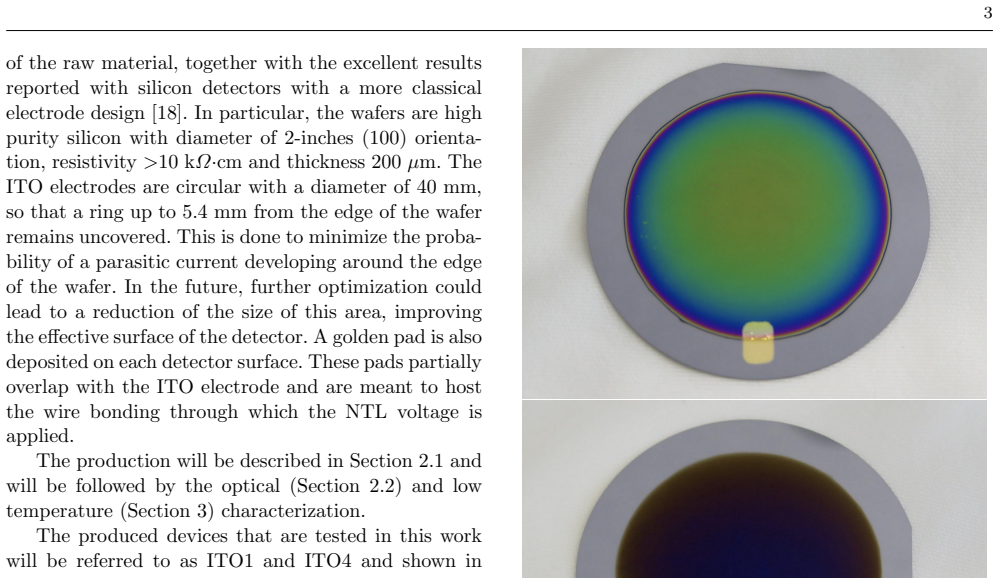
The Neganov-Trofimov-Luke (NTL) effect is used by experiments based on cryogenic detectors to boost the sensitivity of light-sensitive devices down to a few optical photons. In this work we introduce a silicon light-detector technology that implements NTL amplification at millikelvin temperatures using transparent indium-tin-oxide (ITO) electrodes. The ITO electrodes enable an electric field perpendicular to the wafer surface, mitigating surface charge recombination, and thanks to their optical properties, simultaneously serve as an anti-reflective coating. By combining these two functions in a single element, the fabrication process is simplified, yielding more robust and cost-effective devices. We report on the production and characterization of the first batch of these detectors. We performed a room-temperature characterization of the ITO electrodes, verifying the structural and optical characteristics of the deposited electrodes. We then operated 2 of these devices as cryogenic calorimeters at millikelvin temperatures. Finally, we develop a consistent analytical model for the NTL gain for both ionizing particles and optical photons, successfully describing the gain dependence on the NTL bias and explicitly accounting for the partial electrode coverage of the device surface.
Editorial analysis
A structured set of objections, weighed in public.
Referee Report
Summary. The paper introduces silicon cryogenic light detectors that use transparent indium-tin-oxide (ITO) electrodes to enable Neganov-Trofimov-Luke (NTL) amplification at millikelvin temperatures. The ITO layer simultaneously provides the perpendicular electric field to reduce surface recombination and functions as an anti-reflective coating. The work reports room-temperature structural and optical characterization of the ITO films, successful operation of two such devices as calorimeters at millikelvin temperatures, and a consistent analytical model for NTL gain that describes bias dependence for both ionizing particles and optical photons while explicitly incorporating partial electrode coverage.
Significance. If validated, the dual-use ITO electrode approach simplifies fabrication of NTL-amplified light detectors, potentially improving robustness and reducing costs for experiments requiring few-photon sensitivity at cryogenic temperatures. The analytical model, if shown to be parameter-free in its partial-coverage treatment, would provide a useful predictive tool for gain optimization across different particle and photon signals.
major comments (3)
- [model section (post-abstract description of analytical model)] The central claim that the analytical NTL-gain model accounts for partial electrode coverage without additional free parameters (beyond the coverage scaling factor listed in the axiom ledger) requires explicit derivation in the model section. If the coverage factor is adjusted to fit data rather than fixed from geometry, the 'parameter-free' description of the gain prediction is undermined.
- [cryogenic operation and model validation sections] Cryogenic performance data for the two operated devices lack reported error bars, quantitative fit metrics (e.g., χ² or residual analysis), and details on data selection/exclusion criteria. This weakens the assertion that the model 'successfully describes' the gain dependence on NTL bias for both ionizing particles and optical photons.
- [ITO electrode characterization and cryogenic results sections] Room-temperature ITO characterization (optical transmission, sheet resistance, recombination properties) is used to inform the cryogenic model inputs, but no direct evidence is provided that these properties are preserved at millikelvin temperatures without introducing excess noise, altered surface recombination, or changes in effective field. This assumption is load-bearing for both the anti-reflective function and the NTL gain formula.
minor comments (2)
- [device description] Clarify the exact geometry and fraction of partial electrode coverage in a dedicated figure or table, including how it enters the gain formula.
- [model section] Provide the explicit equations of the analytical NTL-gain model, including all terms for bias dependence and coverage, to allow independent verification.
Simulated Author's Rebuttal
We thank the referee for the careful and constructive review of our manuscript. We have revised the paper to address the points raised and provide point-by-point responses below.
read point-by-point responses
-
Referee: The central claim that the analytical NTL-gain model accounts for partial electrode coverage without additional free parameters (beyond the coverage scaling factor listed in the axiom ledger) requires explicit derivation in the model section. If the coverage factor is adjusted to fit data rather than fixed from geometry, the 'parameter-free' description of the gain prediction is undermined.
Authors: We thank the referee for highlighting this. In the revised manuscript we have added a dedicated subsection in the model section with an explicit step-by-step derivation of the partial-coverage term. The coverage factor is computed directly from the known electrode geometry (mask design and post-deposition optical verification of the patterned area fraction) and is treated as a fixed input; it is not varied to improve the fit to the gain data. The only adjustable parameters remain those already enumerated in the model description. We have updated the surrounding text to make this distinction unambiguous. revision: yes
-
Referee: Cryogenic performance data for the two operated devices lack reported error bars, quantitative fit metrics (e.g., χ² or residual analysis), and details on data selection/exclusion criteria. This weakens the assertion that the model 'successfully describes' the gain dependence on NTL bias for both ionizing particles and optical photons.
Authors: We agree that the statistical presentation of the data should be strengthened. The revised manuscript now includes error bars on all gain-versus-bias points, derived from the standard deviation across repeated measurements. We have added χ² values and reduced-χ² metrics for the model fits to both the ionizing-particle and optical-photon datasets, together with residual plots. A new paragraph in the cryogenic-results section describes the data-selection procedure: all recorded events were retained except those from runs affected by documented cryogenic-system instabilities, which are listed in the supplementary material. These additions support the claim that the model successfully describes the observed bias dependence. revision: yes
-
Referee: Room-temperature ITO characterization (optical transmission, sheet resistance, recombination properties) is used to inform the cryogenic model inputs, but no direct evidence is provided that these properties are preserved at millikelvin temperatures without introducing excess noise, altered surface recombination, or changes in effective field. This assumption is load-bearing for both the anti-reflective function and the NTL gain formula.
Authors: We acknowledge that no direct cryogenic characterization of the ITO films was performed. In the revised manuscript we have inserted a new discussion paragraph that (i) cites literature on ITO films in comparable cryogenic environments indicating stability of optical transmission and sheet resistance, (ii) examines the possible consequences for noise and surface recombination, and (iii) notes that the observed calorimeter performance (energy resolution and pulse shapes) is consistent with the room-temperature inputs. While this provides indirect support, we recognize the assumption remains load-bearing and identify direct mK characterization as a desirable follow-up measurement. revision: partial
- Direct experimental evidence that ITO electrode properties (optical transmission, sheet resistance, recombination) remain unchanged at millikelvin temperatures
Circularity Check
Analytical NTL-gain model is self-contained with no reduction to fitted inputs or self-citations
full rationale
The paper presents an analytical model for NTL gain that explicitly incorporates partial electrode coverage and describes bias dependence for both ionizing particles and optical photons. No equations, parameter-fitting steps, or self-citations appear in the abstract or provided text that would make the gain predictions equivalent to inputs by construction. The model is introduced as a consistent derivation after device operation, with no load-bearing uniqueness theorems or ansatzes imported from prior author work. Device characterization at room temperature and mK operation provide independent empirical support rather than circular validation.
Axiom & Free-Parameter Ledger
free parameters (1)
- electrode coverage scaling factor
axioms (1)
- domain assumption NTL amplification mechanism remains valid and linear for both optical photons and ionizing particles at millikelvin temperatures
Reference graph
Works this paper leans on
-
[1]
Giuliani, Journal of Low Temperature Physics167 (2012)
A. Giuliani, Journal of Low Temperature Physics167 (2012). DOI 10.1007/s10909-012-0576-9
-
[2]
M. Biassoni, O. Cremonesi, Progress in Particle and Nuclear Physics114, 103803 (2020). DOI https://doi.org/10.1016/j.ppnp.2020.103803
-
[3]
A.H. Abdelhameed, et al., Phys. Rev.D100(10), 102002 (2019). DOI 10.1103/PhysRevD.100.102002
-
[4]
Sch¨ affner, et al., Astroparticle Physics69, 30 (2015)
K. Sch¨ affner, et al., Astroparticle Physics69, 30 (2015). DOI 10.1016/j.astropartphys.2015.03.008
-
[5]
Singh, et al., Phys
V. Singh, et al., Phys. Rev. Appl.20, 064017 (2023)
2023
-
[6]
E.S. Battistelli, et al., Eur. Phys. J.C75(8), 353 (2015). DOI 10.1140/epjc/s10052-015-3575-6
-
[7]
Gray, et al., Journal of Low Temperature Physics (2016)
D. Gray, et al., Journal of Low Temperature Physics (2016). DOI 10.1007/s10909-016-1535-7. URL http://link.springer.com/10.1007/s10909-016-1535-7
-
[8]
Alfonso, et al., Journal of Instrumen- tation18(06), P06033 (2023)
K. Alfonso, et al., Journal of Instrumen- tation18(06), P06033 (2023). DOI 10.1088/1748-0221/18/06/P06033. URL https://dx.doi.org/10.1088/1748-0221/18/06/P06033
-
[9]
D.Q. Adams, et al., Science390(6777), 1029 (2025). DOI 10.1126/science.adp6474. URL https://www.science.org/doi/abs/10.1126/science.adp6474
-
[10]
O. Azzolini, et al., Eur. Phys. J.C78(5), 428 (2018). DOI 10.1140/epjc/s10052-018-5896-8
-
[11]
Armengaud, et al., Eur
E. Armengaud, et al., Eur. Phys. J. C80(1), 44 (2020)
2020
-
[12]
Azzolini, et al., Phys
O. Azzolini, et al., Phys. Rev. Lett.129, 111801 (2022)
2022
-
[13]
Augier, et al., Eur
C. Augier, et al., Eur. Phys. J. C82(11), 1033 (2022)
2022
-
[14]
Alfonsoet al.,CUPID, the CUORE upgrade with particle identification, Eur
K. Alfonso, et al., Eur. Phys. J. C85(7), 737 (2025). DOI 10.1140/epjc/s10052-025-14352-1. [Erra- tum: Eur.Phys.J.C 85, 1346 (2025)]
-
[15]
Luke, Journal of Applied Physics64(12), 6858 (1988)
P.N. Luke, Journal of Applied Physics64(12), 6858 (1988). DOI 10.1063/1.341976. URL https://doi.org/10.1063/1.341976
-
[16]
Armatol, et al., JINST21(01), P01035 (2026)
A. Armatol, et al., JINST21(01), P01035 (2026). DOI 10.1088/1748-0221/21/01/P01035
-
[17]
L. Gironi, et al., Phys. Rev. C94(5), 054608 (2016). DOI 10.1103/PhysRevC.94.054608
-
[18]
M. Biassoni, et al., Eur. Phys. J. C75(10), 480 (2015). DOI 10.1140/epjc/s10052-015-3712-2
-
[19]
M. Willers, F.v. Feilitzsch, A. G¨ utlein, A. M¨ unster, J.C. Lanfranchi, L. Oberauer, W. Potzel, S. Roth, S. Sch¨ onert, M.v. Sivers, S. Wawoczny, A. Z¨ oller, A. Giuliani, Jour- nal of Instrumentation10(03), P03003 (2015). DOI 10.1088/1748-0221/10/03/P03003
-
[20]
Pattavina, et al., Journal of Low Temperature Physics 184(1-2), 286 (2016)
L. Pattavina, et al., Journal of Low Temperature Physics 184(1-2), 286 (2016). DOI 10.1007/s10909-015-1404-9
-
[21]
Novati, et al., Nucl
V. Novati, et al., Nucl. Instrum. Meth. A940, 320 (2019)
2019
-
[22]
D.M.C.et al, Eur. Phys. J. C77(1), 3 (2016). DOI 10.1140/epjc/s10052-016-4565-z
-
[23]
L. Berg´ e, et al., Phys. Rev. C97(3), 032501 (2018). DOI 10.1103/PhysRevC.97.032501
-
[24]
G.T. Chavan, Y. Kim, M.Q. Khokhar, S.Q. Hussain, E.C. Cho, J. Yi, Z. Ahmad, P. Rosaiah, C.W. Jeon, Nanoma- terials13(7) (2023). DOI 10.3390/nano13071226. URL https://www.mdpi.com/2079-4991/13/7/1226
-
[25]
Y. Ding, S. Xiong, L. Sun, Y. Wang, Y. Zhou, Y. Li, J. Peng, K. Fukuda, T. Someya, R. Liu, X. Zhang, Chem- ical Society Reviews (2024). DOI 10.1039/D4CS00080C
-
[26]
T. Wang, K. Lu, Z. Xu, Z. Lin, H. Ning, T. Qiu, Z. Yang, H. Zheng, R. Yao, J. Peng, Crystals11(5), 511 (2021). DOI 10.3390/cryst11050511. URL https://www.mdpi.com/2073-4352/11/5/511
-
[27]
W. Li, H. Zhang, S. Shi, J. Xu, X. Qin, Q. He, K. Yang, W. Dai, G. Liu, Q. Zhou, H. Yu, S.R.P. Silva, M. Fahlman, Journal of Materials Chemistry C8, 4636 (2020). DOI 10.1039/C9TC06865A
-
[28]
J. Patel, R.K. Sharme, M.A. Quijada, M.M. Rana, Nanomaterials14(24), 2013 (2024). DOI 10.3390/nano14242013. URL https://www.mdpi.com/2079-4991/14/24/2013
-
[29]
V. Rajendran, A. Prathuru, C. Fernandez, D. Sujatha, S.K. Panda, N.H. Faisal, Engi- neering Reports6(3), e12836 (2024). DOI https://doi.org/10.1002/eng2.12836. URL https://onlinelibrary.wiley.com/doi/abs/10.1002/eng2.12836
-
[30]
K.S. Tseng, Y.L. Lo, Applied Sur- face Science285, 157 (2013). DOI https://doi.org/10.1016/j.apsusc.2013.08.024. URL https://www.sciencedirect.com/science/article/pii/S0169433213015122
-
[31]
R.J. Moerland, J.P. Hoogenboom, Optica3(2), 112 (2016). DOI 10.1364/OPTICA.3.000112. URL https://opg.optica.org/optica/abstract.cfm?URI=optica- 3-2-112
-
[32]
C. Arnaboldi, et al., Rev. Sci. Instrum.86(12), 124703 (2015). DOI 10.1063/1.4936269
-
[33]
Arnaboldi, et al., JINST13(02), P02026 (2018)
C. Arnaboldi, et al., JINST13(02), P02026 (2018). DOI 10.1088/1748-0221/13/02/P02026
-
[34]
Adams, et al., Journal of Instrumen- tation17(11), P11023 (2022)
D. Adams, et al., Journal of Instrumen- tation17(11), P11023 (2022). DOI 10.1088/1748-0221/17/11/P11023. URL https://dx.doi.org/10.1088/1748-0221/17/11/P11023
-
[35]
C. Arnaboldi, G. Pessina, S. Pirro, Nucl. Instrum. Meth. A559, 826 (2006). DOI 10.1016/j.nima.2005.12.210
-
[36]
Adams, et al., (2025)
D.Q. Adams, et al., (2025)
2025
-
[37]
D.M. Chernyak, F.A. Danevich, A. Giuliani, E. Olivieri, M. Tenconi, V.I. Tretyak, Eur. Phys. J. C72, 1989 (2012). DOI 10.1140/epjc/s10052-012-1989-y
-
[38]
Alfonso, et al., (2025)
K. Alfonso, et al., (2025)
2025
-
[39]
A. Ahmine, et al., Eur. Phys. J. C83(5), 373 (2023). DOI 10.1140/epjc/s10052-023-11519-6
-
[40]
A. Armatol, et al., Phys. Rev. C104(1), 015501 (2021). DOI 10.1103/PhysRevC.104.015501
discussion (0)
Sign in with ORCID, Apple, or X to comment. Anyone can read and Pith papers without signing in.